If you’ve read our hands-on preview of Google and Motorola’s new Moto X, you’ll already know that the phone is pretty similar to the new Droid Ultra that Verizon announced last week. This observation extends to the phone’s internals—the Moto X uses the same “X8 computing system” that the Droids do.
As we noted at the time, Google and Motorola’s announcement of the X8 was less-than-straightforward. What was sold as some sort of custom eight-core system-on-a-chip (SoC) has actually turned out to be a Qualcomm Snapdragon chip married to what are apparently separate “contextual computing processor” and “natural language processor” units.
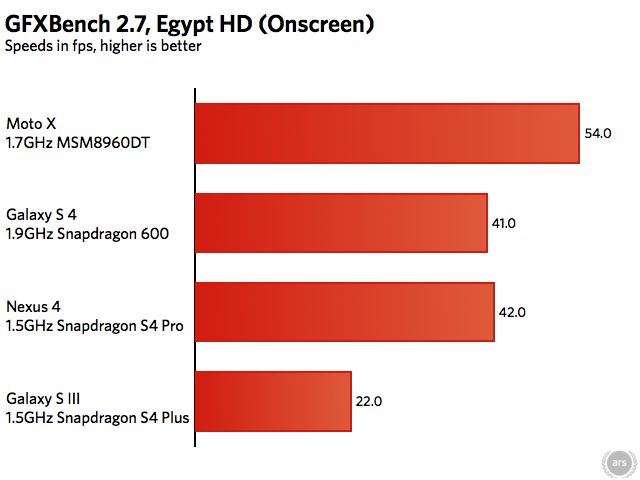
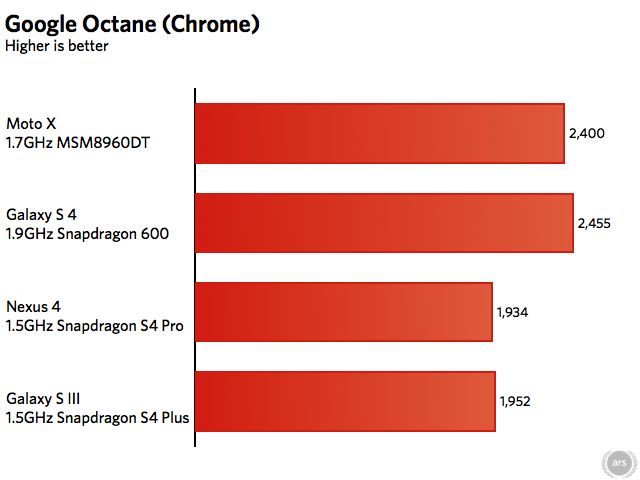
What those two extra units do is still a bit mysterious, and it’s something we hope to figure out as we spend more time with the phone. In the meantime, we thought we’d take a quick look at the Qualcomm Snapdragon chip that will be driving most of the action here (part number MSM8960DT, according to CPU-Z), since it’s a configuration we haven’t seen before: it takes the Adreno 320 GPU from the quad-core Snapdragon S4 and Snapdragon 600s that we’ve been seeing in high-end Android phones since late last year, and marries it to a dual-core CPU more similar to the Snapdragon S4 Plus and Snapdragon 400 chips shipping in mid-range phones today.
The GPU: Definitely high-end
To test the GPU, we turn to the GFXBench 2.7 test. For the uninitiated, there are two different versions of this test: the “onscreen” test that runs at the phone’s native display resolution and the “offscreen” test that renders all scenes at 1080p regardless of the phone’s resolution. The offscreen tests are good for measuring the raw horsepower of a particular GPU, while the onscreen tests are more representative of what you can expect when running actual games on the phone.





 Loading comments...