Skip to content
Tech

After Final Cut Pro debacle, does Apple still care about creative pros?

Apple's contentious Final Cut Pro X release has created uneasy feelings among …

Dave Girard | 245
Credit: Photo illustration by Aurich Lawson
Story text

So, Michael Jackson is dead and Final Cut Pro X is out, and most people prefer the older versions of each. Most can also agree on Michael Jackson’s fate—making a lot more albums from beyond the grave—but people aren’t so sure about Final Cut Pro’s future.

The FCP X launch, and the discontent surrounding the new product, fed into a larger anxiety about Apple’s intentions for the pro Mac market. Was FCP X just a single, poorly handled event or was it an indication of Apple’s direction from now on, media pros be damned? With all this talk of bringing iOS features “back to the Mac,” is OS X about to lose its luster for content creation? Is the Mac Pro going the way of the XServe?

Apple doesn’t answer such questions about future plans, but it’s not hard to read Apple’s palms if you look hard enough. The company won’t ditch creative pros—but that doesn’t mean there won’t be serious rough spots ahead.

Where I’m coming from

I’m not just an armchair Mac analyst looking to make a dime off the FCP X love/hate parade. I’ve been a professional Mac user for 17 years and have experience with a broad field of high-end content creation, as my career has included photo retouching and compositing, magazine art direction, and 3D rendering and illustration. The Mac I’m typing this on, with all the trimmings, is worth over $10,000; the software it runs is worth more than that. I frequently see my requested features rolled into the high-end 2D and 3D software that I beta test, I exploit OS X’s scripting features to work faster, and my inkjet printer takes four people to move. It doesn’t get much more “pro using a Mac” than me, if you’ll forgive the utter lack of modesty.
While I’m deeply invested in Apple’s desktop Mac Pro line, I’m also realistic about Apple’s faults and about how the company views content creation professionals as it becomes increasingly consumer-oriented. Which is why the recent, most contentious example of Apple’s approach—the FCP X launch—wasn’t much of a surprise to me.

FCP X

Unless you’ve been under a low-tech, Internet-less rock for the past two weeks, you’ve probably heard about Final Cut Pro X, the latest version of Apple’s professional video app, if only in passing. Let me bring you up to speed if you don’t already know how the drama unfolded: FCP X was met with mixed reactions, most of them negative, thanks to a healthy set of missing features that video professionals rely on. These span the gamut from not being able to open legacy projects (very bad) to missing tape support (not as bad). But the different interface and workflows in the new version made it clear that this wasn’t just a high-end product missing a few features; it was a completely new direction for Final Cut Pro, and it was aimed at the increasing prosumer market. It was “iMovie Pro,” whether that sounds derogatory or not.

“The FCP X launch would make a nice grade school science project: a volcano with flaming red media coverage coming out the top.”

If you’re convinced that I’m misreading its intended audience, read this post from Sachin Agarwal, who was involved in FCP X’s early development, the stage when it’s decided who this application is intended for and how it’s going to be designed. You don’t have to look far to see examples of a paradigm shift in FCP X: there is no “Revert to Saved” and everything is saved as you go. If you quit the app, your work is saved and the undo queue is lost—a godsend to my mother and a nightmare for professionals.

FCP X was obviously a conscious decision by the software’s designers to appeal to a different set of users. Many of these kinds of changes in FCP X aren’t simply about “modernizing your workflow”; they are meant to be idiot-proof.

A PR fiasco post-mortem

I can understand Apple’s reasons for the change of direction; going tit-for-tat in matching features with pro-level competitors is pointless when there’s a huge gap waiting to be filled in the prosumer video market. As The Steve is fond of saying, he only skates where the puck is going.

Nevertheless, you have to feel for the editors burnt by the shift in direction. Thanks to Apple’s immediate discontinuation of Final Cut Pro 7 (a decision Apple is apparently reconsidering for enterprise users), a lot of people are stuck with expensive hardware and software built around a completely different paradigm that they might not like or that just doesn’t work for them. Some will be able to fill the gaps left by the removal of Color with competent third-party options like Colorista or Resolve, once they’re updated for FCP X. I’m sure that many others will head to other software options, out of fear of what the next version will bring (Ping notifications!).

Despite the (presumably) good business decision to target the more lucrative prosumer market, Apple botched the launch badly, thanks in part to their world-famous secrecy sauce. FCP X’s launch combined high expectations with a 1.0 code base that wasn’t a straight port. Most of the time, when products get a bad review from me, it’s because they are launched too early with buggy and missing features. Take that potent mixture of problems, add a lot of hype with no warnings that FCP X would be anything less than a full replacement for its predecessor, and you have something that would make a nice grade school science project: a volcano with flaming red media coverage coming out the top.

If FCP X was released to consumers with a lead-up that prepared people for this new direction, some might now be hailing it as a revolution (shudder). Instead, FCP has a reputation as “the app professionals don’t want.” It’s going to take years of well-placed advertising and flawless releases to undo half of that damage.

(As you can tell by now, this isn’t a review of FCP X. Of all the content-creation areas I work in, non-linear editing is the one I know the least about; most of my video work is done in nodal compositors like Nuke. If you’re an FCP user on the fence about whether to leave it behind and chase the current discounts being offered by Adobe and Avid, my advice is to wait for the dust to settle a bit. Wait for qualified comparisons between FCP X, Premiere Pro, and Avid Media Composer, because I think the negative press is creating the impression that FCP X is a worse product than it actually is.)

Much like it rushed to fill the holes in Aperture 1.0 (which lacked an eyedropper!), Apple will probably do right by FCP X users. The wealth of plug-ins that built up around this program definitely aren’t going anywhere, either—indeed, they’ll probably get cheaper in order to appeal to the prosumers who would otherwise be scared away by the high price tag. Apple just handed the huge FCP plug-in market a license to print money, which I’m sure was the intention from the start—set the entry point low and let the market do the rest with all the users.

People who think that sounds like an excuse for FCP X’s lacking features should consider this: I’ve spent over $2,000 on top of Autodesk’s $3,500 pricetag for Maya to replace its poorly supported mental ray renderer, and another $200 replacing its weak Boolean tools. Sure, Maya is a bigger program, but my point stands: almost no professional-level application is complete at its base price, and FCP X’s price is 1/12th that of Maya’s. Autodesk doesn’t have the excuse that Maya’s deficiencies are because of its 1.0 status, but Maya is still the de-facto standard in film animation 3D.

Now you’re also seeing the other side of the FCP X picture: high-end professionals complain. We complain a lot. But our complaints about esoteric features, when placed next to the market ambitions of Apple, don’t seem to match: “Hey Steve, the Internet is ablaze because FCP X lacks tape support!”

I don’t want to trivialize the concerns of those affected by FCP X’s change in direction—I’d be fuming if Maya suddenly became easier to use but less complete—but I think most people see the logic in Apple’s decision. But that decision still seems to leave filmmaking pros in the dust. Could other creative pros be next?

Shake, Color, and XServe: “We could be next”

FCP X was the flashiest of a set of stars aligning to scare creative professionals working on Macs. Let’s look at the hyperbole, the genuine concerns, and the actual problems affecting content creators on OS X and see whether they match up.

Because Apple had few qualms about discontinuing Shake (an industry-leading compositing application), Color (a formerly $25,000 grading app) and the XServe (their brief foray into the 1U server market), there’s a feeling that creative professionals could be next in line to be end-of-lifed.

Some interpret these moves by Apple as implicitly showing that “if you don’t make up a decent chunk of Apple’s profits or part of their grand vision, you will be dropped… and your little Mac Pro, too!” People who run GPU renderers will be told to buy iMacs and, if they don’t like the smell of melting plastic, then perhaps a Mac is not for them. Scary.

But that’s not going to happen. While the discontinuation of Shake—which has only recently been adequately replaced by Nuke as the industry standard in compositing—was unfortunate, the XServe was different. Apple realized this highly competitive niche market had needs that extended beyond the normal power user, and the cost of implementing something like a completely new filesystem outweighed the benefits of doing so.

“For the foreseeable future Apple’s still going to have a desktop operating system for content creation and heavy lifting (OS X) and another for media consumption (iOS).”

Rackmount users are even more crotchety and difficult to support well than are video professionals, so this would be like sticking your toe into a pond and finding out it’s a sea of piranhas—piranhas that demand modifications to the OS kernel (we have those at my local zoo). Add that to competing with a free OS that works perfectly well (and usually better for low-latency server tasks) and you have a costly experiment with relatively few users who would be angered by dropping the XServe.

People looking for a beefy OS X Server machine still have the Mac Pro and, if the rumors prove true, the next Mac Pro will be a 3U rack-mountable unit. Server user problem solved, costs reduced, and sleek-looking redesign accomplished in one shot. Traveling audio pros or event visuals people will have a rack-mountable Mac Pro they can stick in a case and, if people don’t want a fat three-unit monster with a GPU in a server, then they are not the customers Apple wants back. (That’s still a rumor, so let’s see how it pans out.)

Do I think that Apple will make a cheaper non-Xeon Mac Pro for all those people who don’t want iMacs but can’t afford a Mac Pro? No. Do I think Apple will pull the plug on the Mac Pro entirely? Not a chance. Anyone else looking for evidence of Apple’s continued investment in the pro hardware market needs only look as far as the new MacBook Pros. It’s fair to say that a 10Gbps port on a laptop and OS-level support for booting OS X from a Thunderbolt RAID array isn’t meant for my mom and the increasing demands of her freelance jewelry business.

OS X 10.7’s “Back to the Mac”

The hyperbole:

Apple is dumbing down user experience and expects us to use a phone OS for content creation! Apple’s desktop OS is on its way out any day now!

The Reality:

If you’re not familiar with “Back to the Mac,” it’s the marketing headline for OS X 10.7—iOS features like full-screen apps, the launch pad, and saved app states are being brought to OS X. The ironic side effect of Back to the Mac is that it makes it seem like Apple is out of ideas for OS X and that the two are merging into one OS. The reality is that the new feature set in 10.7 is about more-capable OS X-only apps and increasing productivity, but marketing it that way is a drag; Apple telling you to “GET MORE WORK DONE!” is like your dad telling you about efficient ways of doing your homework. While I’m not a fan of some of the interface changes in 10.7 (no custom icons in the sidebar pane?), there are plenty of things that will appeal to professional content creators of various stripes. These will be covered much better in John Siracusa’s forthcoming monster Lion review here at Ars, but I’ll list a few features to prove my point.

Versions: It’s like a Time Machine for documents, only you can see every version saved to disk. Although Apple gave up on ZFS support in OS X, which offers this type of functionality in the filesystem, it saw the appeal for end users so added it as an opt-in API for Cocoa apps. While I have zero chance of seeing Versions integrated into Maya or Photoshop, since they use strictly cross-platform code, I can’t wait to have it for BBEdit for writing my Maya scripts, which I often zip before editing because things can go wrong in a much shorter timeframe than Time Machine covers. Like Time Machine, Apple just made a power-user feature instantly accessible to all.

Saved States: Reboot your machine and have every app and window (optionally) restore to the state when you shut the machine down. Great for getting up and running quickly or scaring your loved ones with pornography. Win/win.

Document Locking: You’re about to edit a portfolio document that hasn’t been edited in X months. Are you sure you want to do that?

Multiple desktops are being brought front and center with Mission Control.

OpenGL 3.2: This one is playing catch-up to Windows and Linux and it’s pretty sad that we were stuck with GL 2.1 for as long as we were. The good news is that we won’t be waiting as long for GL 4.1 support (I have personal spy drones in the right places).

OS X is not going anywhere

Even if there’s more money in iPhones and iPads than there is in desktop machines, we’re not going to be shouting “for ex in dollar sign, at sign, open squiggly bracket” code into an iPad to make applications, and we’re not going to be baking Unity lightmaps on iPods. For the foreseeable future—you can hold me to 20 years if you need to have a number—Apple’s still going to have a desktop operating system for content creation and heavy lifting (OS X) and another for media consumption (iOS).

While Apple’s own creative products might be limited to consumer features, the OS isn’t. Consider this: Apple still offers X11 with installs of OS X 10.7. It doesn’t get any more unsexy and niche than X11 but Apple knows it’s needed by certain people (I use it with this awesome app). X11 does nothing for Apple’s reputation as innovators, but if Apple dropped X11, it would leave their friends at Pixar without access to their RenderMan tools. Considering how close Steve is to Pixar, that means someone could probably get a good right hook on him before being restrained.

Anyway, Apple’s motivations for their professional-turned-prosumer software don’t really matter as long as they continue providing and updating the frameworks that these pro apps depend on. That shows no sign of changing: I submitted an OpenGL graphics bug that affected Mudbox and the Quadro 4000 during beta testing of Lion and it was fixed in the next developer preview.

One professional content creator need that is badly needed in OS X is 10-bits per channel monitor support. All those shiny Eizo screens are being limited on Apple’s software end, meaning high-end photographers and videographers are paying $5,000 for these screens and getting only part of that value. That’s bad, and it’s been an issue for a few years. Apple just hired THX audio guru Tomlinson Holman to be its audio tzar; maybe it needs to get a tzar for graphics/video so it isn’t so slow on the uptake of standards like 30-bit color and OpenGL 4.1.

Apple’s war over content formats and standards is affecting content creators

The Hyperbole:

Apple’s competition with formats like Blu-ray puts them at odds with adequately serving video professionals.

The Reality:

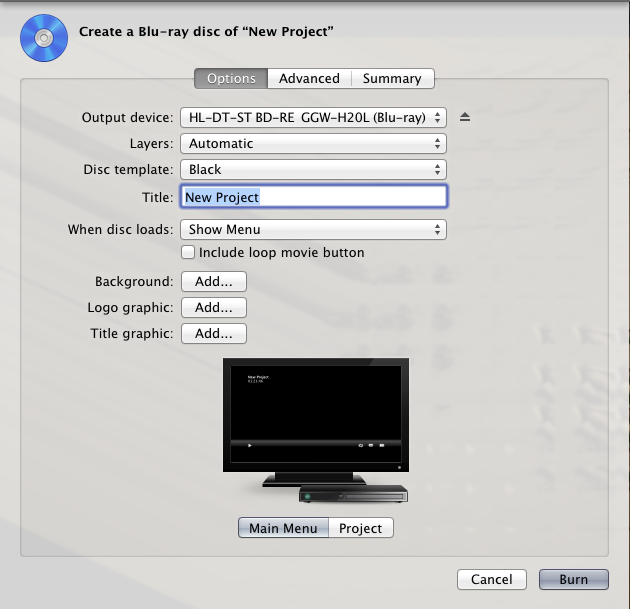
Maybe I should put an exclamation point on that one, because the hyperbole and the reality are the same in this case. In my reviews of the last couple Mac Pros, I’ve always complained about the Blu-ray issue. The good news is that Apple has added Blu-ray burning support to FCP X.

My LG Blu-ray burner in FCP X

If you want to play back Blu-ray disks on the Mac, there is this software, which works, if you have a Blu-ray drive:

Click for full 1080p image.

As nice as it is that a company has filled this gap on OS X, Apple should be offering this first-hand, at least as a built-to-order option. Unlike Flash on iOS, this can’t be spun as a positive user experience unless you’re considering laptop battery life—it’s just Apple saying they won’t do Blu-ray because it competes with iTunes and Apple’s future plans for a diskless world. But Apple isn’t alone in putting creative users on the losing end of a format war: Windows 8 is finally getting the ability to read PDFs without third-party software. That wasn’t slow coming because people didn’t want it.

This is one example of a larger problem: Apple is willing to put the needs of content creators second to its whims in the battle for media dominance. Sometimes it’s just a spat that gets in the way. Whether or not Apple was punishing Nvidia for its handling of the 8600M chipset affair, or simply because Apple picked AMD and rolled with them, the ousting of Nvidia as a build-to-order option just as Nvidia was making a dent in pro media markets with CUDA and high performance GPGPUs is negatively affecting content creators. It also means that Nvidia’s cards aren’t getting the same support as the AMD ones, and it shows—The Quadro 4000 Mac Ediition is still missing OpenCL support in Lion (this is on Apple’s end, not Nvidia’s) so pros using Nvidia’s latest Quadro card drivers are left holding a card that isn’t full-featured compared to Windows and Linux (yes, the free OS).

Considering how many copies of Premiere Pro Apple just sold with FCP X—even my alma mater Concordia University is switching—I’m guessing a lot more Quadro 4000 Mac edition owners are going to be caught in the middle of this unfriendly relationship. If Apple’s not going to properly support the Nvidia cards, then it should do the right thing and give the Quadro OpenCL support to Nvidia, because I don’t see this getting better for future models and some of us need to use both CUDA and OpenCL.

Bright sides on this issue are harder to spot, but there are a couple. Apple seems to be clueing in that pros need less anemic GPUs—the latest i7 iMac comes with a 2GB GPU option so I’m assuming the next Mac Pro will get an AMD option with 2GB as well. And we’re lucky that AMD’s Mac drivers work a lot better with pro OpenGL 3D apps than they do in Windows. To people familiar with AMD’s Windows driver performance with 3D apps, which probably sell as many Quadro cards to pros as Nvidia does, I’m not just being kind—they actually work perfectly on the Mac.

What can creative pros on Macs do?

Although Apple needs to clue in about things like 30-bit color, it can’t read your mind. File feature requests and bug reports through Apple’s Radar system. Apple does a very good job of addressing bugs and it actually reads feature requests (I get responses, so I know). Requests aren’t letters to Santa Claus—let them know that you need 30-bit support for your monitor or that you want OpenGL 4.1 yesterday because it’s getting in the way of your work.

With all the negative press that FCP X is getting, the uncertainty surrounding Apple’s desktop operating system, and the permanent culture of secrecy, people need to back out a bit and see the big picture: everything still points to business as usual for creative pros on OS X. I feel for those video editors who got caught in the fault lines of Apple’s prosumer strategy, but it’s way too early for creative professionals on OS X to hit the panic button. Now get back to work—that opener font isn’t going to pick itself.

Thanks to Cristobal Urbina of Fur Trade Recordings for his input on Mac-based audio pros.

Listing image: Photo illustration by Aurich Lawson

Dave Girard Associate Writer
245 Comments