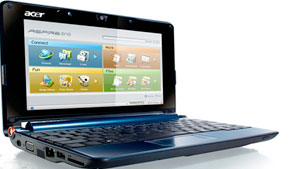
DigiTimes has been making the rounds of the Taiwanese OEMs, and the company claims to have the scoop on a coming wave of ARM-based netbooks, often called “smartbooks,” that will wash ashore in the US in the last quarter of this year. Smartbooks based on Qualcomm’s SnapDragon processor and NVIDIA’s Tegra line are allegedly on deck from netbook names like ASUS, Acer, and Foxconn. Lesser-known Chinese netbook maker Compal, which was showing off products at this past CES but which doesn’t yet ship to the US, is also named as an ARM netbook maker, as are Inventec and Mobinnova.
Then there’s the Touch Book, from Always Innovating, which�sent out a note today to everyone who contacted them via web form (including Ars) to say that the device is is now shipping. We haven’t really covered the Touch Book, but boy have we been getting reader mail about it. A lot of folks want us to review it, and I’ve contacted the company in an effort to get a review unit. (No response so far, but I’ll keep trying.) The Touch Books’ main gimmick is that its screen can be detached and used as a standalone tablet, and the second gimmick is that it runs the TI OMAP 3 chip, which is looking like a killer PMP/tablet processor.
In all, it looks like by Christmas of this year, we’ll have the long-awaited Intel Atom vs. ARM Cortex A8 netbook price/performance/power smackdown that the gadget press has been waiting for since 2007. There’s a sizable amount of hype around the Cortex A8 parts being considerably cheaper and more power-efficient than Intel’s Atom, but it’s worth taking a moment to think about how the two platforms actually stack up against one another.
In terms of absolute power draw, there’s no question that the sub-1W ARM A8 platforms are going to smoke Intel’s Atom platform. Atom alone has a TDP of around 2W (give or take 0.5W, depending on usage), and when you factor in the other two chips that make up the current iteration of the platform, then you can tack on another zero there.
 Loading comments...