Skip to content
Features

Review: Tesla Motors’ all-electric Model S is fast—but is it a good car?

Ars drives a Model S for 500 miles to try to find the soul inside the machine.

Lee Hutchinson | 356
Credit: Steven Michael
Story text

My videographer Steve uttered a single strained curse as inertia’s invisible hand pushed us back into the leather with enough force to knock the camera mount out of alignment. The Tesla’s acceleration was instant, ludicrous, neck-snapping—more appropriate for a roller-coaster than a car. The camera’s point of view was now skewed sideways from this morning’s careful alignment, but Steve didn’t reach for it because we had just gone from 70 miles per hour to north of 100, and we were still going strong.

I should have slowed down, because I-10 out west of Houston is the natural habitat of humorless state troopers, but I didn’t. The breathtakingly flat torque curve of the Model S begs to be explored. The pedal under my right foot was just pure magic. No shifting of gears or howling engine here—the only sound was the ever-increasing rush of air as we hurtled toward the car’s 130 mph limiter.

And as we accelerated, my prejudices about electric cars were forcibly rearranged.

Rolling soul

Specs at a glance: 2013 Tesla Model S (P85+)
Body type 5-door
Layout Rear engine, rear wheel drive
Powerplant 3-phase AC induction motor
Transmission Single speed reduction gear
Horsepower 410 bhp @ 5000-6700 rpm
Torque 443 lb-ft @ 0-5100 rpm
Steering Variable-ratio rack & pinion (electric)
Suspension Double wishbone front, multilink rear, pneumatically adjustable height
Tires Michelin Pilot Sport P2:
245/35ZR21 front,
265/35ZR21 rear
Top speed 130 mph (210 kph), software limited
Battery 85 kWh lithium ion
Rated max range 265 miles (426 km) @ ~300 wH/mile
Internet connectivity 3G (complementary, no cost)
Weight 4,673 lb (2,108 kg)
Wheelbase 116.5 in (295.9 cm)
Dimensions 195.9 in (497.6 cm) x 77.3 in (196.3 cm) x 56.5 in (143.5 cm) (LWH)
Base price $62,400
Price as tested $121,870
Options added 85 kWh Performance upgrade, Performance Plus package, silver metallic paint, all-glass panoramic roof, 21″ silver turbine wheels, performance leather seats, obeche wood matte trim, carbon fiber spoiler, high-power charging upgrade, technology package, smart air suspension, high-fidelity sound, extended Napa leather trim, Alcantara headliner, rear-facing seats, premium interior lighting, paint armor, and destination and documentation fee

For those who love cars, “soul” evokes the history-drenched cities where great marques were born—Maranello, Stuttgart, Detroit—and sepia-toned pictures of soot-covered men in overalls and goggles climbing out of cigar-shaped race cars. Soul is the bear-throated howl of a V8 working up through the gears, the scream of 12 cylinders at redline that shakes you in your seat at the track, the rushing 200 mile-per-hour wall of wind that smells like oil and rubber. It’s tradition and pride.

Timeless cars like the Porsche 911 or the Ferrari F40 undoubtedly have soul. They are precise and unforgiving machines, requiring skill to drive well even in their modern incarnations, though that skill is rewarded with supernal experiences. But souls aren’t confined to supercars. Cars like Nissan’s iconic S30 Fairlady Z, Volkswagen’s original Beetle, or Subaru’s ever-mutating, turbocharged Imprezas are each more than the sum of their parts.

But an electric car has no burbling cylinder-filled heart, no throaty exhaust to inspire little kids to mimic engine noise. Can an electric car flicker behind your eyelids, holding your thoughts even while you’re not driving it?

I feel a thrill when looking at beautiful examples of automotive craftsmanship like a BMW M3 or an Audi S5 or an Acura NSX. But the electrics and hybrids produced by the big players are as exciting as cold oatmeal mixed with three-days-dead road kill. Think machines like the execrable crap-box Prius, Honda’s truly awful Insight, Nissan’s clock-stoppingly ugly Leaf, and Chevy’s Volt, which has all the personality of a beige carpet sample square.

At least when Doc Brown built a time machine out of a DeLorean, he did it in the right spirit. Similarly, if we’re going to be driving high-tech electric cars, why can’t they be made with some style?

Things didn’t have to be this way—it apparently just took Elon Musk, a billionaire with a penchant for launching his own rockets into space, to make us all see it.

The almost unbelievably ugly Nissan LeafHURRRRRRRRRRRRRK—ugh, I’m sorry, I just threw up all over my keyboard.
The almost unbelievably ugly Nissan LeafHURRRRRRRRRRRRRK—ugh, I’m sorry, I just threw up all over my keyboard. Credit: Wikimedia Commons

An iterative journey

The Model S isn’t the first all-electric vehicle from Tesla Motors—that title goes to the Tesla Roadster. The Roadster was essentially a Lotus Elise with its guts replaced by electric gear. When the car finally debuted in 2008 after years of production delays, it served as a very expensive, very exclusive test platform for the battery and drivetrain technologies that would eventually make their way into the Model S.

Before the Model S came the Tesla Roadster.
Before the Model S came the Tesla Roadster. Credit: Wikimedia Commons

The key to developing an electric car that doesn’t suck, it turns out, is iteration. The Roadster had a limited production run of 2,500 vehicles (the total number of Elise chassis that Lotus agreed to sell Tesla); the line underwent recalls and updates until production ended in 2012. The technology that Tesla crammed into the little coupe evolved into the larger battery, longer range, and tuned electronics in the much larger Model S sedan. Building the Roadster also allowed Tesla to test out more than the “electric” part of the equation. And as a new auto manufacturer, the company needed to figure out the “car” part as well.

The long view taken by Tesla in bringing the Roadster to market before the Model S is now paying dividends. No trace of amateurishness clings to the Model S, a beautiful automobile that does exactly what Tesla Motors says it will do. Once you get past the phenomenal acceleration, it’s a car. There’s no hypermile gamification built into the dashboard, no welding of internal combustion engine with batteries, nothing to pull you out of the I-am-driving-a-car experience. Even charging it—something that I had to pay an inordinate amount of attention to while testing the Model S—wouldn’t have been an issue if I owned the car and had a 240 V outlet (or one of Tesla’s high-amp wall connectors) to plug it in every evening.

Price as configured

Model S configurations are distinguished by a combination of range and horsepower. The entry-level version comes with a 60 kWh battery rated for 208 miles of range and a motor rated at 302 horsepower; it starts at $62,400. An additional $10,000 steps you up to an 85 kWh battery with 265 miles of rated range and 362 hp. Another $10,000 on top of that gets you the “P85” model, with the same battery and range but featuring an updated drive inverter that bumps the power up to 416 hp. Finally, $6,500 on top of that buys the “P85+” performance package, which adds a great deal of suspension tuning and some upgraded tires.

The press loaner that Tesla Motors supplied to Ars was of the most potent variety—a Model S P85+. On top of that, the car had almost every option box checked: the famous smoked glass roof, acres of leather on the inside, air suspension that could raise and lower the car’s ride height, an additional internal charger that could more quickly ingest electricity from Tesla’s high-powered wall plugs, fancy 21-inch wheels, and even a $1,500 carbon fiber spoiler on the rear deck. Thus equipped, our loaner Model S carried a list price of $121,870, according to Tesla’s design page.

But the price isn’t necessarily the price. Model S buyers are eligible for state and federal tax credits, and Tesla has a “true cost of ownership” page on its site to help buyers understand the value proposition of the car. In fact, the calculations on that page are making car dealership associations quite unhappy. By displaying an “effective monthly cost,” dealership associations allege that Tesla is “misleading” customers on price. The irony of this accusation is apparently lost on the dealership associations.

The “+” means “expensive.”
The “+” means “expensive.” Credit: Steven Michael

Appearance and styling

The Model S is a graceful car, with a precisely engineered exterior designed to minimize drag. Curves and accent points dominate every view; the large headlights taper back to a fine point, and an invisible line extends back from that point through the “T” logo badge on the front quarter panel and back along the beveled door handles. The A-pillars sweep without a transition point into the transparent roof, and the forward-canted B-pillar stands separate from the frameless front and rear doors (it actually contains a substantial amount of strengthening steel to help stiffen the car’s chassis). The overall effect is of a wind tunnel model—you can almost see the airstream flowing above and below the car.

The Model S P85+ in my driveway, where I wish it had a permanent home.
The Model S P85+ in my driveway, where I wish it had a permanent home. Credit: Steven Michael
Rear three-quarters view, highlighting that expensive carbon fiber spoiler.
Rear three-quarters view, highlighting that expensive carbon fiber spoiler. Credit: Steven Michael

A great deal of work went into making the Model S slip smoothly through that airstream, too. The car has a drag coefficient of 0.24 (better than a Nissan GT-R’s 0.26 or even a current-gen Prius’ 0.25), which is aided by extra design touches like a solid front fascia instead of a grille and retractable door handles. The Model S also benefits from having a flat underbody—no exhaust pipes disrupt the airflow.

From a stylistic perspective, the Model S is more homage than original thought. The almond-shaped headlights and prominent nosecone conjure images of Maserati, while the rear half has a distinct Aston Martin DBS flavor. The taillights and rear evoke the Jaguar XF. The rear is squatty and powerful, while the front is almost thin. The Model S makes a very pretty automobile, but for all its sleekness the car feels like it’s lacking a thematic through-line.

The leading edge of the Model S, with its almond-shaped headlights and round nosecone, feels like it’s borrowing styling cues from Maserati…
The leading edge of the Model S, with its almond-shaped headlights and round nosecone, feels like it’s borrowing styling cues from Maserati… Credit: Lee Hutchinson
…whereas from the rear, it looks a hell of a lot like a modern Jaguar.
…whereas from the rear, it looks a hell of a lot like a modern Jaguar. Credit: Lee Hutchinson

Still, it’s attractive. Tesla Motors could have gone with more distinctive styling, but it would have potentially compromised the car-ness of the Model S—this is, first and foremost, a fast luxury sedan. What you see instead is a handsome automobile with a rakish profile, LED eyelashes, and big 21-inch wheels. It blends well in traffic—though it’s perhaps not as anonymous as an Audi A8. It’s also not a gape-jawed Aston Martin.

One of the Tesla’s 265 mm-wide rear tires mounted on its 21-inch wheel. Brake calipers peek stylishly through. Also visible is the smaller parking brake. Putting the car in “Park” engages this second set of brakes rather than locking a pawl into place as in an automatic transmission.
One of the Tesla’s 265 mm-wide rear tires mounted on its 21-inch wheel. Brake calipers peek stylishly through. Also visible is the smaller parking brake. Putting the car in “Park” engages this second set of brakes rather than locking a pawl into place as in an automatic transmission. Credit: Steven Michael

Our loaner was equipped with the optional all-glass roof, which we found to be both beautiful and annoying. The front half forms a retractable sunroof, while the rear half is fixed. The smoked glass prevents sun glare from becoming a problem; in fact, the roof admitted a pleasant amount of light into the cabin. However, in the hot Texas sun, it also acted a bit like a greenhouse. For cooler climates, it’s no doubt a nice feature, but for our testing it meant cranking up the air conditioning—and using more energy.

The exterior finish was of suitably high quality, with the gaps between the body panels showing uniform distance (this precision is thanks in part to Tesla’s expensive, robot-based assembly line). Exterior trim pieces were all firmly attached without any odd seams or misses with the paint; even the front spoiler lacked any hint of wiggle.

The big 21-inch tires fill out the wheel wells beautifully. Our loaner car also had adjustable height suspension, which we cranked to its lowest setting for the photos.
The big 21-inch tires fill out the wheel wells beautifully. Our loaner car also had adjustable height suspension, which we cranked to its lowest setting for the photos. Credit: Steven Michael

Look, Ma, no handles!

The Model S’ pop-out door handles deserve special mention. They create an aerodynamic benefit, of course, but they’re also just extremely neat. On Models S cars equipped with the optional tech package—as our loaner was—drivers need only have the key on their person as they approach the car, and the door handles will extend. Without the tech package, a light touch on the handle makes it pop out smoothly.

The door handles, seen here flush against the body, extend as the driver approaches with key in pocket (if the car is equipped with the tech package, that is—otherwise, they’ll extend when lightly pressed).
The door handles, seen here flush against the body, extend as the driver approaches with key in pocket (if the car is equipped with the tech package, that is—otherwise, they’ll extend when lightly pressed). Credit: Steven Michael

Each handle is mechanically disconnected from the actual door release mechanism. Tugging on the extended handle causes it to move a few millimeters more, at which point the door’s window drops a centimeter or so to clear its rubber weatherstripping, and the door pops open. On shutting the door, the window quickly rolls back into place.

Cars with the tech package can also lock themselves when the driver walks away, and the door handles recede automatically into their recesses. For other Teslas, the door handles can be banished by clicking on the “roof” of the small car-shaped key.

The battery—or batteries

The Model S’ battery occupies most of the car’s floorpan. The complete battery pack is as wide as the whole car, and it stretches from the front wheels nearly to the back wheels.

The 60 or 85 kWh lithium ion battery is encased in an armored enclosure divided into 16 internal compartments. Inside are about 7,000 Panasonic NCR18650 lithium ion batteries, each about the size and shape of a standard consumer AA battery. The batteries are wired in series in order to produce the more than 300 kW required to drive the 2.5-ton Model S forward at speed.

Rendered image showing the electric motor between the rear wheels and the battery compartment stretching forward.
Rendered image showing the electric motor between the rear wheels and the battery compartment stretching forward. Credit: Tesla Motors

The battery pack has been in the news lately due to the much-covered Model S fire. Huge electrical potentials are bound up in those batteries, and if the battery pack is punctured, the batteries can indeed catch fire—which is what happened. Should you worry? According to Tesla’s statement, the compartmentalized battery pack did its job and the fire didn’t spread into the passenger cabin of the car in question. From a safety perspective, the battery doesn’t appear to have any negative impacts on the car—in fact, the National Highway Traffic Safety Administration called the Model S the safest car it’s ever tested.

The car’s main high-voltage electrical components.
The car’s main high-voltage electrical components. Credit: Tesla Motors

But the big battery pack isn’t the only battery in the Model S. The car actually has two separate electrical systems. As the Model S First Responder Guide explains:

In addition to the high voltage system, Model S has a low voltage system, powered by a traditional 12 volt battery. The low voltage system operates the same electrical components found in conventional vehicles, including the supplementary restraint system (SRS), airbags, ignition, touchscreen, and interior, and exterior lights.

The low voltage system interacts with the high voltage system. The DC-DC converter supplies the 12V battery with power to support low voltage functions, and the 12V battery supplies power to the high voltage contacts to allow power to flow out of the high voltage battery.

The low-voltage system powers the display and other smaller components, and it’s run off a 12 V battery which in turn trickle-charges from the car’s main battery.

The 12 V system is powered by a simple lead-acid battery located close to the glove box. The Model S remains quite dependent on that 12 V battery, since it’s responsible for opening the relays that allow the big under-car lithium ion battery to actually power the vehicle. If the smaller battery ever goes dead, posts behind the car’s nosecone can be used to charge it.

Interior

Leather, glass, and wood dominate the interior of the Model S. The dashboard is a long, three-tone affair with almost a retro 1960s modernist flavor—the expanses of African obeche wood look less like standard automotive inlays and more like the furniture in Mad Men. Leather covers most other surfaces, although there are a few disappointing plastic bits poking out here and there.

The cockpit of the Model S.
The cockpit of the Model S. Credit: Steven Michael

Some interior components will look naggingly familiar to Mercedes owners: the steering wheel and its control stalks, including the gear selection lever, are all direct out of the Mercedes parts bin. So too are the power window and mirror controls. This no doubt saves design resources for Tesla, but it also leads to some annoyingly backward Teutonic trends making an appearance on the otherwise-new Model S. In particular, the cruise control stalk’s awkward and highly visible placement led me to repeatedly grab at it when I instead meant to reach for the much-lower turn signal stalk. With so many other functions addressable through the wheel controls, the cruise control was a disappointment.

However, the steering wheel itself is an excellent choice since the Mercedes part pressed into service here is extremely large and grippy. The thick steering wheel in fact turns out to be almost a safety feature since Tesla’s beautiful leather-covered seats are a lot more visually pleasing than they are effective. In corners, the almost total lack of side bolstering made me grateful that I had a giant steering wheel to hang on to. Passengers, on the other hand, must fend for themselves during turns and acceleration—the Model S has no grab bar on the dash, no convenient door handle, no “oh shit” handle above the door.

No transmission means no driveshaft hump, which in turn means that the car’s floor is flat all across. Instead of a raised console between the front seats, you have a large open expanse. My wife found it the perfect spot to put her purse; in fact, she said that the large open space was one of her favorite things about the car. In back, the flat floor makes middle passengers far more comfortable than they might be in a similarly sized vehicle. We had absolutely no problem comfortably transporting five adults in the Model S.

Our Model S was also fitted with the optional rear-facing jump seats, which are sized to perfectly fit a pair of kids. Our test kids loved riding in the back, even though the position was “eyeballs out” when accelerating—a fact that, if anything, made them like the car more. Gleeful shouts of “MORE MORE MORE!” drifted forward every time I mashed on the accelerator.

Our rear-facing jump seat testers approved wholeheartedly of both the car and the seating position.
Our rear-facing jump seat testers approved wholeheartedly of both the car and the seating position. Credit: Lee Hutchinson

Visibility is excellent out of the front and sides. The broad B-pillars at first might look like they block over-the-shoulder views, but they’re positioned perfectly. I had no trouble at all seeing all around the car, and a quick head turn and glance when changing lanes was sufficient to show me everything I needed to see without obstruction.

Rearward visibility isn’t terribly expansive due to the extreme angling of the rear deck.
Rearward visibility isn’t terribly expansive due to the extreme angling of the rear deck. Credit: Steven Michael

I was less impressed by rearward visibility. The sweeping rear hatch features an enormous stretch of glass, but it’s canted at such an angle that the actual amount of vertical real estate through which you can look is quite narrow. On top of this, the rearview mirror distorts the field of view slightly, squeezing things flatter than they appear in real life. This is a necessary trade-off since the rearview mirror is positioned high enough up on the sweeping front windshield to stay out of your regular field of view; unfortunately, it affects the rear viewing ability.

As partial compensation, the Model S can toggle on the backup camera while the car is in motion. This is cool but not terribly useful. The wide-angle lens is great for seeing things up close while you’re actually backing up, but it’s not well-suited for actually watching traffic behind the car.

Fit, finish, polish, and price

There’s no getting around the fact that this is an expensive car. Even the 60 kWh base model’s $62,400 price tag is twice what most people would consider paying for a new car.

Some allowances have to be made for the Model S’ newness and semi-experimental nature. This is no limited-edition test bed like its predecessor, the Tesla Roadster. On the other hand, this is also not quite a mass-market automobile. The electric powerplant and battery still add considerable overhead to the price.

But regardless of the source of the numbers, they’re high. At the price range for each of the three main Model S models, Tesla is positioned directly against some well-entrenched luxury marques—Mercedes, BMW, Audi, Lexus, Jaguar, and Maserati. For a luxury sedan to effectively play in the rarified air north of the $80,000 mark, the quality bar has been set high. The Tesla measures up in many ways—particularly performance—but it falls short in others.

Credit: Steven Michael

Interior build quality is nice, but it doesn’t quite hit the standards of what you’d see in an S-class Mercedes or a 7-series BMW or an LS-class Lexus. The minimalist dash and console are certainly refreshing, but the hints of plastic are jarring where they appear. Further, though the Model S is stuffed full of bells and whistles that other cars don’t have, it lacks many of the whiz-bang features that other brands do have. Voice recognition and full integration with Google Maps are both old hat in this market segment. There’s no heads-up display and no forward-looking infrared camera (as with Audi and its tech package, for example). There’s no adaptive cruise control, no automatic blind spot detection, no self-closing doors. Compared with the polish of other players in this space, Tesla’s Model S comes up a little short.

On the other hand, there’s more to the cost of a car than just its price; a total cost of ownership calculation skews heavily in the Model S’ favor, considering tax credits and the cost of electricity versus gas. And I certainly don’t want to give the impression that the Model S isn’t a well-appointed, extremely nice car on the inside—it absolutely is. But once you pile on the options, it just isn’t as nice as other cars in its price class.

Storage

In place of a trunk, the Model S has a rear deck, like a hatchback. With the rear seats up, there’s lots of room; with the rear seats folded forward, there’s a ludicrous amount of room. Tesla claims the Model S has 58.1 cubic feet of storage space available in the cabin with the seats folded down.

There’s also an under-deck storage compartment in the rear, though it’s taken up by the jump seats when they’re stowed. In a car without jump seats equipped, the compartment is open for use.

The Model S has no front-mounted engine, either—the large AC motor is situated directly between the two rear wheels. So, much like rear- and mid-engine cars, the space beneath the Model S’ hood is open for storage. Tesla calls the compartment a “frunk”—a portmanteau of “front trunk”— and it’s a fun word to say. Frunk, frunk, frunk!

The front trunk, or “frunk.” If your first thought is to wonder if it’s big enough to climb into, then we are of similar minds.
The front trunk, or “frunk.” If your first thought is to wonder if it’s big enough to climb into, then we are of similar minds. Credit: Steven Michael

The frunk adds another 5.3 cubic feet of storage. This doesn’t sound like a huge amount, but the frunk is shaped to accept oddly shaped or bulky cargo. It extends back toward the cabin firewall and could easily hold something like a golf bag.

I can neither confirm nor deny that a person might be able to fit in the frunk, but if I had to speculate, it certainly looks possible. There’s even a lighted emergency-release handle inside the frunk that you can pull if you find yourself locked inside by a vindictive photographer who said that he’d just shut the thing and then immediately open it, and it would make for an awesome picture so you believed him and climbed in and he shut it and then started laughing.

You know, if that sort of thing were ever to happen.

Both rear seats fold down, yielding a significant amount of cargo space.
Both rear seats fold down, yielding a significant amount of cargo space. Credit: Steven Michael

Instrumentation and screens

The touchscreen demands attention. It’s the first thing anyone comments on when they enter the cabin, usually with some variation on “Wow, look at that giant screen!” The screen in the middle of the Model S console is a 17-inch glass-fronted capacitive multitouch LCD, and it’s complemented by a second (non-touch) LCD in the dashboard in front of the driver where the standard cabin instrumentation would normally sit. Both screens are beautifully sharp and clear, and I had no trouble viewing them even while wearing polarized sunglasses.

In fact, aside from the steering wheel’s stalks, the mirror and window buttons, and one button each for the hazard lights and the trunk, there are no real physical controls in the cabin. All the car’s functions are accessed through the touchscreen. The lack of physical controls at first caused me a bit of anxiety, since without tactile feedback and a bit of muscle memory, adjusting controls would require you to pull your eyes off the road and look at what your hands are doing. Even simple adjustments like the climate control are done via the touchscreen.

Fortunately, it’s nowhere near as big of an issue as I thought it would be, primarily due to the car’s ability to swap functionality up onto the steering wheel’s controls. The wheel contains two rollers and four buttons, and the right roller can be set to control a wide variety of functions—climate control, sunroof, display brightness, and several others. In practice, I never found that I had to take my eyes off the road to adjust the air conditioning.

The left roller controls the audio volume, with its companion buttons used to track forward and back. Both rollers are clickable—clicking the left one toggles the music on and off; clicking the right one performs a different function depending on what it’s currently controlling.

The touchscreen itself is split into halves, with a number of “apps” along the very top edge. When running, each app can take up one vertical half of the screen; some apps like Navigation can be expanded to take up the entire screen. Along the bottom edge of the screen, another strip displays the climate controls and sound system volume. The bottom strip is always accessible, even when different apps are up on the screen.

The center console’s energy display, showing past energy consumption trends and current projected range.
The center console’s energy display, showing past energy consumption trends and current projected range. Credit: Steven Michael

In addition to the apps, the touchscreen also allows you to customize the car’s behavior—you can toggle the headlights on and off or set them to take care of themselves, fiddle with the sunroof, raise and lower the ride height of the car (if your car is equipped with the optional air-ride suspension), lock and unlock the doors, unlatch the frunk, open or close the rear hatch, open the charging port, check the charging status of the car, and perform many other actions.

Here’s a quick video run-through of the touchscreen’s functionality to explain things more visually:

Walking through the Tesla Motors Model S center and driver displays.

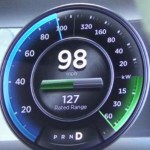
The smaller display in front of the driver usually shows the combination circular speedometer/kWh meter while driving. The center of the display is taken up by a digital speedometer, under which is a bar graphically representing the amount of charge and the rated range remaining. Along the left edge of the circle is an analog speedometer needle that sweeps upward as you accelerate. The right edge is used to measure the amount of energy being expended by the car or being returned to the battery via regenerative braking.

To the left and right of the speed/kWh meter are the sections of the display that correspond to the steering wheel roller controls. The left side shows the current media source and cover art, if available; it also shows an isometric perspective navigation map if a destination is set in the car’s nav system. The right section normally shows a minimized version of the main display’s energy gauge, but it changes when the wheel controls are manipulated to show the climate control temperature or whatever else is being controlled. The right side of the display even shows your phone’s contact list and caller information if you have a phone connected.

What the driver sees while in motion. The central round display shows forward speed and energy usage, as well as the “rated” range available. Visible to the left is the active navigation system showing turn-by-turn directions.
What the driver sees while in motion. The central round display shows forward speed and energy usage, as well as the “rated” range available. Visible to the left is the active navigation system showing turn-by-turn directions. Credit: Steven Michael

But what’s it like to drive?

Sitting down in the Model S for the first time is an odd experience because the car activates as you approach. By the time you’ve placed your butt in the driver’s seat, the car has spun up most of its electronics; the air conditioning or heating is on and blowing, and the screens are lit and showing you information. My first instinctive reaction was that I had better quickly start up the engine because I didn’t want to drain the battery while I fiddled with the electronics—but, of course, everything drains the battery.

The ritual of making the Model S ready to move is simple—you sit in it and depress the brake pedal with your foot. The image on the dashboard flips around and displays the combined speedometer and energy meter; the car is now “on.” You click the gear selector up to reverse or down to drive, and you’re ready to move.

Two big differences between the Model S and a traditional internal combustion engine vehicle immediately become apparent.

The first is the lack of “creep.” Creep is the tendency of cars with automatic transmissions to move forward slowly when in gear, even without the accelerator depressed. It’s caused by the transmission’s torque converter—a fluid-filled component that connects the engine to the rest of the transmission. Unlike a manual transmission, an automatic transmission is never fully disconnected from a car’s engine and, at idle, the rotation of the engine-connected impeller inside of the torque converter imparts some rotational energy to the drive gear. (Manual transmission cars de-couple the engine from the transmission via a clutch and so do not exhibit creep.)

The Model S has no transmission as such and so does not creep unless creep “emulation” is enabled via the console. Instead, by default it behaves like a car with a manual transmission—it can roll forward or backward on hills, and power isn’t applied to the drive wheels until the accelerator is depressed.

The Model S is quick, but not quite as quick as one of NASA’s supersonic T-38s.

The second difference is the presence of regenerative braking. This will be familiar to other electric car drivers, but it can be surprising if a driver isn’t prepared for it. Regenerative braking (or “regen”) takes advantage of the Model S electric motor, allowing it to reverse its operation and convert mechanical energy back into electrical energy—in this case, that mechanical energy is the existing forward momentum of the car. When you lift your foot off of the accelerator pedal, the effect is similar to strong engine braking in a manual transmission car: you feel an immediate braking effect, and the energy meter in the dashboard dives down into the green “regen” zone, showing the amount of energy being reclaimed in kilowatt-hours.

Regen in the Model S is noticeable when moving at highway speeds, but it’s most pronounced at slower surface street speeds. It’s strong enough that as I was driving around town, I almost never had to touch the brake pedal to slow down for stoplights until the very last moment. Regen can haul the car down from 40 mph to about 5 mph in a short amount of time, and you only have to gently tap the brakes to stop the car altogether. Used judiciously, regen will provide a small but noticeable increase in range.

Both behaviors can be modified via the car’s control panel, but honestly, I quite liked them at their defaults. It doesn’t take long at all to get used to the behavior—no more than a couple of minutes, really.

One potential issue with the lack of creep is that the Model S will roll on inclines. Feedback from Model S owners in hilly areas has led Tesla Motors to modify the creep setting so that it prevents backward rolling. If you live in San Francisco or another area where you’re likely to be stopping or parking on hills, you’ll likely want to enable creep.

Moving at legal speeds

At low speeds, the car exhibits the same disconcerting lack of noise as all electric and hybrid vehicles. The air conditioning compressor and fan mitigate that somewhat—with the air on, creeping around a parking lot in the Model S isn’t that much different from creeping around in a quiet luxury car. Electric car aficionados are likely to notice that when moving slowly, the Model S displays no hint of “cogging”—the stuttery, ratchet-like tendency of electric motors to want to keep their rotors aligned with their magnets at low speed. The Model S’ AC induction motor lacks static poles and so is immune to the issue; it simply provides smooth motion.

Out of the parking lot and on surface streets, the Model S feels like a large sedan. The P85+ model’s large 21-inch tires are noisy over bumps, but that’s par for the course with that much rolling rubber. The steering in “Comfort” mode is gentle without being loose or floaty. The Model S’ tractability coupled with its ample cargo room make it a perfectly fine grocery-getter, and I ran errands in it for an afternoon and quite enjoyed it.

But the thing that I most wanted to experience is how the car feels to drive, at speed, on the open road. Well, I’ll tell you: it feels awesome.

Moving at somewhat extralegal speeds

Out on the interstate, the top-shelf P85+ felt like it was in its natural habitat. The P85+ model’s big motor is equipped with an uprated AC inverter, providing a boost in output to 416 horsepower (up from the standard 85 kWh Model S’ 362 hp).

Horsepower, of course, doesn’t tell the true story of a car’s performance—it’s a compound number that’s easily understandable but not widely understood. You need to know many more numbers in order to characterize how “fast” a car is—particularly, you need to know the peak amount of torque the engine can produce and the RPM range where it produces that peak torque.

Here’s the thing, though: the Model S doesn’t need to keep its engine spinning at a certain number of revolutions per minute in order to reach an ideal output range, because it’s powered by an electric motor capable of producing torque proportional to the amount of current applied. Essentially, it’s always at peak torque.

The real-world performance implications are neck-snapping. You mash the pedal and the car goes; the acceleration will literally bang your head against the headrest if you’re not prepared. The motor can immediately deliver 443 lb-ft of torque (600 Newton-meters) to the drive wheels, and it can do so without the interruption of a down-shift and the noise and delay of an engine revving up into its power band. It can punch you back into your seat from a dead stop, or it can punch you back into your seat at 80 miles per hour. And the only sound the car makes as it yanks your eyeballs back into your head is a faint electric whine.

Tesla owners speak of the “Tesla grin”—the expression that breaks out across the face of new Tesla drivers the first time they open the car up on the road. I definitely had a Tesla grin plastered across my face for most of my drive time. There aren’t many things on the road that the Model S can’t blow past with an apparent lack of effort, and maintaining speed is similarly effortless. Once on the highway, 70 miles per hour feels like standing still; cruising between 80 and 90 felt most comfortable and, fortunately, the light traffic on I-10 that Friday afternoon was mostly moving at about the same speed.

Features like the solid nosecone (as opposed to a large front grille or air intake) help the Model S to slip through the air and maximize energy efficiency. They also look cool.
Features like the solid nosecone (as opposed to a large front grille or air intake) help the Model S to slip through the air and maximize energy efficiency. They also look cool. Credit: Steven Michael

At cruising speeds, the soundlessness of the parking lot is gone. The primary source of noise is the wind outside the cabin; I didn’t have a decibel meter on my road trip, but the noise was subjectively much louder than the cabin of a Mercedes or a Lexus LS. Additionally, those beautiful, fat 21-inch tires sing their own loud song on the pavement. The interior was certainly quiet enough at 70 mph to carry on a conversation at a normal volume, but it was decidedly not the silent electric car experience you might expect—really, it wasn’t even a luxury car level of quiet.

But oh, that intoxicating, addictive acceleration. I’ll overlook a lot of flaws in order to feel that much instant power under my right foot. Various sources peg the P85+’s quarter-mile times in the very low 13s—Car and Driver shows 13.3 seconds at 104 miles per hour, which is excellent for a 2.5-ton sedan.

Through the twisties

The car is rated for 0.91 g on the skidpad, also excellent for a car of the Model S’ size and heft. Subjectively, the car feels extremely flat when hurled through corners. No small amount of this stability is provided by the fact that a significant amount of the car’s mass—its battery pack—is only inches above the road surface. This results in an extremely low center of gravity, which means fast and controlled turns. I’m not the most skilled test driver, but I didn’t notice much over- or understeer when powering through corners; it was relatively easy to pick and hold a line when carving through turns. The P85+ package equips the Model S with fat Z-rated Michelin Pilot Sport 245/35 shoes in the front and even fatter 265/35s in the rear. With contact patches that big, the car goes directly where you aim it when cornering.

The large battery is as low as it’s possible to get and still be part of the car.

Also contributing to the road-hugging feel is the placement of the motor. The AC motor fits the traditional definition of “rear engine,” since it extends past the rear axle while still being part of the rear axle. Placing the heavy engine in line with the drive wheels leads to a 48/52 weight distribution (that is, 48 percent of the car’s weight is carried by the front wheels and 52 percent by the rear).

The rear engine is an extremely heavy component, and it hangs just aft of the rear wheels.

The Model S rewards spirited driving, and while it’s not going to stay as solidly stuck to the pavement as a BMW, the upgrades that come with the Performance Plus package are more than enough to make the car ridiculously fun to fling through corners. However, it’s worth noting that there’s more than enough power on hand to quickly break the rear wheels free. We spent most of our driving with the traction control turned on, and the car kept us from doing anything truly stupid. Turn it off, and it’s terrifyingly easy to spin the tires at just about any speed.

ZOOOOOOOOOOOOM
ZOOOOOOOOOOOOM Credit: Steven Michael

I charge the body electric

Bypassing gas stations is a high point for electric car owners, and the huge battery and long range of the Model S remains one of its most attractive features. But eventually, you need to put some energy back into that giant battery.

Charging the Model S is a nuanced subject. The car will accept electricity from a variety of sources: a standard US 110 V wall outlet, a 240 V utility outlet, 240 V RV outlets, standard electric car charging stations (using a Tesla-supplied adapter), special Tesla High-Power Wall Connectors (HPWCs), or the Tesla Supercharger network. Each type of outlet will supply a different amount of juice and will take a different amount of time to bring the Model S up to a full charge. With the exception of the Superchargers, all of the charging methods supply the car with alternating current (AC) electricity, which the car’s onboard chargers then convert to direct current (DC) and store in the battery. (Superchargers, as we’ll see, bypass the car’s on-board charging circuitry and feed DC directly into the battery.)

Because my intent was to put as many miles on the press loaner car as I could, I had to be continually aware of where and when my next charge was going to happen. Actual Model S owners will no doubt equip their garages with some manner of high-amperage outlet, but this wasn’t an option for me—the only plug I have in my garage is a standard 110 V, 12A outlet. When plugged into this, the Model S charges at the rate of about three miles per hour of charge. Overnight, I could build up only about 30 to 40 miles of additional range.

The fine folks at NRG eVgo graciously lent me a guest pass to use their charging network, and I was able to lean a bit on the eVgo charging station near my house to top off at about 20 miles per hour of charge. However, the majority of the juice I put into the vehicle came courtesy of Tesla.

On our road trip out from Houston to Austin, I first stopped by the Houston Galleria Tesla store and took advantage of one of the HPWC stations in the garage there. These use dedicated 80A circuits to pump about 50 miles per hour of charge back into the battery—though, to get that high level of energy, the Model S must be equipped with a second internal charger (at the cost of several thousand dollars at purchase).

Charging is handled with typical Tesla polish. The car comes with a mobile charging connector which hooks in to any available 110 V or 240 V outlet and a J1772 adapter to connect to public charging stations. To charge the car, you open the charging port (hidden in the driver’s side tail light) and simply connect the other end of the charging connector. The port glows green when it’s drawing power, and the car’s dashboard displays the progress of the charge—how much energy the car is drawing, how much range the car currently has, and how long until full.

The Model S charging port is concealed beneath one of the taillights.
The Model S charging port is concealed beneath one of the taillights. Credit: Lee Hutchinson

For our outbound stop with Tesla’s HPWC at the Galleria, we waited for a full hour, which added about 50 miles of range onto the battery. This gave us a comfortable margin to reach Columbus, about 100 miles west of Houston, even accounting for higher speed driving and air conditioning usage. As it turns out, we likely didn’t need the extra range, but without it we would have gotten to Columbus with only about 20 miles of charge remaining.

Once at Columbus, we hooked the car up to one of the Supercharger outlets—which provide an otherworldly amount of current.

Supercharging

The Supercharger bypasses the car’s chargers and feeds DC directly into the battery—prodigious amounts of DC, in fact. Once connected, the Supercharger began dumping about 300 volts at 300 amps into our car. After a minute or two, the car started making all kinds of loud noises—fans came on that I’d never heard before. The battery is liquid-cooled, and it’s easy to see how moving this much power would produce significant heat.

During supercharging, the car takes on a LOT of juice very quickly.
During supercharging, the car takes on a LOT of juice very quickly. Credit: Lee Hutchinson

We headed to the restaurant next door to grab lunch while the car charged; when we came back 45 minutes later, 180 miles had been added onto the car’s range. The charging rate starts very high, adding 100 miles of range very quickly so that long-distance drivers can charge quickly and move on to the next Supercharger station. After the first huge dump of electricity, the charging rate tapers off—by the end of the charge, the car was drawing energy at 400 volts and 20 amps. (This helps preserve the life of the battery, since dumping juice into it quickly will degrade the battery pack much faster than a slower charge.)

The vehicle lets you set the amount of charge, too. The charging status display inside the car has a draggable power bar that lets you charge up most of the way for a standard amount of range or add an extra 30-40 miles of range for a long trip. Making a “full” charge an optional feature instead of the standard also helps conserve the battery pack’s life—the cells used are standard lithium ion, so they live longer if they’re not charged all the way up and not discharged all the way down. Tesla says that the Model S battery pack should last for a full decade before it needs to be replaced—and that’s longer than many people keep their cars.

The Columbus Supercharger station is the third one that Tesla Motors has opened in Texas; the company will place two more between Houston and Dallas-Fort Worth by the end of the year. This will link together the “Texas Triangle” of Austin/San Antonio, Dallas-Fort Worth, and Houston. Judging by the speed at which the Columbus Supercharger dumped juice into our loaner Model S, travel between the state’s main cities will be quite easy once the remaining pair of Supercharger stations open.

The “Texas Triangle,” showing the locations of Austin, Dallas-Fort Worth, Houston, and San Antonio.
The “Texas Triangle,” showing the locations of Austin, Dallas-Fort Worth, Houston, and San Antonio. Credit: Google

But is it practical?

Right now, today, the Model S is a great commuter car that can also take some long-distance road trips, so long as Supercharger stations are available. The biggest detriment I found to having the car for the limited time I had it was finding a place to charge up; the second biggest detriment was actually having to wait while it charged. This isn’t like simply pumping gas—even the high-current Supercharger takes at least 20 minutes to add on 100 miles of range. The fastest non-Supercharger method—the 80A Tesla HPWC—can only supply about 50 miles of range per hour of charge.

I spent a lot of time doing this—but only because I didn’t have access to a fast charger at home.
I spent a lot of time doing this—but only because I didn’t have access to a fast charger at home. Credit: Lee Hutchinson

Another option is for Tesla to actually swap your battery while you wait. Some Supercharger stations will soon be equipped with an automated battery-swap bay, which will unbolt and remove the entire high-voltage battery pack from the bottom of the car and replace it with a fresh one, all in about 90 seconds. Unlike Supercharging, this battery swap isn’t free; Tesla estimates it will charge between $60-$80 for the swap. Drivers must also return to the same Supercharger station and swap their original batteries back in or pay what could be a substantial fee (the difference in value between the new battery pack and the old—Tesla hasn’t given any clues how much this might be, though).

There are few standard driving regimes where the Model S wouldn’t make a good fit; even a 150+ mile round trip commute is well within the range of an 85 kWh Model S, so long as you charge up overnight. The car is less suited for long road trips without easy Supercharger access, and another area where it might be non-optimal is if you’re visiting a friend or relative who only has a 110 V outlet available to charge the car. In that case, you can lean on any nearby Tesla dealerships for a quick charge or take advantage of any public electric car charging station.

Fighting to buy

The most disappointing thing about buying a Model S right now is the actual buying process—if you’re unlucky enough to live in a state like Texas where the entrenched automobile dealerships have blocked Tesla’s attempts to do business. I spoke with a number of Texas Tesla owners at the opening ceremony of the Columbus Supercharger on October 9, 2013, and they all described a buying experience that was more complex than needed: the cars must be purchased in California (over the phone or the Internet—the buyer doesn’t actually have to go there) and then freighted to Texas for delivery. Customers are responsible for paying the Texas state sales tax and registering vehicles themselves, which is par for the course for an out-of-state car purchase.

More annoyingly, ironclad pro-dealership laws in Texas prohibit Tesla from servicing vehicles within the state—or, at least, they prohibit customers from directly arranging that service themselves. Instead, the customers must perform a complicated dance of contacting the Tesla corporate office in California, describing the problem, and having the California office book a service appointment on their behalf.

The Columbus Supercharger opening was attended by dozens of Houston Tesla owners—folks who are buying cars in spite of the legislative roadblocks that lobby groups are keeping propped up.
The Columbus Supercharger opening was attended by dozens of Houston Tesla owners—folks who are buying cars in spite of the legislative roadblocks that lobby groups are keeping propped up. Credit: Lee Hutchinson

These ludicrous franchise laws in states like Texas are nominally in place to protect the very consumers they end up inconveniencing. The original intent of dealership franchise laws was to prevent automakers from artificially inflating car costs, either by controlling their entire vertical structure or by colluding on pricing. Today, though, the laws provide far more benefit to the entrenched franchised dealers than they do to consumers. There is no evidence that a Ford or a GM would provide a worse price on a car than an independently owned dealership; there is ample evidence that direct sales provide a massively superior buying experience. A small percentage of people enjoy haggling for a car, a process complete with histrionics and threats and bluffs, but for most folks, buying through a dealership remains an unpleasant experience.

According to Tesla Motors founder Elon Musk, Tesla went with the direct sales approach because buying an electric car is a complex process that requires more information and hand-holding than buying a gas-powered vehicle. A mass-market electric car like the Model S is different from the cars that prospective buyers will be familiar with, and by ensuring that only Tesla employees are selling Tesla cars, Tesla hopes to more directly control the quality of the buying experience. Of course, this shuts out third-party dealerships. Texas Automobile Dealers Association President Bill Wolters said that making an exception to franchise laws for Tesla would put in peril “the integrity of the entire franchise system” (though how any human being could use “integrity” in the same sentence with car dealerships is almost incomprehensible).

For now, Tesla continues to fight for the right to sell direct in some states (most notably in Texas) while in others, direct sales are no problem at all.

Nothing but Model Ss (Model Esses?) as far as the eye can see. There were plenty of additional cars to my right, waiting for their turn to charge.
Nothing but Model Ss (Model Esses?) as far as the eye can see. There were plenty of additional cars to my right, waiting for their turn to charge. Credit: Lee Hutchinson

Tesla, does this unit have a soul?

The Model S doesn’t smell like oil, it doesn’t drink gasoline, and it doesn’t howl when you stomp on it. But even though it lacks a beating mechanical internal combustion heart, it absolutely, positively, most definitely does have a soul. The Model S is a young car without the proud racing history of companies like Porsche or Ferrari, but it’s still an incredibly powerful New World statement that squarely challenges the Old.

In the few days I had the loaner Model S, I gave rides to most of my friends—along with a few of my friends’ kids. The responses were identical, young and old. The slide-out door handles drew gasps from 10-year-olds and jaded thirtysomethings alike; the enormous touchscreen made all eyes pop; the gut-rearranging torque drew gleeful screams of “OHHH YEAAAAAAAAAAH” out of every single person that sat in the cabin.

Driving fast feels so damn good.
Driving fast feels so damn good. Credit: Steven Michael

As for the driving experience—well, you forget about all of the neat electronics and the touchscreen and the battery and the network of Superchargers when you slip behind the wheel because the Model S is not just a great electric car. It’s a great car, period. That’s the highest praise I can give; Tesla Motors has succeeded in making an excellent automobile that also happens to be the best electric car money can buy.

On our own

The sun hung low in the sky behind us on our way back from Columbus to Houston, and Steve and I were fiddling with the Bluetooth audio. My phone was linked to the car, and we’d been flipping idly through my “4-5 Star” playlist, which contains an eclectic bunch of stuff from all different time periods. Steve punched the track forward button, and Bobby Brown’s “On Our Own” started up out of the Model S speakers. We were both transported instantly back to elementary school, listening to the song on tape on the bus to school.

We started singing along—the words came easy, even after 25 years—and then we came to the rap breakdown:

Found out about Vigo, the master of evil,
Try to battle my boys? That’s not legal!

Steve stopped singing. “Dude, Bobby Brown just rhymed ‘Vigo,’ ‘evil,’ and ‘legal.’ How is that even possible?”

I glanced at Steve and started laughing; it was unexpectedly hilarious. Steve got caught up in the mood and also started laughing, and I mashed the accelerator down to the floor, pushing the Model S up past 100.

If you’d been standing on the side of I-10 as we whisked by in a streak of silver-colored futuristic electric automobile, I’m not sure what would have been louder: the thump of vintage ’80s rap-pop, or our dopplered howls of speed-happy delight.

Credit: Steven Michael

Want to see the Model S in action and experience what it’s like to take the car out on the wide-open Texas highways? Don’t miss our epic video review!

Photo of Lee Hutchinson
Lee Hutchinson Senior Technology Editor
Lee is the Senior Technology Editor, and oversees story development for the gadget, culture, IT, and video sections of Ars Technica. A long-time member of the Ars OpenForum with an extensive background in enterprise storage and security, he lives in Houston.
356 Comments