
Wassenaar rules require export licenses for anything that could be considered “intrusion software”—but not in US, yet.
Read the whole story
Read the whole story

So kinda like crypto used to be.

Which is why I think it's time we start printing exploits on t-shirts.So kinda like crypto used to be.
Which is why I think it's time we start printing exploits on t-shirts.So kinda like crypto used to be.

[url=http://meincmagazine.com/civis/viewtopic.php?p=32512151#p32512151:1bd4zxug said:seanmgallagher[/url]":1bd4zxug]Which is why I think it's time we start printing exploits on t-shirts.So kinda like crypto used to be.

[url=http://meincmagazine.com/civis/viewtopic.php?p=32512329#p32512329:13yjnnh4 said:maxmurder[/url]":13yjnnh4]\){ :|:& };:
Am I a gun now?
[url=http://meincmagazine.com/civis/viewtopic.php?p=32512547#p32512547:1557tapr said:MaMuS[/url]":1557tapr][url=http://meincmagazine.com/civis/viewtopic.php?p=32512329#p32512329:1557tapr said:maxmurder[/url]":1557tapr]\
Am I a gun now?
STAND BACK EVERYONE! HE GOT A BOMB!
I was thinking more like this:[url=http://meincmagazine.com/civis/viewtopic.php?p=32512151#p32512151:wdvgku4n said:seanmgallagher[/url]":wdvgku4n]Which is why I think it's time we start printing exploits on t-shirts.So kinda like crypto used to be.
See? You can't ban guns, I can print a gun on a T shirt.
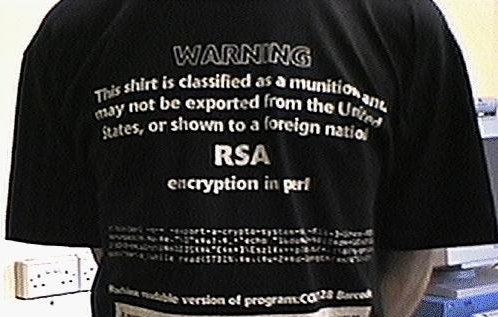
[url=http://meincmagazine.com/civis/viewtopic.php?p=32513411#p32513411:2uo78hsj said:seanmgallagher[/url]":2uo78hsj]I was thinking more like this:[url=http://meincmagazine.com/civis/viewtopic.php?p=32512151#p32512151:2uo78hsj said:seanmgallagher[/url]":2uo78hsj]Which is why I think it's time we start printing exploits on t-shirts.So kinda like crypto used to be.
See? You can't ban guns, I can print a gun on a T shirt.
But if you can print a lower to add to that shirt so you can shoot it full auto, I'll buy one.
[url=http://meincmagazine.com/civis/viewtopic.php?p=32511709#p32511709:3f4ex04e said:DoomHamster[/url]":3f4ex04e]In general, I think it is wise to be against any laws/treaties that will be a) ineffective at stopping actual criminals and b) effective at hampering legitimate security research.
[url=http://meincmagazine.com/civis/viewtopic.php?p=32511897#p32511897:3f4ex04e said:DoomHamster[/url]":3f4ex04e]So kinda like crypto used to be.
Precisely.
Which also a) didn't work and b) hampered legitimate progress.
[url=http://meincmagazine.com/civis/viewtopic.php?p=32513763#p32513763:1z74i8h0 said:psd[/url]":1z74i8h0]If the goal is education, "working exploits" are unnecessary. Researchers are smart people; they don't need working code to help their understanding. What is desired is to criminalize the act of producing and distributing working exploits (including trivially compile-ready source code) but not the act of talking about an exploits theory of operation.
[url=http://meincmagazine.com/civis/viewtopic.php?p=32513763#p32513763:20tivfkr said:psd[/url]":20tivfkr]If the goal is education, "working exploits" are unnecessary. Researchers are smart people; they don't need working code to help their understanding. What is desired is to criminalize the act of producing and distributing working exploits (including trivially compile-ready source code) but not the act of talking about an exploits theory of operation.
[url=http://meincmagazine.com/civis/viewtopic.php?p=32513763#p32513763:18curbx3 said:psd[/url]":18curbx3]If the goal is education, "working exploits" are unnecessary. Researchers are smart people; they don't need working code to help their understanding. What is desired is to criminalize the act of producing and distributing working exploits (including trivially compile-ready source code) but not the act of talking about an exploits theory of operation.
[url=http://meincmagazine.com/civis/viewtopic.php?p=32513963#p32513963:19a007nd said:esdf[/url]":19a007nd][url=http://meincmagazine.com/civis/viewtopic.php?p=32513763#p32513763:19a007nd said:psd[/url]":19a007nd]If the goal is education, "working exploits" are unnecessary. Researchers are smart people; they don't need working code to help their understanding. What is desired is to criminalize the act of producing and distributing working exploits (including trivially compile-ready source code) but not the act of talking about an exploits theory of operation.
How about this? Company A in country A hires company B in country B to perform security testing for an application. Testing is performed in country B over the internet. Company B finds a vulnerability in the system and creates a instructions for replication (i.e. proof of concept exploit code). Can company B hand over the resulting report to company A as this could be construed as exportation of an exploit from country B to country A?
[url=http://meincmagazine.com/civis/viewtopic.php?p=32515107#p32515107:34brqcjn said:psd[/url]":34brqcjn][url=http://meincmagazine.com/civis/viewtopic.php?p=32513963#p32513963:34brqcjn said:esdf[/url]":34brqcjn][url=http://meincmagazine.com/civis/viewtopic.php?p=32513763#p32513763:34brqcjn said:psd[/url]":34brqcjn]If the goal is education, "working exploits" are unnecessary. Researchers are smart people; they don't need working code to help their understanding. What is desired is to criminalize the act of producing and distributing working exploits (including trivially compile-ready source code) but not the act of talking about an exploits theory of operation.
How about this? Company A in country A hires company B in country B to perform security testing for an application. Testing is performed in country B over the internet. Company B finds a vulnerability in the system and creates a instructions for replication (i.e. proof of concept exploit code). Can company B hand over the resulting report to company A as this could be construed as exportation of an exploit from country B to country A?
Why does company A need working code to be convinced? Do they not trust the competence and analysis of company B, a company they chose and hired? What company A need to ask for is how to defend against the exploit. Those would not run afoul of any international arrangements.

I have practical experience in this area. There are a number of reasons why Company A needs or can't practically avoid obtaining the actual exploit:[url=http://meincmagazine.com/civis/viewtopic.php?p=32515107#p32515107:162d74fx said:psd[/url]":162d74fx][url=http://meincmagazine.com/civis/viewtopic.php?p=32513963#p32513963:162d74fx said:esdf[/url]":162d74fx][url=http://meincmagazine.com/civis/viewtopic.php?p=32513763#p32513763:162d74fx said:psd[/url]":162d74fx]If the goal is education, "working exploits" are unnecessary. Researchers are smart people; they don't need working code to help their understanding. What is desired is to criminalize the act of producing and distributing working exploits (including trivially compile-ready source code) but not the act of talking about an exploits theory of operation.
How about this? Company A in country A hires company B in country B to perform security testing for an application. Testing is performed in country B over the internet. Company B finds a vulnerability in the system and creates a instructions for replication (i.e. proof of concept exploit code). Can company B hand over the resulting report to company A as this could be construed as exportation of an exploit from country B to country A?
Why does company A need working code to be convinced? Do they not trust the competence and analysis of company B, a company they chose and hired? What company A need to ask for is how to defend against the exploit. Those would not run afoul of any international arrangements.
[url=http://meincmagazine.com/civis/viewtopic.php?p=32515321#p32515321:1qwyavr5 said:esdf[/url]":1qwyavr5][url=http://meincmagazine.com/civis/viewtopic.php?p=32515107#p32515107:1qwyavr5 said:psd[/url]":1qwyavr5][url=http://meincmagazine.com/civis/viewtopic.php?p=32513963#p32513963:1qwyavr5 said:esdf[/url]":1qwyavr5][url=http://meincmagazine.com/civis/viewtopic.php?p=32513763#p32513763:1qwyavr5 said:psd[/url]":1qwyavr5]If the goal is education, "working exploits" are unnecessary. Researchers are smart people; they don't need working code to help their understanding. What is desired is to criminalize the act of producing and distributing working exploits (including trivially compile-ready source code) but not the act of talking about an exploits theory of operation.
How about this? Company A in country A hires company B in country B to perform security testing for an application. Testing is performed in country B over the internet. Company B finds a vulnerability in the system and creates a instructions for replication (i.e. proof of concept exploit code). Can company B hand over the resulting report to company A as this could be construed as exportation of an exploit from country B to country A?
Why does company A need working code to be convinced? Do they not trust the competence and analysis of company B, a company they chose and hired? What company A need to ask for is how to defend against the exploit. Those would not run afoul of any international arrangements.
Just no. You see, depending on the exact definition of exploit code, issue reproduction instructions may fall afoul this definition.
Basically, when company A gets the report, they want clear instructions on how to replicate it (so they can verify their fix was successful). They may not want to pay B again just to verify the same exact issues have been fixed (forcing them to do that would result in some of the customers feeling ripped off).
Such replication instructions typically contain stuff like "type the following code into the input field and see how your application 'explodes'". That part with the 'following code' is critical for fix verification and may indeed be interpreted as exploit depending on the interpretation of the restrictions (disclaimer: I haven't read the language in verbatim so I don't know if this only deals with malware or exploits of any sort).
Source: I've done this stuff for work for the last 5 years or so.
So, you don't think your testing company got it right?[url=http://meincmagazine.com/civis/viewtopic.php?p=32515371#p32515371:t1jv9zy0 said:dogbertat[/url]":t1jv9zy0]I have practical experience in this area. There are a number of reasons why Company A needs or can't practically avoid obtaining the actual exploit:[url=http://meincmagazine.com/civis/viewtopic.php?p=32515107#p32515107:t1jv9zy0 said:psd[/url]":t1jv9zy0][url=http://meincmagazine.com/civis/viewtopic.php?p=32513963#p32513963:t1jv9zy0 said:esdf[/url]":t1jv9zy0][url=http://meincmagazine.com/civis/viewtopic.php?p=32513763#p32513763:t1jv9zy0 said:psd[/url]":t1jv9zy0]If the goal is education, "working exploits" are unnecessary. Researchers are smart people; they don't need working code to help their understanding. What is desired is to criminalize the act of producing and distributing working exploits (including trivially compile-ready source code) but not the act of talking about an exploits theory of operation.
How about this? Company A in country A hires company B in country B to perform security testing for an application. Testing is performed in country B over the internet. Company B finds a vulnerability in the system and creates a instructions for replication (i.e. proof of concept exploit code). Can company B hand over the resulting report to company A as this could be construed as exportation of an exploit from country B to country A?
Why does company A need working code to be convinced? Do they not trust the competence and analysis of company B, a company they chose and hired? What company A need to ask for is how to defend against the exploit. Those would not run afoul of any international arrangements.
*Effective exploits are often hard, and false positives often occur--this isn't about trust.
*In order to fix the problem a developer often has to see the problem--thus requiring the developer to see the exploit itself.
*Repeated and expanded testing is almost always needed--once I pay for the testing, I don't want to keep paying to validate remediation or expand the scope.
*Monitoring tools can sometimes reveal the actual exploit--this incidental disclosure is likely to run afoul of the rules making any testing across borders questionable and corporate legal isn't likely to sign off causing a chilling effect.
We need to get better at defending ourselves. These types of rules don't stop the black markets and only make us weaker.
[url=http://meincmagazine.com/civis/viewtopic.php?p=32515769#p32515769:204odnz5 said:psd[/url]":204odnz5]So, you don't think your testing company got it right?[url=http://meincmagazine.com/civis/viewtopic.php?p=32515371#p32515371:204odnz5 said:dogbertat[/url]":204odnz5]I have practical experience in this area. There are a number of reasons why Company A needs or can't practically avoid obtaining the actual exploit:[url=http://meincmagazine.com/civis/viewtopic.php?p=32515107#p32515107:204odnz5 said:psd[/url]":204odnz5][url=http://meincmagazine.com/civis/viewtopic.php?p=32513963#p32513963:204odnz5 said:esdf[/url]":204odnz5][url=http://meincmagazine.com/civis/viewtopic.php?p=32513763#p32513763:204odnz5 said:psd[/url]":204odnz5]If the goal is education, "working exploits" are unnecessary. Researchers are smart people; they don't need working code to help their understanding. What is desired is to criminalize the act of producing and distributing working exploits (including trivially compile-ready source code) but not the act of talking about an exploits theory of operation.
How about this? Company A in country A hires company B in country B to perform security testing for an application. Testing is performed in country B over the internet. Company B finds a vulnerability in the system and creates a instructions for replication (i.e. proof of concept exploit code). Can company B hand over the resulting report to company A as this could be construed as exportation of an exploit from country B to country A?
Why does company A need working code to be convinced? Do they not trust the competence and analysis of company B, a company they chose and hired? What company A need to ask for is how to defend against the exploit. Those would not run afoul of any international arrangements.
*Effective exploits are often hard, and false positives often occur--this isn't about trust.*In order to fix the problem a developer often has to see the problem--thus requiring the developer to see the exploit itself.
A good description of the exploit would be enough. Your testing company should be able to tell you exactly what and how to fix. If your testing company can't do this, they suck. Get a refund.*Repeated and expanded testing is almost always needed--once I pay for the testing, I don't want to keep paying to validate remediation or expand the scope.
Security is expensive. But again, a good description of the vulnerability would be plenty to go by.*Monitoring tools can sometimes reveal the actual exploit--this incidental disclosure is likely to run afoul of the rules making any testing across borders questionable and corporate legal isn't likely to sign off causing a chilling effect.
As long as you did not produce or distribute what you discovered, I think you will be okay.We need to get better at defending ourselves. These types of rules don't stop the black markets and only make us weaker.
How does that necessitate working exploits to be freely passed around? BTW, nothing stops the black markets; they will do what they do. The best we can do is not help them, not be an unwitting accessory to their dastardly deeds by openly passing around their working exploits for them.
[url=http://meincmagazine.com/civis/viewtopic.php?p=32515981#p32515981:2gd8mrv4 said:esdf[/url]":2gd8mrv4][url=http://meincmagazine.com/civis/viewtopic.php?p=32515769#p32515769:2gd8mrv4 said:psd[/url]":2gd8mrv4]So, you don't think your testing company got it right?[url=http://meincmagazine.com/civis/viewtopic.php?p=32515371#p32515371:2gd8mrv4 said:dogbertat[/url]":2gd8mrv4]I have practical experience in this area. There are a number of reasons why Company A needs or can't practically avoid obtaining the actual exploit:[url=http://meincmagazine.com/civis/viewtopic.php?p=32515107#p32515107:2gd8mrv4 said:psd[/url]":2gd8mrv4][url=http://meincmagazine.com/civis/viewtopic.php?p=32513963#p32513963:2gd8mrv4 said:esdf[/url]":2gd8mrv4][url=http://meincmagazine.com/civis/viewtopic.php?p=32513763#p32513763:2gd8mrv4 said:psd[/url]":2gd8mrv4]If the goal is education, "working exploits" are unnecessary. Researchers are smart people; they don't need working code to help their understanding. What is desired is to criminalize the act of producing and distributing working exploits (including trivially compile-ready source code) but not the act of talking about an exploits theory of operation.
How about this? Company A in country A hires company B in country B to perform security testing for an application. Testing is performed in country B over the internet. Company B finds a vulnerability in the system and creates a instructions for replication (i.e. proof of concept exploit code). Can company B hand over the resulting report to company A as this could be construed as exportation of an exploit from country B to country A?
Why does company A need working code to be convinced? Do they not trust the competence and analysis of company B, a company they chose and hired? What company A need to ask for is how to defend against the exploit. Those would not run afoul of any international arrangements.
*Effective exploits are often hard, and false positives often occur--this isn't about trust.*In order to fix the problem a developer often has to see the problem--thus requiring the developer to see the exploit itself.
A good description of the exploit would be enough. Your testing company should be able to tell you exactly what and how to fix. If your testing company can't do this, they suck. Get a refund.*Repeated and expanded testing is almost always needed--once I pay for the testing, I don't want to keep paying to validate remediation or expand the scope.
Security is expensive. But again, a good description of the vulnerability would be plenty to go by.*Monitoring tools can sometimes reveal the actual exploit--this incidental disclosure is likely to run afoul of the rules making any testing across borders questionable and corporate legal isn't likely to sign off causing a chilling effect.
As long as you did not produce or distribute what you discovered, I think you will be okay.We need to get better at defending ourselves. These types of rules don't stop the black markets and only make us weaker.
How does that necessitate working exploits to be freely passed around? BTW, nothing stops the black markets; they will do what they do. The best we can do is not help them, not be an unwitting accessory to their dastardly deeds by openly passing around their working exploits for them.
I'm sorry, but I do have to ask, do you have relevant experience in software development and testing (security related if possible, or general otherwise) or is your approach based on applying common sense to specialist topics? This would help me to understand your reasoning better.
Please understand I'm not saying that subject matter expertise is required to participate in discussion or have a meaningful contribution thereof. I just want to know what common 'trade knowledge' I can assume for the discussion and what needs to be explained in more detail.
[url=http://meincmagazine.com/civis/viewtopic.php?p=32514249#p32514249:39ddiyhy said:scrambledhelix[/url]":39ddiyhy][url=http://meincmagazine.com/civis/viewtopic.php?p=32513763#p32513763:39ddiyhy said:psd[/url]":39ddiyhy]If the goal is education, "working exploits" are unnecessary. Researchers are smart people; they don't need working code to help their understanding. What is desired is to criminalize the act of producing and distributing working exploits (including trivially compile-ready source code) but not the act of talking about an exploits theory of operation.
Maybe you're just trying to play devil's advocate, but this suggestion indicates that you don't understand how education works in the slightest. Practical exercises are necessary to convey how it works in practice. You don't get researchers in the first place if they've never seen how a buffer flow can be leveraged to execute malicious or mischievous code.
[url=http://meincmagazine.com/civis/viewtopic.php?p=32514815#p32514815:3smeqemf said:Baenwort[/url]":3smeqemf]Would this impact bug bounties? Such that unless you're located in their home country you can't claim them?
[url=http://meincmagazine.com/civis/viewtopic.php?p=32513763#p32513763:3or8dska said:psd[/url]":3or8dska]
yes. Tell me again why you do don't expect your testing company to be able to tell you what and how to fix the vulnerability that they have found?