
An extremely rare clotting problem that's also seen with the AstraZenica vaccine.
Read the whole story
Read the whole story
Like I said, I am pro vaccines. But the covid 19 vaccines are going to be administered to everybody, including hundreds of millions, billions maybe, who might never get the virus, or might not suffer noticeable symptoms if they do get it.So stopping and assessing the situation is the right thing to do.
How many in a million may get Covid-19 while waiting for that assessment and get severe issues from that? Sometimes doing nothing is not the safest option.
The pause is a CDC guidance, your local health officials will determine if and when they choose to pause. For instance NYC has paused and is rescheduling j&J vaccines, have not yet heard that the whole state is doing the same (maybe another Cuomo / De Blasio drama will unfold).Damnit!
I was scheduled to get that tomorrow.
Was? Did it get canceled? I'm scheduled to get it tomorrow, too. I've not heard any word from the provider about a cancelation. Seems like it would be a really bad idea to cancel appointments that are already scheduled.
I did not see anything about the Pfizer vaccine. This is about the Janssen(J&J) version. Do you have a reference on Pfizer vaccine causing the syndrome.The first article is on the AZ vaccine. That was fairly widely deployed in Europe, so they vaccinated a lot of women above 50.At this stage in the data nobody really knows. The case counts are all extremely low, but everything I've seen indicates it's mostly young women This article is typical:...
That quote could be interpreted to mean that patients over 60 are at lower risk of clots associated with the vaccine.
I don't think that's what they meant, and even if they did, why would that be the case... because people over 60 have s**ttier immune systems that are less likely to react to any particular virus?
"Nine of the 11 patients were women, and the median patient age was 36 years (range, 22 to 49)." According to the Ars piece, the J&J associated blood clots are also tend to be younger and female: "So far, all six cases have occurred among women below the age of 50 and appeared between one and two weeks after vaccination." Since the only group that young to get vaccinated has been health care workers, it's rather notable that 15 of the 17 cases have been women under 50, and most of them seem to be younger.
The "young women get this more" idea comes from observed data. The closest thing I have seen to speculation on why is the dude who made the oral contraceptives joke on this thread.
That said, you know how you shouldn't do a vast study that tries to figure out the answer to hundreds of questions because you'll get false positives? I would not be surprised if, 2 years from now, everybody's convinced this was a false positive. We just happened to have a bunch of young women have these clots, and they worked in health care so they'd been vaccinated. And they're very unusual clots so it was highly unlikely to be chance, but this was just the highly unlikely thing that happened with Covid vaccines?
EDIT: 9+6 is not 14, 11+6 is not 15.
I wonder about the age part. The cases are in younger women. But the J&J vaccine was only approved recently and we started vaccinations of the elderly quite a while ago. How many women over the age of 60 have received the J&J vaccine? I'm guessing it's pretty low.
Now they're noticing it in the US, with Pfizer.
And there's lots of potential speculation, but very little hard data. It could be an artifact of small numbers, it could be an interaction with some medical treatment that younger women are likely to get, it could be just the clue that lets us figure out how the blood clotting system actually works, it could be a combination of the three, etc.
Or it could be that, while the AZ has a small risk of the blood clots in young women, the Pfizer does not; and the apparent correlation with age is an artifact of most of the older women already having the vaccine.
A shocking statistic.I recently read the chances of been struck by lightning are one in three hundred thousand.
My guess is pretty much every provider is going to cancel all appointments by the end of the day. I've read of several that already have, the rest will probably follow suit soon.Damnit!
I was scheduled to get that tomorrow.
Was? Did it get canceled? I'm scheduled to get it tomorrow, too. I've not heard any word from the provider about a cancelation.
Why? Without cancelling the appointments the pause does nothing. At least in my area, providers are booking a couple weeks in advance.Seems like it would be a really bad idea to cancel appointments that are already scheduled.
Here in Denmark where I live, roughly 140k were vaccinated with the AstraZeneca vaccine before the program was paused. There were 10 cases of blot clotting in individuals under 65, but only in the case of the 1 fatality (a 30-year-old woman) has the blood work been made public. As in the case with Norway, there don't appear to be publicly available age data, although that would clearly be possible for researchers to get access to (at least here in Denmark).
The pause is a CDC guidance, your local health officials will determine if and when they choose to pause. For instance NYC has paused and is rescheduling j&J vaccines, have not yet heard that the whole state is doing the same (maybe another Cuomo / De Blasio drama will unfold).Damnit!
I was scheduled to get that tomorrow.
Was? Did it get canceled? I'm scheduled to get it tomorrow, too. I've not heard any word from the provider about a cancelation. Seems like it would be a really bad idea to cancel appointments that are already scheduled.
“Yeah right?” What are you talking about? I’m fully vaccinated, my children are fully vaccinated, I have as a “frontline nurse” received my 2 Pfizer covid-19 vaccine shots months ago. I usually get the flu vaccine every year because it’s pretty stupid not to - whatever vaccine they might think up next, I’ll be in line for that as well. Vaccines are great.Like I said, I am pro vaccines. But the covid 19 vaccines are going to be administered to everybody, including hundreds of millions, billions maybe, who might never get the virus, or might not suffer noticeable symptoms if they do get it.So stopping and assessing the situation is the right thing to do.
How many in a million may get Covid-19 while waiting for that assessment and get severe issues from that? Sometimes doing nothing is not the safest option.
And then go on to transmit it to someone who dies.
Pro-vaccine, yeah right.
Damnit!
I was scheduled to get that tomorrow.
Was? Did it get canceled? I'm scheduled to get it tomorrow, too. I've not heard any word from the provider about a cancelation. Seems like it would be a really bad idea to cancel appointments that are already scheduled.
Based on how AstraZeneca numbers developed, the incidence will be higher than that and the younger women -angle is a sample bias due to medical professionals being priority group (presumably in US as well) which is a female-dominated profession.
Here's two comparisons on being admitted to ICU in UK within 16 weeks vs blood clot risk.
Medium risk at 60 cases / 100k / day:
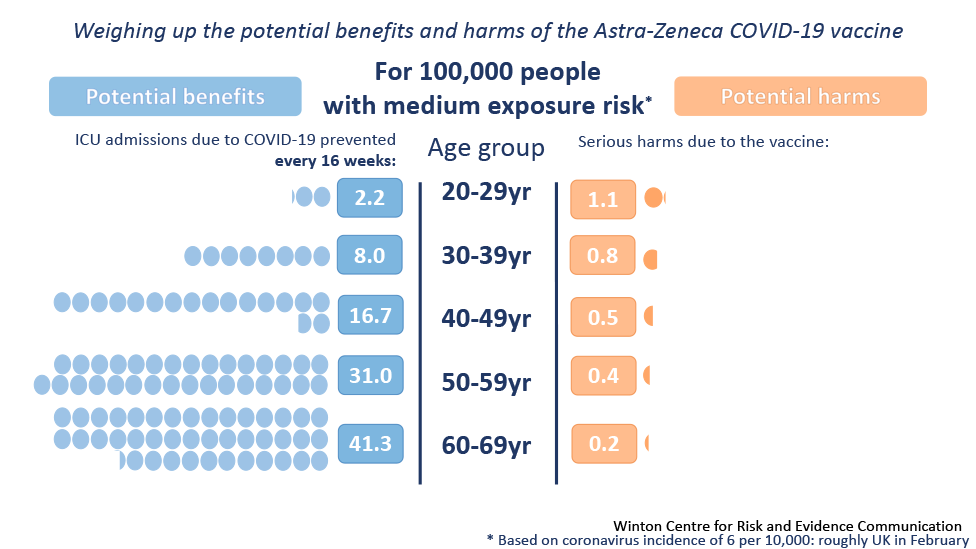
And low risk at 20 cases / 100k / day

To my layman's opinion vaccinating people in 50s should be slam dunk, below that it becomes debatable.
...
I'm getting mine through my workplace and I called health services there to ensure I would still be getting it and they said no, that they would not be administering it until the recommended pause was lifted.
Possible but irrelevant. The low hanging fruit is to just give a different vaccine in females under 50. The alternative is prophylaxis in all people (but particularly women under 50) which means we are exposing millions of people to medication for benefits that are unlikely to justify the risk. If it really is immune mediated the last thing you want to do is 'tone down' the immune response to a vaccine. We also cannot fine tune platelet aggregation without risk of hemorrhage.If that's the mechanism, I wonder if there's anything easy that can be done prophylactically to make it non-lethal, with a risk of side effects even lower than the rare blood clotting?Apparently, in very rare cases, the Adenovirus triggers an immune response to factors found on the surface of platelets, which are an essential part of the clotting process. This activates platelets, causing clots, and at the same time reduces the total platelet count.
...
Possible but irrelevant. The low hanging fruit is to just give a different vaccine in females under 50. The alternative is prophylaxis in all people (but particularly women under 50) which means we are exposing millions of people to medication for benefits that are unlikely to justify the risk. If it really is immune mediated the last thing you want to do is 'tone down' the immune response to a vaccine. We also cannot fine tune platelet aggregation without risk of hemorrhage.
Possibly Novavax to the rescue . . . https://theconversation.com/what-is-nov ... -it-157227
...
I'm getting mine through my workplace and I called health services there to ensure I would still be getting it and they said no, that they would not be administering it until the recommended pause was lifted.
Maybe put some effort into getting a Pfizer shot for yourself?
If you're in a position to make a choice, might as well.
Possible but irrelevant. The low hanging fruit is to just give a different vaccine in females under 50. The alternative is prophylaxis in all people (but particularly women under 50) which means we are exposing millions of people to medication for benefits that are unlikely to justify the risk. If it really is immune mediated the last thing you want to do is 'tone down' the immune response to a vaccine. We also cannot fine tune platelet aggregation without risk of hemorrhage.If that's the mechanism, I wonder if there's anything easy that can be done prophylactically to make it non-lethal, with a risk of side effects even lower than the rare blood clotting?Apparently, in very rare cases, the Adenovirus triggers an immune response to factors found on the surface of platelets, which are an essential part of the clotting process. This activates platelets, causing clots, and at the same time reduces the total platelet count.
Possibly Novavax to the rescue . . . https://theconversation.com/what-is-nov ... -it-157227
Sam Harris is an anti-religion activist.Oh well, I guess you can't logically argue somebody out of a position they didn't logically argue their way into (I think that is a famous phrase or something from somebody..)
My favorite quote on this matter...
“If someone doesn't value evidence, what evidence are you going to provide to prove that they should value it? If someone doesn’t value logic, what logical argument could you provide to show the importance of logic?”
Sam Harris
How about adjusting your communication with the target audience?
Adjusting the communications style can convince religious people you respect them, and the atheist position has been misrepresented by their Pastors/Imams/etc., which means that if one of them has already logiced himself out of Jehovah/Vishnu/etc. you have shown them a different path that they may choose. But the rest of the congregation? If logicking people out of their religions worked there'd only be one religion.
In this case a bunch of people have chosen to be anti-Vax for non-logic-related reasons that make sense to them, and you might be able to use those to convince them, but that ain't easy. You'd have to get into their heads, figure out what their actual objection is, and deal with it.
Which kinda works with family because you know them and they trust you. But in my specific family situation the anti-vaxer is a woman in her 30s, with a 16-year-old daughter. Which is a harder case to counter when the blood clots almost entirely happen in young women.
I recently read the chances of been struck by lightning are one in three hundred thousand.
Looks like the adenovirus vector is a flop; that sucks. Hopefully we can get the cost of the synthetic lipids and raw mRNA down with massive manufacturing scales.
One in a million people get some life-threatening blood clots.
720,000 in a million people avoid some life-threatening virus completely
179,999 in a million people might still get the corona virus and have fewer symtoms
Friendly reminder that aspirin is deadlier than J&J and AstraZeneca vaccines combined
In my state one lady died and other is on life support. You numbers might say one thing now but they could radically change. Remember Fauci said Covid was no big deal and we didn't need masks?
I imagine I'm not alone in this experience with my relative. The depressing part of this though is that she's a 30-something college-educated Democrat who has a career related to healthcare. If people like her are vaccine-hesitant, how will we ever reach the rest of the population?
Damn. the J&J vaccine was the argument I was going to use with my vaccine fearful relatives that don't like the mRNA vaccines because they are fearful of long term effects. ...
This is kind of a bogus argument though. As I posted in a different thread yesterday, the J&J vaccine is basically an mRNA vaccine. It just uses DNA to get your cells to make the same mRNA you would get directly from the mRNA vaccines.
Nope. That was just an ADHD brain fart.I did not see anything about the Pfizer vaccine. This is about the Janssen(J&J) version. Do you have a reference on Pfizer vaccine causing the syndrome.The first article is on the AZ vaccine. That was fairly widely deployed in Europe, so they vaccinated a lot of women above 50.At this stage in the data nobody really knows. The case counts are all extremely low, but everything I've seen indicates it's mostly young women This article is typical:...
That quote could be interpreted to mean that patients over 60 are at lower risk of clots associated with the vaccine.
I don't think that's what they meant, and even if they did, why would that be the case... because people over 60 have s**ttier immune systems that are less likely to react to any particular virus?
"Nine of the 11 patients were women, and the median patient age was 36 years (range, 22 to 49)." According to the Ars piece, the J&J associated blood clots are also tend to be younger and female: "So far, all six cases have occurred among women below the age of 50 and appeared between one and two weeks after vaccination." Since the only group that young to get vaccinated has been health care workers, it's rather notable that 15 of the 17 cases have been women under 50, and most of them seem to be younger.
The "young women get this more" idea comes from observed data. The closest thing I have seen to speculation on why is the dude who made the oral contraceptives joke on this thread.
That said, you know how you shouldn't do a vast study that tries to figure out the answer to hundreds of questions because you'll get false positives? I would not be surprised if, 2 years from now, everybody's convinced this was a false positive. We just happened to have a bunch of young women have these clots, and they worked in health care so they'd been vaccinated. And they're very unusual clots so it was highly unlikely to be chance, but this was just the highly unlikely thing that happened with Covid vaccines?
EDIT: 9+6 is not 14, 11+6 is not 15.
I wonder about the age part. The cases are in younger women. But the J&J vaccine was only approved recently and we started vaccinations of the elderly quite a while ago. How many women over the age of 60 have received the J&J vaccine? I'm guessing it's pretty low.
Now they're noticing it in the US, with Pfizer.
And there's lots of potential speculation, but very little hard data. It could be an artifact of small numbers, it could be an interaction with some medical treatment that younger women are likely to get, it could be just the clue that lets us figure out how the blood clotting system actually works, it could be a combination of the three, etc.
Or it could be that, while the AZ has a small risk of the blood clots in young women, the Pfizer does not; and the apparent correlation with age is an artifact of most of the older women already having the vaccine.
I recently read the chances of been struck by lightning are one in three hundred thousand.
CDC says 1 in 500,000, on a per-year basis. https://www.cdc.gov/disasters/lightning/victimdata.html
It's not evenly distributed. According to the CDC, God hates Florida Man. (Ok, that's not quite how they phrased it.....)
Also, men are more likely to be struck than women -- 85% vs 15%, so a pretty big effect.
And before you say, "I just stay inside," they note "about one-third (32%) of lightning injuries occur indoors."
...
Yes, It's complicated.
There is a working paper somewhere on recommendations for 'vaccine induced CVT' but I can't find it quickly and I have to quit futzing around and go to a meeting. It is certainly a work in progress..
Your link suggests anticoagulants, which makes sense for "normal" CVT, but if anticoagulants are counterindicated due to low platelet count, it seems like we're back to not having a treatment for this condition.
Looks like the adenovirus vector is a flop; that sucks. Hopefully we can get the cost of the synthetic lipids and raw mRNA down with massive manufacturing scales.
One in a million people get some life-threatening blood clots.
720,000 in a million people avoid some life-threatening virus completely
179,999 in a million people might still get the corona virus and have fewer symtoms
Friendly reminder that aspirin is deadlier than J&J and AstraZeneca vaccines combined
In my state one lady died and other is on life support. You numbers might say one thing now but they could radically change. Remember Fauci said Covid was no big deal and we didn't need masks?
Looks like the adenovirus vector is a flop; that sucks. Hopefully we can get the cost of the synthetic lipids and raw mRNA down with massive manufacturing scales.
One in a million people get some life-threatening blood clots.
720,000 in a million people avoid some life-threatening virus completely
179,999 in a million people might still get the corona virus and have fewer symtoms
Friendly reminder that aspirin is deadlier than J&J and AstraZeneca vaccines combined
In my state one lady died and other is on life support. You numbers might say one thing now but they could radically change. Remember Fauci said Covid was no big deal and we didn't need masks?
Perhaps you could refresh my memory on this one, deplorable.
I see two, depending on how you break it down. I'm assuming HistoryDave is taking the two different things Fauci supposedly said as two different claims.In my state one lady died and other is on life support. You numbers might say one thing now but they could radically change. Remember Fauci said Covid was no big deal and we didn't need masks?
Perhaps you could refresh my memory on this one, deplorable.
Just one claim in that sentence...

My guess is pretty much every provider is going to cancel all appointments by the end of the day. I've read of several that already have, the rest will probably follow suit soon.Damnit!
I was scheduled to get that tomorrow.
Was? Did it get canceled? I'm scheduled to get it tomorrow, too. I've not heard any word from the provider about a cancelation.
Why? Without cancelling the appointments the pause does nothing. At least in my area, providers are booking a couple weeks in advance.Seems like it would be a really bad idea to cancel appointments that are already scheduled.
Are you suggesting men never lactate?I had to answer several questions. Such as "Is this your first dose? did you have an allergic reaction?" Uhhh... no, this is my first time! And they ask men, "Are you lactating?" The questionnaire needs work
Has there been any evidence that COVID itself can cause blood clotting through the same mechanism? I don't know enough about the biological nuts and bolts of vaccines & COVID to understand the short explanation given in the article.
If COVID doesn't share this same risk, I'm curious why this vaccine would uniquely cause it. Anyone knowledgeable about medicine & biology able to fill me in on this in greater depth than the article provides?
I recently read the chances of been struck by lightning are one in three hundred thousand.
CDC says 1 in 500,000, on a per-year basis. https://www.cdc.gov/disasters/lightning/victimdata.html
It's not evenly distributed. According to the CDC, God hates Florida Man. (Ok, that's not quite how they phrased it.....)
Also, men are more likely to be struck than women -- 85% vs 15%, so a pretty big effect.
And before you say, "I just stay inside," they note "about one-third (32%) of lightning injuries occur indoors."
How does one get struck by lightning indoors? In the shower? or plumbers working on metal pipes?
Regarding comparisons to Aspirin...Aspirin has been around for a long time and its side effects have been thoroughly researched. We’re quite confident that its rare side effects are, in fact, rare.
Why people think aspirin is harmless is just weird or is it just that they have either forgotten or never read the label?
You don't want to find out too late the many excellent reasons why aspirin is not recommended for children under 12 unless under doctor's advice!
It took a long term to determine those side effects of aspirin and the same level of research has to happen with these and other vaccines. While it is very disappointing, it is essential to stop and review the actual data. Understanding the reasons behind this may lead to better treatment of blood clots and other blood disorders.
Here in Denmark where I live, roughly 140k were vaccinated with the AstraZeneca vaccine before the program was paused. There were 10 cases of blot clotting in individuals under 65, but only in the case of the 1 fatality (a 30-year-old woman) has the blood work been made public. As in the case with Norway, there don't appear to be publicly available age data, although that would clearly be possible for researchers to get access to (at least here in Denmark).
A recently published paper describes five cases of rare blood clots in Norway after the Astra Zeneca vaccine. Three women died (aged 37,42, and 54), while a woman aged 39 and a man aged 32 recovered.
These rare blood clots are not that rare in Norway, with 5 cases (possibly 6) out of 130 000 vaccinated persons (about 1:20000).
Has there been any evidence that COVID itself can cause blood clotting through the same mechanism? I don't know enough about the biological nuts and bolts of vaccines & COVID to understand the short explanation given in the article.
If COVID doesn't share this same risk, I'm curious why this vaccine would uniquely cause it. Anyone knowledgeable about medicine & biology able to fill me in on this in greater depth than the article provides?
