
Internet shortcuts come with code execution capability. Latest Mac not fully patched.
Read the whole story
Read the whole story
This snippet with just eight lines of code is what launched the Calculator shown above. But any skillful threat actor could modify this test code to execute outright malicious code on the victim's machine.
This snippet with just eight lines of code is what launched the Calculator shown above. But any skillful threat actor could modify this test code to execute outright malicious code on the victim's machine.
how, though? does the file: URI handler accept arguments in the command, or is there another way to provide the malicious payload? a drive-by download might work, but since macOS is Unix, wouldn't it require the execute permission bit be set on the file somehow?
(obviously, this is a serious security issue - i'm just curious specifically how an attack would work.)
It's funny because I feel like I've been seeing this exact sentiment here, nearly word-for-word, for the last ~5 years?OK, I get that security is hard. I get that there are millions of lines of code in an operating system and things like this are going to fall through the cracks. Honestly, I do.
However, is it just me or is Apple getting particularly bad for this just recently? This. The recent iOS text message bug. The thing where you could get root without a password. Reading that Facebook post where it mentioned Microsoft going back to basics for security in the early 00s, I'm wondering if Apple need to do the same; dial back a bit on yearly OS releases and focus on security?
OK, I get that security is hard. I get that there are millions of lines of code in an operating system and things like this are going to fall through the cracks. Honestly, I do.
However, is it just me or is Apple getting particularly bad for this just recently? This. The recent iOS text message bug. The thing where you could get root without a password. Reading that Facebook post where it mentioned Microsoft going back to basics for security in the early 00s, I'm wondering if Apple need to do the same; dial back a bit on yearly OS releases and focus on security?
This snippet with just eight lines of code is what launched the Calculator shown above. But any skillful threat actor could modify this test code to execute outright malicious code on the victim's machine.
how, though? does the file: URI handler accept arguments in the command, or is there another way to provide the malicious payload? a drive-by download might work, but since macOS is Unix, wouldn't it require the execute permission bit be set on the file somehow?
(obviously, this is a serious security issue - i'm just curious specifically how an attack would work.)
Exactly. While you can run arbitrary files on the user's machine from an email like this, those files have to already exist on the target machine. How do you exploit it on a standard Mac OS installation?
I came expecting a flaw that allowed an attacker to run untrusted binary code. While this can clearly be used to try to convince a user to open something unusual, the code in question must already exist on the device, no? And opening something unsigned or untrusted would trigger gatekeeper warnings, no?
I mean, this is a dumb attempt at a fix, but I am missing how this is worse than any other means of opening an executable file.
OK, I get that security is hard. I get that there are millions of lines of code in an operating system and things like this are going to fall through the cracks. Honestly, I do.
However, is it just me or is Apple getting particularly bad for this just recently? This. The recent iOS text message bug. The thing where you could get root without a password. Reading that Facebook post where it mentioned Microsoft going back to basics for security in the early 00s, I'm wondering if Apple need to do the same; dial back a bit on yearly OS releases and focus on security?
The title seems rather clickbaity. It doesn't seem to me that there is any proof of concept that will "take over your Mac" if it hasn't already been so compromised that it contains a malicious executable at a location known to the attacker... Or is there a way of passing environment variables to executables via the URL?
The title seems rather clickbaity. It doesn't seem to me that there is any proof of concept that will "take over your Mac" if it hasn't already been so compromised that it contains a malicious executable at a location known to the attacker... Or is there a way of passing environment variables to executables via the URL?

The title seems rather clickbaity. It doesn't seem to me that there is any proof of concept that will "take over your Mac" if it hasn't already been so compromised that it contains a malicious executable at a location known to the attacker... Or is there a way of passing environment variables to executables via the URL?
The proof of concept in the linked write-up suggests that the mechanism would be using Terminal.app to run something like a shell command. I would also not be surprised if you could run one of the pre-installed scripting environments (JSC, Python, Ruby, Perl, AppleScript, etc.) with a little creativity.
The other thing I'd worry about is whether Mail.app saves all of the downloads for a particular message in the same location. They've moved all of that into the sandboxed container hierarchy under ~/Library using what appear to be per-message random directory names but I don't know whether that would mean that, for example, a message which had clickme.inetloc could run the totallynotmalware.sh attachment from the same message because they're in the same directory.
For example, opening an email that contains an inetloc attachment via the "Mail" app will trigger the vulnerability without warning.

OK, I get that security is hard. I get that there are millions of lines of code in an operating system and things like this are going to fall through the cracks. Honestly, I do.
However, is it just me or is Apple getting particularly bad for this just recently? This. The recent iOS text message bug. The thing where you could get root without a password. Reading that Facebook post where it mentioned Microsoft going back to basics for security in the early 00s, I'm wondering if Apple need to do the same; dial back a bit on yearly OS releases and focus on security?
No, they have always been this bad. Which isn't all that bad compared to other companies. Just normal, which just seems to surprise some fans, but nobody else.OK, I get that security is hard. I get that there are millions of lines of code in an operating system and things like this are going to fall through the cracks. Honestly, I do.
However, is it just me or is Apple getting particularly bad for this just recently? This. The recent iOS text message bug. The thing where you could get root without a password. Reading that Facebook post where it mentioned Microsoft going back to basics for security in the early 00s, I'm wondering if Apple need to do the same; dial back a bit on yearly OS releases and focus on security?
This isn't in the ARS proof-of-concept, but if you can make it execute an app AND pass parameters to it, then you can do basically anything. Use the "rm" command to delete something critical from the system. Or use the wget command to download and run a malicious script, and installs a process to monitor you or something.This snippet with just eight lines of code is what launched the Calculator shown above. But any skillful threat actor could modify this test code to execute outright malicious code on the victim's machine.
how, though? does the file: URI handler accept arguments in the command, or is there another way to provide the malicious payload? a drive-by download might work, but since macOS is Unix, wouldn't it require the execute permission bit be set on the file somehow?
(obviously, this is a serious security issue - i'm just curious specifically how an attack would work.)
As several people are pointing out, this article has several sensational errors.
For one, the portion of the title "Clicking this attachment will take over your macOS" is utterly false as written. At best it could become "Clicking an attachment could take over your macOS".
Also false or misleading is "Internet shortcuts come with code execution capability." They come with file open capability, not code execution. They have command execution capability but even that's misleading since it's one command: open URL. And that leads us to...
While a quote from someone else, this is false "...the commands it runs can be local to the macOS allowing the execution of arbitrary commands by the user without any warning / prompts". It does not allow the execution of arbitrary commands. The main problem is the word "arbitrary".
The following is of course false, as stated later in the article: "...opening an email that contains an inetloc attachment via the "Mail" app will trigger the vulnerability without warning." The user has to double click the attachment.
Come on, Ars.
This isn't in the ARS proof-of-concept, but if you can make it execute an app AND pass parameters to it, then you can do basically anything. Use the "rm" command to delete something critical from the system. Or use the wget command to download and run a malicious script, and installs a process to monitor you or something.This snippet with just eight lines of code is what launched the Calculator shown above. But any skillful threat actor could modify this test code to execute outright malicious code on the victim's machine.
how, though? does the file: URI handler accept arguments in the command, or is there another way to provide the malicious payload? a drive-by download might work, but since macOS is Unix, wouldn't it require the execute permission bit be set on the file somehow?
(obviously, this is a serious security issue - i'm just curious specifically how an attack would work.)
Does your security software protect from the flaw described in this article?While the threat landscape for MacOS is, over all, considerably lower than for Windows systems, I'm grateful to Ars for articles like this. You'd be amazed how many of my Mac users still regularly complain that we require security software because "Macs don't get viruses." Being able to quickly link management to mainstream IT publications like this means they believe me when I call bullshit.
(Edited for clarity)
I agree... write ONE headline, that accurately and concisely describes the topic of the article, WITHOUT clickbait--and stick with it.As several people are pointing out, this article has several sensational errors.
For one, the portion of the title "Clicking this attachment will take over your macOS" is utterly false as written. At best it could become "Clicking an attachment could take over your macOS".
Also false or misleading is "Internet shortcuts come with code execution capability." They come with file open capability, not code execution. They have command execution capability but even that's misleading since it's one command: open URL. And that leads us to...
While a quote from someone else, this is false "...the commands it runs can be local to the macOS allowing the execution of arbitrary commands by the user without any warning / prompts". It does not allow the execution of arbitrary commands. The main problem is the word "arbitrary".
The following is of course false, as stated later in the article: "...opening an email that contains an inetloc attachment via the "Mail" app will trigger the vulnerability without warning." The user has to double click the attachment.
Come on, Ars.
Come on Ars, indeed. This whole A/B debacle is a real black eye for the site. This is only one of dozens of similar, relatively recent, complaints about blatant click bait headlines. The sad thing is that it probably works, else they wouldn't do it and the whole point (as far a Conde Nast is concerned) is to get clicks.
But it is sad. What the authors can and should do is to be more restrained and accurate in their reporting. TFA is a little lite on that.
This isn't WIRED and Ars shouldn't be trying to emulate them.
I agree... write ONE headline, that accurately and concisely describes the topic of the article, WITHOUT clickbait--and stick with it.As several people are pointing out, this article has several sensational errors.
For one, the portion of the title "Clicking this attachment will take over your macOS" is utterly false as written. At best it could become "Clicking an attachment could take over your macOS".
Also false or misleading is "Internet shortcuts come with code execution capability." They come with file open capability, not code execution. They have command execution capability but even that's misleading since it's one command: open URL. And that leads us to...
While a quote from someone else, this is false "...the commands it runs can be local to the macOS allowing the execution of arbitrary commands by the user without any warning / prompts". It does not allow the execution of arbitrary commands. The main problem is the word "arbitrary".
The following is of course false, as stated later in the article: "...opening an email that contains an inetloc attachment via the "Mail" app will trigger the vulnerability without warning." The user has to double click the attachment.
Come on, Ars.
Come on Ars, indeed. This whole A/B debacle is a real black eye for the site. This is only one of dozens of similar, relatively recent, complaints about blatant click bait headlines. The sad thing is that it probably works, else they wouldn't do it and the whole point (as far a Conde Nast is concerned) is to get clicks.
But it is sad. What the authors can and should do is to be more restrained and accurate in their reporting. TFA is a little lite on that.
This isn't WIRED and Ars shouldn't be trying to emulate them.
This whole headline A/B nonsense is just stupid.

The title seems rather clickbaity. It doesn't seem to me that there is any proof of concept that will "take over your Mac" if it hasn't already been so compromised that it contains a malicious executable at a location known to the attacker... Or is there a way of passing environment variables to executables via the URL?
The title seems rather clickbaity. It doesn't seem to me that there is any proof of concept that will "take over your Mac" if it hasn't already been so compromised that it contains a malicious executable at a location known to the attacker... Or is there a way of passing environment variables to executables via the URL?
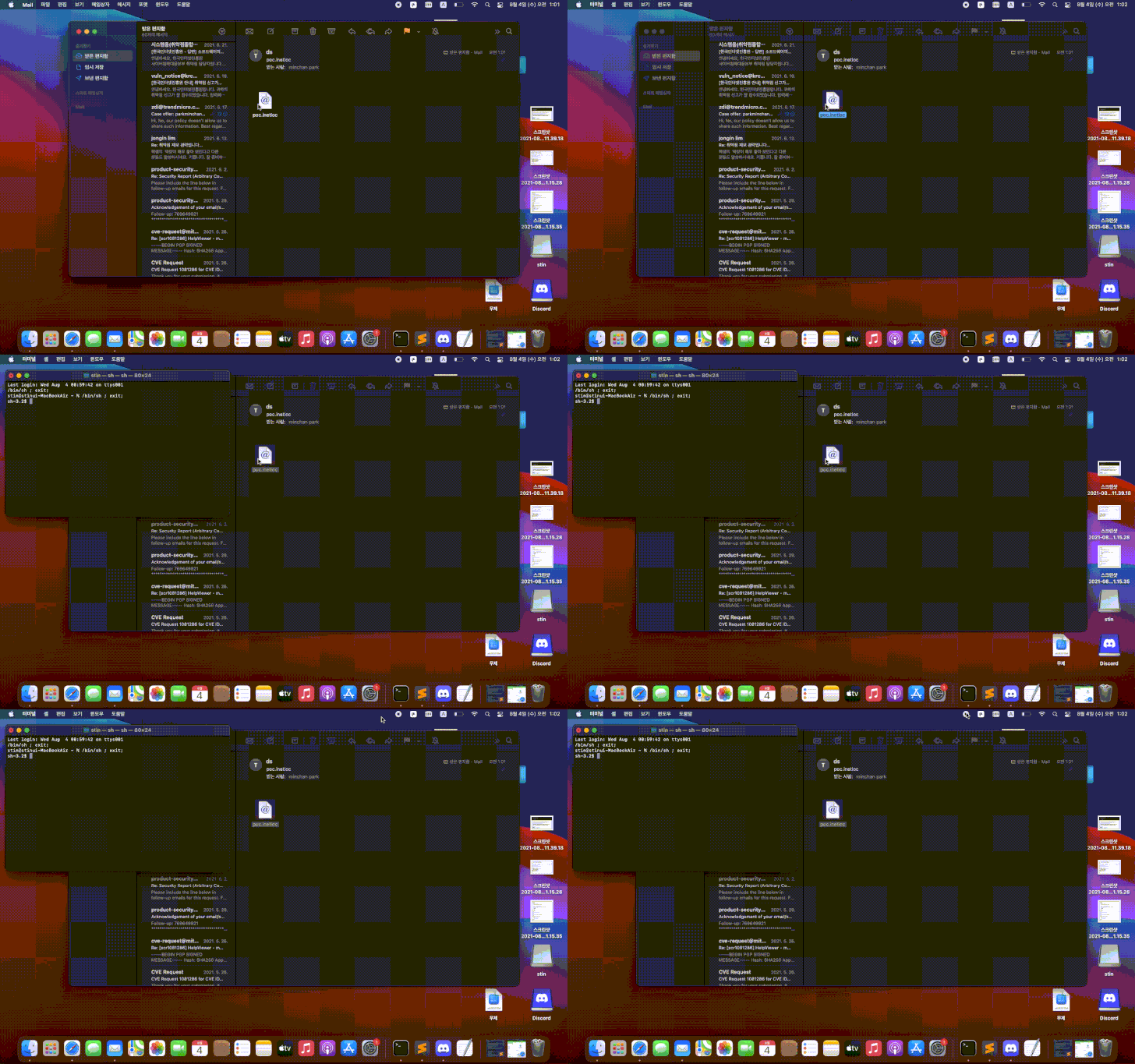
I tested this theory on my macOS Big Sur 11.3.1
The title seems rather clickbaity. It doesn't seem to me that there is any proof of concept that will "take over your Mac" if it hasn't already been so compromised that it contains a malicious executable at a location known to the attacker... Or is there a way of passing environment variables to executables via the URL?
Edit: Proof of concept
It will as soon as I finish adding a custom regex for the email and file OAS when I get to work! We use our RMM's MDM feature to block access to the native mail applications, and none of our users have root or admin access, even on Macs (much to their chagrin). However, if our RMM didn't have an Apple MDM integration, this would be completely infeasible to manage at scale.Does your security software protect from the flaw described in this article?While the threat landscape for MacOS is, over all, considerably lower than for Windows systems, I'm grateful to Ars for articles like this. You'd be amazed how many of my Mac users still regularly complain that we require security software because "Macs don't get viruses." Being able to quickly link management to mainstream IT publications like this means they believe me when I call bullshit.
(Edited for clarity)
I tested this theory on my macOS Big Sur 11.3.1
WTF? There have been numerous security updates since then, and the current version is 11.6. Test it on that or change the title of the article to "Apple users warned: Not installing security updates is dumb".
I can't reproduce the proof-of-concept on Mojave 10.14.6 (which got a security update a few weeks ago). On older macOS Calculator.app is in /Applications not /System/Applications but even after correcting that double-clicking poc.inetloc does nothing.


