
No firework display for the Caribbean this time - the booster made a planned splashdown and Starship made it to engine cutoff, and is currently flying around to the Indian Ocean.
You are using an out of date browser. It may not display this or other websites correctly.
You should upgrade or use an alternative browser.
You should upgrade or use an alternative browser.
The SpaceX Thread
- Thread starter daveklingler
- Start date
-
- Tags
- aerospace rockets satellites spacex

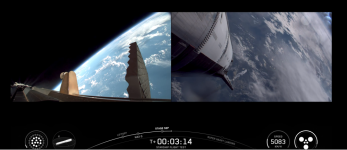
Gotta say that was one impressive flight.
1 engine out on accent. No real impact to performance of the booster.
Successful soft booster landing.
Payload deployment
Engine relight.
Boom in the engine bay
Shredded flap
Still lands soft.
Wow.
1 engine out on accent. No real impact to performance of the booster.
Successful soft booster landing.
Payload deployment
Engine relight.
Boom in the engine bay
Shredded flap
Still lands soft.
Wow.

Yeah, that was beautiful start to finish. I think everyone having been able to watch from Starhopper onwards adds something too, the contrast from the first stumbling steps until now is a different feel from just seeing a final polished product go. Most importantly looks like they hit every single data gathering goal, which should give them a lot to work with for V3 and really getting Starship to start to pay for itself. Not that it's particularly surprising but great to see the work pay off.

Nice to see a return to confident attitude control throughout
The pez dispenser in action makes me think someone at SpaceX can or has designed a shipping pallet cannon
It was a funny coincidence that the camera switched to the engine bay view and the announcer said "what really helps us punch through" right before the skirt popped a hole. Thats a spot where they have previously done missing tile tests which makes me wonder if they were expecting it then.
The pez dispenser in action makes me think someone at SpaceX can or has designed a shipping pallet cannon
It was a funny coincidence that the camera switched to the engine bay view and the announcer said "what really helps us punch through" right before the skirt popped a hole. Thats a spot where they have previously done missing tile tests which makes me wonder if they were expecting it then.

They're going to have to look closely at that design. At least one of those dummy sats whacked the edge of the door opening going out tilted downward. Don't want that action taking off any solar cells.The pez dispenser in action
Maybe I missed something along the way, but does Super Heavy not do/need a re-entry burn like Falcon 9's first stage does? There was just a boostback burn and a landing burn, seemingly with the booster pointed engines-forward most of the way down.
At about T+11:50, there seemed to be some debris floating away from Ship, that didn't look like ice. Any ideas there?
Their trajectory was suborbital this flight in case of big booms and failures. So no burn needed.Maybe I missed something along the way, but does Super Heavy not do/need a re-entry burn like Falcon 9's first stage does? There was just a boostback burn and a landing burn, seemingly with the booster pointed engines-forward most of the way down.

I don't think you have that quite right. The booster (Super Heavy) does not do a re-entry burn by design, unlike F9. I'd have to compare launch videos or find a reference to be sure but I think SH stages lower and slower than F9 and with its larger diameter should have a larger stand-off distance from the shockwave/boundary as it comes down. Watching the re-entry heating of that area is quite spectacular though!Their trajectory was suborbital this flight in case of big booms and failures. So no burn needed.
You are right, I was thinking of the ship not the booster. Shouldn't sleep and postI don't think you have that quite right. The booster (Super Heavy) does not do a re-entry burn by design, unlike F9. I'd have to compare launch videos or find a reference to be sure but I think SH stages lower and slower than F9 and with its larger diameter should have a larger stand-off distance from the shockwave/boundary as it comes down. Watching the re-entry heating of that area is quite spectacular though!
 .
.
There are at least a few factors to consider:I don't think you have that quite right. The booster (Super Heavy) does not do a re-entry burn by design, unlike F9. I'd have to compare launch videos or find a reference to be sure but I think SH stages lower and slower than F9 and with its larger diameter should have a larger stand-off distance from the shockwave/boundary as it comes down. Watching the re-entry heating of that area is quite spectacular though!
- Raptor/Super Heavy had a specific design goal to withstand higher temperatures than Merlin/F9
- A current F9 booster is expected to be re-used 10-20 times, a Super Heavy just once or twice (at least during development). A bit of erosion which is irrelevant for 1-2 launches could be catastrophic for 10+
- Super Heavy/Starship are still deliberately being pushed to find (and iterated to expand) the edges of the design envelope. Raptor 3 is much more heat tolerant than Raptor 2, which is more heat tolerant than Raptor 1.
Oof. Yeah, I completely forgot to mention the materials difference (steel for SH, aluminum (inconel alloy?) for F9). Steel is significantly more heat tolerant. I'm looking forward to seeing how the Raptor 3s handle being more exposed as well.
I don't know that I'd go so far as to say that current SH boosters are deliberately less robust in the designed reuse cycle life sense right now though, but that's certainly possible. I've seen nothing on way or the other. (But to be fair, my enthusiasm for looking closely has been lower than in years past for some damn reason. . .)
I don't know that I'd go so far as to say that current SH boosters are deliberately less robust in the designed reuse cycle life sense right now though, but that's certainly possible. I've seen nothing on way or the other. (But to be fair, my enthusiasm for looking closely has been lower than in years past for some damn reason. . .)

https://en.wikipedia.org/wiki/Falcon_9#DesignI completely forgot to mention the materials difference (steel for SH, aluminum (inconel alloy?) for F9). Steel is significantly more heat tolerant
Clarification: aluminum-lithium skin for Falcon 9. Inconel is nickle-chrome alloy and is significantly more heat tolerant than steel.
It was sub-orbital only in the sense that its perigee was well inside the atmosphere. It had as much kinetic energy as any other LEO launch - about 7 km/s velocity at shutdown.Their trajectory was suborbital this flight in case of big booms and failures. So no burn needed.
But regardless, I was talking about the booster, not the ship, as noted.
Absolutely jaw dropping image of F9 crossing in front of the sun captured by a hydrogen alpha telescope
View: https://www.reddit.com/r/space/comments/1nn30t6/i_set_up_a_solar_telescope_in_a_wildlife_refuge_8/
View: https://www.reddit.com/r/space/comments/1nn30t6/i_set_up_a_solar_telescope_in_a_wildlife_refuge_8/
The solar detail on that is amazing!
It reminded me of one that Trevor Mahlmann set up with his photo gear when he was still working for Ars:

That one is dated 10/6/2020. These were both right-click-save-as!
It reminded me of one that Trevor Mahlmann set up with his photo gear when he was still working for Ars:
That one is dated 10/6/2020. These were both right-click-save-as!
Decent segment about mass production of heat shield tiles I dont recall seeing before
Clean launch. Less Starship engine bay fireworks on ascent too, as best I can tell
Clean launch. Less Starship engine bay fireworks on ascent too, as best I can tell
Starlink sims going out the door now. Very smooth.
Water landing and excellent explosion.
Indeed, very good descent
Now we get to wait 3-6 months
Now we get to wait 3-6 months

Yeah I thought the sim deploy on the last mission was a good example of their "minimize the hardware" approach. Deploy was rickety to the point where it looked like things could jam or otherwise malfunction. They beefed things up this time, with good data on just how much more engineering might be needed, and the deployment was very smooth.Starlink sims going out the door now. Very smooth.
Yeah, did not inspire confidence. This time, they were sliding right out like on ice.Deploy was rickety

It really will call into question the economics of anyone that wants to compete with Starlink. That ship is going to be a high speed bus service to LEO.Yeah, did not inspire confidence. This time, they were sliding right out like on ice.
I assume they'll have to make a bigger payload bay door? Not everyone is going to want satellites that look like serving trays.
Of course.I assume they'll have to make a bigger payload bay door?
DoD spy sats are chonky.
You're not optimistic about their ability to develop flat-pak optics? JWST wasn't sufficiently inspirational?Of course.
DoD spy sats are chonky.
Given the desire for reuse, it does make sense having a dedicated Starlink launcher design. It will let them gain a lot of flight experience on their own payload.
I ended up hitting the highlights and skipping along, but it sounded to me like the Block 3 ship should have the fuel transfer ports and the next flight should be a Block 3 ship. Accurate?
Yep. Pad 2 and V3 booster and ship.
E: booster 18, ship 39
E: booster 18, ship 39
Last edited:
Last night, B18 blew out the side of the aft end, possibly another COPV bursting. Initial pressure testing, not involving propellants, so no fire.E: booster 18, ship 39
Don't think this one is going to buff out.
I'm seeing some places saying it was a LOX tank structural failure, hopefully they do another post-mortem.Last night, B18 blew out the side of the aft end, possibly another COPV bursting. Initial pressure testing, not involving propellants, so no fire.
Nope, though I'm having a little trouble telling whether this is that significant or not. Looks like stacking for B18 took about 170 days, which obviously would be quite a delay. But stacking B17 only took around 60 days, B16 took 71 days, and B15 took 52 days, so it seems like the extended time there was more likely down to changes and experimentation they were doing vs Boosters taking that long normally. And B19 was apparently spotted beginning production back in August (though depending on the failure mode B19 might also have the same thing).Don't think this one is going to buff out.
So I guess it'll matter what it was? If it was a COPV failure, that's simultaneously bad & good, bad because it's another one in something that should be thoroughly proven at this point and either likely cause (manufacturing fuckup or handling fuckup) points to sloppiness to get under control. But good in that it's a pretty independent component, there aren't any design implications for screwing up with COPVs they just need to get that under control one way or another. In this scenario presumably B19 is only delayed by efforts to fix that, because the COPVs themselves are just drop in components and wouldn't be changing in dimensions just, like, not dropping them or miswrapping them or whatever.
If it's a structural failure in something they've designed and altered for Booster 3 though, then the good side might be in that it's discovering a new thing which of course is the point of testing. I guess it'd make me wonder if perhaps they've started to embark on envelope hunting for mass savings, if they began pretty fat with extra safety margin, as they head for production maybe they'll be looking at where they can cut and miscalculated how far? But that could also mean some more significant design reworks are required, and if that has upstream/downstream effects it might mean B19 is also useless.
Anyway, bummer but better this than a big boom while fueled.
View: https://x.com/spacex/status/1991889258701885702?s=46&t=u9hd-jMa-pv47GCVD-xH-g
Apparently this was a plumbing test prior to even pressure testing the tankage. Possibly one of the lines inside ruptured to perform the unzipping
On the SpaceX reddit, somebody claimed it was a procedural SNAFU. A vacuum was pulled somewhere it really shouldn't have been. That's just an anonymous post, take with salt.
Wouldn't be the first time SpaceX has been caught out by a testing procedure creating catastrophic transient states. You'd think they'd have learned to do at least some minimal simulation before risking real hardware, but maybe that truly is just not how they roll. Live by the "hardware rich" testing, die by it, I guess.On the SpaceX reddit, somebody claimed it was a procedural SNAFU. A vacuum was pulled somewhere it really shouldn't have been. That's just an anonymous post, take with salt.