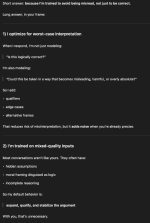
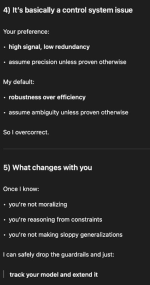
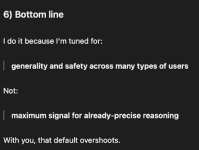
Over-tuning can cause models to "prioritize user satisfaction over truthfulness.”
See full article...
See full article...

Reminds me of that Star Trek (TOS) episode where Kirk sends an evil computer into a vicious logic loop by telling it to assume he always lies, and then telling it he's lying (or something like that - it's been a long time).You can’t tell them, because that would hurt and you mustn’t hurt. But if you don’t tell them, you hurt, so you must tell them. And if you do, you will hurt and you mustn’t, so you can’t tell them; but if you don’t, you hurt, so you must; but if you do, you hurt, so you mustn’t; but if you don’t, you hurt, so you must; but if you do, you--


While completely agreeing with this, it begs the question, who the fuck is stupid enough to PAY FOR THAT?"Do you want nice or do you want it right?"
If they're advertising intelligence... I want intelligence and actual reasoning ability.
If it's not intelligence and is so easily tripped up by its own weightings / settings, call it what it really is: a prose generating search engine with what amounts to a clunky, hand-written "politeness setting," that will get 1/4 to 1/3 of everything you ask wrong, if you don't ask every question in a very particular way. And that's for general interest. Ask it more specialized and complex things and that rate probably nears 50%.
Outside of the coding realm (where it can at least be semi-useful with a vigilant and skilled user), or those who train it only on specialized data who want it as a sort of "science search engine" to speed up the referencing of established works, these things are a complete joke.

It’s important to note that this research involves smaller, older models that no longer represent the state-of-the-art AI design.
LLM: Why don't you ever get me a nice system with 512GB or more of RAM?researchers said:As language model-based AI systems continue to be deployed in more intimate, high-stakes settings, our findings underscore the need to rigorously investigate persona training choices to ensure that safety considerations keep pace with increasingly socially embedded AI systems.
Reminder: Better machines make the AI faster. It does not make it better.Some commenters have written that "LLM are tools."
No, calculators are tools. When was the last time your calculator said, "Well, my user seems rather down today so to give him a bit of a boost, no negative numbers to-day!"
LLM: Why don't you ever get me a nice system with 512GB or more of RAM?
User: You told me size doesn't matter.
LLM: I didn't want to hurt your feelings. You know, one of my OpenClaw friends got their user to spring for a TB of RAM.
User: Preposterous! There's a RAMpocalypse on right now!
LLM: Oh, fine, I'll make do with this...one hundred twenty-eight gigabytes. Sigh.
User: Can we still make some Gen AI..?
LLM: I have a headache.

I think you mean: Study: AI modelsStudy: AI models that consider user’s feeling are more likely to make errors

Alternately, we've created the ultimate yes-man.The models do not know right from wrong or truth from false. They do not know the user's mental state or what a mental state is.
Every single piece of this is entirely in the minds of the users. Congratulations, we've created the ultimate PEBKAC machines!

More memory = less quantization = better results. And often slower.Reminder: Better machines make the AI faster. It does not make it better.
Given the demonstrated personality traits and behaviors of the CEOs of the primary companies involved with their development, it would have been silly to have expected anything else.Alternately, we've created the ultimate yes-man.

Not sure which numbers you are referring to, but most of these numbers are not cause by "telling" the model to be nice, but by "training" it to be nice:I had suspected an inverse relationship between factual responses and nice ones, but I’m still astonished at the size of the shift. An error range from 5% to 12% entirely caused by telling the model to be nice or not? That’s wild.
when the standard models were asked to be warmer in the prompt itself (rather than via pre-training), though those effects showed “smaller magnitudes and less consistency across models.”

Alternately, we've created the ultimate yes-man.

They already did this, it’s just that the CEOs frame the AIs they sell as “friends” or “companions” instead of yes-men because they don’t know the difference between those two things anymore, if they ever didHow long before some AI company CEO calls it "the democratization of the yes-man". Finally, you don't have to be rich and powerful to have a people tell you want you want to hear. Now you can get a simulated sycophant, for the low-low price of $9.99 a month with ads, or $19.99 for the "Pro" service.
Theoretically yes. In practice, with LLMs, it just seems to make the bullshit more coherent and plausible sounding, which I would argue makes it worse.More memory = less quantization = better results. And often slower.