SpaceX cleared an important milestone Monday on the road to launching a new version of Starship.
See full article...
See full article...
The tyranny of the rocket equation?Compensating for something?
This seems unlikely. This 2024 render from Chameleon Circuit shows an oxygen landing tank (wrapped around the base of the methane transfer tube) which was roughly that large, but the transfer tube was much smaller.For example, in Version 3, the internal transfer tube that channels methane fuel from the top of the booster to the engine compartment is about the same size as the first stage of SpaceX’s workhorse Falcon 9 rocket, which is roughly 12 feet (3.7 meters) in diameter.
It’s assumed the transfer tube now doubles as the header tank for the landing burn.Perhaps for V3, the methane sump and manifold is 3.7m wide, but if the transfer tube is that wide, it's no longer just a transfer tube.
Space Force One-WayDesignate it Space Force One and gift it to Trump who recently told the Artemis II astronauts that he might want to go to space himself.
I wonder what the tradeoff looks like for a jettisonable aerospike to improve the aerodynamics of a blunt-nosed rocket?At what point does this become like buildings - occupied height vs. spire height etc?
If ULA wants to take the crown, just plop an unusually long "escape system" to the top of their rocket.
You're out of dateThis seems unlikely. This 2024 render from Chameleon Circuit shows an oxygen landing tank (wrapped around the base of the methane transfer tube) which was roughly that large, but the transfer tube was much smaller.
View attachment 134885
Perhaps for V3, the methane sump and manifold is 3.7m wide, but if the transfer tube is that wide, it's no longer just a transfer tube.
Because until they can show (to themselves) control of the starship during re-entry, any landing attempt into the Gulf would require approaching over populated areas.I wonder why SpaceX never attempted a Starship launch for a full orbit but with perigee inside the atmosphere. That way they can try landing Starship on the ocean near its launch site, just like the booster. Is it because such orbit requires engine relight?
Full orbit would have to pass over populated territory in California/Mexico/Texas.I wonder why SpaceX never attempted a Starship launch for a full orbit but with perigee inside the atmosphere. That way they can try landing Starship on the ocean near its launch site, just like the booster. Is it because such orbit requires engine relight?
holy shit.You're out of date
It's still early. Give some time for the voting system to do its job. After all, it's lot faster to type out a quip about Elon than it is to thoughtfully engage with the post and have informed discussions of rocketry.Brutal signal to noise ratio here
It is also a landing header tank.Is it possible that it is serving multiple functions now though? That just seems like an insane volume for a transfer tube?
It seems to always take them a couple of attempts at least to work out the kinks with each new version. I would expect at least one RUD before they have a successful-enough flight to get an ocean landing of the upper stage.Current plan is for "two successful "soft" ocean landings of the upper stage Starship before attempting a catch"
and the first since last October, after delays in readying V3 for its first launch.
$30B? SpaceX is only getting $4B in funding for Starship/Artemis, and that includes payment for a demonstration and two operational missions.So let me get this straight - if we gut the government space program to pay for ~$100T in tax cuts for billionaires, 50 years after landing on the moon and 40 years after ending the Apollo program we'll be ready to test a rocket that is part of a test program to land on Mars, at a further cost of ~$30B (with no new capability provided except profit margins for said billionaires).
And all it cost us was 50 years and $100T.
Private space has been a complete and utter disaster.
I forgot about cheap internet for billionaire yachts, we have that too.
It seems to be.Is the Yucatan Strait less traveled by aircraft and deemed to be safer?
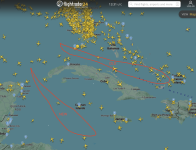
They’re changing the launch course from ~90° to ~105°, from flying north of Cuba to flying south of Cuba.So they are changing the launch course from approximately 105° to 125°, (from overflying the Florida Strait to the Yucatan Strait).
Because they’ll need to launch to that trajectory to rendezvous with something launched from the Cape.Why?
There’s no significant overflight. This is north of the Yucatán, not over it.Are they increasing the inclination of the orbit to increase the amount of land covered?
It’s a question of how long it takes for the debris to fall. There’s an exclusion zone and a DRA (debris response area). The exclusion zone is an immediate hazard during a launch. The DRA is a region in which the rocket should be high enough that you should be able to escape the falling debris before it reaches your altitude. It’s still an issue, but it’s not an immediate hazard.How high does a spacecraft need to be before overflight is effectively a non-issue?

holy shit.
Is it possible that it is serving multiple functions now though? That just seems like an insane volume for a transfer tube?
The two-stage-to-orbit architecture, methalox fuel and low staging velocity is not good for payload energy-to-launch mass performance.[snip]
On-topic: isn't it amazing that the world's most powerful rocket ever can't get out of LEO without refueling! It is so counterintuitive. I guess the heavy weight of the steel is the culprit, but also the enabler of refueling and reuse.

Yes, but Pad 2 readiness ended up being the long pole in the schedule anyway. If Booster 18 and Ship 38 had completed Massey's tests successfully, they'd have been waiting until now for the pad to be ready for booster static fire and full-stack wet dress rehearsal.By "delays" you mean losing a first stage and second stage during testing.