
You are using an out of date browser. It may not display this or other websites correctly.
You should upgrade or use an alternative browser.
You should upgrade or use an alternative browser.
SpaceX’s Starship V3—still a work in progress—mostly successful on first flight
- Thread starter JournalBot
- Start date
I can certainly respect that opinion, but we know that the sun will one day expand and envelope the earth, and collectively we have to decide if we want to venture off our home planet or if we want to stay here and simply turn to proverbial dust when that happens. I personally support the idea they we should strive to expand our presence beyond earth so that humanity doesn't have to end when the earth becomes uninhabitable.The scifi-brained Manifest Space Destiny mindset is creepy.
Earth is a perfect garden, possibly the one place in the universe where humans and animals can thrive (or even survive.) Why, exactly, do we have to have a "collective future flying among the stars"?
Philosophically I think this could be compared to a group of people living on some of the western islands in the Hawaii chain, they can see the younger and taller island of Hawaii on the horizon, but it has active volcanoes, lava flows, and sharp, rocky land that hasn't yet been turned into rich soil. Why would they leave the comparative paradise of their current island? And it will probably take countless years until their current island erodes back into the ocean. But would you really fault them for deciding at some point that they want to develop the skills and technology to allow them to leave their current island?
Upvote
28
(67
/
-39)
Post content hidden for low score.
Show…
One minor infrastructure thing for SpaceX to fix for future launches: The huge "Gateway to Mars" sign on the wall of Starbase's launch site turned into just "Gat way".
Upvote
28
(28
/
0)
schnackenpfefferhausen
Ars Scholae Palatinae
I threw up in my mouth, just a little bit, at the "USA" chant.
Makes me really want to root against them.
Makes me really want to root against them.
Upvote
5
(91
/
-86)
The word "mega" means large... and the Space Starship is a very large rocket. Here is a size comparison:From the article: "mega-rocket"
Seriously? Mega-rocket?
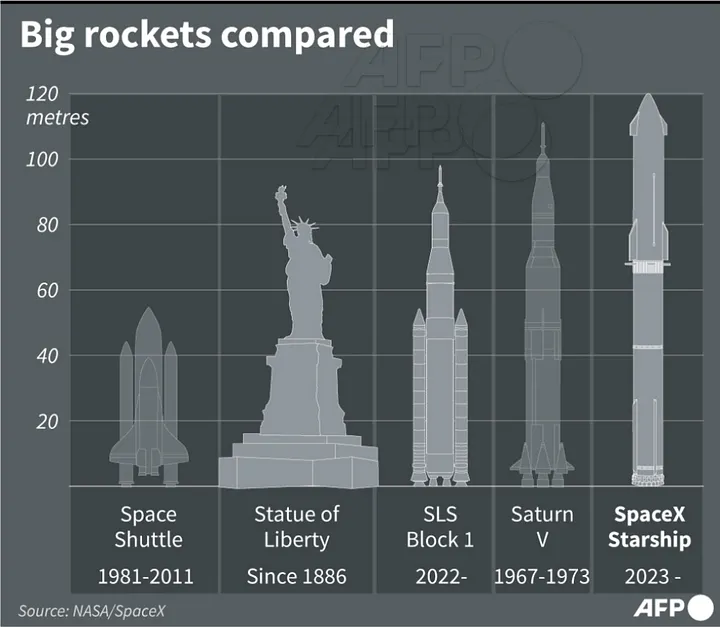
At some point writers have cycle through synonyms in the thesaurus - "large", "big", "giant", "tall", etc... naming things with of "Mega", "Giga", "Falcon", and Iain Banks's Culture series and Spaceballs references are about the least offensive things Musk does (I find his fascination with "X" to be much more annoying and it just gets worse from there)
Last edited:
Upvote
135
(137
/
-2)
We've seen this movie before. This team delivers the goods, and they change the game when they do. I really never doubted that the program would be a success, without being able to predict exactly how long it'll take. That's still true, but the end is a lot closer now than before.
Upvote
32
(40
/
-8)
Post content hidden for low score.
Show…
Post content hidden for low score.
Show…
VelvetRemedy
Ars Centurion
Because we won't survive over any reasonable time as a species unless we get off the planet in quantity, and we cannot afford to lose momentum (as we already did once in the 20th). Of course it's fun too. But the important thing is not to die off as a species because we were too lazy, distracted or stupid to do hard things.
And go where? Mars? It's toxic and hostile and, even if it's magically terraformed, it's going to eventually fall victim to the same distant-solar-future thing that people are handwringing about regarding Earth. And by the way, on multi-million-year timelines, "losing momentum" for a few decades is totally irrelevant.
Upvote
43
(87
/
-44)
You are complaining about one of the very few companies that recovers and reuses their boosters and fairings nearly 100% of the time? A company that is working to build a fully recoverable stack... yet seemingly ignoring the history of all launch solutions until the very recent past throwing their stages into the ocean (or onto land).How about all that pollution and marine life? The space fashos need to cleanup after themselves
Upvote
207
(216
/
-9)
Post content hidden for low score.
Show…
Ilya Volyova
Smack-Fu Master, in training
SpaceX is now one of the more experienced if not most experienced manufacturers of rocket engines in the industry (easily the one with the most experience in a short and continuously active timeframe).
The situation will be a good amount different by the time they get to putting humans on Starship for earth operations (note they may never do that with the current generation).
The situation with SpaceX reminds me a lot of robotics before Rodney Brooks came along, where researchers would spend years marking a single robot and writing papers about it for the rest of their career. Rapid iteration, actually flying your prototypes, and building with manufacturing and refurbishment in mind from first principles is something that took WAY too long to reach the space industry, and it's going to pay huge dividends as it becomes what everyone is doing.
Upvote
84
(88
/
-4)
Post content hidden for low score.
Show…
Because being reasonable and cleaning your room is haaaaaaard, but playing space cowboy is fuuuuuun.
The Arsian population is generally pretty concerned about climate change, ecosystemic collapse and technofascism, but there is a portion whose boner for space colonization is so strong that it seems to deprive their brain of oxygen.
And don’t tell me this isn’t the time and place to talk about this, or that these rockets have nothing to do with those issues. It is always the time and place, because the situation is so dire that we can’t afford the carelessness, and those rockets are a part of the problem.
Cars might be a bigger issue than rockets if that's where you're going...
Upvote
96
(101
/
-5)
Post content hidden for low score.
Show…

On the live stream, Dan said that Starship was going to do a "pirouette" soon after the release. That would give them a 360 degree view.The satellite view was very cool, but one thing I was a little confused about: they said on the broadcast that they were doing that to be able to inspect the heat shield. But the satellites are released from the top of the ship (the side without heat tiles). Was it supposed to do a flip maneuver after they released, or did they mean they wanted to inspect the few tiles they stuck on the top of the flaps?
If you watch the roll indicator after releasing those satellites, you can see the ship turn over. The background was pitch black when they did it. Night time over that part of Earth.
Upvote
78
(78
/
0)

I really hope not. I'd prefer not showing fascist propaganda in schools worldwide.The clip of the satellite leaving starship whilst looking back is probably the best example of I've ever seen of Newton's 1st law in action. Hope they show this in schools and colleges.
The dumb fuckers in the ground crew suddenly chanting "USA!!! USA!!! USA!!!!" when the PEZ dispenser deployed the mass simulators kinda totally ruined it all for me, sorry. Shouting "USA!!!" in the current political climate is akin to cheering on V2 launches agains the Allies with "Sieg Heil!" shouts.
Any sane person doesn't just cheer for their home team, they cheer for the Humanity team. And only football hooligans care less about the play and their team than people actually enjoying the play and its achievements, from whatever team managed it, even if their own home team craters...
Upvote
0
(122
/
-122)
I'm pretty sure that ensuring it sank was on the checklist. They don't want it recovered.Being an expected outcome doesn’t mean it was necessary for success. I doubt it was on a checklist.
At least one of the early Falcon 9 recovery experiments floated after landing in the Pacific, and SpaceX had to arrange the use of weaponry to sink it.
Upvote
98
(102
/
-4)
Post content hidden for low score.
Show…
Everywhere. I won't. Too old. Don't, if you don't want. But some of us will go.And go where? Mars? It's toxic and hostile and, even if it's magically terraformed, it's going to eventually fall victim to the same distant-solar-future thing that people are handwringing about regarding Earth. And by the way, on multi-million-year timelines, "losing momentum" for a few decades is totally irrelevant.
Upvote
34
(65
/
-31)
Post content hidden for low score.
Show…
Post content hidden for low score.
Show…
Even airliners are. A full Starship stack launch generates about as much CO2 as 3-ish long-haul jumbo/"heavy" airliner flights.Cars might be a bigger issue than rockets if that's where you're going...
Upvote
92
(98
/
-6)
Does anyone know why their warm gas RCS thrusters had a blue tinge? They had a fairly continuous vent of white out of the side, presumably boil off from the forward part of the methane tank. When the RCS thrusters would fire they were consistently a very different color. But shouldn't they be the same gas coming from the same tank? Is it just a difference in pressure causing this?
One example is visible in the timestamped video here.
View: https://www.youtube.com/watch?v=mRi55GyADv8&t=2903s
One example is visible in the timestamped video here.
View: https://www.youtube.com/watch?v=mRi55GyADv8&t=2903s
Upvote
24
(24
/
0)
Post content hidden for low score.
Show…
Post content hidden for low score.
Show…

DigitalDevourer
Seniorius Lurkius
I'm pretty sure that ensuring it sank was on the checklist. They don't want it recovered.
At least one of the early Falcon 9 recovery experiments floated after landing in the Pacific, and SpaceX had to arrange the use of weaponry to sink it.
Do you have a link to this?
Not doubting you exactly, but I've never heard of this and would love to know more; ideally, I'd like to read it myself, or better yet see photos!
I've read both of Eric Berger's books, and I don't recall this particular story being in them, and he had stories of practically everything regarding the first 3-4 SpaceX rocket launches.
I'd love to know how they managed to wrangle up the authorization to live-fire an armed missile, or redirect an active-duty naval vessel to target it with artillery, especially given the tense relationships SpaceX had with the USAF and USN in their early years.
Upvote
26
(29
/
-3)
This again? The bigger problem with the Soviet N1 program is that they had single-use pyrotechnic valves in the engines that precluded testing them prior to the full-stack launch. Very difficult to achieve a reliable composite system if you can't test the individual components.Sure, and I'll grant that the Raptor engines are indeed quite reliable in isolation.
However, I think it legitimately remains to be seen as to whether the "plumbing" issues are trivial or not. At this point, it certainly seems that the difficulty of managing the plumbing, propellant and harmonics seems to compound with the number of engines, and SpaceX has only made minimal progress towards fixing the issue.
It's difficult not to draw comparisons to the Soviets' doomed N1 program -- the individual NK-15 and NK-33 engines turned out to be extremely reliable, but they never figured out how to safely run 30 of them together.
This go around, we certainly seem to be doing better, but we're still falling considerably short of "good enough," for surprisingly similar reasons.
Last edited:
Upvote
124
(126
/
-2)
I can't believe people started bringing up the N1 again. Before booster ever flew, people were going on about how the N1 failed, and how that many engines can't work. Now, SpaceX has been able to use 30+ engines together successfully. The N1 didn't work for the Soviets a long time ago (and on only one attempt, IIRC). It has zero relevance.It's difficult not to draw comparisons to the Soviets' doomed N1 program -- the individual NK-15 and NK-33 engines turned out to be extremely reliable, but they never figured out how to safely run 30 of them together.
SpaceX made a lot of changes for this flight, it's not unexpected they need to fix some things.
Upvote
124
(126
/
-2)
This worry is especially true for our current civilization, which is highly interdependent and highly fragile. Even moderate sized asteroid or comet strikes would radically change the climate for a century or more and set us back to the stone age. Most of our knowledge is stored on fragile systems which degrade in decades or less and will be gone.I've honestly never understood this desperation mindset that a lot of people seem to have.
See, cuz, the only reason it's desperate is if you actually care about saving the human race. It has absolutely nothing to do with saving the Earth.
Because despite all of our technological advances we do not have anywhere near the technological capacity to actually destroy the earth.
And while people say this is a garden paradise of a world, this garden paradise has an annoyingly bad habit of cleansing the dominant life forms on it every hundred million years or so, give or take an epoch.
—•—•—‡—•—•—‡—•—•—
I understand that the Earth's climate is potentially nearing a tipping point where human life and society can no longer be easily maintained.
The world that would exist afterwards would be one of limited biodiversity, shattered ecosystems, and fragile or non-existent resilience for other life forms across the entire planet.
But…
The Earth has survived far, far worse in its four and a half billion year lifespan.
It has survived ice ages that lasted for tens of thousands of years.
It has weathered asteroid strikes that collided with enough force to blacken the skies and blot out the sun for decades.
Despite solar wind superstorms, magnetic pole flips, supervolcanic eruptions, and continental collisions that triggered planet wide earthquakes and the ignition of the Ring of fire across the globe, the Earth is still capable of sustaining life.
Just not the type of life forms that were dominant when those catastrophes happened.
—•—•—‡—•—•—‡—•—•—
So, that's the whole point of the rocket ships that let humans travel to other planets.
When that one asteroid struck the Earth and killed all the dinosaurs it turns out the earth did just fine without them; probably didn't even notice they were gone.
The dinosaurs were screwed of course, but the Earth kept on going.
So, when humans manage to royally screw up the Earth's biosphere and make it so we can't sustain ourselves anymore and all life on earth dies, the Earth will still be going just fine without us.
It sucks for all of the other animals and things we take with us, yeah, but realistically life is a zero-sum game and it trends towards death. So I guess so long and thanks for all the fish?
Upvote
29
(33
/
-4)
Recoverable when landing in the middle of the Indian Ocean, directly on the surface of the water? No. That was never possible. That was never the idea.Given that it was SpaceX, and explosion.
But wasn't the idea that this be recoverable at least? With the idea that it could be re-used? That there it is possible for the recovery of payload and passengers?
But with all the 'Hur-Dur, The reusable sales point is is just marketing, dummy. It was supposed to explode on landing" comments I guess I should give SpaceX an A+++++.
Upvote
110
(114
/
-4)
Post content hidden for low score.
Show…
Post content hidden for low score.
Show…
Whatever is living on earth at that point will have had more time to evolve than from bacteria to human.I can certainly respect that opinion, but we know that the sun will one day expand and envelope the earth, and collectively we have to decide if we want to venture off our home planet or if we want to stay here and simply turn to proverbial dust when that happens. I personally support the idea they we should strive to expand our presence beyond earth so
You would not recognise it.
Upvote
60
(63
/
-3)
Post content hidden for low score.
Show…
Why the heck do you want a higher cause ? What even is a higher cause ?Okay, but that's totally ignoring the "why" part. Why does this matter? What problems does moving some humans to Mars solve, and why does it have to be now instead of in a thousand years or five thousand or fifty thousand? And why is it worth indulging someone who is currently actively hostile to living things? What's the higher cause here?
Isn't it enough being exiting and fun ?
Enjoy life, man !
Upvote
25
(47
/
-22)
It's kind of silly to use the threat of climate change as an argument for settling other planets. No matter how bad climate change gets, the easiest planet to survive on is going to be this one. Antarctica is easier to settle than Mars. It has significantly more sunlight than Mars, and provides easy access to water and oxygen. And it's relatively warm, compared to Mars. If we can't survive on a climate-changed Earth, Mars is much harder.I've honestly never understood this desperation mindset that a lot of people seem to have.
See, cuz, the only reason it's desperate is if you actually care about saving the human race. It has absolutely nothing to do with saving the Earth.
Because despite all of our technological advances we do not have anywhere near the technological capacity to actually destroy the earth.
And while people say this is a garden paradise of a world, this garden paradise has an annoyingly bad habit of cleansing the dominant life forms on it every hundred million years or so, give or take an epoch.
—•—•—‡—•—•—‡—•—•—
I understand that the Earth's climate is potentially nearing a tipping point where human life and society can no longer be easily maintained.
The world that would exist afterwards would be one of limited biodiversity, shattered ecosystems, and fragile or non-existent resilience for other life forms across the entire planet.
But…
The Earth has survived far, far worse in its four and a half billion year lifespan.
It has survived ice ages that lasted for tens of thousands of years.
It has weathered asteroid strikes that collided with enough force to blacken the skies and blot out the sun for decades.
Despite solar wind superstorms, magnetic pole flips, supervolcanic eruptions, and continental collisions that triggered planet wide earthquakes and the ignition of the Ring of fire across the globe, the Earth is still capable of sustaining life.
Just not the type of life forms that were dominant when those catastrophes happened.
—•—•—‡—•—•—‡—•—•—
So, that's the whole point of the rocket ships that let humans travel to other planets.
When that one asteroid struck the Earth and killed all the dinosaurs it turns out the earth did just fine without them; probably didn't even notice they were gone.
The dinosaurs were screwed of course, but the Earth kept on going.
So, when humans manage to royally screw up the Earth's biosphere and make it so we can't sustain ourselves anymore and all life on earth dies, the Earth will still be going just fine without us.
It sucks for all of the other animals and things we take with us, yeah, but realistically life is a zero-sum game and it trends towards death. So I guess so long and thanks for all the fish?
Upvote
107
(115
/
-8)
Post content hidden for low score.
Show…
Here: https://www.twz.com/18343/did-the-u-s-air-force-bomb-a-rogue-spacex-booster-rocketDo you have a link to this?
Not doubting you exactly, but I've never heard of this and would love to know more; ideally, I'd like to read it myself, or better yet see photos!
I've read both of Eric Berger's books, and I don't recall this particular story being in them, and he had stories of practically everything regarding the first 3-4 SpaceX rocket launches.
I'd love to know how they managed to wrangle up the authorization to live-fire an armed missile, or redirect an active-duty naval vessel to target it with artillery, especially given the tense relationships SpaceX had with the USAF and USN in their early years.
I misremembered where this happened, but this is the event, though there may have been more than one. There are photos, but not of the actual "scuttling".
Upvote
32
(32
/
0)