
You are using an out of date browser. It may not display this or other websites correctly.
You should upgrade or use an alternative browser.
You should upgrade or use an alternative browser.
New tech can make your house a solar microgrid
- Thread starter JournalBot
- Start date
Do any of these systems let you run the smarts part locally on your own server in a jail or container?
Last time I looked into it they all wanted a cloud connection and after my experience with home automation that is a no-no for me on anything I intend to keep for more than two or three years.
Last time I looked into it they all wanted a cloud connection and after my experience with home automation that is a no-no for me on anything I intend to keep for more than two or three years.
Upvote
5
(5
/
0)
The outage doesn't stop them from producing power; the power just can't be used in the absence of a functioning grid. That's because the microinverters are part of an integrated system that includes the grid, power meter, and other associated hardware.
Can someone expand upon this? Why can't I just put in a large switch to change from on-grid mode to off-grid mode, like the switch described in the article, and stick with a single large inverter? In my ignorance, it sounds like this company is selling the distributed microinverter model by claiming its on-grid/off-grid ability is unique to its system.
It's actually a myth that backfeeding is the problem in the first place. You are absolutely right that this can be easily solved with a transfer switch - and you need that anyway because a battery or generator *are* allowed to power your house during an outage despite having the same backfeed problem.
The real issue is fire safety. In case of fire or other emergencies, batteries and generators can be shut off and be without power. Solar panels will generate power as long as there is light (even the light from a house fire!). That is the real reason why the National Electric Code mandates that in case of a power outage, panel arrays must be disconnected from the house network.
This product obviously does not change the NEC, so I cannot see how it can deliver what it promises.
You can already buy a solar panel and battery system that powers your house during outages?!
It’s just quite expensive at the moment because the current supply of batteries is so in demand.
Yes. Note that during an outage, the panels still have to be shut off - the battery alone will power your house. Once the battery is drained, you lose power even if the sun is shining.
Upvote
-15
(1
/
-16)

This is complete nonsense.The outage doesn't stop them from producing power; the power just can't be used in the absence of a functioning grid. That's because the microinverters are part of an integrated system that includes the grid, power meter, and other associated hardware.
Can someone expand upon this? Why can't I just put in a large switch to change from on-grid mode to off-grid mode, like the switch described in the article, and stick with a single large inverter? In my ignorance, it sounds like this company is selling the distributed microinverter model by claiming its on-grid/off-grid ability is unique to its system.
It's actually a myth that backfeeding is the problem in the first place. You are absolutely right that this can be easily solved with a transfer switch - and you need that anyway because a battery or generator *are* allowed to power your house during an outage despite having the same backfeed problem.
The real issue is fire safety. In case of fire or other emergencies, batteries and generators can be shut off and be without power. Solar panels will generate power as long as there is light (even the light from a house fire!). That is the real reason why the National Electric Code mandates that in case of a power outage, panel arrays must be disconnected from the house network.
This product obviously does not change the NEC, so I cannot see how it can deliver what it promises.
You can already buy a solar panel and battery system that powers your house during outages?!
It’s just quite expensive at the moment because the current supply of batteries is so in demand.
Yes. Note that during an outage, the panels still have to be shut off - the battery alone will power your house. Once the battery is drained, you lose power even if the sun is shining.
Upvote
13
(14
/
-1)
Panels aren't required to initiate a rapid shutdown when there is a power outage. That is handled by the inverter/transfer switch to disconnect from the grid and island the system from backfeed.Why would the grid switching be any different from that for a back-up generator. Our generator can output 18 kW and switches in and out automatically with the grid on and off. And after a storm, the noise tells us that half our neighbors also have back-up generators. This is a solved problem, and IIRC correctly the isolator switch was about $2K including installation into the house electric supply.
Generators and batteries can be turned off with a switch. Solar panels produce power whenever there is light.
That is why solar panels (at least in the US) require a rapid disconnect *directly at the array* that prevents feeding power even to the house. This rapid disconnect must trip during a power outage, as well as during several other conditions.
No, you are confusing two things here. The transfer switch separates your house wiring from the grid. The rapid shutdown separates the panel from your house wiring. The NEC is quite specific on the requirements - it must shut down power within (from memory) 1 foot of the edge of the panel. There is no requirement to power down individual panels, though.
Rapid shut downs are for emergency use when a first responders/utility worker needs to work around the PV system in a hurry i.e. a fire.
Correct. Note that they aren't just manual switches; just like circuit breakers and GFIs, they have to trip automatically in certain specified conditions. One of those conditions is a power outage.
Upvote
-5
(4
/
-9)

The outage doesn't stop them from producing power; the power just can't be used in the absence of a functioning grid. That's because the microinverters are part of an integrated system that includes the grid, power meter, and other associated hardware.
Can someone expand upon this? Why can't I just put in a large switch to change from on-grid mode to off-grid mode, like the switch described in the article, and stick with a single large inverter? In my ignorance, it sounds like this company is selling the distributed microinverter model by claiming its on-grid/off-grid ability is unique to its system.
It's actually a myth that backfeeding is the problem in the first place. You are absolutely right that this can be easily solved with a transfer switch - and you need that anyway because a battery or generator *are* allowed to power your house during an outage despite having the same backfeed problem.
The real issue is fire safety. In case of fire or other emergencies, batteries and generators can be shut off and be without power. Solar panels will generate power as long as there is light (even the light from a house fire!). That is the real reason why the National Electric Code mandates that in case of a power outage, panel arrays must be disconnected from the house network.
This product obviously does not change the NEC, so I cannot see how it can deliver what it promises.
You can already buy a solar panel and battery system that powers your house during outages?!
It’s just quite expensive at the moment because the current supply of batteries is so in demand.
Yes. Note that during an outage, the panels still have to be shut off - the battery alone will power your house. Once the battery is drained, you lose power even if the sun is shining.
Every post you've ever made on this subject shows a fundamental lack of understanding of electrical power systems.
At least you're consistent.
Your statement in this context is wrong.
During an outage your entire system would be disconnected from the municipal grid and generating it's own 60 Hz sine wave. You don't need to turn anything off.
Upvote
14
(15
/
-1)
I guess pricing is probably regional. I got a system two years ago with 21kw of the most efficient panels w/power optimizers and 48kwh battery (3x LG RESU16H) for $70k, minus 26% federal credit for a little more than $50k total. I thought that wasn’t too bad at the time.This is the exact system I'm having installed in November this year.
21.16kW with 30kWh battery backup. Running me about 98k, installed, before incentives.
In the last 21 months the system has generated about $8000 in power at local rates, for about a 13 year payoff. That seems pretty good with battery included, I remember when solar was a 20 year payoff and no battery. If I’m honest though I bought it for the geek factor and I enjoy watching the stats every day and charging my car from excess solar.
I’ve heard in Australia solar is dirt cheap.
Inflation accounts for part of the difference from your system to this guy: $70K pre-pandemic is equivlant to $81K now.
Upvote
1
(1
/
0)
ditchman56
Seniorius Lurkius
The outage doesn't stop them from producing power; the power just can't be used in the absence of a functioning grid. That's because the microinverters are part of an integrated system that includes the grid, power meter, and other associated hardware.
Can someone expand upon this? Why can't I just put in a large switch to change from on-grid mode to off-grid mode, like the switch described in the article, and stick with a single large inverter? In my ignorance, it sounds like this company is selling the distributed microinverter model by claiming its on-grid/off-grid ability is unique to its system.
That is essentially what the solar company did for me when I purchased my system last summer. In my fuse panel in my garage, they added a fuse with a lockout that I have to manually throw to disconnect from the grid and then engage my battery and allow the panels to charge the battery. The downside to this is that there has to be a complete shutdown in order for this to work. If their setup works automatically then it could possibly avoid even the short blackout I have to go through
Upvote
6
(6
/
0)
A couple of thoughts:
...
Further, all the microinverters would have to synchronize the AC power. If they are all trying to start unsynchronized, they would be fighting each other, also causing shutdown.
I see 2 possible solutions:
1) the transfer switch has a “neutral” setting where the solar array is disconnected from both the house and grid, allowing the microinverters a chance to power up and sync. Then the transfer switch connects the system to the house.
Or 2) all the microinverters are interconnected with a data bus that coordinates the synchronization and application of power.
It would be interesting to see more details
I think it's #2, that's why there is a required "smart controller". From the technology side, it's no different than having a bunch of wireless APs or a bunch of home cameras and a central control system. But in the power world these things move much much slower due to safety and regulations.
Upvote
1
(1
/
0)
Jesus Christ that's less than half of what we use during the summer months. That's without an EV.Per my electric bill, I'm averaging more than 30kWh/day of electrical use. So others' 10kWh battery don't seem very big to me.This is the exact system I'm having installed in November this year.
21.16kW with 30kWh battery backup. Running me about 98k, installed, before incentives.
I have an PHEV, but the battery is ~12.2 kWh, and I don't drive every day. Per the car's app, about ~56 kWh per week is used to charge it up, so that accounts for ~8kWh per day.
So, that brings me down to over 22 kWh daily use.
How much electricity are other people using? Am I an outlier?
Doesn't seem that unusual. I just checked; we are at 19 kWh daily (during air conditioning season), and that is with mostly gas appliances, and a very small but old house. At some point a few years ago, we were at twice that much due to a tenant who extensively used electric heating (we no longer have a tenant; it's just us). Replacing our windows also helped.
Upvote
5
(5
/
0)
The outage doesn't stop them from producing power; the power just can't be used in the absence of a functioning grid. That's because the microinverters are part of an integrated system that includes the grid, power meter, and other associated hardware.
Can someone expand upon this? Why can't I just put in a large switch to change from on-grid mode to off-grid mode, like the switch described in the article, and stick with a single large inverter? In my ignorance, it sounds like this company is selling the distributed microinverter model by claiming its on-grid/off-grid ability is unique to its system.
It's actually a myth that backfeeding is the problem in the first place. You are absolutely right that this can be easily solved with a transfer switch - and you need that anyway because a battery or generator *are* allowed to power your house during an outage despite having the same backfeed problem.
The real issue is fire safety. In case of fire or other emergencies, batteries and generators can be shut off and be without power. Solar panels will generate power as long as there is light (even the light from a house fire!). That is the real reason why the National Electric Code mandates that in case of a power outage, panel arrays must be disconnected from the house network.
This product obviously does not change the NEC, so I cannot see how it can deliver what it promises.
:/ you say the real reason is fire safety, but then explain a scenario of back-feeding.
That depends on your definition of "backfeeding". Most of the time, it means, feeding power from the house back to the grid. That is handled by a transfer switch, and required for a generator or battery as well as for solar.
In this case, we are talking about solar panels keeping the nearby wiring (in the house, and on the roof) energized. I suppose you could call that backfeeding, but it's not how the term is usually used.
Of course it is true that the fire safety issue occurs because of energized electric cables.
Yes, the NEC is National Electrical Fire Code, it does not mean that it only protects against FIRE.
Specifically, is defined in section 690.13 and every where I read about this everyone see this as an intended provision of limiting unintentional contact with energized parts through the use of a lock or a tool.
The relevant section here is 690.12.
You are right that the NEC is not exclusively about fire, but that's the main focus. It isn't written by any electrical engineering body, but by the National Fire Protection Association. Other countries handle it differently (for instance, the German equivalent is written by the VDE, which is an electrical engineering organization).
Upvote
1
(3
/
-2)
dudeimlost
Ars Scholae Palatinae
This is complete nonsense.The outage doesn't stop them from producing power; the power just can't be used in the absence of a functioning grid. That's because the microinverters are part of an integrated system that includes the grid, power meter, and other associated hardware.
Can someone expand upon this? Why can't I just put in a large switch to change from on-grid mode to off-grid mode, like the switch described in the article, and stick with a single large inverter? In my ignorance, it sounds like this company is selling the distributed microinverter model by claiming its on-grid/off-grid ability is unique to its system.
It's actually a myth that backfeeding is the problem in the first place. You are absolutely right that this can be easily solved with a transfer switch - and you need that anyway because a battery or generator *are* allowed to power your house during an outage despite having the same backfeed problem.
The real issue is fire safety. In case of fire or other emergencies, batteries and generators can be shut off and be without power. Solar panels will generate power as long as there is light (even the light from a house fire!). That is the real reason why the National Electric Code mandates that in case of a power outage, panel arrays must be disconnected from the house network.
This product obviously does not change the NEC, so I cannot see how it can deliver what it promises.
You can already buy a solar panel and battery system that powers your house during outages?!
It’s just quite expensive at the moment because the current supply of batteries is so in demand.
Yes. Note that during an outage, the panels still have to be shut off - the battery alone will power your house. Once the battery is drained, you lose power even if the sun is shining.
someone probably just got a really shitty/cheap grid-tied system with battery backup and thinks that's the end of story...
What I'd have like to see on this article was detail on just how the heck having individual inverters micromanaging the individual PV panel would actually channel substantially more power to the system - or if are they just assumed most of the home installation has terribly variable panel quality and sunlight obstructions.
Upvote
5
(6
/
-1)
Someone with more experience with grid-tie only systems can jump in here and correct me, but if I understand it correctly, grid only inverters don't have direct connections to main/sub-panels like hybrid or off-grid inverters do. There is no way for them to feed power back into the house, because a power outage cuts the power via the inverter, and the main panel is outside of that. This makes them less expensive equipment, and less expensive to install.So if the current solar inverters (the ones that feed the grid only when the grid is alive) are smart enough to detect a signal from the grid (whether by being connected to a smart meter, or just sensing the phase change caused by the 60hz of the input from the grid), why can't the inverter's "brains" just shunt it's output towards the house? Is the solar inverter producing more amperage or something in order to send power to the grid, or is the output of a normal solar inverter just not compatible with household loads?
I've never looked at a wiring diagram for how solar is wired on a house, so I'm honestly just curious at this point. I'm sure there's a reason for it all, and I'm no elechicken so I'll just have to take the word of the EE's here in the comments I guess.
Again, I could be misunderstanding that, I only have direct experience with inverters that have panel connection options.
The main differences between grid-tie inverters and off-grid inverters is that grid tie inverters depend on sensing the frequency from the grid and sync to it. off-grid inverters are able to generate their own 60 Hz frequency.
Upvote
1
(3
/
-2)
Reading the comments, a lot of you guys are getting brutally taken advantage of by the industry, which at least in my state doesn't surprise me. Shady salespeople and shady sales practices abound.
If you're paying significantly above $2/watt installed, or significantly more than what Tesla quotes (they don't play the games), you must shop around. Also realize those low-interest "solar loans" are regular unsecured debt, they're just paying enormous "franchise fees" to buy down that interest rate, and it's embedded in your quote. Get cash prices, get your own HELOC, you'll save a fortune.
You shouldn't really make such a blanket statement. Conditions are different for different homeowners, so of course prices are very different from one to the next. For example, you sometimes need to upgrade your electric system to even be able to handle solar - that would drive up the cost dramatically.
Upvote
-4
(0
/
-4)
Better idea. FIX THE GRID!
Is this the modern world or not? There shouldn't BE power outages.
What are you, some kind of socialist?
/s
Also, even if we did modernize the grid, power outages are still going to be a thing. Weather happens. Accidentally severing lines while digging still happens. Hell, cyberattacks and good ol' fashioned "drive a truck into the substation" still happen.
Upvote
6
(6
/
0)
The outage doesn't stop them from producing power; the power just can't be used in the absence of a functioning grid. That's because the microinverters are part of an integrated system that includes the grid, power meter, and other associated hardware.
Can someone expand upon this? Why can't I just put in a large switch to change from on-grid mode to off-grid mode, like the switch described in the article, and stick with a single large inverter? In my ignorance, it sounds like this company is selling the distributed microinverter model by claiming its on-grid/off-grid ability is unique to its system.
It's actually a myth that backfeeding is the problem in the first place. You are absolutely right that this can be easily solved with a transfer switch - and you need that anyway because a battery or generator *are* allowed to power your house during an outage despite having the same backfeed problem.
The real issue is fire safety. In case of fire or other emergencies, batteries and generators can be shut off and be without power. Solar panels will generate power as long as there is light (even the light from a house fire!). That is the real reason why the National Electric Code mandates that in case of a power outage, panel arrays must be disconnected from the house network.
This product obviously does not change the NEC, so I cannot see how it can deliver what it promises.
You can already buy a solar panel and battery system that powers your house during outages?!
It’s just quite expensive at the moment because the current supply of batteries is so in demand.
Yes. Note that during an outage, the panels still have to be shut off - the battery alone will power your house. Once the battery is drained, you lose power even if the sun is shining.
Every post you've ever made on this subject shows a fundamental lack of understanding of electrical power systems.
At least you're consistent.
Your statement in this context is wrong.
During an outage your entire system would be disconnected from the municipal grid and generating it's own 60 Hz sine wave. You don't need to turn anything off.
Either you are outside the US (where you may well be right) or you should inform yourself better. In addition to what you say, the array itself also must be separated from the house within one foot of the edge of the array. I just looked it up: one foot away from the panel edge, the voltage must not be higher than 30V 30 seconds after the rapid shutdown is triggered (which must happen during an outage).
Upvote
-5
(2
/
-7)
You're mixing NEC requirements together. NEC requires an auto-grid disconnect for PV and battery systems.Panels aren't required to initiate a rapid shutdown when there is a power outage. That is handled by the inverter/transfer switch to disconnect from the grid and island the system from backfeed.Why would the grid switching be any different from that for a back-up generator. Our generator can output 18 kW and switches in and out automatically with the grid on and off. And after a storm, the noise tells us that half our neighbors also have back-up generators. This is a solved problem, and IIRC correctly the isolator switch was about $2K including installation into the house electric supply.
Generators and batteries can be turned off with a switch. Solar panels produce power whenever there is light.
That is why solar panels (at least in the US) require a rapid disconnect *directly at the array* that prevents feeding power even to the house. This rapid disconnect must trip during a power outage, as well as during several other conditions.
No, you are confusing two things here. The transfer switch separates your house wiring from the grid. The rapid shutdown separates the panel from your house wiring. The NEC is quite specific on the requirements - it must shut down power within (from memory) 1 foot of the edge of the panel. There is no requirement to power down individual panels, though.
Rapid shut downs are for emergency use when a first responders/utility worker needs to work around the PV system in a hurry i.e. a fire.
Correct. Note that they aren't just manual switches; just like circuit breakers and GFIs, they have to trip automatically in certain specified conditions. One of those conditions is a power outage.
NEC requires a manual rapid disconnect, there are no "condition" requirements.
690.12Rapid Shutdown of PV Systems on Buildings.
(C)Initiation Device. The initiation device(s) shall initiate the rapid shutdown function of the PV system. The device “off” position shall indicate that the rapid shutdown function has been initiated for all PV systems connected to that device. For one-family and two-family dwellings, an initiation device(s) shall be located at a readily accessible location outside the building.
The rapid shutdown initiation device(s) shall consist of at least one of the following:
(1)Service disconnecting means
(2)PV system disconnecting means
(3)Readily accessible switch that plainly indicates whether it is in the “off” or “on” position
Upvote
13
(13
/
0)
Jesus Christ that's less than half of what we use during the summer months. That's without an EV.Per my electric bill, I'm averaging more than 30kWh/day of electrical use. So others' 10kWh battery don't seem very big to me.This is the exact system I'm having installed in November this year.
21.16kW with 30kWh battery backup. Running me about 98k, installed, before incentives.
I have an PHEV, but the battery is ~12.2 kWh, and I don't drive every day. Per the car's app, about ~56 kWh per week is used to charge it up, so that accounts for ~8kWh per day.
So, that brings me down to over 22 kWh daily use.
How much electricity are other people using? Am I an outlier?
Doesn't seem that unusual. I just checked; we are at 19 kWh daily (during air conditioning season), and that is with mostly gas appliances, and a very small but old house. At some point a few years ago, we were at twice that much due to a tenant who extensively used electric heating (we no longer have a tenant; it's just us). Replacing our windows also helped.
Probably depends a lot on the size of your house, and therefore of your air conditioner.
Upvote
-2
(1
/
-3)
This is complete nonsense.Can someone expand upon this? Why can't I just put in a large switch to change from on-grid mode to off-grid mode, like the switch described in the article, and stick with a single large inverter? In my ignorance, it sounds like this company is selling the distributed microinverter model by claiming its on-grid/off-grid ability is unique to its system.
It's actually a myth that backfeeding is the problem in the first place. You are absolutely right that this can be easily solved with a transfer switch - and you need that anyway because a battery or generator *are* allowed to power your house during an outage despite having the same backfeed problem.
The real issue is fire safety. In case of fire or other emergencies, batteries and generators can be shut off and be without power. Solar panels will generate power as long as there is light (even the light from a house fire!). That is the real reason why the National Electric Code mandates that in case of a power outage, panel arrays must be disconnected from the house network.
This product obviously does not change the NEC, so I cannot see how it can deliver what it promises.
You can already buy a solar panel and battery system that powers your house during outages?!
It’s just quite expensive at the moment because the current supply of batteries is so in demand.
Yes. Note that during an outage, the panels still have to be shut off - the battery alone will power your house. Once the battery is drained, you lose power even if the sun is shining.
someone probably just got a really shitty/cheap grid-tied system with battery backup and thinks that's the end of story...
No, a look at the National Electric Code is the end of story (at least for the US). It's mandated that systems work that way.
Upvote
-8
(2
/
-10)
I've seen the same numbers from people in Australia, specifically. Solar in the US is no different than anything else. Everyone wants to put their hands into the cookie jar and get their own piece of the action.Jesus, reading the comments here, solar is expensive in the US.
Our install here in Sweden with a 12 kWp + 10 kWh system that is backup capable ("just" needs the islanding switch gear installed to function as a whole house UPS) was ~15k USD installed (incl VAT and subsidies) in early 2021.
Upvote
3
(3
/
0)
Unfortunately the only way to safely power your home when the grid is out is to physically disconnect it, that's so you don't backfeed power and shock the maintenance guys working on the lines they think are turned off.
I'm guessing that what the load controller and other hardware does, and most likely the smart microinverters won't push any power in "off-grid" mode until they get a signal or can verify that the grid really is disconnected.
Kind of surprised they couldn't get the price any lower but maybe there is more hardware than just an anti-islanding relay...
They've had ATS's for whole house generators for ages. There's no reason that the same couldn't have been employed for solar systems other than <you can fill in the rest here I am sure>.
Upvote
4
(4
/
0)
Someone posted in the recent Ars article about V2G a Youtube video made an elderly UK couple who have been doing V2G from their Nissan Leaf since 2019 and just put out an 3 year update.I'm going to skip past a product like this or a home battery and go straight to an electric vehicle which supports bidirectional charging. Power outages in my area have fortunately never been more than about 12 hours, so a normal EV battery which has enough power to cover my home for at least 2-3 days would more than cover those needs. That is, assuming I'm not misunderstanding the ability to use the EV battery power even when the grid is down.
I'm curious to see what backfeeding 30A or higher from vehicle batteries would do to them in the long run. Depending on the circumstances, I would also hesitate to draw too much from them.
TLDW: Over 3 years, their car has "imported" 16,600 kWh from the grid and "exported" 9890 kWh back to the grid via V2G. They drove their vehicle 21,000 miles... but because it was used for V2G, the battery itself was charged/discharged as if it had been driven 60,000 miles. Despite the Nissan Leaf being infamous for it's less durable passively cooled battery - their battery still has a 94% state of health and their car reports basically the same range (240 miles) as it did when they bought it. V2G has saved them around £3600 ($4500). The end of the video shows them doing V2H ... running an electric oven, their computer, all the lights, etc... while also sending by 1.6kW to the grid at around 6PM at night... all from their Nissan Leaf. From that, I'm extrapolating that in general V2G battery wear is minimal and the money earned more makes up for it (although obviously YMMV)
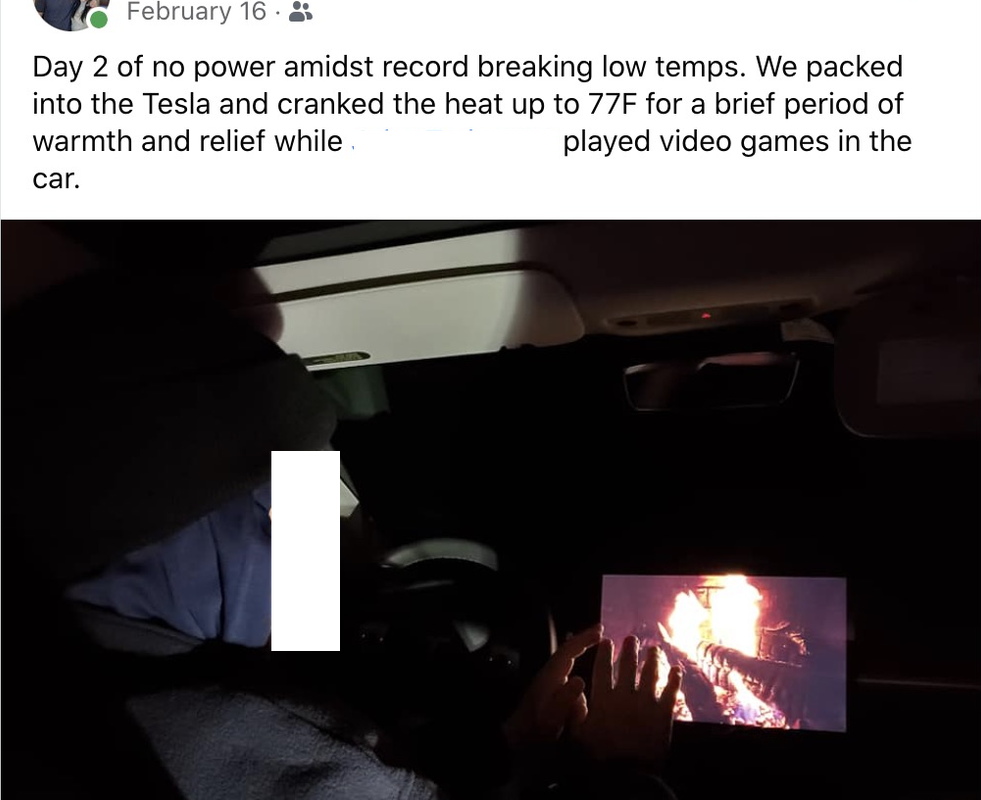
So YMMV... but my friend was stuck in the 2021Texas Freeze... and they used their EV warm up occasionally in their garage over a few days... but they only heated the small space of the car (which was sort of double insulated inside the garage).If the power is out because of a snowstorm, yeah, using the car's battery to keep you warm might help, but if it is out long enough not only are you going to be left in the cold, but now you're left in the cold, can't leave (if the EV is your only vehicle), and you can't charge the car.
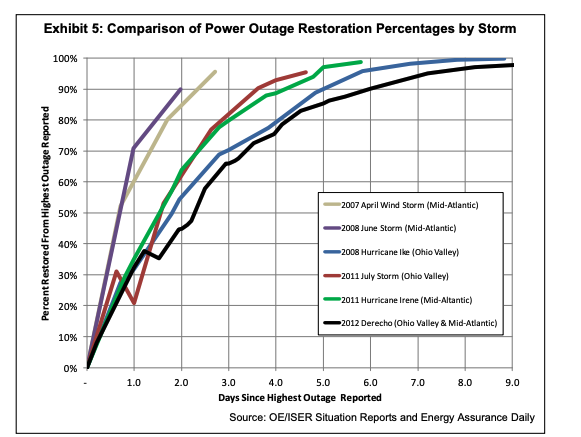
For the Texas outage within power was restored to some areas 2-3 such that an EV person could reach a DC charger in less than 1 hour of driving (not much else to do if power is out). Looking at historical power outages... it looks like historically things have been similar... where some homes might have power outages for longer... but over 85% were restored within 5 days, making it likely they would have access to DC charging with remaining range (taken from this research paper)
With V2H/V2L ... I think I would only use an electric blanket inside of a sleeping bag which would pull 0.2kW per blanket versus trying to heat the entire home. Two electric blankets running 12 hours a day would be... 2.4kW or 12kwh over 5 days... so a 60kwh battery could easily do that if people ration their energy properly ... and likely still have enough range to drive to some where to charge... even if the power outage caught them with only 50% SOC (30 kwh).
Upvote
13
(13
/
0)
I'm seeing a few posts from non US residents, so far Sweden and South Africa. In both cases, their total installation costs were substantially less than what is charged here in the US.
Would be interested in more input and numbers from others outside the US, to ascertain how much we're being unnecessarily shafted.
Would be interested in more input and numbers from others outside the US, to ascertain how much we're being unnecessarily shafted.
Upvote
9
(9
/
0)
I just got 8kW of panels installed with a "Sunlight Backup" system from Enphase. To me, the sunlight backup feels like a gimmick. I definitely haven't used it yet, and it's only wired up to run a couple of circuits in my home (primarily refrigerator and 1 office circuit for internet/outlets).
Microinverters have been the solution of choice for anyone interested in getting the best equipment for their solar array for a while. Unless you have 0% shading year round, they are likely going to perform better than string inverters, for a small bump in cost.
Can someone expand upon this? Why can't I just put in a large switch to change from on-grid mode to off-grid mode, like the switch described in the article, and stick with a single large inverter? In my ignorance, it sounds like this company is selling the distributed microinverter model by claiming its on-grid/off-grid ability is unique to its system.
I don't have the full answer to this, but this is only a feature they've added to their latest generation of Microinverters, and it was paired with a massive increase of the compute speed (frequency) of the chips inside them. My guess is they need really low latency to coordinate the switch from on-grid to off-grid powering modes without causing havoc to the power flow in the home. So, not impossible with a string inverter system, just another "innovation" that Enphase is creating. I imagine they will have some other uses for highly responsive/powerful compute in their microinverters, and this is just the first "valuable" feature there.
I watched an Enphase sales training webinar (which I can no longer find) that suggested as much. The compute power increase is the main hardware change from IQ7 to IQ8. But there is some discussion online to give evidence to this as well.
It is amazing that the company that sells micro inverters told you that they have the most efficient product. I bet if you called up SolarEdge or a company that sells their products, you'll learn that power optimizers are the most efficient! The truth is, even with partial shade, power optimizers and micro inverters perform basically as well as each other as far as efficiency goes. This comparison (
https://www.paradisesolarenergy.com/blo ... efficiency ) has power optimizers at 97.6% efficiency and micro inverters at 97%.
Upvote
7
(7
/
0)
I'm seeing a few posts from non US residents, so far Sweden and South Africa. In both cases, their total installation costs were substantially less than what is charged here in the US.
Would be interested in more input and numbers from others outside the US, to ascertain how much we're being unnecessarily shafted.
In *some* cases, you get the same low costs in the USA.
Upvote
-3
(0
/
-3)
Reading the comments, a lot of you guys are getting brutally taken advantage of by the industry, which at least in my state doesn't surprise me. Shady salespeople and shady sales practices abound.
If you're paying significantly above $2/watt installed, or significantly more than what Tesla quotes (they don't play the games), you must shop around. Also realize those low-interest "solar loans" are regular unsecured debt, they're just paying enormous "franchise fees" to buy down that interest rate, and it's embedded in your quote. Get cash prices, get your own HELOC, you'll save a fortune.
You shouldn't really make such a blanket statement. Conditions are different for different homeowners, so of course prices are very different from one to the next. For example, you sometimes need to upgrade your electric system to even be able to handle solar - that would drive up the cost dramatically.
They can be different if various electrical components have to be upgraded, but we're talking low-thousands, not the tens of thousands I'm seeing people overpaying in here. BTW, that's something solar companies also overpay for, I got my own electrician involved for a subpanel upgrade and they did it for just a little more than half the price, so I'd recommend anyone getting a solar system and being told certain upgrades need to happen that they split that out and bid it separately.
Companies like Project Solar call BS on the excuses, Tesla too but I don't generally recommend them just due to the proprietary nature of their system. They still serve as a good gut-check reference bid.
The state of sales in the solar world is just very, very rough. Buyer beware.
Upvote
7
(8
/
-1)
Even 30kWHr/day, which was the other guy's usage including topping up a PHEV, is only about 2/3 of my usage, and he was asking if he was an outlier on the high side. It's not like I have a 10k sqft house. What the hell is typical usage?Jesus Christ that's less than half of what we use during the summer months. That's without an EV.Per my electric bill, I'm averaging more than 30kWh/day of electrical use. So others' 10kWh battery don't seem very big to me.This is the exact system I'm having installed in November this year.
21.16kW with 30kWh battery backup. Running me about 98k, installed, before incentives.
I have an PHEV, but the battery is ~12.2 kWh, and I don't drive every day. Per the car's app, about ~56 kWh per week is used to charge it up, so that accounts for ~8kWh per day.
So, that brings me down to over 22 kWh daily use.
How much electricity are other people using? Am I an outlier?
Doesn't seem that unusual. I just checked; we are at 19 kWh daily (during air conditioning season), and that is with mostly gas appliances, and a very small but old house. At some point a few years ago, we were at twice that much due to a tenant who extensively used electric heating (we no longer have a tenant; it's just us). Replacing our windows also helped.
Probably depends a lot on the size of your house, and therefore of your air conditioner.
Upvote
2
(2
/
0)
Even 30kWHr/day, which was the other guy's usage including topping up a PHEV, is only about 2/3 of my usage, and he was asking if he was an outlier on the high side. It's not like I have a 10k sqft house. What the hell is typical usage?Jesus Christ that's less than half of what we use during the summer months. That's without an EV.Per my electric bill, I'm averaging more than 30kWh/day of electrical use. So others' 10kWh battery don't seem very big to me.This is the exact system I'm having installed in November this year.
21.16kW with 30kWh battery backup. Running me about 98k, installed, before incentives.
I have an PHEV, but the battery is ~12.2 kWh, and I don't drive every day. Per the car's app, about ~56 kWh per week is used to charge it up, so that accounts for ~8kWh per day.
So, that brings me down to over 22 kWh daily use.
How much electricity are other people using? Am I an outlier?
Doesn't seem that unusual. I just checked; we are at 19 kWh daily (during air conditioning season), and that is with mostly gas appliances, and a very small but old house. At some point a few years ago, we were at twice that much due to a tenant who extensively used electric heating (we no longer have a tenant; it's just us). Replacing our windows also helped.
Probably depends a lot on the size of your house, and therefore of your air conditioner.
Looks like I am averaging ~50kWh/day usage right now here in the PNW. That's in a fully electric house with a heat pump AC and EV and metal shop.
Upvote
4
(4
/
0)

The article reads like an ad for Enphase. Ars, please do your homework instead of relying on a vendor for article content. The Enphase-specific stuff is a distractor and suggests that they offer something that other vendors don't. Which isn't the case.
I’ve noticed that in a lot in these farmed-out articles. It makes me even less interested in going to these publications’ homepages. They have much lower standards for journalistic integrity.
Ars should hire a reporter to cover the burgeoning green electric consumer product industry. Be skeptical about maker claims. It’s a “smart home product” at its core and it’s only as durable as the software to control the panels and batteries.
Many reporters have experience with solar panels. Roberto Baldwin (Engadget reporter who was a tech reporter and has covered EVs for Ars) also has his own solar panels. There must be several other qualified and underemployed reporters out there who would do a good job. It needs serious research especially because it’s different in every utility-controlled monopoly market and codes are different everywhere. And green power is facing not just disingenuous sales campaigns but also a coordinated onslaught of black ops propaganda from the right wing.
A key factor is whether the electric utilities have got you in their grip — how do they pay/charge for buying/selling your electricity? Have they slapped on a bunch of extra fees for the privilege of using distributed home solar instead of building more power and battery plants of their own?
In Colorado Xcel has subsidized many solar panel installations but they pay less and less for power while changing more and more. Just like they turned off people’s thermostats with no warning for a lousy $25 a year credit, they will do whatever they want with the same zero regard for customer service as any monopoly. And let’s not even start with Texas.
Upvote
7
(7
/
0)
Reading the comments, a lot of you guys are getting brutally taken advantage of by the industry, which at least in my state doesn't surprise me. Shady salespeople and shady sales practices abound.
If you're paying significantly above $2/watt installed, or significantly more than what Tesla quotes (they don't play the games), you must shop around. Also realize those low-interest "solar loans" are regular unsecured debt, they're just paying enormous "franchise fees" to buy down that interest rate, and it's embedded in your quote. Get cash prices, get your own HELOC, you'll save a fortune.
You shouldn't really make such a blanket statement. Conditions are different for different homeowners, so of course prices are very different from one to the next. For example, you sometimes need to upgrade your electric system to even be able to handle solar - that would drive up the cost dramatically.
They can be different if various electrical components have to be upgraded, but we're talking low-thousands, not the tens of thousands I'm seeing people overpaying in here. BTW, that's something solar companies also overpay for, I got my own electrician involved for a subpanel upgrade and they did it for just a little more than half the price, so I'd recommend anyone getting a solar system and being told certain upgrades need to happen that they split that out and bid it separately.
My solar company referred me to an electrical contractor for that to begin with; they don't do that. And the upgrades can be a lot more than just "replace a subpanel".
Companies like Project Solar call BS on the excuses
Companies like that generally work by having a standardized setup that works for 50% or so of the houses. That's enough for them to do good business. When you don't fall into that 50%, they usually don't even come out for a quote.
Upvote
3
(3
/
0)
The article did not make it clear how the house is disconnected from the grid when the grid fails. It says
Presumably whatever they are doing it ends up on the bus in the house's power panel - and that is normally wired directly to the grid by way of the meter. My best guess is that "on-grid" just means "sync AC to grid" and "off-grid" means "sync AC to other panels". It would be nice not to guess, but there is no further explanation. Maybe "off-grid" also means "sends a signal to the main disconnect device, and listens for a 'power has returned' signal from that same device"? The house must come off the grid if it is live, otherwise it could kill the repairman working on a downed line or blown transformer.
Microinverters have the nice property that any panel in light can contribute power, whereas having a single inverter for all panels has the problem that any one panel without light blocks current from all the others. They also have the nice property that if they fail only that one panel's power output is lost. I just don't see how, all by themselves, they could disconnect a house from the grid.
Each one contains a chip that—when the main power grid suffers a power failure—switches from an on-grid to an off-grid mode. In this mode, the microinverters ignore the grid and direct any power to the building they're attached to. In essence, it can operate as part of a grid-integrated system or part of a microgrid.
Presumably whatever they are doing it ends up on the bus in the house's power panel - and that is normally wired directly to the grid by way of the meter. My best guess is that "on-grid" just means "sync AC to grid" and "off-grid" means "sync AC to other panels". It would be nice not to guess, but there is no further explanation. Maybe "off-grid" also means "sends a signal to the main disconnect device, and listens for a 'power has returned' signal from that same device"? The house must come off the grid if it is live, otherwise it could kill the repairman working on a downed line or blown transformer.
Microinverters have the nice property that any panel in light can contribute power, whereas having a single inverter for all panels has the problem that any one panel without light blocks current from all the others. They also have the nice property that if they fail only that one panel's power output is lost. I just don't see how, all by themselves, they could disconnect a house from the grid.
Upvote
3
(4
/
-1)
Even 30kWHr/day, which was the other guy's usage including topping up a PHEV, is only about 2/3 of my usage, and he was asking if he was an outlier on the high side. It's not like I have a 10k sqft house. What the hell is typical usage?Jesus Christ that's less than half of what we use during the summer months. That's without an EV.Per my electric bill, I'm averaging more than 30kWh/day of electrical use. So others' 10kWh battery don't seem very big to me.This is the exact system I'm having installed in November this year.
21.16kW with 30kWh battery backup. Running me about 98k, installed, before incentives.
I have an PHEV, but the battery is ~12.2 kWh, and I don't drive every day. Per the car's app, about ~56 kWh per week is used to charge it up, so that accounts for ~8kWh per day.
So, that brings me down to over 22 kWh daily use.
How much electricity are other people using? Am I an outlier?
Doesn't seem that unusual. I just checked; we are at 19 kWh daily (during air conditioning season), and that is with mostly gas appliances, and a very small but old house. At some point a few years ago, we were at twice that much due to a tenant who extensively used electric heating (we no longer have a tenant; it's just us). Replacing our windows also helped.
Probably depends a lot on the size of your house, and therefore of your air conditioner.
It doesn't have to be 10k sqft. We only have 400 sqft. I'm sure the 1980s poorly insulated walls also have something to do with our bill. There usually are many factors.
Upvote
2
(2
/
0)
If anyone is curious, here is a string inverter capable of the same thing. https://www.solacity.com/product/phocos ... w-120-48v/
Upvote
3
(3
/
0)
How much did enphase pay for this arsvertisement?
A real journalist-school-quality article would have compared and contrasted several different solar and battery systems and actually followed up on those tough questions like “How long do you promise to keep the cloud services going and the app updated?” “Will there ever be a fee to use those cloud services?” “How will I get these repaired and what is the warranty?”
But the publication would have to pay for that time.
Upvote
4
(4
/
0)
If you go to their website (mission accomplished?) you see you need to have at a minimum 2 other devices to make the run off panels in a grid down situation possible. The first is a Combiner which all of the microinverters go through. It provides the metering as well as internet gateway for the system. The second device is called a System Controller which seems to be their flavor of an automatic transfer switch similar to what you would have with a traditional backup generator.The article did not make it clear how the house is disconnected from the grid when the grid fails. It says
Each one contains a chip that—when the main power grid suffers a power failure—switches from an on-grid to an off-grid mode. In this mode, the microinverters ignore the grid and direct any power to the building they're attached to. In essence, it can operate as part of a grid-integrated system or part of a microgrid.
Presumably whatever they are doing it ends up on the bus in the house's power panel - and that is normally wired directly to the grid by way of the meter. My best guess is that "on-grid" just means "sync AC to grid" and "off-grid" means "sync AC to other panels". It would be nice not to guess, but there is no further explanation. Maybe "off-grid" also means "sends a signal to the main disconnect device, and listens for a 'power has returned' signal from that same device"? The house must come off the grid if it is live, otherwise it could kill the repairman working on a downed line or blown transformer.
Microinverters have the nice property that any panel in light can contribute power, whereas having a single inverter for all panels has the problem that any one panel without light blocks current from all the others. They also have the nice property that if they fail only that one panel's power output is lost. I just don't see how, all by themselves, they could disconnect a house from the grid.
Upvote
4
(4
/
0)
watermeloncup
Ars Tribunus Angusticlavius
Even 30kWHr/day, which was the other guy's usage including topping up a PHEV, is only about 2/3 of my usage, and he was asking if he was an outlier on the high side. It's not like I have a 10k sqft house. What the hell is typical usage?Jesus Christ that's less than half of what we use during the summer months. That's without an EV.Per my electric bill, I'm averaging more than 30kWh/day of electrical use. So others' 10kWh battery don't seem very big to me.This is the exact system I'm having installed in November this year.
21.16kW with 30kWh battery backup. Running me about 98k, installed, before incentives.
I have an PHEV, but the battery is ~12.2 kWh, and I don't drive every day. Per the car's app, about ~56 kWh per week is used to charge it up, so that accounts for ~8kWh per day.
So, that brings me down to over 22 kWh daily use.
How much electricity are other people using? Am I an outlier?
Doesn't seem that unusual. I just checked; we are at 19 kWh daily (during air conditioning season), and that is with mostly gas appliances, and a very small but old house. At some point a few years ago, we were at twice that much due to a tenant who extensively used electric heating (we no longer have a tenant; it's just us). Replacing our windows also helped.
Probably depends a lot on the size of your house, and therefore of your air conditioner.
I wish I could get that low. I'm living in a ~1600 ft^2 apartment, and during the summer we use about 50-60 kWh/day, almost all of that just for the AC. We don't keep it ice box cold either, generally 70-72 degrees. I think the insulation is just incredibly poor, exacerbated by being a top floor unit in a building with a flat roof. If it gets above 90F the AC runs constantly runs and can't keep the living room below 75F. At first I thought the AC unit was unhealthy, but the temperature differential is within the normal range so I guess that's just how it is. Unfortunately I'm a renter so there's basically nothing I can do about this. I'm just shocked that a unit in a 2009 building could be so be so grossly inefficient.
Upvote
3
(5
/
-2)

Anomalydesign
Wise, Aged Ars Veteran
Wait a second, 1500W at 12V is 125 amps! How long is your cable run?That makes short outages just a minor nuisance. It isn't even always obvious when they happen. For longer outages where we start to worry about climate control and refrigeration etc, we take advantages of the fact that most electric cars, including ours, have surprisingly robust 12v systems. We installed an Anderson connector under the hood into which we plug a 1500w AC inverter to run the fridge, and/or a small AC unit/Space heater that we can use in a smallish, well insulated room. Even our ancient tiny MiEV with its small (by EV standards) 16kWh battery pack can keep those necessities going for over a day.
About 1.5 feet, with VERY thick copper cables and an inline fuse. We pop open the hood plop the inverter right there, and plug it into the Anderson connector on the car's 12v system that way. The longer run is from the inverter to temporary distribution in the house, but that's at 120v AC, so just a 10 AWG cable with locking connectors for that.
The tricky part is actually getting an electric car to stay on indefinitely when it's not driving. It's a whole series of putting it in neutral, using the parking brake, opening and closing the doors etc, all in the right order. Otherwise the car will shut off the high voltage battery after an hour or two, and the tiny 12v lead acid battery would die very fast.
Upvote
5
(5
/
0)
The outage doesn't stop them from producing power; the power just can't be used in the absence of a functioning grid. That's because the microinverters are part of an integrated system that includes the grid, power meter, and other associated hardware.
Can someone expand upon this? Why can't I just put in a large switch to change from on-grid mode to off-grid mode, like the switch described in the article, and stick with a single large inverter? In my ignorance, it sounds like this company is selling the distributed microinverter model by claiming its on-grid/off-grid ability is unique to its system.
Robert Lewellyn did a series of episodes on Fully Charged (YouTube) where he discussed the process of upgrading his solar, adding batteries, adding EV charging, and eventually making it work during power outages.
It's exactly what you suggested - he had to add a device which disconnected his house from the grid during an outage so you would't be powering your neighbours, or electrocuting somebody working to fix the mains.
Upvote
5
(5
/
0)
"You'd think so, but no—mostly. Solar panels affixed to homes (and other structures) that are connected to the power grid will also go kaput during power outages."
This is not always true. Mine work just fine during power outages. That's hardware specific. My invert is Pika (which is now Generac), and it powers a subpanel, which is still powered during blackouts. The subpanel takes care of most things in the house, but all the big stuff isn't on it. I was always confused why other systems like LG don't do this.
It may simply be older. Before the 2014 or 2017 edition of the NEC, solar systems that run through outages were legal, and many of those are grandfathered in. Or you might be outside the US, where the NEC does not apply.
It was installed in 2019. FYI, it has a battery backup that keeps the subpanel running when the grid is down, day or night.
Upvote
2
(2
/
0)