
You are using an out of date browser. It may not display this or other websites correctly.
You should upgrade or use an alternative browser.
You should upgrade or use an alternative browser.
New tech can make your house a solar microgrid
- Thread starter JournalBot
- Start date
Why wouldn't a more modern world just have disaggregated power generation that doesn't rely so much on the grid? Solar/battery combinations in every household would take the load off that grid and use it just for minor balancing rather than total reliance on it. It would also have the added benefit of low-cost, low-impact energy for everyone, rather than the whims of the market (ConEd just sent me a letter informing me of at 32% price increase, as a personal example). Wouldn't that be a better ideal?
Efficiencies of scale. Grid-scale solar averages $1.35/W. That cost goes down with scale. The other front-page solar story points out that a 50MW solar farm is 20% more cost effective per MW than a 20MW farm, meaning a 50MW facility is closer to $1.22/W. (https://meincmagazine.com/science/2022/09 ... p-falling/)
You drop down to the KW scale and the cost goes up noticeably. Residential solar is around $2.50/W and goes up as you add smart inverters and/or storage needed to provide a local grid.
This doesn't even account for the long-term maintenance differences between supporting 500 separate residential 10kW systems vs a single 50MW farm. Residential solar is also usually positioned far less optimally than a solar farm as you rely on the existing roof angle, so when you compare the actual cost per produced W, the residential gets even worse.
So net result is that as a civilization, we get probably 250% more usable W/$ when building solar farms over small distributed systems.
Doesn't mean there isn't value to distributed solar but that distributed storage on the grid itself (i.e. 1MW-hr batteries located every couple of miles) would serve us better for minimizing the majority of power outages.
Upvote
8
(8
/
0)
The only difference from a traditional installation is having one inverter on every panel. Everything else is just business as normal.
Having inverters on the individual panels makes zero sense, because (a) that is a lot more hardware, and (b) if you have a battery, you now have to convert *back* to DC, and you need *another* inverter to use the battery.
Having inverters on the individual panels makes zero sense, because (a) that is a lot more hardware, and (b) if you have a battery, you now have to convert *back* to DC, and you need *another* inverter to use the battery.
Upvote
8
(8
/
0)
Why can't I just put in a large switch to change from on-grid mode to off-grid mode, like the switch described in the article, and stick with a single large inverter?
You can.
In my ignorance, it sounds like this company is selling the distributed microinverter model by claiming its on-grid/off-grid ability is unique to its system.
On the nose. Microinverters are nothing new and nothing in this article explains how they help electrically isolate your home from the grid during a power outage.
This article 100% misses the point of why solar panels don't work during an outage. The reason is safety of the linemen working on the gird.
Upvote
16
(16
/
0)
This article reads like they created the idea of micro inverters. Those have been available for years. I imagine what is new is a controller that allows you to switch to off grid mode and power directly from the panels.
Upvote
8
(8
/
0)
This article reads like they created the idea of micro inverters. Those have been available for years. I imagine what is new is a controller that allows you to switch to off grid mode and power directly from the panels.
Exactly. And oddly the article doesn't talk about that component at all.
Upvote
7
(7
/
0)

A couple of thoughts:
US regulations requires all grid-connected (“grid-tie”) inverters to automatically shut down when they detect a loss of grid power. As previously stated, this is so you don’t back-feed the grid and electrocute a power line worker trying to repair the problem. In actuality, your system would be trying to power your whole neighborhood and would shutdown due to overload.
The system discussed in this article must incorporate a transfer switch or relay that disconnects from the incoming grid power.
The challenge I see is that as the the individual microinverters try to come online, they are powering the whole house. Typically microinverters are only about 200 watts, which isn’t enough to do much, and therefore would shutdown due to overload.
Further, all the microinverters would have to synchronize the AC power. If they are all trying to start unsynchronized, they would be fighting each other, also causing shutdown.
I see 2 possible solutions:
1) the transfer switch has a “neutral” setting where the solar array is disconnected from both the house and grid, allowing the microinverters a chance to power up and sync. Then the transfer switch connects the system to the house.
Or 2) all the microinverters are interconnected with a data bus that coordinates the synchronization and application of power.
It would be interesting to see more details
US regulations requires all grid-connected (“grid-tie”) inverters to automatically shut down when they detect a loss of grid power. As previously stated, this is so you don’t back-feed the grid and electrocute a power line worker trying to repair the problem. In actuality, your system would be trying to power your whole neighborhood and would shutdown due to overload.
The system discussed in this article must incorporate a transfer switch or relay that disconnects from the incoming grid power.
The challenge I see is that as the the individual microinverters try to come online, they are powering the whole house. Typically microinverters are only about 200 watts, which isn’t enough to do much, and therefore would shutdown due to overload.
Further, all the microinverters would have to synchronize the AC power. If they are all trying to start unsynchronized, they would be fighting each other, also causing shutdown.
I see 2 possible solutions:
1) the transfer switch has a “neutral” setting where the solar array is disconnected from both the house and grid, allowing the microinverters a chance to power up and sync. Then the transfer switch connects the system to the house.
Or 2) all the microinverters are interconnected with a data bus that coordinates the synchronization and application of power.
It would be interesting to see more details
Upvote
6
(6
/
0)
This article reads like a promo and lacks details on what’s so innovative about their overall system.
Their new micro-inverters still require a bunch of other boxes to be installed so the system can be physically disconnected from the grid during an outage, which article fails to explain is critical to the installation and city/utility approval to run a micro-grid and not kill someone.
Googling their product literature, the so-called affordable Encharge 3 and 10 systems includes only the battery, so the price is misleading because solar is separate, written within an article about and titled “solar microgrid” and new IQ8 micro-inverters that are installed for each solar panel. Also the link to pricing is a random employee answer on the company’s support forum. The 10kWh battery is said to cost $18-20k installed, which excludes solar. It’s not affordable and not competitive with Tesla.
Solar panels without micro-inverters have diodes within them than can shut off rows of cells if their output is low from shading. There can be money savings from using cheaper panels with possibly lower efficiency than panels with micro-inverters over the lifetime of the panels.
Tesla Energy is the main competition with their solar and Powerwall system, and most likely the pricing will be far unbeatable. Pricing is upfront and easy to get on their website. Is there a MSRP on the price of the battery alone?
Disclosure: I have a Tesla system, their customer service sucks when equipment is installed wrong or breaks. But in terms of pricing, losing $20-50 a month on broken equipment for a few months waiting for repair won’t displace the $20-30,000 price advantage compared to other companies. The installed cost was $35,500 for 8.16kW solar array and 26kwh of battery storage (2 Powerwalls), before 26% federal tax credit.
Their new micro-inverters still require a bunch of other boxes to be installed so the system can be physically disconnected from the grid during an outage, which article fails to explain is critical to the installation and city/utility approval to run a micro-grid and not kill someone.
Googling their product literature, the so-called affordable Encharge 3 and 10 systems includes only the battery, so the price is misleading because solar is separate, written within an article about and titled “solar microgrid” and new IQ8 micro-inverters that are installed for each solar panel. Also the link to pricing is a random employee answer on the company’s support forum. The 10kWh battery is said to cost $18-20k installed, which excludes solar. It’s not affordable and not competitive with Tesla.
Solar panels without micro-inverters have diodes within them than can shut off rows of cells if their output is low from shading. There can be money savings from using cheaper panels with possibly lower efficiency than panels with micro-inverters over the lifetime of the panels.
Tesla Energy is the main competition with their solar and Powerwall system, and most likely the pricing will be far unbeatable. Pricing is upfront and easy to get on their website. Is there a MSRP on the price of the battery alone?
Disclosure: I have a Tesla system, their customer service sucks when equipment is installed wrong or breaks. But in terms of pricing, losing $20-50 a month on broken equipment for a few months waiting for repair won’t displace the $20-30,000 price advantage compared to other companies. The installed cost was $35,500 for 8.16kW solar array and 26kwh of battery storage (2 Powerwalls), before 26% federal tax credit.
Upvote
13
(13
/
0)
I guess pricing is probably regional. I got a system two years ago with 21kw of the most efficient panels w/power optimizers and 48kwh battery (3x LG RESU16H) for $70k, minus 26% federal credit for a little more than $50k total. I thought that wasn’t too bad at the time.This is the exact system I'm having installed in November this year.
21.16kW with 30kWh battery backup. Running me about 98k, installed, before incentives.
In the last 21 months the system has generated about $8000 in power at local rates, for about a 13 year payoff. That seems pretty good with battery included, I remember when solar was a 20 year payoff and no battery. If I’m honest though I bought it for the geek factor and I enjoy watching the stats every day and charging my car from excess solar.
I’ve heard in Australia solar is dirt cheap.
I got a system that is about half this without a battery backup and it has about a 7 year payback, 5 years in. I don't get outages now more than 1 or 2 minutes a year, so unless I could use my electric vehicle battery, it wouldn't be worth it to buy a battery.
Yeah, I hear you. Net metering is trending away from paying you a significant amount for excess so the battery also helps me use most of what I produce rather than sending it to the neighbors for a fractional credit. Except for the dead of winter, I usually go overnight easily and weeks at a time without pulling from grid.
Upvote
5
(5
/
0)
I use quite a lot because I have a detached 500sqft apartment on my property connected to my power and occupied. So I pretty much have 2 households worth of electricity usage. The battery charges during the sun hours and the house runs off the power produced by solar. Your battery just needs to be large enough to get you through the night. If you have the ability to charge the car during sun hours, then you can take that usage out of your battery size calculations. I use 60-100kWh/day and a 30kWh battery has been ok for whole house backup as long as we are mindful of our nighttime loads. A 40kWh battery would probably be enough that we would barely notice the grid is down with whole house backup. We did have a 2.5 day grid outage and our battery didn’t go under 40% with us being mindful of our nighttime usage. I did feel fortunate because some of my neighbors had to seek shelter elsewhere and none of my frozen food spoiled.Per my electric bill, I'm averaging more than 30kWh/day of electrical use. So others' 10kWh battery don't seem very big to me.This is the exact system I'm having installed in November this year.
21.16kW with 30kWh battery backup. Running me about 98k, installed, before incentives.
I have an PHEV, but the battery is ~12.2 kWh, and I don't drive every day. Per the car's app, about ~56 kWh per week is used to charge it up, so that accounts for ~8kWh per day.
So, that brings me down to over 22 kWh daily use.
How much electricity are other people using? Am I an outlier?
Upvote
5
(5
/
0)
I'm going to skip past a product like this or a home battery and go straight to an electric vehicle which supports bidirectional charging. Power outages in my area have fortunately never been more than about 12 hours, so a normal EV battery which has enough power to cover my home for at least 2-3 days would more than cover those needs. That is, assuming I'm not misunderstanding the ability to use the EV battery power even when the grid is down.
You still have to have equipment that will isolate your house from the grid when the power goes off.
Upvote
4
(4
/
0)
Once in a while I get mail advertisements that read as an opportunity to buy a share in a local commercial solar installation as an alternative to installing solar on my roof. I haven't investigated deeply enough to know if any of those are a 'real deal' as opposed to something that could bite me later if *something* changes in law or utility covenants. But as noted up-thread, utility scale installation costs are dropping faster that rooftop PV systems.
My neighborhood has underground power lines and (knocks-on-wood) rare power outages in the past three years I'm here, given sometimes extreme weather (western NY, lots of snow, rain, and some surprisingly high winds). The value of solar for me would be more about lower cost, making a share of a commercial operation maybe attractive.
My neighborhood has underground power lines and (knocks-on-wood) rare power outages in the past three years I'm here, given sometimes extreme weather (western NY, lots of snow, rain, and some surprisingly high winds). The value of solar for me would be more about lower cost, making a share of a commercial operation maybe attractive.
Upvote
4
(4
/
0)
This article reads like a promo and lacks details on what’s so innovative about their overall system.
Their new micro-inverters still require a bunch of other boxes to be installed so the system can be physically disconnected from the grid during an outage, which article fails to explain is critical to the installation and city/utility approval to run a micro-grid and not kill someone.
Googling their product literature, the so-called affordable Encharge 3 and 10 systems includes only the battery, so the price is misleading because solar is separate, written within an article about and titled “solar microgrid” and new IQ8 micro-inverters that are installed for each solar panel. Also the link to pricing is a random employee answer on the company’s support forum. The 10kWh battery is said to cost $18-20k installed, which excludes solar. It’s not affordable and not competitive with Tesla.
Solar panels without micro-inverters have diodes within them than can shut off rows of cells if their output is low from shading. There can be money savings from using cheaper panels with possibly lower efficiency than panels with micro-inverters over the lifetime of the panels.
Tesla Energy is the main competition with their solar and Powerwall system, and most likely the pricing will be far unbeatable. Pricing is upfront and easy to get on their website. Is there a MSRP on the price of the battery alone?
Disclosure: I have a Tesla system, their customer service sucks when equipment is installed wrong or breaks. But in terms of pricing, losing $20-50 a month on broken equipment for a few months waiting for repair won’t displace the $20-30,000 price advantage compared to other companies. The installed cost was $35,500 for 8.16kW solar array and 26kwh of battery storage (2 Powerwalls), before 26% federal tax credit.
$18-20k is quite a bit higher than I paid for my enphase batteries. They are closer to $10k each. $18-20k would include all the systems to form a micro grid and that’s probably closer to 16k in reality. You say Tesla is upfront with their pricing but I have heard many stories of prices skyrocketing even after a contract has been signed. Also, Tesla solar isn’t available everywhere, including my home in Indiana. Tesla is using the absolute most basic of inverters as well. Their battery has a higher peak output to energy storage ratio but they also require cooling fans whereas the LFP chemistry of Enphase batteries only requires passive cooling. I have a 15 year warranty on my batteries. From what I can tell from Tesla is you get what you pay for and reliability during grid outages is a primary concern of mine. Sure the total uptime ramifications may be insignificant on a spreadsheet but if that downtime comes when my other source of power is out the spreadsheet doesn’t matter.
Upvote
5
(5
/
0)
Unfortunately the only way to safely power your home when the grid is out is to physically disconnect it, that's so you don't backfeed power and shock the maintenance guys working on the lines they think are turned off.
I'm guessing that what the load controller and other hardware does, and most likely the smart microinverters won't push any power in "off-grid" mode until they get a signal or can verify that the grid really is disconnected.
Kind of surprised they couldn't get the price any lower but maybe there is more hardware than just an anti-islanding relay...
So how do the battery-backed systems work as a large UPS effectively?
Or do they have more smarts that prevents them feeding power to the grid if they don't sense any grid power?
If that's the case, why can't regular inverters do the same without a battery? Is it just inverter manufacturers cheaping out?
A switch disconnecting the grid from the house is a trivial expense, and only stupid greed and incompetence prevent the PV from functioning during a grid-down event.
Very few things can run directly off solar panels. The voltage and amps vary widely depending on clouds/irradiance and temperature. A battery is generally needed to buffer the PV output, and then the inverter can output a controlled voltage and manage surge loads.
This article is mostly fluff which barely repeats the press release without any research or discovery.
Upvote
-12
(1
/
-13)
Wait a second, 1500W at 12V is 125 amps! How long is your cable run?That makes short outages just a minor nuisance. It isn't even always obvious when they happen. For longer outages where we start to worry about climate control and refrigeration etc, we take advantages of the fact that most electric cars, including ours, have surprisingly robust 12v systems. We installed an Anderson connector under the hood into which we plug a 1500w AC inverter to run the fridge, and/or a small AC unit/Space heater that we can use in a smallish, well insulated room. Even our ancient tiny MiEV with its small (by EV standards) 16kWh battery pack can keep those necessities going for over a day.
Upvote
5
(5
/
0)
It was the Tesla solar roof that the price skyrocketed. The solar panel and Powerwall systems are as per contract price$18-20k is quite a bit higher than I paid for my enphase batteries. They are closer to $10k each. $18-20k would include all the systems to form a micro grid and that’s probably closer to 16k in reality. You say Tesla is upfront with their pricing but I have heard many stories of prices skyrocketing even after a contract has been signed. Also, Tesla solar isn’t available everywhere, including my home in Indiana. Tesla is using the absolute most basic of inverters as well. Their battery has a higher peak output to energy storage ratio but they also require cooling fans whereas the LFP chemistry of Enphase batteries only requires passive cooling. I have a 15 year warranty on my batteries. From what I can tell from Tesla is you get what you pay for and reliability during grid outages is a primary concern of mine. Sure the total uptime ramifications may be insignificant on a spreadsheet but if that downtime comes when my other source of power is out the spreadsheet doesn’t matter.
The Tesla system works fine during power outage. Runs 2 AC compressors all day and night with the grid down. The system can run off grid for days, weeks, or months at a time depending on the weather and time of year. I had a problem with the install where a cable was loose and only half the panels were connected to the inverter, took them a long time to come out and fix it.
Upvote
2
(3
/
-1)
The inverter provide 1500w of AC. So at 120v AC it comes to 12.5 amps which is basically one breaker/circuit on your electric panel.Wait a second, 1500W at 12V is 125 amps! How long is your cable run?That makes short outages just a minor nuisance. It isn't even always obvious when they happen. For longer outages where we start to worry about climate control and refrigeration etc, we take advantages of the fact that most electric cars, including ours, have surprisingly robust 12v systems. We installed an Anderson connector under the hood into which we plug a 1500w AC inverter to run the fridge, and/or a small AC unit/Space heater that we can use in a smallish, well insulated room. Even our ancient tiny MiEV with its small (by EV standards) 16kWh battery pack can keep those necessities going for over a day.
Upvote
6
(6
/
0)
This is the exact system I'm having installed in November this year.
21.16kW with 30kWh battery backup. Running me about 98k, installed, before incentives.
That's a huge peak production figure. How much energy do you typically use in a month? I just got a system with about 4-4.5kW peak installed.
Last month was 2300kWh, but I don't have the workshop fully configured yet.
I'm also on FPL, which does retail net metering.
Upvote
2
(2
/
0)
The outage doesn't stop them from producing power; the power just can't be used in the absence of a functioning grid. That's because the microinverters are part of an integrated system that includes the grid, power meter, and other associated hardware.
Can someone expand upon this? Why can't I just put in a large switch to change from on-grid mode to off-grid mode, like the switch described in the article, and stick with a single large inverter? In my ignorance, it sounds like this company is selling the distributed microinverter model by claiming its on-grid/off-grid ability is unique to its system.
It's actually a myth that backfeeding is the problem in the first place. You are absolutely right that this can be easily solved with a transfer switch - and you need that anyway because a battery or generator *are* allowed to power your house during an outage despite having the same backfeed problem.
The real issue is fire safety. In case of fire or other emergencies, batteries and generators can be shut off and be without power. Solar panels will generate power as long as there is light (even the light from a house fire!). That is the real reason why the National Electric Code mandates that in case of a power outage, panel arrays must be disconnected from the house network.
This product obviously does not change the NEC, so I cannot see how it can deliver what it promises.
Upvote
-3
(3
/
-6)
Per my electric bill, I'm averaging more than 30kWh/day of electrical use. So others' 10kWh battery don't seem very big to me.This is the exact system I'm having installed in November this year.
21.16kW with 30kWh battery backup. Running me about 98k, installed, before incentives.
I have an PHEV, but the battery is ~12.2 kWh, and I don't drive every day. Per the car's app, about ~56 kWh per week is used to charge it up, so that accounts for ~8kWh per day.
So, that brings me down to over 22 kWh daily use.
How much electricity are other people using? Am I an outlier?
I'm installing a pair of batteries, and leaving room for a pair more.
My intention is in a power outage scenario, go into 'low power' mode and use the battery as a buffer.
Upvote
2
(2
/
0)
This is interesting, tho I wonder how long until places will allow it. My coworker is having a new solar system installed on their house and apparently there is some rule here that houses must be grid-connected and are not allowed to run in an "off-grid" configuration.
I asked if it would tie in before or after a generator interlock but it sounds like the solar would go to the power meter directly, so you couldn't even run a portable generator to trick it into thinking the grid is up and augment the capacity of the generator in an outage.
I asked if it would tie in before or after a generator interlock but it sounds like the solar would go to the power meter directly, so you couldn't even run a portable generator to trick it into thinking the grid is up and augment the capacity of the generator in an outage.
Upvote
2
(2
/
0)
I submitted a request for quotes through Energy Sage less than a year ago to install solar and the total cost was about $70k. I got the impression that the (only) installer that responded with a quote didn't want to travel to my location. Which is sad because it seems like more rural locations are those that might benefit the most from solar generation and backup since outages in those areas can run much longer than more localized (and higher priority) urban outages.
I'm in the same boat; rural solar installations really are dramatically more expensive. I was quoted "only" $50k, a neighbor was quoted $75k.
There are many reasons for it. The main one is that rural homes generally need a lot of upgrades to the electric system before you can even install solar in the first place. Another is that suburban homes are essentially cookie-cutter homes; the same installation will work on most homes in a subdivision. Rural homes tend to require a lot of custom engineering.
Upvote
5
(6
/
-1)
Why would the grid switching be any different from that for a back-up generator. Our generator can output 18 kW and switches in and out automatically with the grid on and off. And after a storm, the noise tells us that half our neighbors also have back-up generators. This is a solved problem, and IIRC correctly the isolator switch was about $2K including installation into the house electric supply.
Generators and batteries can be turned off with a switch. Solar panels produce power whenever there is light.
That is why solar panels (at least in the US) require a rapid disconnect *directly at the array* that prevents feeding power even to the house. This rapid disconnect must trip during a power outage, as well as during several other conditions.
Upvote
0
(1
/
-1)
david hassel
Smack-Fu Master, in training
This is the exact system I'm having installed in November this year.
21.16kW with 30kWh battery backup. Running me about 98k, installed, before incentives.
That's a huge peak production figure. How much energy do you typically use in a month? I just got a system with about 4-4.5kW peak installed.
based upon the name, i would imagine this guy has an electric car that he drives for uber/lyft and therefore wants them to be available... always. It still seems very excessive to me too. Typical solar install is around 5k and this guy is 4 times that size....
Upvote
-1
(1
/
-2)
For the occasional power outage, this feels like overkill.
I would venture to guess a much higher proportion of people have a perfectly good 50-80kWh battery sitting in their garage (hooked in between 4 wheels) than have rooftop solar to begin with. And all of those people have a vehicle charger. A bidirectional EV charger with a built-in transfer switch will cover all the situations that these special microinverters will, including at night, or during storms. Only during truly extended outages would this option be an advantage.
The problem unfortunately is that bidirectional EV chargers are still largely vaporware (as in, cannot actually be bought and installed today). Hopefully that will change in the next year or two though...
I would venture to guess a much higher proportion of people have a perfectly good 50-80kWh battery sitting in their garage (hooked in between 4 wheels) than have rooftop solar to begin with. And all of those people have a vehicle charger. A bidirectional EV charger with a built-in transfer switch will cover all the situations that these special microinverters will, including at night, or during storms. Only during truly extended outages would this option be an advantage.
The problem unfortunately is that bidirectional EV chargers are still largely vaporware (as in, cannot actually be bought and installed today). Hopefully that will change in the next year or two though...
Upvote
4
(4
/
0)

I'm leery of the proprietary nature of a lot of the equipment Enphase uses to do islanding.
Like Google are they going to decide my solar system is obsolete? Are they going to maintain the cloud services and the app for the actual lifetime of the panels? Or will they end up going out of business like a lot of other smart home manufacturers and bricking my expensive investment?
I’d like to see a lot more reporting on this, solar installations are still an almost secretive product with nearly zero mainstream tech coverage. And obviously the mass of people even here seem to be ingesting some sort of right-wing anti-solar propaganda. Home solar systems need to become as common as cell phones in America, especially since grid electric here is overpriced and banana-republic-level unreliable.
Upvote
7
(7
/
0)
The article reads like an ad for Enphase. Ars, please do your homework instead of relying on a vendor for article content. The Enphase-specific stuff is a distractor and suggests that they offer something that other vendors don't. Which isn't the case.
Upvote
6
(7
/
-1)
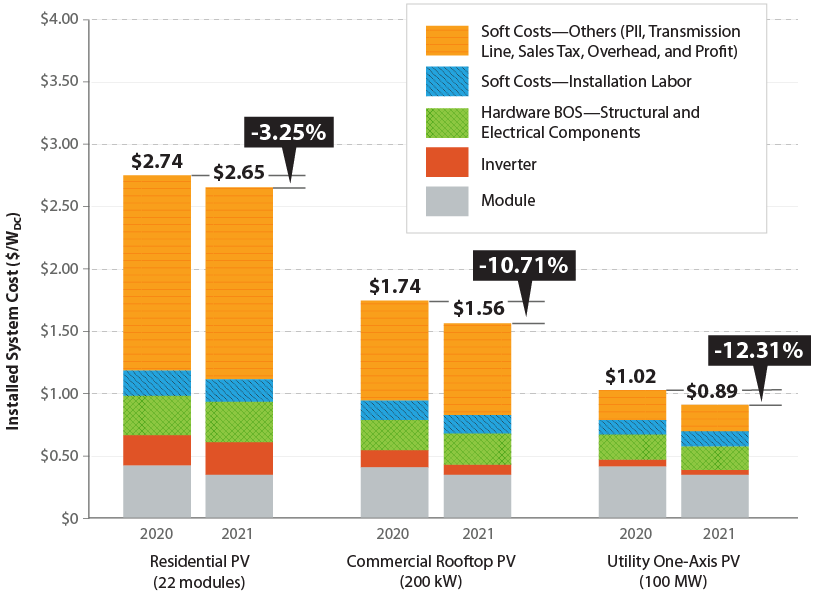
Great chart. Really hard to understand with dark theme!I always read stories about how solar is getting cheaper better.
Each time I check with local companies it is just not ... there yet for me, in the upper Midwest, even with a whole chunk of the roof facing south. Doesn't seem to be getting cheaper very quickly.
Sometimes I feel like the really cool tech progress is disconnected when it comes access on the ground / just isn't there yet for folks in not 100% ideal solar situations.
For small residential systems "soft costs" and labor are about 75% of total price now. So hardware getting 20% cheaper mean at most a 5% reduction in end user price. The hardware is already below $1/watt. That is everything from panels to bolts. So there won't be any huge cost reductions from falling hardware prices.
The falling hardware cost has really helped utility grade solar where they can take advantage of economies of scale.
Upvote
6
(6
/
0)
The outage doesn't stop them from producing power; the power just can't be used in the absence of a functioning grid. That's because the microinverters are part of an integrated system that includes the grid, power meter, and other associated hardware.
Can someone expand upon this? Why can't I just put in a large switch to change from on-grid mode to off-grid mode, like the switch described in the article, and stick with a single large inverter? In my ignorance, it sounds like this company is selling the distributed microinverter model by claiming its on-grid/off-grid ability is unique to its system.
It's actually a myth that backfeeding is the problem in the first place. You are absolutely right that this can be easily solved with a transfer switch - and you need that anyway because a battery or generator *are* allowed to power your house during an outage despite having the same backfeed problem.
The real issue is fire safety. In case of fire or other emergencies, batteries and generators can be shut off and be without power. Solar panels will generate power as long as there is light (even the light from a house fire!). That is the real reason why the National Electric Code mandates that in case of a power outage, panel arrays must be disconnected from the house network.
This product obviously does not change the NEC, so I cannot see how it can deliver what it promises.
You can already buy a solar panel and battery system that powers your house during outages?!
It’s just quite expensive at the moment because the current supply of batteries is so in demand.
Upvote
2
(2
/
0)

Panels aren't required to initiate a rapid shutdown when there is a power outage. That is handled by the inverter/transfer switch to disconnect from the grid and island the system from backfeed.Why would the grid switching be any different from that for a back-up generator. Our generator can output 18 kW and switches in and out automatically with the grid on and off. And after a storm, the noise tells us that half our neighbors also have back-up generators. This is a solved problem, and IIRC correctly the isolator switch was about $2K including installation into the house electric supply.
Generators and batteries can be turned off with a switch. Solar panels produce power whenever there is light.
That is why solar panels (at least in the US) require a rapid disconnect *directly at the array* that prevents feeding power even to the house. This rapid disconnect must trip during a power outage, as well as during several other conditions.
Rapid shut downs are for emergency use when a first responders/utility worker needs to work around the PV system in a hurry i.e. a fire.
Upvote
11
(12
/
-1)

So if the current solar inverters (the ones that feed the grid only when the grid is alive) are smart enough to detect a signal from the grid (whether by being connected to a smart meter, or just sensing the phase change caused by the 60hz of the input from the grid), why can't the inverter's "brains" just shunt it's output towards the house? Is the solar inverter producing more amperage or something in order to send power to the grid, or is the output of a normal solar inverter just not compatible with household loads?
I've never looked at a wiring diagram for how solar is wired on a house, so I'm honestly just curious at this point. I'm sure there's a reason for it all, and I'm no elechicken so I'll just have to take the word of the EE's here in the comments I guess.
I've never looked at a wiring diagram for how solar is wired on a house, so I'm honestly just curious at this point. I'm sure there's a reason for it all, and I'm no elechicken so I'll just have to take the word of the EE's here in the comments I guess.
Upvote
1
(1
/
0)
"You'd think so, but no—mostly. Solar panels affixed to homes (and other structures) that are connected to the power grid will also go kaput during power outages."
This is not always true. Mine work just fine during power outages. That's hardware specific. My invert is Pika (which is now Generac), and it powers a subpanel, which is still powered during blackouts. The subpanel takes care of most things in the house, but all the big stuff isn't on it. I was always confused why other systems like LG don't do this.
It may simply be older. Before the 2014 or 2017 edition of the NEC, solar systems that run through outages were legal, and many of those are grandfathered in. Or you might be outside the US, where the NEC does not apply.
Upvote
2
(3
/
-1)
While solar is getting cheaper, the stories we get about "solar cost reduced by xx%" is almost always referring to utility scale solar systems, not residential installs.I always read stories about how solar is getting cheaper better.
Each time I check with local companies it is just not ... there yet for me, in the upper Midwest, even with a whole chunk of the roof facing south. Doesn't seem to be getting cheaper very quickly.
Sometimes I feel like the really cool tech progress is disconnected when it comes access on the ground / just isn't there yet for folks in not 100% ideal solar situations.
The costs of panels and batteries are coming down, but as you note, it's not in free fall or anything. Now for utility scale installs it's has a hefty downward trend.
Plus, when it comes to batteries, they tend to go up rather than down nowadays. Manufacturing costs are no longer dropping, and the demand from homeowners, grid operators and car manufacturers far exceeds the cell manufacturing capacity.
Upvote
2
(3
/
-1)
david hassel
Smack-Fu Master, in training
The outage doesn't stop them from producing power; the power just can't be used in the absence of a functioning grid. That's because the microinverters are part of an integrated system that includes the grid, power meter, and other associated hardware.
Can someone expand upon this? Why can't I just put in a large switch to change from on-grid mode to off-grid mode, like the switch described in the article, and stick with a single large inverter? In my ignorance, it sounds like this company is selling the distributed microinverter model by claiming its on-grid/off-grid ability is unique to its system.
It's actually a myth that backfeeding is the problem in the first place. You are absolutely right that this can be easily solved with a transfer switch - and you need that anyway because a battery or generator *are* allowed to power your house during an outage despite having the same backfeed problem.
The real issue is fire safety. In case of fire or other emergencies, batteries and generators can be shut off and be without power. Solar panels will generate power as long as there is light (even the light from a house fire!). That is the real reason why the National Electric Code mandates that in case of a power outage, panel arrays must be disconnected from the house network.
This product obviously does not change the NEC, so I cannot see how it can deliver what it promises.
:/ you say the real reason is fire safety, but then explain a scenario of back-feeding. Yes, the NEC is National Electrical Fire Code, it does not mean that it only protects against FIRE.
Specifically, is defined in section 690.13 and every where I read about this everyone see this as an intended provision of limiting unintentional contact with energized parts through the use of a lock or a tool.
Upvote
5
(5
/
0)
I wanted to install a solar/battery backup system like this but there are two big issues:
- Almost every cost effective(i.e. reasonably priced) battery backup that works with solar is based on DC voltage coming from the solar panels. The micro inverters are great and very efficient when some panels are shaded, but once you get to the house with 240 AC output from the panels, there are no common options to attach to a battery backup(only custom.)
- This system is so new that it's still relativity expensive and you may have problems finding an installer. This issue will fade in time. I looked into this only a few months ago and solar installers were not that interested/knowledgeable on solar/battery backup systems that ran off 240 AC from the panels.
- Almost every cost effective(i.e. reasonably priced) battery backup that works with solar is based on DC voltage coming from the solar panels. The micro inverters are great and very efficient when some panels are shaded, but once you get to the house with 240 AC output from the panels, there are no common options to attach to a battery backup(only custom.)
- This system is so new that it's still relativity expensive and you may have problems finding an installer. This issue will fade in time. I looked into this only a few months ago and solar installers were not that interested/knowledgeable on solar/battery backup systems that ran off 240 AC from the panels.
Upvote
1
(1
/
0)
Per my electric bill, I'm averaging more than 30kWh/day of electrical use. So others' 10kWh battery don't seem very big to me.This is the exact system I'm having installed in November this year.
21.16kW with 30kWh battery backup. Running me about 98k, installed, before incentives.
I have an PHEV, but the battery is ~12.2 kWh, and I don't drive every day. Per the car's app, about ~56 kWh per week is used to charge it up, so that accounts for ~8kWh per day.
So, that brings me down to over 22 kWh daily use.
How much electricity are other people using? Am I an outlier?
Doesn't seem that unusual. I just checked; we are at 19 kWh daily (during air conditioning season), and that is with mostly gas appliances, and a very small but old house. At some point a few years ago, we were at twice that much due to a tenant who extensively used electric heating (we no longer have a tenant; it's just us). Replacing our windows also helped.
Upvote
1
(1
/
0)
Jesus, reading the comments here, solar is expensive in the US.
Our install here in Sweden with a 12 kWp + 10 kWh system that is backup capable ("just" needs the islanding switch gear installed to function as a whole house UPS) was ~15k USD installed (incl VAT and subsidies) in early 2021.
My 12.5kw + 18.5Kwh battery system cost me $65K, before our federal incentive.
I'm just going to go cry in a corner now.
Wowser, installed a sunsynk 8kw panels +8kw inverter +15kwh battery for 200K ZAR which is about $10K USD in Feb this year. South Africa's national power utility has been unreliable since 2008. Comes standard with all the islanding built into the inverter.
This article read as paid-for-content / advertising which I did not think Ars did
Upvote
13
(13
/
0)
Someone with more experience with grid-tie only systems can jump in here and correct me, but if I understand it correctly, grid only inverters don't have direct connections to main/sub-panels like hybrid or off-grid inverters do. There is no way for them to feed power back into the house, because a power outage cuts the power via the inverter, and the main panel is outside of that. This makes them less expensive equipment, and less expensive to install.So if the current solar inverters (the ones that feed the grid only when the grid is alive) are smart enough to detect a signal from the grid (whether by being connected to a smart meter, or just sensing the phase change caused by the 60hz of the input from the grid), why can't the inverter's "brains" just shunt it's output towards the house? Is the solar inverter producing more amperage or something in order to send power to the grid, or is the output of a normal solar inverter just not compatible with household loads?
I've never looked at a wiring diagram for how solar is wired on a house, so I'm honestly just curious at this point. I'm sure there's a reason for it all, and I'm no elechicken so I'll just have to take the word of the EE's here in the comments I guess.
Again, I could be misunderstanding that, I only have direct experience with inverters that have panel connection options.
Upvote
4
(4
/
0)

This is the exact system I'm having installed in November this year.
21.16kW with 30kWh battery backup. Running me about 98k, installed, before incentives.
That's a huge peak production figure. How much energy do you typically use in a month? I just got a system with about 4-4.5kW peak installed.
based upon the name, i would imagine this guy has an electric car that he drives for uber/lyft and therefore wants them to be available... always. It still seems very excessive to me too. Typical solar install is around 5k and this guy is 4 times that size....
Or he owns light industrial property.
Upvote
2
(2
/
0)

The outage doesn't stop them from producing power; the power just can't be used in the absence of a functioning grid. That's because the microinverters are part of an integrated system that includes the grid, power meter, and other associated hardware.
Can someone expand upon this? Why can't I just put in a large switch to change from on-grid mode to off-grid mode, like the switch described in the article, and stick with a single large inverter? In my ignorance, it sounds like this company is selling the distributed microinverter model by claiming its on-grid/off-grid ability is unique to its system.
This would be functionally no different from a generator transfer switch.
Generac 100 Amp Automatic Smart Transfer Switch w/ Power Management: $400.
Upvote
5
(5
/
0)
Reading the comments, a lot of you guys are getting brutally taken advantage of by the industry, which at least in my state doesn't surprise me. Shady salespeople and shady sales practices abound.
If you're paying significantly above $2/watt installed, or significantly more than what Tesla quotes (they don't play the games), you must shop around. Also realize those low-interest "solar loans" are regular unsecured debt, they're just paying enormous "franchise fees" to buy down that interest rate, and it's embedded in your quote. Get cash prices, get your own HELOC, you'll save a fortune.
If you're paying significantly above $2/watt installed, or significantly more than what Tesla quotes (they don't play the games), you must shop around. Also realize those low-interest "solar loans" are regular unsecured debt, they're just paying enormous "franchise fees" to buy down that interest rate, and it's embedded in your quote. Get cash prices, get your own HELOC, you'll save a fortune.
Upvote
4
(4
/
0)