
Lightweight Linux laptop crams a 99 Wh battery inside

Mr_B

Ars Scholae Palatinae
970
Li-Po batteries tend to be lighter, more stable, and have a longer life span, making them popular in smartphones. However, Li-Ion batteries tend to have higher capacities for less and slower self-discharge.

No. Lipo are capable of higher power throughput for their size, while li-ion are capable of longer runtime & lifetime for their size.
 
Upvote
35 (37 / -2)

jhodge

Ars Tribunus Angusticlavius
8,737
Subscriptor++
"Of course, there's more to how long a laptop will last before needing a charge besides battery size. Tuxedo claims the InfinityBook Pro 14 can last for "around 10 hours" with "office work and web surfing via WLAN" and up to 16 hours with the machine idle"

This calls for a reverse of the normal "will it run Linux" test. Replace Linux with Windows 11 and see what happens to the battery life.
 
Upvote
60 (61 / -1)

Jivejebus

Ars Scholae Palatinae
739
Subscriptor++
Why can't easier to replace/repair laptops (not only Linux ones) offer over 100Wh batteries (as a customer-installs it option)?
I don't need to bring it on a plane and I am responsible for my own actions. Just want more juice.

Probably because they also can't ship them by air either. Still amazed to see so few AMD laptops in the thin and light segment. Intel must really have everyone by the balls
 
Upvote
63 (65 / -2)
D

Deleted member 46272

Guest
I think a word got lost somewhere:
Li-Po batteries tend to be lighter, more stable, and have a longer life span, making them popular in smartphones. However, Li-Ion batteries tend to have higher capacities for less and slower self-discharge.

"... higher capacities for less ..... and slower self-discharge." Less volume?
 
Upvote
5 (5 / 0)

Jamjen831

Ars Scholae Palatinae
1,169
Subscriptor++
two SSDs in a Raid 0 or Raid 1 array

They should really rename RAID0, if we go with the modern meaning of "Redundant Array of Independent Disks", it really does not qualify. You are better off with just spanning across two disks. I don't think the bump in read/write is worth potentially losing the entire array.
 
Upvote
16 (21 / -5)

Little-Zen

Ars Praefectus
3,234
Subscriptor
It's specced with an Intel Core i7-12700H with eight Efficiency cores, six Performance cores, 20 threads, a turbo speed of 4.7 GHz, and a 40 W TDP. It can also hold up to an RTX 3050 TI Max-Q (4GB, 35 W TGP that can boost to up to 45 W)

I was wondering why the stated battery life seemed so low, compared to what I'd expect from a thin laptop with a battery this big.

Those specs certainly explain it. Neat idea to try and cram that much power in a thin space, but I'd be more interested in seeing what the battery life is like with the 28W 6P/8E i7 (i7-1280p) and no discrete graphics.
 
Upvote
31 (31 / 0)

50me12

Ars Tribunus Angusticlavius
7,659
> "around 10 hours" with "office work and web surfing via WLAN"

I got the honest and say my Windows experience might be tainting how much I believe any battery numbers these days and that might not be fair.

I would hope for more battery life and less focus on raw performance, but maybe that’s not really an option until we see another generation of intel processors….
 
Upvote
6 (6 / 0)
two SSDs in a Raid 0 or Raid 1 array

They should really rename RAID0, if we go with the modern meaning of "Redundant Array of Independent Disks", it really does not qualify. You are better off with just spanning across two disks. I don't think the bump in read/write is worth potentially losing the entire array.

Recently had an argument with the IT guy at work over RAID 0, which he was convinced was what RAID 1 is, and wouldn't believe me when I explained to him what it really is, because it would make no sense for it to be called RAID but have no redundancy...

(Fingers crossed that none of our servers use RAID 0!)
 
Upvote
21 (23 / -2)

ikjadoon

Ars Tribunus Militum
1,632
Subscriptor++
I'm always surprised many ultrabooks stick to the ~50 WHr range.

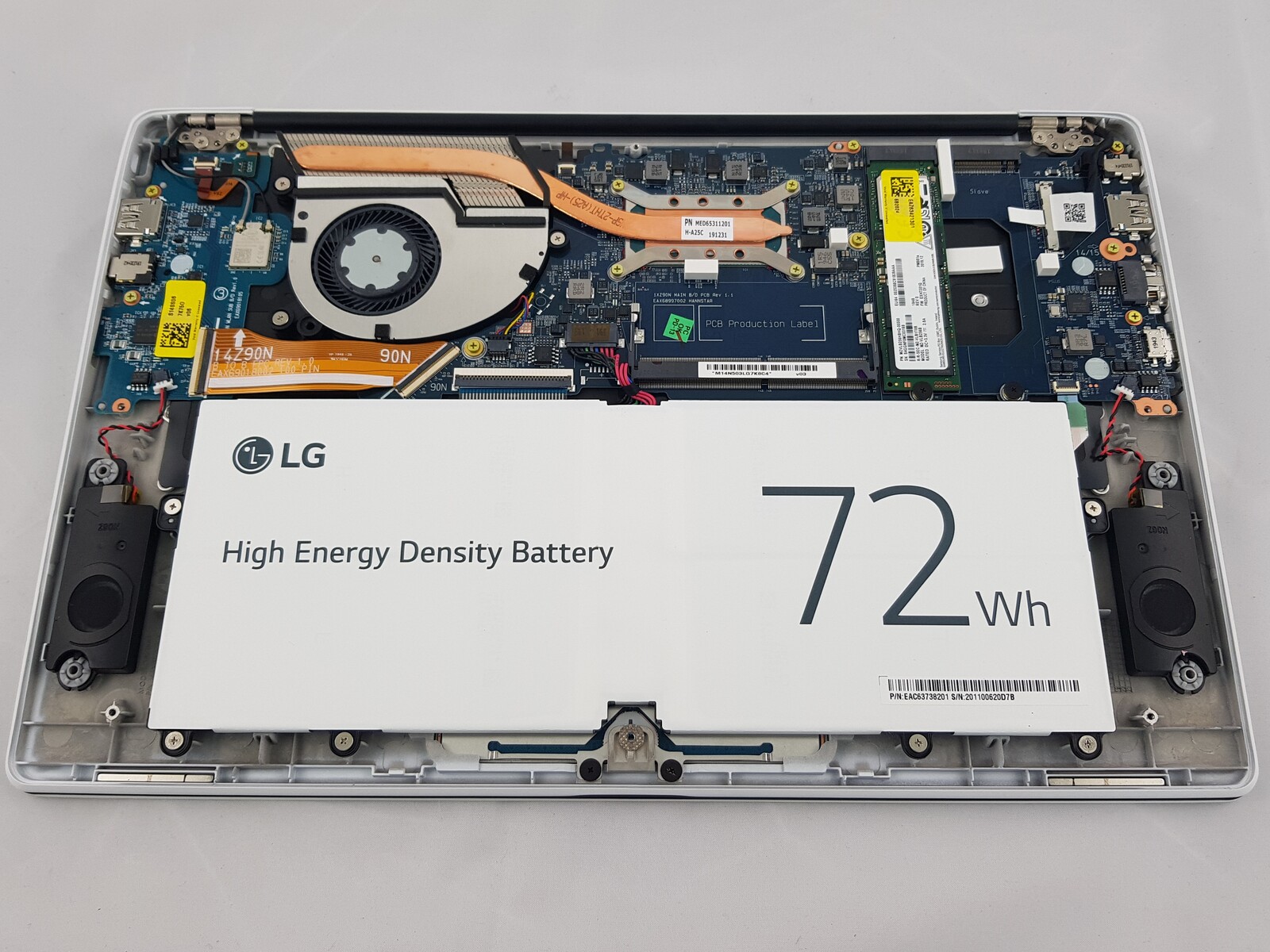
LG is a unique exception here, but still no match for this InfinityBook Pro 14. The LG Gram uses a Li-On, 72 WHr battery in a 2.2 lbs (999g) / 17mm laptop.

Side profile:

CCSehd0.png


And the kicker? The 72 WHr battery only weighs 270g = 3.75 g / WHr. From an older model, LG seems particularly proud of their in-house battery, which seemingly only LG & Samsung could even attempt:

csm_attach.mobile_2f5f47f796.jpg


But still: 99 WHr in a 14" device!? Dell, Lenovo, HP, Apple: what are you doing? Your motherboards are tiny today. Using LG's g / WHr,

50 WHr battery = ~188 g / 0.41 lb
100 WHr battery = ~375 g / 0.82 lb (+0.41 lb!)

Thus, doubling battery life is only +0.41 lb, while a 50% battery increase is just +0.20 lb more. Is the packaging (e.g., layout) and supply really that hard?
 
Upvote
31 (32 / -1)

50me12

Ars Tribunus Angusticlavius
7,659
I'm always surprised many ultrabooks stick to the ~50 WHr range.

LG is a unique exception here, but still no match for this InfinityBook Pro 14. The LG Gram uses a Li-On, 72 WHr battery in a 2.2 lbs (999g) / 17mm laptop.

Side profile:

CCSehd0.png


And the kicker? The 72 WHr battery only weighs 270g = 3.75 g / WHr. From an older model, LG seems particularly proud of their in-house battery, which seemingly only LG & Samsung could even attempt:

csm_attach.mobile_2f5f47f796.jpg


But still: 99 WHr in a 14" device!? Dell, Lenovo, HP, Apple: what are you doing? Your motherboards are tiny today. Using LG's g / WHr,

50 WHr battery = ~188 g / 0.41 lb
100 WHr battery = ~375 g / 0.82 lb (+0.41 lb!)

Thus, doubling battery life is only +0.41 lb, while a 50% battery increase is just +0.20 lb more. Is the packaging (e.g., layout) and supply really that hard?

Well Apple doesn't really have to put much work into getting more battery life with their M processors. Everyone else might want to.
 
Upvote
-10 (9 / -19)

jhodge

Ars Tribunus Angusticlavius
8,737
Subscriptor++
I'm always surprised many ultrabooks stick to the ~50 WHr range.

LG is a unique exception here, but still no match for this InfinityBook Pro 14. The LG Gram uses a Li-On, 72 WHr battery in a 2.2 lbs (999g) / 17mm laptop.

Side profile:

CCSehd0.png


And the kicker? The 72 WHr battery only weighs 270g = 3.75 g / WHr. From an older model, LG seems particularly proud of their in-house battery, which seemingly only LG & Samsung could even attempt:

csm_attach.mobile_2f5f47f796.jpg


But still: 99 WHr in a 14" device!? Dell, Lenovo, HP, Apple: what are you doing? Your motherboards are tiny today. Using LG's g / WHr,

50 WHr battery = ~188 g / 0.41 lb
100 WHr battery = ~375 g / 0.82 lb (+0.41 lb!)

Thus, doubling battery life is only +0.41 lb, while a 50% battery increase is just +0.20 lb more. Is the packaging (e.g., layout) and supply really that hard?

Well Apple doesn't really have to put much work into getting more battery life with their M processors. Everyone else might want to.

Apple also ships a 70WHr battery in the 14" MBP: "Actual rating of 69.6 watt-hours (14-inch model) or 99.6 watt-hours (16-inch model)"

https://www.apple.com/macbook-pro-14-and-16/specs
 
Upvote
36 (36 / 0)

mmiller7

Ars Legatus Legionis
12,401
"LiPo batteries tend to be smaller, more stable, and have a longer lifespan, making them popular in smartphones"

I thought it was the other way around, I keep hearing the LiPo being less stable and more hazardous when kept full (like a laptop may be working at your desk all day) vs Lithium Ion, and also as a result degrades faster?

Maybe someone can do a proper research article to publish on here about the various chemistries and compare-contrast.
 
Upvote
20 (20 / 0)

LukeSchlather

Smack-Fu Master, in training
68
Subscriptor++
two SSDs in a Raid 0 or Raid 1 array

They should really rename RAID0, if we go with the modern meaning of "Redundant Array of Independent Disks", it really does not qualify. You are better off with just spanning across two disks. I don't think the bump in read/write is worth potentially losing the entire array.

Pretty sure they did this intentionally. The raid "levels" are roughly the level of redundancy they offer. 0 offers no redundancy, that's the meaning.
 
Upvote
45 (45 / 0)
I'm always surprised many ultrabooks stick to the ~50 WHr range.

LG is a unique exception here, but still no match for this InfinityBook Pro 14. The LG Gram uses a Li-On, 72 WHr battery in a 2.2 lbs (999g) / 17mm laptop.

Side profile:

CCSehd0.png


And the kicker? The 72 WHr battery only weighs 270g = 3.75 g / WHr. From an older model, LG seems particularly proud of their in-house battery, which seemingly only LG & Samsung could even attempt:

csm_attach.mobile_2f5f47f796.jpg


But still: 99 WHr in a 14" device!? Dell, Lenovo, HP, Apple: what are you doing? Your motherboards are tiny today. Using LG's g / WHr,

50 WHr battery = ~188 g / 0.41 lb
100 WHr battery = ~375 g / 0.82 lb (+0.41 lb!)

Thus, doubling battery life is only +0.41 lb, while a 50% battery increase is just +0.20 lb more. Is the packaging (e.g., layout) and supply really that hard?

Well Apple doesn't really have to put much work into getting more battery life with their M processors. Everyone else might want to.

Apple also ships a 70WHr battery in the 14" MBP: "Actual rating of 69.6 watt-hours (14-inch model) or 99.6 watt-hours (16-inch model)"

https://www.apple.com/macbook-pro-14-and-16/specs
And for the record the new M2 MBA has a 52.6Wh li-po (good for about 12 hours)
 
Upvote
2 (2 / 0)
D

Deleted member 46272

Guest
It's specced with an Intel Core i7-12700H with eight Efficiency cores, six Performance cores, 20 threads, a turbo speed of 4.7 GHz, and a 40 W TDP. It can also hold up to an RTX 3050 TI Max-Q (4GB, 35 W TGP that can boost to up to 45 W)

I was wondering why the stated battery life seemed so low, compared to what I'd expect from a thin laptop with a battery this big.

Those specs certainly explain it. Neat idea to try and cram that much power in a thin space, but I'd be more interested in seeing what the battery life is like with the 28W 6P/8E i7 (i7-1280p) and no discrete graphics.

Intel CPU performance is 99% driven by power/thermal budgets, not by core counts.
https://meincmagazine.com/gadgets/2022/03 ... -pick-one/

The photos are showing 2 fans, implying that Tuxedo is, at least, trying to cram some cooling capacity into the laptop, but the ultimate proof will be in how well it's all implemented and tuned and how the laptop behaves under load. This laptop may or may not be marketing-driven BS.

As a single anecdotal case, I have a Lenovo T490 (that I hate) with an i7-8565U CPU, and it doesn't take much time to make it overheat and throttle WAY down into sub-GHz territory while sitting on a cool office desk because of the laptop's awful thermal design (yes, the single under-specced fan works, gets cleaned, and blows out hot air). I would have strongly preferred a lower-powered CPU that can sustain at least base speeds under sustained load, but Lenovo marketing required an i7 spec, and then got one crammed in, thermals be damned.
 
Upvote
15 (15 / 0)

psiu_glen

Wise, Aged Ars Veteran
187
It would be nice to see faster progress with ARM designs and compatibility. Even if you had a more off the shelf reference design for companies to use that required a few other companion chips (versus Apple designing everything into theirs), it would still make such a huge impact. A Linux fanless MBA equivalent, let alone with 99Wh would be amazeballs.
 
Upvote
8 (10 / -2)

Zacpod

Ars Tribunus Militum
1,811
It would be nice to see faster progress with ARM designs and compatibility. Even if you had a more off the shelf reference design for companies to use that required a few other companion chips (versus Apple designing everything into theirs), it would still make such a huge impact. A Linux fanless MBA equivalent, let alone with 99Wh would be amazeballs.

Yup! I'd love to have something like that!

No way in hell am I giving Apple any more money after they burned me twice with desoldered video chips. Plus their whole anti-right-to-repair consumer-hostile bullshit.

But I'd still love an ARM powered laptop.
 
Upvote
5 (10 / -5)

SolarPatrolman

Wise, Aged Ars Veteran
118
I don't understand this obsession with thin-ness so many electronics companies have nowadays.

I'm a sci-fi nerd from way back and think thin TVs, computers & phones are cool from an aesthetics/future-world standpoint, but when thin for thin sake gets in the way of function, ergonomics and/or affordability, no thank you.

Plus, could that sexy-n-skinny look negatively impact component durability i.e. lifespan, caused by heat issues in cramped spaces or (as far as portable gear is concerned) being handled too roughly?
 
Upvote
10 (11 / -1)

HiroTheProtagonist

Ars Tribunus Angusticlavius
6,627
Subscriptor++
I don't understand this obsession with thin-ness so many electronics companies have nowadays.

I'm a sci-fi nerd from way back and think thin TVs, computers & phones are cool from an aesthetics/future-world standpoint, but when thin for thin sake gets in the way of function, ergonomics and/or affordability, no thank you.

Plus, could that sexy-n-skinny look negatively impact component durability i.e. lifespan, caused by heat issues in cramped spaces or (as far as portable gear is concerned) being handled too roughly?

Thin usually implies lighter, and some people have a reduced carrying capacity. Thankfully I'm still capable of carrying my monster 17.3" GTX 1060 laptop, but I would imagine that the average laptop user is not interested in lugging around 7lb+ worth of laptop and charger when their needs can be met with something that weighs 3lbs and has a battery that lasts most of a day.

But you ultimately answered your own curiosity: thinner devices break more easily and tend to drive more sales from people too impatient to wait for replacements.
 
Upvote
6 (6 / 0)

niwax

Ars Praefectus
3,347
Subscriptor
Notably, the laptop uses a lithium-polymer (LiPo) battery rather than lithium-ion (Li-Ion),

Well, that's a confusing term. I saw LiPo and got *very, very* excited about the future of Lithium-Polonium batteries. My dream of an RTG powered laptop is deferred again!

Remember how worked up people got when iPhones started throttling as the battery went? Imagine how they'll react when their laptop has to run at half power in 106 years!
 
Upvote
17 (17 / 0)
D

Deleted member 46272

Guest
Why can't easier to replace/repair laptops (not only Linux ones) offer over 100Wh batteries (as a customer-installs it option)?
I don't need to bring it on a plane and I am responsible for my own actions. Just want more juice.

Probably because they also can't ship them by air either. Still amazed to see so few AMD laptops in the thin and light segment. Intel must really have everyone by the balls

... and that's where external batteries (remember those? LOL) were useful. Some laptops had internal batteries and the runtime could be supplemented by optional external batteries, which was really useful for travelers.

That said, with almost everything transitioned to USB-C PD for charging, universal battery banks/"generators" are the modern response to this, and can be had in various capacities with pretty much no limit, with the advantage that most of them can charge multiple devices and you can carry as many as you want and they come in every size and capacity. Here's a "portable" kit at 90,000 Ah:
https://www.amazon.com/a/dp/B09W9KDYFN?th=1

Good luck getting it on a plane, though!

EDIT - converted kWH to aH
 
Upvote
1 (1 / 0)

evighed

Ars Centurion
233
Subscriptor
two SSDs in a Raid 0 or Raid 1 array

They should really rename RAID0, if we go with the modern meaning of "Redundant Array of Independent Disks", it really does not qualify. You are better off with just spanning across two disks. I don't think the bump in read/write is worth potentially losing the entire array.

Pretty sure they did this intentionally. The raid "levels" are roughly the level of redundancy they offer. 0 offers no redundancy, that's the meaning.

That's not quite true. For example, take a RAID array with four drives. With RAID 1, three of them could fail and the array would continue to function just fine since the same data would be mirrored across all disks. With RAID 4 or RAID 5, if two disks failed, you lose the array, since there would no longer be sufficient parity left to reconstruct the data.

I'm not certain why they picked the numbers they did for the RAID levels. I suspect they numbered them roughly in order of algorithmic complexity.
 
Upvote
4 (6 / -2)
"LiPo batteries tend to be smaller, more stable, and have a longer lifespan, making them popular in smartphones"

I thought it was the other way around, I keep hearing the LiPo being less stable and more hazardous when kept full (like a laptop may be working at your desk all day) vs Lithium Ion, and also as a result degrades faster?

Maybe someone can do a proper research article to publish on here about the various chemistries and compare-contrast.
Last I recalled apple switched to li polymer since it is more stable. Shrug. I though the major difference was packaging.
 
Upvote
0 (0 / 0)

eldakka

Ars Tribunus Militum
1,752
Subscriptor
two SSDs in a Raid 0 or Raid 1 array

They should really rename RAID0, if we go with the modern meaning of "Redundant Array of Independent Disks", it really does not qualify. You are better off with just spanning across two disks. I don't think the bump in read/write is worth potentially losing the entire array.

Recently had an argument with the IT guy at work over RAID 0, which he was convinced was what RAID 1 is, and wouldn't believe me when I explained to him what it really is, because it would make no sense for it to be called RAID but have no redundancy...

(Fingers crossed that none of our servers use RAID 0!)

I guess, at a stretch, it could be seen as 0 == false and != 0 is true, therefore you get:
RAID 0 == RAID FALSE
and
RAID 1+ == RAID TRUE
 
Upvote
5 (5 / 0)
Those battery life numbers on the 99Wh option are really disappointing.

A friend has switched to a Mac recently for one reason alone: battery life. He's a lifelong Windows user and wasn't entirely happy with everything he has to adapt to, but alas, battery life is the killer feature to him. He now goes on three day business trips without bringing a charger. Linux and Windows really need to up their battery life game A LOT if they want to compete.
 
Upvote
4 (6 / -2)

eas

Ars Scholae Palatinae
1,313
Why can't easier to replace/repair laptops (not only Linux ones) offer over 100Wh batteries (as a customer-installs it option)?
I don't need to bring it on a plane and I am responsible for my own actions. Just want more juice.

Because most people who want laptops don't want to pay for a laptop they can't travel with and those that do are so few that they won't want to pay the cost that comes with tiny production runs.
 
Upvote
7 (7 / 0)

eas

Ars Scholae Palatinae
1,313
"LiPo batteries tend to be smaller, more stable, and have a longer lifespan, making them popular in smartphones"

I thought it was the other way around, I keep hearing the LiPo being less stable and more hazardous when kept full (like a laptop may be working at your desk all day) vs Lithium Ion, and also as a result degrades faster?

Maybe someone can do a proper research article to publish on here about the various chemistries and compare-contrast.
Last I recalled apple switched to li polymer since it is more stable. Shrug. I though the major difference was packaging.

Distinctions between LiPo and Lithium Ion batteries are effectively meaningless. Rather than conveying information, the distinction sows confusion. People misuse "LiPo" to describe different things that are just variations on Lithium Ion battery chemistry and configuration.
 
Upvote
4 (4 / 0)

wirrbeltier

Wise, Aged Ars Veteran
182
"Of course, there's more to how long a laptop will last before needing a charge besides battery size. Tuxedo claims the InfinityBook Pro 14 can last for "around 10 hours" with "office work and web surfing via WLAN" and up to 16 hours with the machine idle"

This calls for a reverse of the normal "will it run Linux" test. Replace Linux with Windows 11 and see what happens to the battery life.

I have the predecessor from Tuxedo's parent company (Schenker Via Pro 14) with a Ryzen 4600H, no dGPU and the same 99Wh battery (FullHD display though). It has dualboot Windows 10/Ubuntuand runs >16h for light usage on both. Fantastic machine in almost every respect, especially with maxed-out 64GB RAM.

Tuxedo and Schenker did not design the laptop btw, they are upscale barebone assembly shops with a reputation for good customer support. In this case, the hardware is based on a Tongfang barebone that you are likely to find under various brand names also in the US.
 
Upvote
15 (15 / 0)

cerata

Ars Centurion
239
Subscriptor
I don't understand this obsession with thin-ness so many electronics companies have nowadays.

I'm a sci-fi nerd from way back and think thin TVs, computers & phones are cool from an aesthetics/future-world standpoint, but when thin for thin sake gets in the way of function, ergonomics and/or affordability, no thank you.

Plus, could that sexy-n-skinny look negatively impact component durability i.e. lifespan, caused by heat issues in cramped spaces or (as far as portable gear is concerned) being handled too roughly?

I'm certainly glad smartphones have backed off from the "thinness for thinness's sake" aesthetic since the mid-2010s.

For laptops though, I'm studying again this year, and have to carry pen & paper, printed manuals etc, around with me. My laptop is about 20mm thick. Even if the weight was the same, if I moved to something thicker, I'd have to carry a bulkier bag around everywhere. I already tend to leave the charger at home to save space.
 
Upvote
5 (5 / 0)

jhodge

Ars Tribunus Angusticlavius
8,737
Subscriptor++
"Of course, there's more to how long a laptop will last before needing a charge besides battery size. Tuxedo claims the InfinityBook Pro 14 can last for "around 10 hours" with "office work and web surfing via WLAN" and up to 16 hours with the machine idle"

This calls for a reverse of the normal "will it run Linux" test. Replace Linux with Windows 11 and see what happens to the battery life.

I have the predecessor from Tuxedo's parent company (Schenker Via Pro 14) with a Ryzen 4600H, no dGPU and the same 99Wh battery (FullHD display though). It has dualboot Windows 10/Ubuntuand runs >16h for light usage on both. Fantastic machine in almost every respect, especially with maxed-out 64GB RAM.

Tuxedo and Schenker did not design the laptop btw, they are upscale barebone assembly shops with a reputation for good customer support. In this case, the hardware is based on a Tongfang barebone that you are likely to find under various brand names also in the US.

Intel’s NUC laptop kits are also based on a Tongfang chassis, I believe.
 
Upvote
9 (9 / 0)