
You are using an out of date browser. It may not display this or other websites correctly.
You should upgrade or use an alternative browser.
You should upgrade or use an alternative browser.
LG joins the rest of the world, accepts that people don’t want 8K TVs
- Thread starter JournalBot
- Start date
4320p/8K does have its uses. Chiefly, I think it would be useful in some conference room/signage applications, or maybe signage/advertising.
But buying four borderless 4K displays is probably easier for those who don't mind the seams.
But buying four borderless 4K displays is probably easier for those who don't mind the seams.
Upvote
5
(9
/
-4)
Post content hidden for low score.
Show…
As always, I'll argue that the real application for higher resolutions like this is on the desktop. Plenty of people use 2-4 27-30" 4K screens, and it would be really nice to replace those with one larger one that doesn't sacrifice pixel density.
Upvote
44
(44
/
0)

The only 8K content I've seen is demo reels in shops, and it did look really better than 4K from a distance -- I find those distance charts don't match reality, to me higher res does look better even if you're "too far" away. Having said that I wouldn't want an 8K TV, mostly because I don't have enough TB of storage and downloading an 8K UHD would take forever!
What I want in a TV is some sort of really good upscaling so I can watch my Xena: Warrior Princess DVDs in 4K. Perhaps an article on what's out there in up-scaling land? I haven't looked recently.
What I want in a TV is some sort of really good upscaling so I can watch my Xena: Warrior Princess DVDs in 4K. Perhaps an article on what's out there in up-scaling land? I haven't looked recently.
Upvote
26
(26
/
0)

Reality check: watching a 2K vs. 4K movie at my computer monitor I can definitely see a difference. And that's not even mentioning how crisper 4K text looks in the OS. Perhaps you just need new glasses?Reality check: almost no one needs or benefits from 4k over 1080p either.
2k is fine for ~98% of people.
Now give me good color depth, consistent frame rates, and fewer compression artifacts.
Upvote
4
(28
/
-24)
It's kinda tricky, though. I've got a 109" screen. I'd have to sit like 2m away from it to 'get the benefit' of 8K - but that's way too close to actually watch things in any sort of comfort.I think of “8K” as pretty different from weird TV gags of the past like curved screens or 3D. Fundamentally, resolution just part of the spec sheet like other display quality hardware details.
If we start trending toward TVs with 4x the area, higher resolution for similar pixel density could make plenty of sense, even if the content always lags behind.
If you look through the graphic that's in the article, that pretty much holds true at all sizes/distances. I don't see any 8K-enhanced display size / viewing distance pair that I'd characterize as a pleasant viewing situation. Do you want to sit 1M from a 50" TV?!
It's only really useful for situations where you're not actually looking at the full picture, but those are fairly niche. OK, maybe a 50" desktop monitor, but meh, still feels like overkill. Other than that it's like...art gallery video installations, and stuff...
Upvote
5
(9
/
-4)
Demo reels in shops are full of lies. They usually adjust various other settings than the one they claim to be demoing (making them worse on the 'before' TV and better on the 'after' TV, obviously).The only 8K content I've seen is demo reels in shops, and it did look really better than 4K from a distance -- I find those distance charts don't match reality, to me higher res does look better even if you're "too far" away. Having said that I wouldn't want an 8K TV, mostly because I don't have enough TB of storage and downloading an 8K UHD would take forever!
What I want in a TV is some sort of really good upscaling so I can watch my Xena: Warrior Princess DVDs in 4K. Perhaps an article on what's out there in up-scaling land? I haven't looked recently.
Upvote
34
(34
/
0)
I think those numbers are quite conservative.I mean, apart from the HDR part (which is technically orthogonal, but in practice is bundled together), this is mostly true for 4K as well. A 55" 1080p TV is "retina" at a bit over 7 foot viewing distance. A 65" 1080p TV is "retina" at bit under 8.5 feet. Bigger TVs exist obviously, but I wouldn't say that >65" TVs are particularly common.
I can see a one pixel wide gap between two parallel one-pixel thick horizontal black lines on a white background on my 55" 4K TV at a distance of 6 feet (I can differentiate between that and a 3-pixel thick gray line of equivalent brightness). And with the whole Nyquist frequency thing, you'd have to have a much higher resolution to be able to display any image such that a human couldn't discern any difference at a higher resolution... if the two parallel lines were offset by half a pixel, they would be displayed as one thicker gray line.
Upvote
15
(16
/
-1)

Same here. I noticed very little difference going from 1080p to 2160p. I noticed a huge difference going from SDR to wide gamut HDR.I will say that I can appreciate going from 1080p to 2160p at normal viewing distances on my 55" TV, but what I appreciate more is the move to 10-bit color and HDR. I am certain I would see no benefit to 4320p at normal viewing distances for any screen size. Well-mastered UHD Blu-rays look amazing, but I don't think 35mm film offers much more than 4K resolution in practice and few movies were filmed on larger formats. For home delivery, 8K is a joke.
EDIT: I enjoyed 720p and a 1080p projectors on a 100" screen for years, too.
I even noticed a difference when I enabled xvYCC support in my 1080p plasma with an appropriate source.
Upvote
9
(10
/
-1)
Now if they would only take a decent sized 8k panel and make a proper computer monitor out of it.
I have the Samsung 7680x2160 monitor, but would really like more vertical screen. It seems like most monitors are small and/or more focused on refresh rate than quality of rendering or DPI.
I have the Samsung 7680x2160 monitor, but would really like more vertical screen. It seems like most monitors are small and/or more focused on refresh rate than quality of rendering or DPI.
Upvote
15
(15
/
0)

Pity. I was hoping they'd fall in price as a good display option for my 45 to 60MP digicam photos. (8K is ~32MP)
Upvote
12
(12
/
0)
this is about TVs, which people are probably mostly using to watch compressed 1080p streams from 10+ feet away, not reading text up close and doing comparisons to look for flaws.Reality check: watching a 2K vs. 4K movie at my computer monitor I can definitely see a difference. And that's not even mentioning how crisper 4K text looks in the OS. Perhaps you just need new glasses?
Upvote
36
(39
/
-3)
A few years ago, needing a new tv, we bought a TCL 55" TV that was on sale and happened to be 4K. I'm always impressed by HD because I grew up with a 17" black and white tube TV in the 1960s. Eventually more and more 4K content started showing up. The first time I noticed it was during an Olympics for track & field. I looked at the stands across from the camera and noticed something strange. When I walked up to the TV, I could see the individual heads of the audience members, something that would have been impossible before 4K. More recently, I've noticed that for scenes of natural landscapes, 4K provides a lot more detail and realism and improves the viewing experience. Overall, though, HD is generally still excellent As always, of course, the refresh rate is really important. I think that we have 60K in our TV, and sometimes when the camera is panning, I notice a slight stuttering of the image. Maybe 120K would help smooth that out, but I'm not interested in spending more money for that until this set dies.I wonder how many of the 4K purchase are due to being the only thing available in the mid to large sizes rather then some desire by the buyer to 'upgrade' to the full 4K experience?
Seems my 55" FHD TV is at the near perfect distance from the sofa. Plenty good enough for me but then I grew up when the 25" Color console TV was the high end standard. Think that TV in the Lovell household in the Apollo 13 movie.
Upvote
21
(22
/
-1)
My AppleTV 4k (OG) was lagging on my 4k 50" TV, so I set it to 1080p instead. Pepped it right up, and could hardly tell the difference.
I love my 5k computer monitor @ 5k.
Right tool (resolution) for the right job. TV has never needed super resolution.
I love my 5k computer monitor @ 5k.
Right tool (resolution) for the right job. TV has never needed super resolution.
Upvote
-4
(6
/
-10)
Big, high-rez computer monitors are one thing, where you really accumulate meaningful pixel real estate going north of 1080p.
But the God's honest truth is I don't even remember if the 55ish inch screen in the living room is 1080p or 4k.
But the God's honest truth is I don't even remember if the 55ish inch screen in the living room is 1080p or 4k.
Upvote
16
(18
/
-2)

Gnafu the Great
Ars Centurion
Just a note: refresh rates are in Hz, so 60 Hz is common and 120 Hz is nicer. No thousands.A few years ago, needing a new tv, we bought a TCL 55" TV that was on sale and happened to be 4K. I'm always impressed by HD because I grew up with a 17" black and white tube TV in the 1960s. Eventually more and more 4K content started showing up. The first time I noticed it was during an Olympics for track & field. I looked at the stands across from the camera and noticed something strange. When I walked up to the TV, I could see the individual heads of the audience members, something that would have been impossible before 4K. More recently, I've noticed that for scenes of natural landscapes, 4K provides a lot more detail and realism and improves the viewing experience. Overall, though, HD is generally still excellent As always, of course, the refresh rate is really important. I think that we have 60K in our TV, and sometimes when the camera is panning, I notice a slight stuttering of the image. Maybe 120K would help smooth that out, but I'm not interested in spending more money for that until this set dies.
Upvote
17
(18
/
-1)
I may have been ninja'd but as a 8+ year OLED owner, it's huge. It's literally the panel I'd been waiting for since I started having opinions about image quality as a teenager.I’m still perfectly happy with my 1080p TV. Don’t get me wrong, I look forward to upgrading when we next move and I know what size makes most sense but getting HDR and those perfect OLED blacks seems like a bigger upgrade than 4K. Especially given that many games on PS5 don’t render in 4K and 4K streaming can be perceptually similar to 1080p (depending on the streaming service).
Upvote
13
(13
/
0)

Reality check: watching a 2K vs. 4K movie at my computer monitor I can definitely see a difference. And that's not even mentioning how crisper 4K text looks in the OS. Perhaps you just need new glasses?
For my monitor there's a clear and definite difference in image quality between 2k and 4k. Text, especially, is clearly better at 4k.
But for television? Nope. I don't sit nearly as close, and I don't stare at at the same small high contrast area for minutes at a time.
Upvote
35
(36
/
-1)
We have a decent home screening setup, 4K 86” OLED in a 4.5m x 3.5m darkened room (there’s usually only 2 of us watching). Both my husband and I were filmmakers for most of our professional lives so we’ve always spent money on good hardware (it’s tax deductible so that helps). We didn’t go for 8K, because we’d have needed a new house to benefit.It's a great resolution for TVs over 90-inches.
Are home cinemas still popular?
And if you have the disposable income, a video wall is what you want over 100-inches. I think you need P1.2 and under for 8K.
Cheapy route is a projector.
The biggest improvements we’ve had in viewing quality was in moving to an 11.2 audio system with a good amplifier, and going to an OLED screen. Good audio - and good blacks - are much more important than resolution.
Upvote
42
(42
/
0)
if knocking a bit off the price for an otherwise equivalent 1080p screen was an option, I'd absolutely go for it.I wonder how many of the 4K purchase are due to being the only thing available in the mid to large sizes rather then some desire by the buyer to 'upgrade' to the full 4K experience?
Seems my 55" FHD TV is at the near perfect distance from the sofa. Plenty good enough for me but then I grew up when the 25" Color console TV was the high end standard. Think that TV in the Lovell household in the Apollo 13 movie.
Upvote
-4
(2
/
-6)
I was so disappointed when watching the Champions League this year and not getting it in 4K. It really is a noticeable difference. I get really excited when the team I want to watch is on the Premier League "Ultra" broadcast. 4K and none of the American added pregame, halftime and postgame nonsense.Im not surprised. were even going backwards on 4k in live TV sports coverage. UEFA football dropped 4k coverage because it was deemed too costly for the TV stations to mix and deal in live 4k 50/60hz hdr content. some of the most watched sports event on the planet and they deemed 1080p to be acceptable after giving us 4k for years.
Upvote
13
(13
/
0)
BadSuperblock
Ars Praefectus
I will say that I can appreciate going from 1080p to 2160p at normal viewing distances on my 55" TV, but what I appreciate more is the move to 10-bit color and HDR.
100% true and the reason is, the increase to 8K is not perceivable at every viewing distance, but with advancements like 10-bit color, HDR, and wide color gamut, you can see the difference at ANY viewing distance so those become more valuable than pixel resolution.
The other problem with 8K is that TV is a motion medium, the image doesn't stay still. People and things are always moving on the screen. Why is that important? Because you can only see the difference between 4K and 8K if you can see detail only one pixel wide. The instant any image detail blurs across just one more pixel, the true resolution has been cut in half because now that detail covers two pixels.
I would buy an 8K panel for only one reason (if I ever had this need): There are people who buy a 4K monitor so they can view four 1080p streams on one panel, for TV production, security cameras, etc. An 8K panel would allow viewing four 4K streams on one panel.
Upvote
10
(10
/
0)
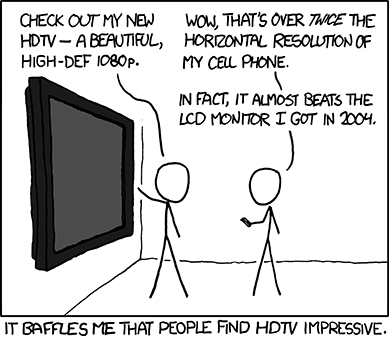
For TVs, sure (at your normal TV sizes and viewing distances). For PC screens, absolutely not -- people sit much closer! 1080p on a PC has been sadness from Day 1. Typical monitor resolutions actually went DOWN for a few years because of that 1080p nonsense.Reality check: almost no one needs or benefits from 4k over 1080p either.
2k is fine for ~98% of people.
If having more resolution than I actually need on my TV is a side-effect of having a decent PC display, I'll happily pay that tax.
Last edited:
Upvote
39
(41
/
-2)

Good. Now, if we can just get some decent 5K2K monitors, then they can take that money from me instead.
Upvote
2
(2
/
0)
bolomkxxviii
Ars Praetorian
You forget VCRs were around 300 lines of resolution.Bah, you call that cranky? 640 x 480 ought to be enough for anybody.
Upvote
14
(14
/
0)
To a large extent, the bigger screens are used for viewing from further away. I doubt there’s much interest in viewing from a distance less than the screen width, and then 4K or at most 5K is the limit of what most eyes can resolve.I think of “8K” as pretty different from weird TV gags of the past like curved screens or 3D. Fundamentally, resolution just part of the spec sheet like other display quality hardware details.
If we start trending toward TVs with 4x the area, higher resolution for similar pixel density could make plenty of sense, even if the content always lags behind.
P. S. This is for TV usage: monitors can be viewed closer relative to screen size, and may benefit from going beyond 5K or 6K.
Last edited:
Upvote
4
(5
/
-1)
Yeah no sh*t. To benefit from 8K you’ll either need to sit super close to conventional TV sizes or have gigantic screens at conventional viewing distances. Not to mention the bandwidth and processing power required for all those pixels. Just a solution looking for a problem no one has or wants.
I mean, PERSONALLY I've wanted one for a massive single tv-as-a-monitor, so I wouldn't say it's a "problem" NO ONE has. But equally, this is coming from someone who has been abusing 4k TVs for monitors since as soon as she could afford ones in the 40ish inch range (original Seiki 39" =^o^= haha).
Since I've regularly run 4k@43" at a normal monitor distance and 100% scaling for years now, I figured a ~60" 8k at maybe 150% scaling would be very nice for a massive single screen desktop.
But other than that type of pedantically nit picking (lol) over a relatively niche case, I'd basically agree. They were never going to take off well enough as TVs for prices to drop, they were always going to be more expensive to make even then, and the increase in visual quality is even harder to notice compared to the difference from 1080p to 4k, making it that much harder to justify the steep price jump, even before the issues with content availability and delivery.
Worse, in terms of "regular"/general marketing, 8k sounds like it's only 2x 4k, when really it represents 4x 4k in pixel count. Many people struggle to really see much difference between 1080p and 4k in normal motion content at comfortable distances anyway, so selling them on 8k feels like an extra uphill climb. 4k tvs at least got to "cheat" by switching from "line" count (e.g. 480p, 720, 1080p) to horizontal pixel count, so it inherently sounds like it's ~4x 1080p... which it essentially really is, so it wasn't even a misrepresentation as such. 8k needed to switch to megapixel count to get the same immediate impression.
Upvote
11
(11
/
0)
I have the Dell UP3218K (which I understand is now discontinued). For the right content it's glorious. I mostly don't use it because my multi-monitor 3x4K+5K setup is more convenient and brighter. (Worryingly two of the LG panels have cracked their bezels somehow, which worries me about their longevity - but then the big fell Dell runs hot.) I'm not really a fan of 32" monitors - it looms - but if I'm going to use one I'm glad it's 8K. I can't imagine tolerating 4K at that size.
I'm perfectly fine with a 4K TV. I can take 8K video myself, but in general the content isn't there for TV use.
I gather FHD is still the most popular gaming resolution on Steam. I hope we'll ramp that up over time, but since gamers seem to care more about 300Hz displays than more pixels it seems it'll take time. A shame, because for non-gaming resolution matters more (and even gaming a 4K TV and a PS4 Pro was a big step up from FHD).
Back in the 2000s I ran a PC up to 8K by using two graphics cards each running two T221s (3840x2400 22") IIRC - only for fun, and only one of them was mine. I didn't expect that still to be such a stretch two decades later.
I'm perfectly fine with a 4K TV. I can take 8K video myself, but in general the content isn't there for TV use.
I gather FHD is still the most popular gaming resolution on Steam. I hope we'll ramp that up over time, but since gamers seem to care more about 300Hz displays than more pixels it seems it'll take time. A shame, because for non-gaming resolution matters more (and even gaming a 4K TV and a PS4 Pro was a big step up from FHD).
Back in the 2000s I ran a PC up to 8K by using two graphics cards each running two T221s (3840x2400 22") IIRC - only for fun, and only one of them was mine. I didn't expect that still to be such a stretch two decades later.
Upvote
-2
(1
/
-3)

fellow human
Ars Praefectus
heh there are already headsets calling themselves 8K due to having two 4K panels8K 2inch VR will be useful

(mind you there's an argument to be made that when you overlay two displays, one per eye, and each renders a different perspective on the scene that your brain does perceive more detail than the resolution of one panel would suggest)
Upvote
0
(0
/
0)
To a large extent, the bigger screens are used for viewing from further away. I doubt there’s much interest in viewing from a distance less than the screen width, and the 4K or at most 5K is the most that most eyes can resolve
IMAX would like to argue with you, given suitable content. As for a monitor, my eyes are stuffed, being able to lean in and barely resolve pixels is very nice - but I appreciate that's a minority case.
Upvote
9
(9
/
0)
I haven't kept up with computer display tech
since I haven't felt a need to buy a monitor in a long time but I'm noticing the manufacturers seem to be pushing those same weird curved screens onto workstation users these days. A sizable portion of these new monitors are already showing at my local Goodwill's as I assume people buy and tire of those quickly. Meanwhile older models are becoming harder to find there.
It feels like history repeating itself.
Curved TVs didn't make much sense, but curved monitors absolutely do. You sit much closer to a monitor than a TV, and you're the only viewer. This means you sit at a focal point, so to speak. It makes a big difference with wider aspect ratios like 21:9 and 32:9, where you have lots of pixels on the periphery.
I've had curved monitors for years and have zero desire to go back to a flat screen. Most of my friends have the same. It just makes sense once you experience it.
That being said, I'm not into a super curved one like some of the extreme gaming monitors. A light curve is perfect. Seems the industry is also understanding this, as even Samsung's newer G9s have eased up on the curvature.
Upvote
19
(19
/
0)
Now if they would only take a decent sized 8k panel and make a proper computer monitor out of it.
I have the Samsung 7680x2160 monitor, but would really like more vertical screen. It seems like most monitors are small and/or more focused on refresh rate than quality of rendering or DPI.
Have you seen Dell's new 6k monitor? Looks amazing. 6144 x 2560 at 120Hz
View: https://www.youtube.com/watch?v=rmiB2NnXgPU
Upvote
3
(8
/
-5)
SinclairZX81
Ars Praefectus
That didn't work the last two times they tried it. Until they can do one that doesn't require glasses or goggles, it's another dead idea.Oh, good. Now they will start trying to shove 3D TVs down our throats.
Upvote
0
(3
/
-3)

I mean... I'd love to have an 8k TV just for Baraka, which would allow it to have a true 1:1 reproduction with the 65/70mm original print - and when they did the 1080p Blu-ray restoration, they apparently did scan it at 8k, so it's already technically been made.
But while I adore Baraka (and I blame my university film studies teacher for that haha), um, I don't know what else I'd watch with that kind of need for detail and quality. 4k is plenty fine enough as an upper limit, and if you're doing streaming of 4k, companies keep compressing the quality more and more, even as the resolution stays the same, because 4k is bandwidth-hungry.
But while I adore Baraka (and I blame my university film studies teacher for that haha), um, I don't know what else I'd watch with that kind of need for detail and quality. 4k is plenty fine enough as an upper limit, and if you're doing streaming of 4k, companies keep compressing the quality more and more, even as the resolution stays the same, because 4k is bandwidth-hungry.
Upvote
9
(9
/
0)
Gnafu the Great
Ars Centurion
Audio really is the most important thing. Heck, even just my 3.0 setup with budget speakers blows me away sometimes. It's funny to think there are probably people rocking 8K TVs with just the built-in speakers or a sound bar...We have a decent home screening setup, 4K 86” OLED in a 4.5m x 3.5m darkened room (there’s usually only 2 of us watching). Both my husband and I were filmmakers for most of our professional lives so we’ve always spent money on good hardware (it’s tax deductible so that helps). We didn’t go for 8K, because we’d have needed a new house to benefit.
The biggest improvements we’ve had in viewing quality was in moving to an 11.2 audio system with a good amplifier, and going to an OLED screen. Good audio - and good blacks - are much more important than resolution.
Upvote
15
(16
/
-1)
MysteryMii215
Wise, Aged Ars Veteran
I think 4K is pretty much the point of diminishing returns when it comes to resolution. It’s high enough that it looks good on even the biggest of screens without putting even more strain on the content production pipeline (especially when a lot of things being released even to this day are still stuck at 1080p/2K resolution) or when running games without upscaling.
Upvote
12
(14
/
-2)