
You are using an out of date browser. It may not display this or other websites correctly.
You should upgrade or use an alternative browser.
You should upgrade or use an alternative browser.
James Webb Telescope
- Thread starter Arizona Cat
- Start date


The best imaging of Neptune's rings since the Voyager 2 flyby in 1989.

Yep, that bright spot is Triton and not a star. It's covered with solid nitrogen which has an albedo of roughly 0.7, whereas Neptune's methane-rich clouds absorb more of the near-IR light and so look comparatively darker in Webb's eyes. The brighter parts of Neptune in the image are from methane ices that reflect more sunlight than its gaseous form, so they show up better.
These are only half of Neptune's known moons.
Yep, that bright spot is Triton and not a star. It's covered with solid nitrogen which has an albedo of roughly 0.7, whereas Neptune's methane-rich clouds absorb more of the near-IR light and so look comparatively darker in Webb's eyes. The brighter parts of Neptune in the image are from methane ices that reflect more sunlight than its gaseous form, so they show up better.
These are only half of Neptune's known moons.


Epic
We really need New Horizons style missions for Neptune and Uranus. We ought to be at a point where building a "good enough" probe and yeeting it toward something interesting can be routine and not require decades of development and funding.
Granted, if the mission profile requires an RTG like New Horizons did that's probably not practical to have spares laying around
We really need New Horizons style missions for Neptune and Uranus. We ought to be at a point where building a "good enough" probe and yeeting it toward something interesting can be routine and not require decades of development and funding.
Granted, if the mission profile requires an RTG like New Horizons did that's probably not practical to have spares laying around

The problem with Uranus and Neptune is the travel time is always going to be very long (decade plus), and it's best done in certain orbital transfer windows that only show up every decade-ish. Ensuring that the mission team is still around by the time the probe reaches its destination is tricky.
There are several proposals for such missions, typically as flybys (shedding that delta-v on arrival is hard!):
* https://en.wikipedia.org/wiki/Explorati ... d_missions
* https://en.wikipedia.org/wiki/Explorati ... e_missions
There are several proposals for such missions, typically as flybys (shedding that delta-v on arrival is hard!):
* https://en.wikipedia.org/wiki/Explorati ... d_missions
* https://en.wikipedia.org/wiki/Explorati ... e_missions

The problem with Uranus and Neptune is the travel time is always going to be very long (decade plus), and it's best done in certain orbital transfer windows that only show up every decade-ish. Ensuring that the mission team is still around by the time the probe reaches its destination is tricky.
There are several proposals for such missions, typically as flybys (shedding that delta-v on arrival is hard!):
* https://en.wikipedia.org/wiki/Explorati ... d_missions
* https://en.wikipedia.org/wiki/Explorati ... e_missions
If Venus Express can use Venus's atmosphere to shed delta-V, why not the atmosphere of a gas giant?
If Venus Express can use Venus's atmosphere to shed delta-V, why not the atmosphere of a gas giant?
Are you sure about that? Venus Express did some very low orbit passes for atmospheric sampling at the end of the mission, but I believe all of their orbital insertion burns were conventional ones. Using an atmosphere for aerobraking for orbital insertion is dangerous, because atmospheres are not at all uniform.

If Venus Express can use Venus's atmosphere to shed delta-V, why not the atmosphere of a gas giant?
Are you sure about that? Venus Express did some very low orbit passes for atmospheric sampling at the end of the mission, but I believe all of their orbital insertion burns were conventional ones. Using an atmosphere for aerobraking for orbital insertion is dangerous, because atmospheres are not at all uniform.
Isn't RKLB planning just such a thing? (I honestly haven't seen the mission profile, but I thought I had read this somewhere)
If Venus Express can use Venus's atmosphere to shed delta-V, why not the atmosphere of a gas giant?
Are you sure about that? Venus Express did some very low orbit passes for atmospheric sampling at the end of the mission, but I believe all of their orbital insertion burns were conventional ones. Using an atmosphere for aerobraking for orbital insertion is dangerous, because atmospheres are not at all uniform.
I was confused about which planet and didn't follow the rabbit hole deep enough. Mars Global Surveyor aerobraked around Mars. It seems the later Venus Express passes were a test for ExoMars Trace Gas Orbiter. On the other hand, as you point out, none was used for insertion, just to lower the apo<adjective>. On the gripping hand, Neptune requires less delta V than Saturn for capture. And only about 240 meters per second more than just getting to Pluto. According to this delta-V map, anyway.
You can use 'apoapsis' and 'periapsis' genericallyapo<adjective>.

I'm no rocket surgeon, but I've killed my share of Jebs.If Venus Express can use Venus's atmosphere to shed delta-V, why not the atmosphere of a gas giant?
Are you sure about that? Venus Express did some very low orbit passes for atmospheric sampling at the end of the mission, but I believe all of their orbital insertion burns were conventional ones. Using an atmosphere for aerobraking for orbital insertion is dangerous, because atmospheres are not at all uniform.
I was confused about which planet and didn't follow the rabbit hole deep enough. Mars Global Surveyor aerobraked around Mars. It seems the later Venus Express passes were a test for ExoMars Trace Gas Orbiter. On the other hand, as you point out, none was used for insertion, just to lower the apo<adjective>. On the gripping hand, Neptune requires less delta V than Saturn for capture. And only about 240 meters per second more than just getting to Pluto. According to this delta-V map, anyway.
I think that delta-V map is misleading you. If the proposals on the table are for a flyby, then it wouldn't be following a transfer trajectory, and the delta-V to do orbital insertion would be a lot higher.
Think softball lob that just reaches home plate vs a fastball flying right over it. The softball is a Hohmann transfer. The fastball means a lot less time spent waiting (and paying for mission operations staff).
NASA announced a mechanical problem with one of Webb's instruments earlier this week. Frome the link:
NASA has stopped using the MRS mode until they resolve the issue.
The James Webb Space Telescope’s Mid-Infrared Instrument (MIRI) has four observing modes. On Aug. 24, a mechanism that supports one of these modes, known as medium-resolution spectroscopy (MRS), exhibited what appears to be increased friction during setup for a science observation. This mechanism is a grating wheel that allows scientists to select between short, medium, and longer wavelengths when making observations using the MRS mode. Following preliminary health checks and investigations into the issue, an anomaly review board was convened Sept. 6 to assess the best path forward.
NASA has stopped using the MRS mode until they resolve the issue.

JWST produces another stellar image. While I'm impressed by all of the things we'll be able to learn from these instruments, these photos are just awe inspiring. I don't think I'll ever get tired of seeing "new image from JWST" announcements.


Aren't pretty much all of JWST's images stellar, by definition? 

Same thing crossed my mind. Which definition of “stellar” were you using? I settled on and agreed with “both.”
Not if they're planetary or lunar.Aren't pretty much all of JWST's images stellar, by definition?
another amazing picture from Webb
https://www.nasa.gov/sites/default/files/thumbnails/image/ngc7496.png

https://www.nasa.gov/sites/default/files/thumbnails/image/ngc7496.png

What is that? I’m an astronomy dummy and the title doesn’t give me any clues.
It's NGC 7496, which is a barred spiral galaxy only a quick 24 million light years away in Grus.
https://esawebb.org/images/weic2306c/The bright spot in the middle that causes the starring is an active galactic nucleus.
It's false color: everything you see in that image is infrared. It was taken by the MIRI instrument on Webb.
https://esawebb.org/images/weic2306c/The bright spot in the middle that causes the starring is an active galactic nucleus.
It's false color: everything you see in that image is infrared. It was taken by the MIRI instrument on Webb.

This is really cool, movies on the NASA site
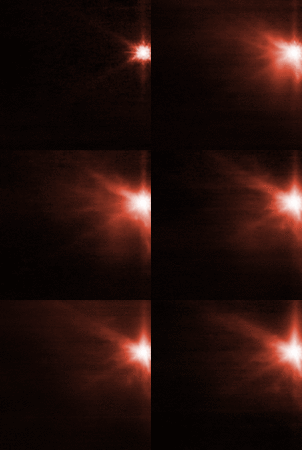
"In September, the James Webb Space Telescope observed as NASA’s Double Asteroid Redirection Test (DART) intentionally smashed a spacecraft into a small asteroid, in the world’s first-ever in-space test for planetary defense. Today, we hear from Stefanie Milam, Webb’s deputy project scientist for planetary science at NASA’s Goddard Space Flight Center, about how the Webb team worked to capture these one-of-a-kind observations."
https://blogs.nasa.gov/webb/
"In September, the James Webb Space Telescope observed as NASA’s Double Asteroid Redirection Test (DART) intentionally smashed a spacecraft into a small asteroid, in the world’s first-ever in-space test for planetary defense. Today, we hear from Stefanie Milam, Webb’s deputy project scientist for planetary science at NASA’s Goddard Space Flight Center, about how the Webb team worked to capture these one-of-a-kind observations."
https://blogs.nasa.gov/webb/
Attachments
From a few months ago: there's an ongoing discussion about what the proprietary period should be for JWST observations. The nominal project plan was for 12 months from the observation, but there's been a push to have all NASA data be immediately public.
https://www.science.org/content/article/should-webb-telescope-s-data-be-open-all
As an astronomer who has worked on public surveys (SDSS and now LSST), I favor a 6 month proprietary period, with the option to waive it, or the suggestion that the default is "all open", but proposers can request a 6 month period. The example of someone at a primarily teaching institution not having time to analyze and publish the data being scooped is a real problem. Putting together observing proposals is hard work itself.
https://www.science.org/content/article/should-webb-telescope-s-data-be-open-all
As an astronomer who has worked on public surveys (SDSS and now LSST), I favor a 6 month proprietary period, with the option to waive it, or the suggestion that the default is "all open", but proposers can request a 6 month period. The example of someone at a primarily teaching institution not having time to analyze and publish the data being scooped is a real problem. Putting together observing proposals is hard work itself.
One of your main goals was to provide tools for other scientists. What are you particularly excited about?
Dolphin: One of the key resources we developed and have made available to the astronomical community is something called the DOLPHOT NIRCam module. This works with an existing piece of software used to automatically detect and measure the brightness of stars and other unresolved objects (things with a star-like appearance). This was developed for cameras on Hubble. Adding this module for NIRCam (as well as one for NIRISS, another of Webb’s instruments) allows astronomers the same analysis procedure they know from Hubble, with the additional benefit of now being able to analyze Hubble and Webb data in a single pass to get combined-telescope star catalogs.
Savino: This is a really big community service component. It’s helpful for everyone. It’s making analysis much easier.
also has nifty pictures of the globular cluster M92
https://blogs.nasa.gov/webb/2023/02...obular-cluster-sparkling-with-separate-stars/
Dolphin: One of the key resources we developed and have made available to the astronomical community is something called the DOLPHOT NIRCam module. This works with an existing piece of software used to automatically detect and measure the brightness of stars and other unresolved objects (things with a star-like appearance). This was developed for cameras on Hubble. Adding this module for NIRCam (as well as one for NIRISS, another of Webb’s instruments) allows astronomers the same analysis procedure they know from Hubble, with the additional benefit of now being able to analyze Hubble and Webb data in a single pass to get combined-telescope star catalogs.
Savino: This is a really big community service component. It’s helpful for everyone. It’s making analysis much easier.
also has nifty pictures of the globular cluster M92
https://blogs.nasa.gov/webb/2023/02...obular-cluster-sparkling-with-separate-stars/

I was reading Science News yesterday and an article on the three Dark Star candidates from JWST data caught my imagination. I was surprised I had missed the news from July that the three JADES candidates were being considered as possible dark stars. My print editions of Science News are known for summarizing information in a solid way, not so much the latest news.
So this theory of dark stars has been around for a number of years (2008) according to Wikipedia. These new candidates have to be reimaged spectrographically to prove that they could be dark stars vs very early giant galaxies.
Are we looking at another tired electron theory or does this theory have legs? I mean, galaxy sized stars, wow.
Dark stars: Scientists discover a new type of star powered by dark matter
By Eric Ralls Earth.com staff writer
07-14-2023
https://www.earth.com/news/dark-stars-scientists-discover-a-new-type-of-star-powered-by-dark-matter/
James Webb Telescope Catches Glimpse of Possible First-Ever ‘Dark Stars’
July 13, 2023 • by Marc Airhart
Stars powered with dark matter still need proving but could reveal clues about the nature of one of the universe’s great mysteries.
https://cns.utexas.edu/news/researc...atches-glimpse-possible-first-ever-dark-stars
So this theory of dark stars has been around for a number of years (2008) according to Wikipedia. These new candidates have to be reimaged spectrographically to prove that they could be dark stars vs very early giant galaxies.
Are we looking at another tired electron theory or does this theory have legs? I mean, galaxy sized stars, wow.
Dark stars: Scientists discover a new type of star powered by dark matter
By Eric Ralls Earth.com staff writer
07-14-2023
https://www.earth.com/news/dark-stars-scientists-discover-a-new-type-of-star-powered-by-dark-matter/
James Webb Telescope Catches Glimpse of Possible First-Ever ‘Dark Stars’
July 13, 2023 • by Marc Airhart
Stars powered with dark matter still need proving but could reveal clues about the nature of one of the universe’s great mysteries.
https://cns.utexas.edu/news/researc...atches-glimpse-possible-first-ever-dark-stars
At this point, some type of star that could only exist in either a universe with much more dense dark matter or a universe without metals is the best theory we have for how supermassive black holes and early galaxies must have formed. Like a lot of cosmological concepts (dark matter, dark energy, inflation) it's a fanciful and far-fetched idea on its face, but... well, it's the simplest explanation we have and it's testable.
Another thing JWST might find evidence for is strange stars (strange matter neutron stars).
All that being said, it's going to take a while before any of this is accepted science. The types of observations we can do at this point are very limited and may be superseded by other explanations.
Another thing JWST might find evidence for is strange stars (strange matter neutron stars).
All that being said, it's going to take a while before any of this is accepted science. The types of observations we can do at this point are very limited and may be superseded by other explanations.
I keep thinking I'm on the helm of the Star Ship Enterprise:
Me (1st Science Officer) - No Captain, what we're approaching is not a galaxy, it is a very rare dark star, we will need to investigate.
But, the metals issue slipped my mind in reading about this, that is another fascinating twist.
Me (1st Science Officer) - No Captain, what we're approaching is not a galaxy, it is a very rare dark star, we will need to investigate.
But, the metals issue slipped my mind in reading about this, that is another fascinating twist.
davidtheweb
Ars Scholae Palatinae
I'm still a fan of using the already-known methods to build 5 more JWSTs and park them all up in a configuration that would allow for their data to be used for an interferometry setup.
There's still those telescopes NRO gave to NASA sitting in a warehouse somewhere...I'm still a fan of using the already-known methods to build 5 more JWSTs and park them all up in a configuration that would allow for their data to be used for an interferometry setup.

There's still those telescopes NRO gave to NASA sitting in a warehouse somewhere...
At least one of the mirrors is going on the Roman Space Telescope.
https://www.popsci.com/science/roman-space-telescope-spy-satellite/
"already-known methods" for doing near and mid-IR interferometry? That's something that we're barely able to do on Earth right now (ESO's VLTI is the only large scale mid-IR one that I know of; CHARA is only near-IR), using precision fiber optics to combine the signals. I don't think there is a technically viable solution for free space interferometry yet, although there are plenty of proposals. It's not something you can just build and expect to work.I'm still a fan of using the already-known methods to build 5 more JWSTs and park them all up in a configuration that would allow for their data to be used for an interferometry setup.
This is an excellent overview of what has been learned from what Webb has seen.
The interactive photos are impressive.
https://www.nytimes.com/interactive/2023/11/05/magazine/james-webb-space-telescope.html
The interactive photos are impressive.
https://www.nytimes.com/interactive/2023/11/05/magazine/james-webb-space-telescope.html
Last edited:
holy shi.....This is an excellent overview of what has been learned from what Webb has seen.
The interactive photos are impressiv.
https://www.nytimes.com/interactive/2023/11/05/magazine/james-webb-space-telescope.html

Gift link for folks without a Times subscription - https://www.nytimes.com/interactive...e_code=1.-Ew.CUbN.0wT6qS0PRIjo&smid=url-share
This just in:
“Scientists used new data taken by the James Webb Space Telescope to make a new reading of the rate at which the universe is expanding over time, by measuring light from 10 galaxies………In a paper submitted to the Astrophysical Journal, University of Chicago cosmologist Wendy Freedman and her colleagues analyzed new data taken by NASA’s powerful James Webb Space Telescope………….“Based on these new JWST data and using three independent methods, we do not find strong evidence for a Hubble tension,” said Freedman, a renowned astronomer and the John and Marion Sullivan University Professor in Astronomy and Astrophysics at the University of Chicago. “To the contrary, it looks like our standard cosmological model for explaining the evolution of the universe is holding up.”
so it looks like it is 70 kilometers per second per megaparsec, within the error bar of the cosmic background value of 67.4
https://news.uchicago.edu/story/new...uggests-our-model-universe-may-hold-after-all
“Scientists used new data taken by the James Webb Space Telescope to make a new reading of the rate at which the universe is expanding over time, by measuring light from 10 galaxies………In a paper submitted to the Astrophysical Journal, University of Chicago cosmologist Wendy Freedman and her colleagues analyzed new data taken by NASA’s powerful James Webb Space Telescope………….“Based on these new JWST data and using three independent methods, we do not find strong evidence for a Hubble tension,” said Freedman, a renowned astronomer and the John and Marion Sullivan University Professor in Astronomy and Astrophysics at the University of Chicago. “To the contrary, it looks like our standard cosmological model for explaining the evolution of the universe is holding up.”
so it looks like it is 70 kilometers per second per megaparsec, within the error bar of the cosmic background value of 67.4
https://news.uchicago.edu/story/new...uggests-our-model-universe-may-hold-after-all
Which error bar? I thought using the distance ladder leads to a different error bar vs the error bar generated via hubble et al?so it looks like it is 70 kilometers per second per megaparsec, within the error bar of the cosmic background value of 67.4
https://arxiv.org/abs/2408.06153Which error bar? I thought using the distance ladder leads to a different error bar vs the error bar generated via hubble et al?
We find three independent values of Ho = 69.85 +/- 1.75 (stat) +/- 1.54 (sys) for the TRGB, Ho = 67.96 +/- 1.85 (stat) +/- 1.90 (sys) for the JAGB, and Ho = 72.05 +/- 1.86 (stat) +/- 3.10 (sys) km/s/Mpc for Cepheids. Tying into supernovae, and combining these methods adopting a flat prior, yields our current estimate of Ho = 69.96 +/- 1.05 (stat) +/- 1.12 (sys) km/s/Mpc. The distances measured using the TRGB and the JAGB method agree at the 1% level, but differ from the Cepheid distances at the 2.5-4% level. The value of Ho based on these two methods with JWST data alone is Ho = 69.03 +/- 1.75 (total error) km/sec/Mpc
A good overview of the results from JWST especially on the galaxies in the very early days of the universe.
Turns out that JWST is brighter and sharper than modeled and this allows the results to fit current models.
The article is another reminder of just how successful JWST has been.
Article’s conclusion:
“The bright, early galaxies that JWST sees as “little red dots” are most likely not as massive as astronomers and astrophysicists originally thought. But only by:
https://bigthink.com/starts-with-a-bang/jwst-galaxies-didnt-break-cosmology/
Turns out that JWST is brighter and sharper than modeled and this allows the results to fit current models.
The article is another reminder of just how successful JWST has been.
Article’s conclusion:
“The bright, early galaxies that JWST sees as “little red dots” are most likely not as massive as astronomers and astrophysicists originally thought. But only by:
- understanding how to properly calibrate JWST,
- making more detailed, higher-resolution simulations of galaxy formation,
- accounting for the bursty nature of star-formation,
- and including the light generated by active supermassive black holes,
https://bigthink.com/starts-with-a-bang/jwst-galaxies-didnt-break-cosmology/
Thanks for posting that. It turns out, at the very limit of detection, a few percent better resolving power and sensitivity makes a huge difference in the intrinsic brightness you can detect.
‘Pillars of creation’ by Richard Panek is about the JWST. It covers how and why it was built, who built and designed it, what has been learned and has lots of nifty pictures. Accessible to all readers. Possible last minute holiday gift.
A good review by the poet Billy Collin’s with an assist from Ann Patchett
View: https://youtu.be/sKsjzrJxics?si=o_3enUBg2hsfwN9e
A good review by the poet Billy Collin’s with an assist from Ann Patchett
View: https://youtu.be/sKsjzrJxics?si=o_3enUBg2hsfwN9e
Another great image, have to zoom in three or more levels to see how good it is

”Shimmering ejections emitted by two actively forming stars make up Lynds 483 (L483). High-resolution near-infrared light captured by NASA’s James Webb Space Telescope shows incredible new detail and structure within these lobes, including asymmetrical lines that appear to run into one another. L483 is 650 light-years away in the constellation Serpens.”
https://webbtelescope.org/contents/media/images/2025/111/01JM03BFKHQ4TXFENM7XQHY405?news=true
”Shimmering ejections emitted by two actively forming stars make up Lynds 483 (L483). High-resolution near-infrared light captured by NASA’s James Webb Space Telescope shows incredible new detail and structure within these lobes, including asymmetrical lines that appear to run into one another. L483 is 650 light-years away in the constellation Serpens.”
https://webbtelescope.org/contents/media/images/2025/111/01JM03BFKHQ4TXFENM7XQHY405?news=true
In the full news release there's this extra fun bit.
The stars themselves are hidden in a teeny, opaque disk of dust that fits into one pixel.

https://esawebb.org/images/potm2503a/

This new NASA/ESA/CSA James Webb Space Telescope Picture of the Month features a rare cosmic phenomenon called an Einstein ring. What at first appears to be a single, strangely shaped galaxy is actually two galaxies that are separated by a large distance. The closer foreground galaxy sits at the center of the image, while the more distant background galaxy appears to be wrapped around the closer galaxy, forming a ring.
The lensing galaxy at the center of this Einstein ring is an elliptical galaxy, as can be seen from the galaxy’s bright core and smooth, featureless body. This galaxy belongs to a galaxy cluster named SMACSJ0028.2-7537. The lensed galaxy wrapped around the elliptical galaxy is a spiral galaxy. Even though its image has been warped as its light travelled around the galaxy in its path, individual star clusters and gas structures are clearly visible.