
You are using an out of date browser. It may not display this or other websites correctly.
You should upgrade or use an alternative browser.
You should upgrade or use an alternative browser.
Headlamp tech that doesn’t blind oncoming drivers—where is it?
- Thread starter JournalBot
- Start date
I think the idea of the Mini Cooper rear lights is that they should remind you of a Union Jack, not an arrow.Another example is the Mini Cooper and Mini Countryman. Below, the car is signaling a right turn while the arrow is pointing left.
View attachment 90863
Upvote
7
(7
/
0)
Victor Bitu
Ars Centurion
I miss the good old days when you saw someone galloping on a horse with no lighting .I just miss the good old days when you saw some old jalopy driving around with one headlight pointed at the trees and the other the ground.
Memories.
Upvote
0
(2
/
-2)
thecastle2
Ars Centurion
It isn't even the high beams are the problem. Its the illegaly modded headlights that have been converted to LED or HID. Plus all the people who lift the front end of their trucks blind oncoming drivers. European cars don't have this defect as they come with self leveling headlights.I wish to holy fuck that cars that automatically turn on the high beams would be required to notice pedestrians, bicyclists, horseback riders before blinding them with LED laser anything. Model 3's and recent Toyota products do this to me every damn night when I walk my dog.
Upvote
0
(2
/
-2)

Big_Banana
Seniorius Lurkius
Drove a Volvo in Germany with this. They call them matrix headlights. They work great and are AWESOME!
Upvote
2
(2
/
0)
MainframeGuy
Smack-Fu Master, in training
I think we're talking about marketing words.Yeah, if it was a screen and not a headlight. But the concept of 132,000,000 pixels in a headlight (that is very bright in a way I don't know how to quantify... 10k lumens? more?) seems like we might be talking about something different than a screen.
Upvote
-3
(0
/
-3)
FlippedBit
Wise, Aged Ars Veteran
Since my initial post is getting downvotes, here are links to sources.Exactly. I've been blinded just walking at night. I really don't see how active-matrix technology is going to fix this kind of problem.
Allegedly, the NHTSA never published a rule allowing automakers to equip vehicles with LED headlights, nor has the NHTSA ever published rules taking into account LED's unique characteristics. The most the NHTSA ever allegedly issued was a vague letter on the matter, which is all the auto manufacturers have used as justification for running ahead with LED headlights.
I've also read that even when it comes to the few existing light measurements LED headlights are subject to, headlight engineers have allegedly figured out how to disable a portion of the LED headlight in the part of the beam subject to measurement, allowing them to skirt the brightness limitations of the test.
Beyond this, I also think we're dealing with issues stemming from fundamentally different lighting technologies in LED/laser.
LED/laser are flat surface emitters that emit light in a very intense, focused beam which is naturally hard on the eyes. Combined with that, LED/laser are naturally more efficient blue light emitters, a portion of the spectrum which is also harsher on the eyes.
In contrast, incandescent is a spherical type emitter that naturally disperses light evenly in every direction. Incandescent is also balanced towards the warm end of the visible light spectrum, which is also easier on the eyes.
All one has to do nowadays to see the difference is look at the headlights of oncoming traffic while out and about at night. You'll instantly see the difference between incandescent vs LED headlights, and how much harsher and hard on the eyes the LED headlights (blindingly so, too often) are vs incandescent headlights.
It's not just a matter of comfort. Your eyes' rods (the part responsible for low light vision) is more sensitive to light in the blue part of the spectrum (the part LEDs naturally emit more of, in contrast to tungsten-based sources). Your rods are also subject to "bleaching" when overloaded (like being blasted in the face with a searingly bright LED headlight), with recovery taking up to 45 minutes for your low-light sensitive rods, impairing your night vision in the meantime.
On the NHTSA never issuing a ruling to allow LED headlights
Automakers cheating on lighting standards by installing "dark pixels" in LED headlights
Rods' sensitivity to blue light (and why red light preserves night vision)
Night vision bleaching and recovery time
See also attachments on this post for data on LED brightness and blue light discomfort. Source 1 / Source 2
Attachments
-
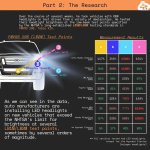 a-summary-of-activist-research-this-is-where-were-currently-v0-yqnio1hb267c1.jpg146.1 KB · Views: 16
 -
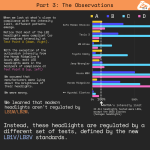 a-summary-of-activist-research-this-is-where-were-currently-v0-jvk78bwb267c1.png45.7 KB · Views: 11
 -
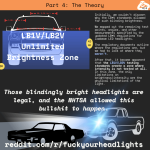 a-summary-of-activist-research-this-is-where-were-currently-v0-olfelxcc267c1.png101.2 KB · Views: 11
 -
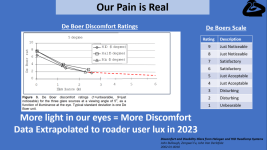 why-you-are-being-blinded-at-night-and-how-it-is-legal-but-v0-7nm6gl53k1hc1.png170.8 KB · Views: 6
 -
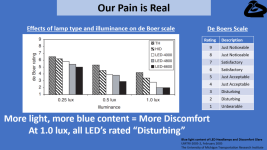 why-you-are-being-blinded-at-night-and-how-it-is-legal-but-v0-zjz6hvn4k1hc1.png187.4 KB · Views: 10
Upvote
5
(8
/
-3)
EarendilStar
Ars Centurion
You aren’t the first person I’ve seen say this, but I’ve never experienced (and Seattle isn’t lacking Teslas…). Do you notice it even when in well lit areas near cities?Tesla Model 3 and Model Y's should be recalled over their absurdly bright, and misaligned headlights. Seriously, start paying attention to the car next time this happens to you, 9 times out of 10, it's a Tesla. And I don't think it's the auto-bright feature, I think they are just pointed up too high by default.
Funny NHTSA is reluctant on this new technology but can't even get simple regulations (or enforcement of them, at least) on current LED headlights.
When I go home (pop. 3000) I don’t notice it, but they very much ARE lacking Teslas.
Upvote
3
(3
/
0)
EarendilStar
Ars Centurion
I can't disagree with this enough. I too drive on dark county roads outside of town and the additional reach good high beams provide is invaluable to me. In fact, when I'm researching a new vehicle one of my top criteria is headlight performance both low and high beams. If a vehicle performs poorly in the IIHS headlight tests or enough people bitch about their performance on the forums the vehicle gets crossed off my list. All the vehicles I've owned have the ability to toggle between low and high beams and I'm able to determine when other vehicles approach and/or are in front of me and dim the headlights accordingly.
Third person that drives country roads chiming in!
Your different experiences could simply be the difference between living outside of town on a 25mph road, and living outside of town on a 50mph road, as well as the prevalence of deer in your area. Low deer area or slower travel and I personally find I don’t need the reach or WIDTH of high beams. Toss in some deer and a fast road, and suddenly it’s invaluable.
Upvote
6
(6
/
0)

Yeah, that’s why I’m asking for less marketing more specs.I think we're talking about marketing words.
Upvote
0
(0
/
0)

Actually, it's both zero enforcement and zero mandated checks (I got my vehicle's road license invalidated in the EU once because I stupidly forgot to adjust the headlights per regs before going for a TÜV check, which is as it should be!), bad enforcement of actual traffic rules (using your fog lights outside of a fog will definitely get you a very hefty fine in Germany or Austria if you get caught), plus the daft US regs on car lights overall (read none at all, plus the dumb red‑not‑amber).It's rear fog lights that are the real problem. Searing bright red lights at the back of whatever vehicle you happen to be behind.
Upvote
5
(5
/
0)
This is all too common in the US. I once came close to hitting a cop: His car was set up to control traffic tightly where people were crossing for a local fair, and it had those blinding, flashing lights. He was crossing in front of his car and into the driving lane to stop traffic and let pedestrians cross. So he had these bright lights behind him, blinding anyone driving up toward him. With his typical dark blue uniform, the reflection from my headlights was minimal. Normally, you'd see his shadow as he crossed in front of his own lights - but since they were flashing on an off, that clue was almost entirely lost. Even moving really at a crawl - I could see what was going on in general terms, but not past the lights to see if anyone was in the crosswalk - I saw him barely in time. And this was in an area that had a fair amount of other lighting!Circa 2018-22 ish, the Ontario Provincial Police fell victim to this thinking..... someone sold them a batch of "the best, the brightest, the most visible cop cruiser lightbars ever made".
The damn things were so blinding that officers' lives were put at risk because passing traffic couldn't see the officer himself at all behind a red-and-blue glare field that, if subject to even the slightest hint of fog or haze, was two or three times larger than the cruiser itself.
I don't think they ever formally admitted the issue, but the newer cop cars are something like one-third to one-half as bright as they were during that period, and now you can actually see the officer well enough to avoid hitting him.
One of these guys on the side of a dark road leaves you completely blinded. And I now someone who gets migraines from flashing lights - these are a guaranteed migraine-starter.
Yes, you want police cars to be highly visible - but just as "too dim" is bad in this situation, "too bright" is just as bad. I suspect the macho attitude of police organizations is a big part of the "brighter is more powerful so must be better" attitude.
Upvote
7
(7
/
0)
sixstringedthing
Ars Scholae Palatinae
You jerkwads HAD to have clicked through the "off road use only" warning when you bought them at whatever shady online store you frequent, so you're well aware they're illegal and terribly dangerous for the rest of us out there!
That arse-covering "For Off Road Use Only" disclaimer is the automotive aftermarket equivalent of those "For Tobacco Use Only" stickers you used to see on bongs/pipes in tobacconists and souvenir shops. I'm 100% confident that nobody is buying blue/purple/red spotlights for offroad use only, in the same manner that nobody is buying a bong to smoke tobacco. A key difference here it that it's pretty hard to injure or kill someone with a bong (unless you're really committed).
I’m pretty sure Tesla owners are supposed to self-calibrate their headlights when they first take possession of the car. Wouldn’t surprise of me if most don’t and that’s why their beams are all over the place.
If that's true, it's utterly crazy. Why on earth would Tesla make aligning/calibrating the headlights a post-delivery task? What would prevent them from doing that at factory or at the dealership?
If it's to do with differing regulations around permitted brightness levels in different markets, that's got nothing to do with physical alignment of the headlights themselves. Surely it could be adjusted via software when the country of sale is programmed in. If it's absolutely necessary to make this an end-user-level task for whatever reason, why not program the user setup procedure such that the vehicle will refuse to move until you've run through the headlight calibration routine and any other safety-critical procedures?
Got a crisp c-note on the answer to all of the above questions being "because Elon doesn't give a shit about any of that stuff".
Last edited:
Upvote
7
(8
/
-1)
That's not what the Tesla Model 3 manual says. Do you make up stuff about other car manufacturers as well?I’m pretty sure Tesla owners are supposed to self-calibrate their headlights when they first take possession of the car. Wouldn’t surprise of me if most don’t and that’s why their beams are all over the place.
Warning
Proceed with caution when adjusting headlights. Tesla has carefully calibrated the position of the headlights to be in an optimum position for most driving scenarios. Tesla recommends that you do not adjust headlights unless you are familiar with how headlights should be adjusted. Once adjusted, you will be unable to automatically restore them to their originally calibrated position. Contact Tesla for assistance when adjusting headlights.
Proceed with caution when adjusting headlights. Tesla has carefully calibrated the position of the headlights to be in an optimum position for most driving scenarios. Tesla recommends that you do not adjust headlights unless you are familiar with how headlights should be adjusted. Once adjusted, you will be unable to automatically restore them to their originally calibrated position. Contact Tesla for assistance when adjusting headlights.
Last edited:
Upvote
-5
(1
/
-6)
TheBaconson
Ars Scholae Palatinae
It is a lot more visible to have your turn indicators a different colour than your other lights, plus some euro cars flash the brake lights to indicate they are hard breaking. So confusion can occur.This is the second or third time I've seen something about amber for turn indicators. I sincerely and honestly ask: What difference does it make? I am not being funny or dismissive; I honestly don't know but would like to.
Upvote
6
(6
/
0)
bob_page_cousin
Wise, Aged Ars Veteran
And I wear my sunglasses at nightIt's gotten worse over the last 5 years or so. "Low" beams are the "high beams" of old...and everyone has the standard lights, fog lights, roof rack lights and some sort of ornamental lights all on...all the time.
"I wear my sunglasses at night..." takes on a whole new meaning.
So I can, so I can
See the light that's right before my eyes...
Upvote
-1
(0
/
-1)

I didn’t even know the auto lights were a thing we bought a new vehicles this year because we keep them for a long time.Yeah, "auto-on" / "auto-off" high beams is something I disable right away. 90% of the time you don't actually need your high beams and on curvy roads the "sensors" just SUUUCK for the oncoming traffic. A human can still manage the on / off way better and "before" the sensor even picks up the oncoming traffic. This of course requires you to pay attention and give a fuck about other people. Both seem to be in short supply in the US.
FWIW, the 2023 F150 and 2024 Honda Pilot light programming is super conservative. Even on US32 in Ohio backwoods, the high beams rarely turn on when driving after dark.
Upvote
0
(0
/
0)
That arse-covering "For Off Road Use Only" disclaimer is the automotive aftermarket equivalent of those "For Tobacco Use Only" stickers you used to see on bongs/pipes in tobacconists and souvenir shops. I'm 100% confident that nobody is buying blue/purple/red spotlights for offroad use only, in the same manner that nobody is buying a bong to smoke tobacco. A key difference here it that it's pretty hard to injure or kill someone with a bong (unless you're really committed).
If that's true, it's utterly crazy. Why on earth would Tesla make aligning/calibrating the headlights a post-delivery task? What would prevent them from doing that at factory or at the dealership?
If it's to do with differing regulations around permitted brightness levels in different markets, that's got nothing to do with physical alignment of the headlights themselves. Surely it could be adjusted via software when the country of sale is programmed in. If it's absolutely necessary to make this an end-user-level task for whatever reason, why not program the user setup procedure such that the vehicle will refuse to move until you've run through the headlight calibration routine and any other safety-critical procedures?
Got a crisp c-note on the answer to all of the above questions being "because Elon doesn't give a shit about any of that stuff".
While I 100% agree with you here, I think it's important to point out that I'm not talking about spotlights at all. This is specifically things like halos.
Colored spotlights are thankfully so non useful that I don't think I've ever seen one.
Upvote
2
(2
/
0)
sixstringedthing
Ars Scholae Palatinae
The quoted snippet appears to be warning against physically adjusting the headlight units, normally done by winding one or more ball joints in/out/up/down with a screwdriver and typically something done by your mechanic if/when needed.That's not what the Tesla Model 3 man7al says. Do you make up stuff about other car manufacturers as well?
Warning
Proceed with caution when adjusting headlights. Tesla has carefully calibrated the position of the headlights to be in an optimum position for most driving scenarios. Tesla recommends that you do not adjust headlights unless you are familiar with how headlights should be adjusted. Once adjusted, you will be unable to automatically restore them to their originally calibrated position. Contact Tesla for assistance when adjusting headlights.
Good to know that the headlights are physically aligned/calibrated before leaving the factory (kind of a bare minimum requirement I think!), but is there a user level brightness calibration procedure that must be (optionally) performed as part of the post-delivery routine?
A colleague at work is the proud new owner of a Model 3, I might ask him about it.
Yeah, poor wording on my part with "spotlights" but you get the point eh. : )While I 100% agree with you here, I think it's important to point out that I'm not talking about spotlights at all. This is specifically things like halos.
Colored spotlights are thankfully so non useful that I don't think I've ever seen one.
I'm a bit of a lighting nerd from my theatre/pro AV days, I sometimes like to browse the usual suspects and ponder whether to purchase a selection of their cheap LED FX/mood lighting products to muck around with, maybe make a youtube video about. Y'know, "get creative" to justify paying good money for cheap toys. This inevitably leads the suggested products into Automotive Lighting territory, at which point you start playing the "How Legal Would That Be In My Jurisdiction, Really?" game. It's fun.
Last edited:
Upvote
-2
(0
/
-2)
Sorry, I didn't post the whole section of the manual, just the warning. The section is about using the touchscreen to adjust the headlights, I doubt if physical adjustment is supported.The quoted snippet appears to be warning against physically adjusting the headlight units, normally done by winding one or more ball joints in/out/up/down with a screwdriver and typically something done by your mechanic if/when needed.
Headlight Adjustments
To adjust the angle of the headlights, touch Controls> Service > Adjust Headlights, then follow the onscreen instructions. You can choose which headlight you would like to adjust by selecting it on the touchscreen.
Upvote
2
(2
/
0)
sixstringedthing
Ars Scholae Palatinae
Ah, cool, thanks for the info. Showing my age/ignorance a bit by assuming that they'd still need to be physically adjusted. : )Sorry, I didn't post the whole section of the manual, just the warning. The section is about using the touchscreen to adjust the headlights, I doubt if physical adjustment is supported.
Headlight Adjustments
To adjust the angle of the headlights, touch Controls> Service > Adjust Headlights, then follow the onscreen instructions. You can choose which headlight you would like to adjust by selecting it on the touchscreen.
Never owned a car with motorised headlight angle adjustment until my current vehicle, and I haven't needed to touch them yet.
So does the Model 3 prompt you to run through a setup routine to calibrate the alignment and brightness, or is that not necessary?
Upvote
1
(1
/
0)
I don't have a Tesla, though my car does have motorized headlights that self test at start and auto adjust while driving, including auto level and auto aim further based on speed and point around corners.So does the Model 3 prompt you to run through a setup routine to calibrate the alignment and brightness, or is that not necessary?
The Tesla manual has nothing about a needed calibration when first receiving the vehicle and the quoted text says it is factory adjusted.
Upvote
1
(1
/
0)
California's interesting because you can have pretty much anything you want in terms of off-road lights, but you have to put an opaque cover on them when you're on-road. You can be ticketed even if the light is off, or disconnected; it has to be covered. Enforcement is pretty spotty but I have heard of people being ticketed.This inevitably leads the suggested products into Automotive Lighting territory, at which point you start playing the "How Legal Would That Be In My Jurisdiction, Really?" game. It's fun.
Upvote
4
(4
/
0)
And just how much is it going to cost to replace these headlights after a collision??? There are already headlights that are over $2k EACH which goes a long way towards totaling a vehicle out.
Upvote
-1
(0
/
-1)
I just want US cars to use Amber for the turn indicators - especially the rear ones.
What's completely absurd is that auto makers will use the same housings with amber turn signals in Europe, but red in the US. Why the hell wouldn't they use amber across the board?
Upvote
5
(5
/
0)
Reminds me of how WV wouldn't allow the Jeep Liberty Renegade to be sold at all because it had roof-mounted lights without any sort of cover provided:California's interesting because you can have pretty much anything you want in terms of off-road lights, but you have to put an opaque cover on them when you're on-road. You can be ticketed even if the light is off, or disconnected; it has to be covered. Enforcement is pretty spotty but I have heard of people being ticketed.
https://forums.off-road.com/threads/liberty-renegades-are-outlawed-in-w-virginia.144124/
Upvote
2
(2
/
0)
Given radar and parking sensors and all the other stuff that's in the grille and front bumper of a modern car, I think that ship has already sailed. Plus on EVs the slightest dent to the battery pack means the whole thing has to be replaced, which usually totals out the vehicle.And just how much is it going to cost to replace these headlights after a collision??? There are already headlights that are over $2k EACH which goes a long way towards totaling a vehicle out.
Upvote
2
(3
/
-1)
Wouldn't you effective block your awareness of the other car at night? Also, polarizing tints the glass a little doesn't it? Tinting is not a good thing at night.I've long wondered why we don't use polarized lighting tech - it is perhaps not quite as elegant as this active matrix headlight tech, because polarized lighting requires other drivers, pedestrians, etc to either have polarized windshields or polarized glasses, etc.
But polarization technology has existed for quite a long time.
So, for example, maybe you have polarized headlights that put out clockwise polarized light. If you are looking at the light from the opposite direction, I think the light would effectively be counter-clockwise polarized relative to you. So if your windshield or glasses block counter-clockwise polarized light, they would block the high beams - but, as those headlights light reflect off surfaces, they become depolarized, so you would get the benefit of seeing not only your own headlights reflecting off surfaces, but also the reflected light of headlights of others - but not see most of the direct point-source light from the lamps. I think this could be setup to allow maybe 10% of the light to not be blocked - because you do want to see the headlights of oncoming vehicles, as that is often the only way to know they are even on the road with you - but you wouldn't be blinded.
You could also polarize the back window of the vehicle to block high beams of drivers behind you - although it would still reflect off of your side mirrors, so that's one downside to this approach.
There would, of course, be a transitional period in this approach where it would take something like 20 to 25 years before almost all the cars on the road had polarized headlights and polarized windshields -although if you lacked polarized windshield, you could wear some cheap glasses to avoid being blinded by other drivers. I'm sure that if this became common, you could buy such glasses at walmart, target, the drug store, or dollar stores, etc.
Had they started doing this in the 70s or 80s, we would have started reaping the benefits by about the 90's or early 2000's. This could have been done long before active matrix LED technology was invented.
Upvote
-2
(0
/
-2)

Great minds think alike. Edward Land, the inventor of the Polaroid camera and sheet polarizer, wanted to do exactly that in the 1930s and 1940s.I've long wondered why we don't use polarized lighting tech - it is perhaps not quite as elegant as this active matrix headlight tech, because polarized lighting requires other drivers, pedestrians, etc to either have polarized windshields or polarized glasses, etc.
But polarization technology has existed for quite a long time.
So, for example, maybe you have polarized headlights that put out clockwise polarized light. If you are looking at the light from the opposite direction, I think the light would effectively be counter-clockwise polarized relative to you. So if your windshield or glasses block counter-clockwise polarized light, they would block the high beams - but, as those headlights light reflect off surfaces, they become depolarized, so you would get the benefit of seeing not only your own headlights reflecting off surfaces, but also the reflected light of headlights of others - but not see most of the direct point-source light from the lamps. I think this could be setup to allow maybe 10% of the light to not be blocked - because you do want to see the headlights of oncoming vehicles, as that is often the only way to know they are even on the road with you - but you wouldn't be blinded.
You could also polarize the back window of the vehicle to block high beams of drivers behind you - although it would still reflect off of your side mirrors, so that's one downside to this approach.
There would, of course, be a transitional period in this approach where it would take something like 20 to 25 years before almost all the cars on the road had polarized headlights and polarized windshields -although if you lacked polarized windshield, you could wear some cheap glasses to avoid being blinded by other drivers. I'm sure that if this became common, you could buy such glasses at walmart, target, the drug store, or dollar stores, etc.
Had they started doing this in the 70s or 80s, we would have started reaping the benefits by about the 90's or early 2000's. This could have been done long before active matrix LED technology was invented.
https://www.polarization.com/land/land.html
https://www.acs.org/education/whatischemistry/landmarks/land-instant-photography.html
Upvote
4
(4
/
0)
cesspoolcreature
Ars Centurion
Complexity comes with increased cost to repair and replace parts, increased cost drives you to replace the vehicle sooner because you can't adjust or repair yourself and the dealership charges a ludicrous amount to do the work.
I'll keep my sealed beams I can replace for $10 and 5 minutes with a screwdriver.
I'll keep my sealed beams I can replace for $10 and 5 minutes with a screwdriver.
Upvote
-2
(0
/
-2)
artvandelayIIII
Ars Tribunus Militum
On a flat plane, maybe, but any time you're coming up a hill or really any rise in the road at all, your lights are fucking someone's eyes up.I got a new car this year. First with LED headlights. I've noticed that mine are engineered to cut their light off maybe an inch or so below the driver side window of oncoming cars.
I get it, your car probably just came with this whether you wanted it or not, but ultrabright headlights are just so hostile to everyone. I think should be some hard limits on lumen output and direction of vehicle headlights -- both new and aftermarket.
Upvote
4
(5
/
-1)

NHTSA prevents my car from using its 360 camera as a default for backing up, even though it's easily just as safe if not more safe for people around the car than just the rear camera. They also prevented my car from having an electric retracting tow hitch in the US, so an awful standard one had to be cut into the bumper after arriving at the port.I'm honestly not too impressed with the NHTSA here.
Yes, on this one issue, the NHTSA rules do look like a slight improvement over SAE J3069. The details are debatable, but it does look like a genuine attempt to do a bit better than J3069.
However..... the NHTSA continues to allow conventional headlights with comically excessive glare. Red turn signal lamps shared with the brake lamps. "Automatic" headlamps that stay off in rain, fog, snow, blowing sand, and any other condition that isn't pitch-dark. Dashboards that light up, making the driver think the external lights are activated, when they are in fact running blacked-out. Lexus sold the RX for 6 years with tail lights that stayed off all night in "auto" mode, unless you manually turned the switch to "on" - I saw half a dozen of these things nearly get rear-ended by 18-wheelers in one year, but the NHTSA never called them out and it was never recalled.
The overall impression, therefore, isn't "NHTSA is being really proactive about safety on this issue" – rather, it's "NHTSA have been demonstrably incompetent for 30 years on a dozen aspects of this issue and are now going overboard with being different on the one new thing that everyone else has already standardized just so that they can look like they're doing something."
Meanwhile, Tesla can beta test self driving functions and disable regulated safety functions or implement them poorly for years.
NHTSA is effectively dumb.
Upvote
1
(1
/
0)
Can't argue that was the intention, Cool Britannia and all, but that's a fail.I think the idea of the Mini Cooper rear lights is that they should remind you of a Union Jack, not an arrow.
What you actually get is a right-pointing left turn signal (and vice versa) that confuses the following driver, if only for a spilt second.
As pointed out in the YouTube video someone else linked to - Ambiguity is the enemy here and I fault BMW for allowing style over function. They should never have allowed that to come to market.
And I say this as a Mini lover - The Italian Job (1969, not 2003) - great movie !
Upvote
2
(2
/
0)
llanitedave
Ars Tribunus Angusticlavius
This has been a peeve of mine for 50 years, ever since my first job required a substantial amount of night driving. I can't believe it's taken this long to address what's always been a serious safety issue.
Upvote
0
(0
/
0)
I'm not sure how popular a retractable fixed-ball hitch would be in the US. Most of the vehicles I see with hitch receivers are using them for bike racks and cargo racks, which wouldn't work with a fixed ball. There are also three different ball sizes in common use in the US.NHTSA prevents my car from using its 360 camera as a default for backing up, even though it's easily just as safe if not more safe for people around the car than just the rear camera. They also prevented my car from having an electric retracting tow hitch in the US, so an awful standard one had to be cut into the bumper after arriving at the port.
Upvote
0
(0
/
0)
The fixed ball comes as an attachment to the hitch, it's a hitch receiver like you described. Sorry if my language there was confusing, it's not often that I talk about these things lol. It was not allowed because it was retractable.I'm not sure how popular a retractable fixed-ball hitch would be in the US. Most of the vehicles I see with hitch receivers are using them for bike racks and cargo racks, which wouldn't work with a fixed ball. There are also three different ball sizes in common use in the US.
Upvote
0
(0
/
0)
Not your fault -- I was going by the ones I've seen video of, which were all fixed with a single ball size, like this one:The fixed ball comes as an attachment to the hitch, it's a hitch receiver like you described. Sorry if my language there was confusing, it's not often that I talk about these things lol. It was not allowed because it was retractable.
View: https://www.youtube.com/watch?v=QUvSKIyTtuA
Upvote
2
(2
/
0)

My biggest complaint is the high number of people mounting those light bar LEDs and just running down the road at night blasting light. There seems to be zero enforcement of off-road use lighting being used in normal traffic. I think my fancy factory LED lights aren't as good as my headlights from 20 years ago but I'm not being an ahole to everyone else with a light bar.
Upvote
2
(2
/
0)