Former head of NASA’s climate group issues dire warning on warming

JohnDeL

Ars Tribunus Angusticlavius
8,824
Subscriptor
Most likely response of denialists to this controversy:
1) "See - we told you the science wasn't settled!" (even though the basic science is settled and what they are arguing about is if we are fucked or well and truly fucked)

2) "We need to get rid of the EPA and allow more pollution because that will save us!" (even though the EPA has done a lot of good and the differences between pollution and global warming are who they kill {more local effects vs. global} and how quickly they do it {fast vs. slow}}

We need to start our transition to renewables yesterday. They are less expensive to build and run than fossil fuel plants and work better in the cold and in the heat.
 
Upvote
56 (65 / -9)
We’re in a grim situation,” he said. “And it’s even grimmer that the politicians have failed their responsibility to the world now for quite a long time. We have a massive political failure. Our politicians like wars. They don’t want to save the planet, in the right way.”

Why am I not surprised Jeffrey Sachs is involved in this? And he hasn't been director of the Earth Institute for a long time, resigned in 2016. 🙄
 
Upvote
8 (10 / -2)

Nalyd

Ars Praefectus
3,055
Subscriptor
the basic science is settled and what they are arguing about is if we are fucked or well and truly fucked
The second one sounds more satisfying to me... "well and truly" bespeaks passion and romance...
Sounds like someone is itching to play Geoengineer
He may be wrong about the specific effect of the aerosols but he does have a point: we're all already playing geoengineer and have been for a century or so.
 
Upvote
60 (61 / -1)

ranthog

Ars Legatus Legionis
15,325
Most likely response of denialists to this controversy:
1) "See - we told you the science wasn't settled!" (even though the basic science is settled and what they are arguing about is if we are fucked or well and truly fucked)

2) "We need to get rid of the EPA and allow more pollution because that will save us!" (even though the EPA has done a lot of good and the differences between pollution and global warming are who they kill {more local effects vs. global} and how quickly they do it {fast vs. slow}}

We need to start our transition to renewables yesterday. They are less expensive to build and run than fossil fuel plants and work better in the cold and in the heat.
I expect to see Fox News coverage encouraging people to roll coal.
 
Upvote
38 (39 / -1)

Anderlan

Wise, Aged Ars Veteran
180
Subscriptor
In the great PBS Nova "Ancient Earth" series episode about the Siberian Traps eruptions, they also note how the insane amounts of volcanic particulates coinciding with volcanic CO2 additions kept things even for a while (on the order of thousands of years) but then the eruptions subsided, so that particulates decreased in atmo but the huge prior CO2 increase of course remained. That was very bad for life at the time.

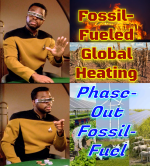
Not apropos the effect of aerosols, I am trying to make "Fossil-Fueled Global Heating" a thing, and trying to make the label "climate change" NOT a thing, and trying to make uttering "human-caused climate change" an actual felony. Because those old labels are of course preferred by the fossil fuel industry. The old labels start from our 2 yard line. We need to start in their 2 yard line, rhetorically, so we need to change the label. So please accept this meme offering. Peace be with us all, go forth in peace and replace "climate change" with "fossil-fueled global heating":
 

Attachments

  • GeordiFFGH-POFF_squareish.PNG
    GeordiFFGH-POFF_squareish.PNG
    1.4 MB · Views: 61
Upvote
14 (18 / -4)

ranthog

Ars Legatus Legionis
15,325
I'll be honest, I remember hearing discussions about how cleaning up our pollution likely would cause increased warming temporarily. But I don't see how you avoid that. Nor does it surprise me that the level of effect of cleaning up our pollution is still being debated.

Sadly we live in a time where debates like this where the question is not if this is bad, but how bad it is, are turned into excuses of how there is no problem. Its like trying to have a real discussion about the origins of SARS-COV-2 when people are turning it into xenophobic rhetoric that is getting people hurt and killed.
 
Upvote
20 (23 / -3)
Post content hidden for low score. Show…
Check out Great Barrier Reef coral extent. Number of Atlantic hurricanes. Sea level rise acceleration based on global tidal gauge network. Increase in areal extent of the Maldives. Arctic and Antarctic sea ice extent (they tend to be out of phase with each other). Volcanic activity beneath WAIS. Temperature records in EAIS. Yup, we're all gonna fry!:)
 
Upvote
-16 (3 / -19)
It's ironic that reducing pollution may have increased global temperatures. It's also heartening that climate scientists are advocating for nuclear power. While "nuclear is evil" has been the Greens holy writ for decades it's still the least polluting and least environmentally disruptive power source, Nuke plants aren't very large, compared to the foot print of a comparable output solar or wind farm and their effects on the local biome.
Also bear in mind that other stuff still happens like the Tongan volcano last year that spewed so much water vapor it's still affecting weather now.
Since they also take 20+ years to build (if they finish at all) and are insanely expensive, nuclear power plants are pretty fucking irrelevant when it comes to what we can do now to mitigate climate change. But hey, you did your part in bringing them up anyway, as seems to be necessary for some reason in every damned climate thread.
 
Upvote
18 (32 / -14)

Castellum Excors

Ars Scholae Palatinae
743
Subscriptor++
Life as it has been is over. It doesn't matter if we do nothing, because climate change doesn't care if we believe in it or not, or even if we do everything perfectly, life is changing. We may not go extinct, but there's no going back. We've simply consumed too much, too fast. We missed our off ramp by at least 20 miles. Humpty Dumpty has fallen off the wall.

And any ideas that we can reverse these changes without tightening our belts and altering our lifestyles is naive. Even if we enter a clean energy fusion golden age, the best we'll be able to do, maybe, is just stop making it worse with severe austerity.

My only hope, at my age, is that the worst to come happens either after I'm dead or at a stage in life were it won't make a difference. I have no children or grand children to worry about. And I'm deeply sorry to those of you who do. They are going to pay for our choices.
 
Upvote
38 (41 / -3)

Hagen Stein

Ars Scholae Palatinae
690
Subscriptor
While "nuclear is evil" has been the Greens holy writ for decades it's still the least polluting and least environmentally disruptive power source [...]
Nuclear power has the exact same issues as fossil power has sans the CO². It's a finite resource, you're dependent on whichever regime controls the resources. It's terribly inefficient and by far the most expensive power source.

Not to mention the fact that it takes ages to build a nuclear plant, time we don't have.
 
Upvote
9 (22 / -13)

ColdWetDog

Ars Legatus Legionis
14,402
It's ironic that reducing pollution may have increased global temperatures. It's also heartening that climate scientists are advocating for nuclear power. While "nuclear is evil" has been the Greens holy writ for decades it's still the least polluting and least environmentally disruptive power source, Nuke plants aren't very large, compared to the foot print of a comparable output solar or wind farm and their effects on the local biome.
Also bear in mind that other stuff still happens like the Tongan volcano last year that spewed so much water vapor it's still affecting weather now.
Nuclear is dead except for small scale plants which aren't quite dead but never seem to make it out of beta.

Nuclear is dead because the civilian nuclear industry managed to shoot themselves in both feet numerous times with utter incompetence both at the operating and design level. There also is the little problem with waste storage except that it really is a little problem and mostly an political hot potato. Even if we gave the nuclear industry unfettered permits to build unlimited plants, nobody would bother to try to bankroll it because the ROI is so slow and unpredictable. Time to find another deus ex machina.

And 'nuc plants aren't very large compared to the output of a wind or solar farm'??? Is that the hill you want to plant your flag on? We have imperial buttloads of space. It really is a long way to the chemist, at least in most parts of North America, South American, Africa and Eurasia.

Finally, the Tongan volcano might still be 'affecting weather' right now, but even decadal issues are weather, not climate. Big difference.
 
Upvote
30 (36 / -6)
Nuclear power has the exact same issues as fossil power has sans the CO². It's a finite resource, you're dependent on whichever regime controls the resources. It's terribly inefficient and by far the most expensive power source.

Not to mention the fact that it takes ages to build a nuclear plant, time we don't have.
Don't get sidetracked into a "but we can build X reactors to use Y instead" bucked of red herrings, nor a "price doesn't matter because we need them for baseload" one. They simply take too long to build to even be in the discussion.
 
Upvote
9 (15 / -6)

ranthog

Ars Legatus Legionis
15,325
Life as it has been is over. It doesn't matter if we do nothing, because climate change doesn't care if we believe in it or not, or even if we do everything perfectly, life is changing. We may not go extinct, but there's no going back. We've simply consumed too much, too fast. We missed our off ramp by at least 20 miles. Humpty Dumpty has fallen off the wall.

And any ideas that we can reverse these changes without tightening our belts and altering our lifestyles is naive. Even if we enter a clean energy fusion golden age, the best we'll be able to do, maybe, is just stop making it worse with severe austerity.

My only hope, at my age, is that the worst to come happens either after I'm dead or at a stage in life were it won't make a difference. I have no children or grand children to worry about. And I'm deeply sorry to those of you who do. They are going to pay for our choices.
We are going to have to change our lifestyles in the long run. However, if we do the right things now I don't think we need to enter an age of austerity in our lives. Making things more sustainable doesn't mean that life will be less.

Now if we don't do the things we need to now, austerity may be necessary to adapt to climate change. Not because the changes that are necessary but because of the expense of the disruptions and adaptations necessary to deal with the changed climate.

The changes to go carbon negative aren't going to be what bankrupts us.
 
Upvote
-5 (8 / -13)

ranthog

Ars Legatus Legionis
15,325
Don't get sidetracked into a "but we can build X reactors to use Y instead" bucked of red herrings, nor a "price doesn't matter because we need them for baseload" one. They simply take too long to build to even be in the discussion.
If you wanted to go all in on nuclear today as the solution, there is actually plenty of time at least in the US. You could expect to start seeing those plants coming online in the mid 2030's which is soon enough. (I am assuming you'd site these at the current locations of nuclear power plants, thus reducing the time necessary to break ground.)

The main problem is with cost over runs, which make the solution far too expensive.

Edit: The only nuclear that takes too long to be part of the discussion are reactor designs that are not ready to build today. So things like thorium based reactors or small modular reactors are likely not going to be available in time to be a major part of the solution.

This sort of applies to most technologies. The storage is an area where future developments can be assumed part of the solution, simply because we don't need large quantities of storage for the grid to operate with renewables and won't need it for a long while in the US.
 
Last edited:
Upvote
-3 (9 / -12)

ColdWetDog

Ars Legatus Legionis
14,402
We are going to have to change our lifestyles in the long run. However, if we do the right things now I don't think we need to enter an age of austerity in our lives. Making things more sustainable doesn't mean that life will be less.

Now if we don't do the things we need to now, austerity may be necessary to adapt to climate change. Not because the changes that are necessary but because of the expense of the disruptions and adaptations necessary to deal with the changed climate.

The changes to go carbon negative aren't going to be what bankrupts us.
The 'money' is there. The will isn't. If the problem was aliens poisoning the planet by injecting CO2 into the atmosphere, we'd spend any amount of money and time to fix it. If it were just a plain ol invasion, we'd still create whatever infrastructure we needed to stop it.

But since the enemy isn't alien, just us, well that slows things down a whole bunch. Then people start to talk about economics. Which is really a problem since we don't understand economics much past roadside Kool Aid stands.
 
Upvote
29 (31 / -2)

Spencer314

Wise, Aged Ars Veteran
195
Nuclear power has the exact same issues as fossil power has sans the CO². It's a finite resource, you're dependent on whichever regime controls the resources. It's terribly inefficient and by far the most expensive power source.

Not to mention the fact that it takes ages to build a nuclear plant, time we don't have.
Uranium can generate a LOT of electricity. But, if we get Thorium working, that can power humanity for a couple of thousand years, at least. That's plenty of time to figure out how to make fusion power work.

From the Wikipedia page on Thorium:
China is believed to have one of the largest thorium reserves in the world. The exact size of those reserves has not been publicly disclosed, but it is estimated to be enough to meet the country's total energy needs for more than 20,000 years.
But, yes, nuclear power plants take a lot of time and money to build, but once they are built they are actually fairly inexpensive to run.

It is frustrating that environmental movements effectively shut down nuclear power development over the exact same decades that it became apparent we have to severely ratchet down our carbon emissions. If this had not been the case, we would be in far better shape right now.

And yes, solar and wind can generate a lot of power, but nuclear can generate far more power with far less land area and also much more reliably. Even now, a strategy of building out solar and wind for the short to medium term and nuclear for the medium and long term makes a lot of sense. And, we need to go all in on modular thorium reactor development, since this is something that can be deployed throughout the world as it really is not very dangerous.

An annoying aspect of nuclear power development history is that nearly all research on nuclear power was directed towards uranium-based power not because it was better (it has been know for a long time that thorium is far safer in the long run) but because uranium produced the materials needed for nuclear weapons production. But, because uranium-based nuclear power production can be used to make materials useful for nuclear weapons production, it just isn't something we would want to deploy in the third world where physical plant safety isn't going to be sufficient, so we doomed the third world to relying on dirty coal plants and gave environmental movements, and those (rightly) fearing nuclear weapons development, plenty of reasons to push hard against nuclear power.
 
Upvote
-5 (17 / -22)

ranthog

Ars Legatus Legionis
15,325
Uranium can generate a LOT of electricity. But, if we get Thorium working, that can power humanity for a couple of thousand years, at least. That's plenty of time to figure out how to make fusion power work.

From the Wikipedia page on Thorium:

But, yes, nuclear power plants take a lot of time and money to build, but once they are built they are actually fairly inexpensive to run.

It is frustrating that environmental movements effectively shut down nuclear power development over the exact same decades that it became apparent we have to severely ratchet down our carbon emissions. If this had not been the case, we would be in far better shape right now.

And yes, solar and wind can generate a lot of power, but nuclear can generate far more power with far less land area and also much more reliably. Even now, a strategy of building out solar and wind for the short to medium term and nuclear for the medium and long term makes a lot of sense. And, we need to go all in on modular thorium reactor development, since this is something that can be deployed throughout the world as it really is not very dangerous.

An annoying aspect of nuclear power development history is that nearly all research on nuclear power was directed towards uranium-based power not because it was better (it has been know for a long time that thorium is far safer in the long run) but because uranium produced the materials needed for nuclear weapons production. But, because uranium-based nuclear power production can be used to make materials useful for nuclear weapons production, it just isn't something we would want to deploy in the third world where physical plant safety isn't going to be sufficient, so we doomed the third world to relying on dirty coal plants and gave environmental movements, and those (rightly) fearing nuclear weapons development, plenty of reasons to push hard against nuclear power.
The idea the environmental movement killed nuclear power plants is nonsense. The nuclear industry sabotaged itself. The cost of building new plants in the US are in the end what killed building new plants in the 80's.

Power companies aren't afraid of protests. It didn't stop them from building horrifically dirty coal plants in places like Wisconsin in the 00's that I have to imagine ended up not being a good investment. What makes you think it would have stopped them from building nuclear?

The 80's and 90's were really the time to be building nuclear sadly even with the extra costs. Today there are better carbon free power solutions that cost less.
 
Upvote
34 (40 / -6)

McTurkey

Ars Tribunus Militum
2,233
Subscriptor
If you wanted to go all in on nuclear today as the solution, there is actually plenty of time at least in the US. You could expect to start seeing those plants coming online in the mid 2030's which is soon enough. (I am assuming you'd site these at the current locations of nuclear power plants, thus reducing the time necessary to break ground.)

The main problem is with cost over runs, which make the solution far too expensive.

Edit: The only nuclear that takes too long to be part of the discussion are reactor designs that are not ready to build today. So things like thorium based reactors or small modular reactors are likely not going to be available in time to be a major part of the solution.

This sort of applies to most technologies. The storage is an area where future developments can be assumed part of the solution, simply because we don't need large quantities of storage for the grid to operate with renewables and won't need it for a long while in the US.
Sure, let's throw half a trillion dollars at building enough nuclear plants to satisfy the transition to net zero.

Now there's no money left for building solar, wind, hydro, or batteries, all of which could be online much faster, so we'd better keep those methane plants running in the meantime.

Oops, we overshot the emissions budget and have a bunch of construction running way behind because the industry is absolutely not able to just scale up that rapidly.

This is a tiresome debate, and I really wish people would stop pretending that nuclear power plant construction exists in a vacuum. Every dollar spent on that is a dollar that does not reduce our emissions for substantially longer than the same dollar spent on renewables.
 
Upvote
26 (32 / -6)

ranthog

Ars Legatus Legionis
15,325
Sure, let's throw half a trillion dollars at building enough nuclear plants to satisfy the transition to net zero.

Now there's no money left for building solar, wind, hydro, or batteries, all of which could be online much faster, so we'd better keep those methane plants running in the meantime.

Oops, we overshot the emissions budget and have a bunch of construction running way behind because the industry is absolutely not able to just scale up that rapidly.

This is a tiresome debate, and I really wish people would stop pretending that nuclear power plant construction exists in a vacuum. Every dollar spent on that is a dollar that does not reduce our emissions for substantially longer than the same dollar spent on renewables.
Did you bother reading my post at all? I explicitly said the primary problem with nuclear is cost.

The cost of the new reactors going online is so high compared to wind and solar there isn't any way to justify building more reactors. Which is why utilities are putting in massive wind and solar farms and canceling reactor plans.


If the only problem was the timeline to build nuclear power plants, then there is no problem. There is plenty of time to build out a fleet of nuclear reactors if you wanted to go that direction. As long as you are choosing an existing design for a reactor. While scaling up is a challenge, being able to mass produce parts likely offsets that.

The OP was claiming we didn't have enough time left to build nuclear reactors. Which is something that would mean we don't have enough time to build wind or solar plants either. At least not at the scale we need globally. It is going to be a major strain to do that no matter what technology we use, and its not something that is probably capable of doing in less than a decade even if we had an unlimited budget.

The idea though that new hydro is going to be a big player in solving climate change is even more laughable than nuclear.
 
Upvote
-3 (6 / -9)
Kevin Trenberth, a distinguished professor emeritus with the National Center for Atmospheric Research, said he was surprised the new paper was published, noting that the journal is relatively obscure.

“I think it is likely wrong,” Trenberth said. “Hansen has never been involved in the IPCC in any capacity, even as a reviewer. He is not at all collegial, and he tends to ignore legitimate criticism. He moves papers around until they get published. He stuffs papers full of extraneous stuff that would not be publishable by itself.”

This is worth noting. Trenberth is a well-respected mainstream scientist, one of the ones who got attacked in the "Climategate" email controversy. And his criticisms of Hansen here echo past criticisms of Hansen's work by other mainstream climate scientists.

Most of us have heard of the handful of "denier" climate scientists (Richard Lindzen, Judith Curry) who say the danger of anthropogenic climate change is overblown. Hansen is probably the only genuine "alarmist" among well-known scientists, the rare climate scientist who's gone too far in opposite direction. His work isn't as careful and rigorous as mainstream work. And while it's possible that the mainstream views will turn out to be too cautious... you still have to back up your claims with evidence.

Yes, we absolutely need to urgently take serious action on climate change. But.. this paper, in and of itself, will probably not hold up.
 
Last edited:
Upvote
20 (20 / 0)
The idea the environmental movement killed nuclear power plants is nonsense. The nuclear industry sabotaged itself. The cost of building new plants in the US are in the end what killed building new plants in the 80's.

Not nonsense really, that is exactly what happened in most of the EU.
We are still battling against some misconceptions and scaremongering. The only reason the balance has shifted in favour is Russia being the cunts they always were.

As to the reasons in the US, can't say I have much knowledge of your region but it wouldn't surprise me that the environmental movement had an effect as well. It's usually a couple factors instead of one.
 
Upvote
6 (8 / -2)

Fatesrider

Ars Legatus Legionis
25,171
Subscriptor
Most likely response of denialists to this controversy:
1) "See - we told you the science wasn't settled!" (even though the basic science is settled and what they are arguing about is if we are fucked or well and truly fucked)

2) "We need to get rid of the EPA and allow more pollution because that will save us!" (even though the EPA has done a lot of good and the differences between pollution and global warming are who they kill {more local effects vs. global} and how quickly they do it {fast vs. slow}}

We need to start our transition to renewables yesterday. They are less expensive to build and run than fossil fuel plants and work better in the cold and in the heat.
There is now talk about needing geoengineering to deal with climate change.

THAT ship has sailed, too, though.

The issue is fairly simple, and predictable.

It's predictable because humans don't respond well to slow-motion train wrecks. We seem to need dire-in-your-face disasters to motivate us to do things on a global basis. Until recently (the last 10 years or so), the train wreck has been slow(ish), but has also been gradually speeding up. And things have "suddenly" gotten more alarming in some circles.

The question is, why?

Could it be that we're still increasing the amount of CO2 we put into the atmosphere every year? Sure. But that isn't ALL of the story. That story can be summed up with two words:

Feedback Loops.

Now, granted, there are a bunch of feedback loops, with each of them having their own limits before engaging. But the very nature of feedback loops is that once going, they can't be controlled, or stopped. So when you cross ONE of them, and natural reactions to a warmer climate commence that are independent of man's influences, the next one WILL fall, adding its voice to civilization's (if not humanity's) dirge.

We. Are. Well. And. Truly. Fucked.

In summer and fall, monthly global temperature anomalies spiked beyond most projections, helping to drive those extremes, and they may not level off any time soon, said James Hansen, lead author of a study published Thursday in the journal Oxford Open Climate Change that projects a big jump in the rate of warming in the next few decades.
I guess the bright side here is that some climate scientists are finally getting the message to not soft-sell the future, but ram that fucker home hard.

What we need to start doing is adapt to what we KNOW is coming. So what's coming?

Anyone remember all those really dire predictions back in the mid 2000's? The "worst case" scenarios? The shit that makes Arrakis sound like a tropical paradise in comparison to what we have going on in the tropics NOW? The catastrophic sea level rise? Displacing more than half the global population over a very short period of time?

That's what's coming. The ONLY question is, "How fast will that happen?"

Given how climate scientists are always decades behind their predictions, I'm going to go with "sooner than anyone predicts" today.

That's what happens when a species isn't mature enough to work together to deal with its messes.
 
Upvote
8 (12 / -4)
Solve the Climate Crisis in 20 years by using cheap Chinese designed Hualong Nuclear Power Plants
https://www.bloomberg.com/news/arti...ches-2-7-billion-china-designed-nuclear-plant
Pakistan Karachi cost $2.7 billion for 1.1 Gigawatts make this cheaper than solar when you account for capacity factor. Solar costs about $1billion per Gigawatt with 25% capacity depending on latitude https://coldwellsolar.com/commercial-solar-blog/how-much-investment-do-you-need-for-a-solar-farm
Solar 25% capacity factor:
https://www.eia.gov/todayinenergy/detail.php?id=39832
Pakistan has commissioned another reactor at Chasnupp this time to cost $4.8 billion for 1.2 GW . Even at this higher price it still beats solar:
https://www.powermag.com/pakistan-expanding-nuclear-plant-with-new-hualong-one-reactor/
 
Upvote
-19 (1 / -20)

JohnDeL

Ars Tribunus Angusticlavius
8,824
Subscriptor
We've known for ages that aerosole masks warming... Nasa even had a article from this back in 2009...

https://climate.nasa.gov/news/215/j... climate models, we estimate,(1.8 °F) hotter.
Yes. The question here is how much masking does a given quantity of aerosol provide?

The IPCC has tended to use the lower values in order to not appear 'alarmist'. (Not that it has done them much good among the people who would tend to call them alarmist, but points for trying, ya know?) Hansen et al. seem to think that a much higher value would be more appropriate.

And that is climate science in a nutshell. The basic science is settled (increasing CO2 increases temperatures, aerosols lower temperatures by increasing albedo) but the fine details (how much does CO2 raise temperatures for a given set of conditions, how much do aerosols lower temperatures for a given set of conditions) is still being vigorously debated.

To put this into a more prosaic form, what we're doing is arguing with the traffic cop about whether we were doing 85 or 95 mph, but we've all agreed that we were speeding.
 
Upvote
8 (9 / -1)
If you wanted to go all in on nuclear today as the solution, there is actually plenty of time at least in the US. You could expect to start seeing those plants coming online in the mid 2030's which is soon enough. (I am assuming you'd site these at the current locations of nuclear power plants, thus reducing the time necessary to break ground.)
Even on an existing site, you'll need an environmental assessment, you may need to upgrade the grid hookup, you need to make sure you have enough cooling water, you still have to find banks stupid enough to front you $10B, on and on and on. It'd be a miracle if you can find 10 sites, and an even bigger one if the first spade goes in the ground before 2028.

You're talking the late 2030s before the first plant comes online. If it comes online at all. And let's be clear, it would be one, maybe two plants. They can't build a single one right now, what on Earth makes you think they could build multiple plants at the same time? Even if they triple the parts production and workforce, and work out all the kinks magically that they haven't been able to for decades now, you're talking 3 plants coming on a decade. 350MWh a year is not going to help at all, especially at $8.10/W built. Assuming no cost overruns, of course (no, stop laughing, I said no cost overruns, for realsies).

And especially not since you can just do wind and solar instead. You can put it almost anywhere (helping the grid out immensely), you can start it much faster, the projects will actually finish, and you can put down ten times as much capacity for the same money. Or five times plus battery backup if you like.

Nuclear is so slow and expensive to build that within the same time frame and for the same money, you could build a solar panel factory from scratch, and then the same capacity in panels from that factory. THAT is how idiotic nuclear is at this point. Even talking about it is a goddamned waste of time and I wish y'all would just fucking stop.
 
Upvote
9 (13 / -4)

Zed Jones

Seniorius Lurkius
38
I'm an old, unhealthy man so while you're all pretty much screwed, I'll probably be worm food by then which, by comparison, will be a plus.

It's going to take massive disasters before the politicians get serious but it'll be too late. It'll be a fun FAAFO meme on social media though, so there's an upside.

Meanwhile, the kooks will still deny it and just say it's the supernatural Apocalypse, The Prophecy Fulfilled, and raid all the stores for TP and sunscreen.

Enjoy!
 
Upvote
10 (11 / -1)
Yes. The question here is how much masking does a given quantity of aerosol provide?

The IPCC has tended to use the lower values in order to not appear 'alarmist'. (Not that it has done them much good among the people who would tend to call them alarmist, but points for trying, ya know?) Hansen et al. seem to think that a much higher value would be more appropriate.

And that is climate science in a nutshell. The basic science is settled (increasing CO2 increases temperatures, aerosols lower temperatures by increasing albedo) but the fine details (how much does CO2 raise temperatures for a given set of conditions, how much do aerosols lower temperatures for a given set of conditions) is still being vigorously debated.

To put this into a more prosaic form, what we're doing is arguing with the traffic cop about whether we were doing 85 or 95 mph, but we've all agreed that we were speeding.
That's the point. Any amount of masking means that without it, our projections of climate change will happen at a faster pace. That just means the climate targets needs to be more aggressive to account for any kind of masking effect that we've also produced.
 
Upvote
2 (3 / -1)

Snark218

Ars Legatus Legionis
36,775
Subscriptor
Most likely response of denialists to this controversy:
1) "See - we told you the science wasn't settled!" (even though the basic science is settled and what they are arguing about is if we are fucked or well and truly fucked)
More like well and truly vs. apocalyptically fucked. Trenberth's criticism of Hansen is harsh but not too far off the mark, though I know there's some personal bad blood between the two. And as tempting as it is to hope Hansen is wrong and that his paper isn't that good, and it's not that good, the last 9 months of climate data are fairly unambiguously terrifying and do not suggest that optimistic scenarios are going to pertain.
 
Upvote
13 (14 / -1)

Snark218

Ars Legatus Legionis
36,775
Subscriptor
Yes. The question here is how much masking does a given quantity of aerosol provide?

The IPCC has tended to use the lower values in order to not appear 'alarmist'. (Not that it has done them much good among the people who would tend to call them alarmist, but points for trying, ya know?) Hansen et al. seem to think that a much higher value would be more appropriate.

And that is climate science in a nutshell. The basic science is settled (increasing CO2 increases temperatures, aerosols lower temperatures by increasing albedo) but the fine details (how much does CO2 raise temperatures for a given set of conditions, how much do aerosols lower temperatures for a given set of conditions) is still being vigorously debated.

To put this into a more prosaic form, what we're doing is arguing with the traffic cop about whether we were doing 85 or 95 mph, but we've all agreed that we were speeding.
This is what's so deeply insane about how the deniers dismiss IPCC reports as alarmism. No, dipshits. It's the minimum viable product of climate science, the most conservative possible estimate for which a consensus can be reached, the safest and most certain possible set of assumptions and scenarios.
 
Upvote
26 (27 / -1)