
You are using an out of date browser. It may not display this or other websites correctly.
You should upgrade or use an alternative browser.
You should upgrade or use an alternative browser.
Debris from a satellite shot down by the Russians appears to threaten the ISS
- Thread starter JournalBot
- Start date

As it happens, he was quoting (in English) the rhyming Russian proverb Доверяй, но проверяй, which is probably derived from a quote of Lenin's.As Ronnie Raygun once said, "Trust but verify".
Upvote
7
(7
/
0)

There are like 10 more pages of comments to go before I catch up, but something that occurred to me (after probably too much Tom Clancy) that this is a prelude to a Ukraine invasion
I had a similar thought actually. Given that they've had this missile tech for years now, this doesn't strike me as a capability test, but rather a quality assessment test of their current stock.
And one of the reasons you'd do that is if you think you may have a use for them in the not too distant future.
Edit: To be clear, I realise that this is almost certainly nothing more than overly-paranoid speculation.
Upvote
4
(4
/
0)

That wasn't what I was objecting to. But apparently people have just started to only remove the initial quote, while retaining the quoted text and the final /quote. So you see all of the prior comments, with a /quote at the end of each one, and no clear idea when the new comment starts. That does really hurt readability.
Yes the original post I saw was damaged in that manner /quote /quote /quote etc
So I quoted it and then showed how it can be fixed by removing the nested quotes. I also said unlike the example which was at the end of the post to put quotes at the top. If you look at my post it has the same quote at the bottom as the final quote in the /quote mess.
After I had shown a method to fix it, the fix was attempted. So whilst my quoting of the damaged quote remained, the original one with the damage was (partially) fixed.
I guess I should apologize. It seems like we're both annoyed by people finding an unreadable way to get around the Ars comment system's annoying way of handling comments. I guess I saw you half-way through fixing a mangled comment and perhaps misunderstood your advice on how to do it right. I did not intend any offense. But I would really like it if people stopped the easy edits which result in those stuff /quote stuff /quote stuff /quote, etc. with one sentence of something new after two pages of prior comments.
Apology accepted.
Fixing comments on a PC not so hard. On a phone it gets tricky so I suggested the KISS way that works on both.
I wish the nested quotes would self subtract rather than make it not post-able. Show last 7 or X quotes and remove the rest. But I guess software has moved on since these forums were setup and so has our expectations .
It’s a shame that there isn’t a GitHub that we could submit a PR into for things like this.
Upvote
3
(4
/
-1)
Kind of sad how politically blind Ars is.
Writing an entire article about this particularly matter and yet failing to mention the US did this long ago, in the end its aresholes all around, American, Russian, Chinese and whatever.
I always thought the first rule of journalism was not be personally involved and be objective, and yet here is yet another example of an article with a clear bias. Whats the bet if the history was changed, and it was USA and not R.
Or a reflection of how much knowledge they do have instead.
Lower the orbit the denser the atmosphere. The denser the atmosphere the higher the drag. So once something starts being dragged by atmosphere it begins to lower quicker and quicker.
So yes, the USA has in the past done such a test. But the last one was done at half the height of the Russian test, beneath the orbit of the ISS. That height difference is significant in how long the debris would stay in orbit and the danger the debris field represents. USA no danger to ISS, short period of existence. Russian danger to ISS and Chinese Space Station and for a significantly longer period. It’s like comparing someone testing a rifle on a firing range versus testing it in shopping mall car park.
Same as the SpaceX mega constellation they are so low in orbit they will passively go lower and burn up in a relatively short time.
Upvote
17
(17
/
0)

Kind of sad how politically blind Ars is.
Writing an entire article about this particularly matter and yet failing to mention the US did this long ago, in the end its aresholes all around, American, Russian, Chinese and whatever.
I always thought the first rule of journalism was not be personally involved and be objective, and yet here is yet another example of an article with a clear bias. Whats the bet if the history was changed, and it was USA and not R.
Or a reflection of how much knowledge they do have instead.
Lower the orbit the denser the atmosphere. The denser the atmosphere the higher the drag. So once something starts being dragged by atmosphere it begins to lower quicker and quicker.
So yes, the USA has in the past done such a test. But the last one was done at half the height of the Russian test, beneath the orbit of the ISS. That height difference is significant in how long the debris would stay in orbit and the danger the debris field represents. USA no danger to ISS, short period of existence. Russian danger to ISS and Chinese Space Station and for a significantly longer period. It’s like comparing someone testing a rifle on a firing range versus testing it in shopping mall car park.
Same as the SpaceX mega constellation they are so low in orbit they will passively go lower and burn up in a relatively short time.
Is that true? It'd be nice if the article mentioned if there were previous cases, and how they differed to this one.
Upvote
-17
(3
/
-20)
I wonder what will happen if one of this debri bits hits China's new space station.
Will China drop everything they doing with Russia in return or will Russia have to pay China in cash or in kind (transfer of military / space tech) to keep China happy enough to keep working with them?
Will China drop everything they doing with Russia in return or will Russia have to pay China in cash or in kind (transfer of military / space tech) to keep China happy enough to keep working with them?
Upvote
0
(1
/
-1)
As it happens, he was quoting (in English) the rhyming Russian proverb Доверяй, но проверяй, which is probably derived from a quote of Lenin's.As Ronnie Raygun once said, "Trust but verify".
Well, yeah. He was speaking to a Russian audience.
Upvote
-3
(2
/
-5)
So yes, the USA has in the past done such a test. But the last one was done at half the height of the Russian test, beneath the orbit of the ISS. That height difference is significant in how long the debris would stay in orbit and the danger the debris field represents. USA no danger to ISS, short period of existence. Russian danger to ISS and Chinese Space Station and for a significantly longer period. It’s like comparing someone testing a rifle on a firing range versus testing it in shopping mall car park.
Same as the SpaceX mega constellation they are so low in orbit they will passively go lower and burn up in a relatively short time.
Is that true? It'd be nice if the article mentioned if there were previous cases, and how they differed to this one.
I can't vouch for the accuracy, but: https://en.wikipedia.org/wiki/Anti-satellite_weapon
Upvote
5
(5
/
0)
If they are going to do an anti-satellite test, why couldn't they wait for the satellite to fall under 200km!!!????
I get it, they need to test their military equipment. The USA has it, they want to maintain that capability as well. But surely a test at 200km would be sufficient to test propulsion, target tracking, control, etc. Hell, with the amount of hardware de-orbiting, they could probably take their pick of lower altitude targets!
Also, as the ability to launch satellites lowers in cost dramatically, the usefulness of anti-satellite weapons decreases. Starship will be able to launch more satellites in a single deployment than most countries could afford to shoot down.
I get it, they need to test their military equipment. The USA has it, they want to maintain that capability as well. But surely a test at 200km would be sufficient to test propulsion, target tracking, control, etc. Hell, with the amount of hardware de-orbiting, they could probably take their pick of lower altitude targets!
Also, as the ability to launch satellites lowers in cost dramatically, the usefulness of anti-satellite weapons decreases. Starship will be able to launch more satellites in a single deployment than most countries could afford to shoot down.
Upvote
7
(7
/
0)
If they are going to do an anti-satellite test, why couldn't they wait for the satellite to fall under 200km!!!????
It's possible that you have them confused with a country that cares.
It's becoming increasingly apparent that they do not.
Edit: not intended to be snarky.
Upvote
11
(12
/
-1)
PilatusCourier
Ars Praetorian
That is how the Maritime Salvage legal regime works. A derelict vessel is a risk to all other shipping in the relevant part of the sea lanes or to the coast nearby, so the companies involved pay salvage companies to salvage them and remove the risk to other shipping. Paid for by the company's shipping insurance. It's way past time for the Liability convention to be either amended or have an Additional Protocol added that allows satellites that are inoperable or otherwise derelict, to be deorbited, under similar conditions to those that apply when some cargo vessel or passenger ship runs aground or burns or otherwise becomes derelict.Well, there is the Outer Space Treaty and the Liability Convention. The country which launched a satellite (or the country where the satellite owner is located, if it's a commercial satellite) is legally liable for any damage cause by the satellite. And that goes down to every impact of a fleck of paint which comes off the satellite. If it were easier to prove which piece of debris from which satellite caused damage, and if the Convention were enforced more, there could be a return on investment for cleaning up space debris. If a dead satellite is an accident waiting to happen, the responsible nation might pay a company to dispose of it for them.In a capitalist economy? That doesn't sound profitable...expending resources to help someone else without ROI...Are there any publicly traded companies working on cleaning up space junk? Probably a decent buy right now.
I'm still gobsmacked that this wasn't ever foreseen as a requirement for commercial satellite operations, now that the world's shipping runs on satellite navigation and communications.
Upvote
9
(11
/
-2)
While eyes are in the sky...... watch what happens at the Ukraine border
I am not going to deny that distracting people can be a useful tactic, but I suspect that Russia invading Ukraine would be a sufficiently big deal that people wouldn't just not notice it because they were too busy being upset about space debris.
They have already invaded Ukraine and annexed parts of it.
Upvote
17
(18
/
-1)
Post content hidden for low score.
Show…
When I asked, after India did theirs, you guys gave me really great details, so I will ask again- What is the prognosis here?
How long will debris at this height take to deorbit? Are we talking about months? Years? Decades? How long until (most of) the debris descends enough to at least get out of the ISS orbit?
The one India shot was a big deal for anything in the immediate path, but I believe it was low enough to clear up after a few weeks.
Is Russia’s mess closer in severity to what India did a few years ago? Or is this closer to the infamous incident from China?
How long will debris at this height take to deorbit? Are we talking about months? Years? Decades? How long until (most of) the debris descends enough to at least get out of the ISS orbit?
The one India shot was a big deal for anything in the immediate path, but I believe it was low enough to clear up after a few weeks.
Is Russia’s mess closer in severity to what India did a few years ago? Or is this closer to the infamous incident from China?
Upvote
-6
(3
/
-9)
Russia is very good at coming up with distractions right before they do something big. That something big is always something to the good of Russia but not to anyone else. When you put together all of Russia's series of events that threaten the Station you come up with something that is intentional no matter how much Russia prevaricates.
Upvote
2
(3
/
-1)
PilatusCourier
Ars Praetorian
Actually, if the Russian military wanted to really puzzle observers, all they needed to do was send up a grappler to latch on to the satellite, then de-orbit said satellite. No orbital debris, and nobody would be able to say whether it was ASAT or Space Debris Removal testing. They could've capitalized on Winston Churchill's characterization of Russia asAll the Russian military had to do is to launch a target satellite to 250km altitude and then shoot it down with the ASAT weapon. The debris field would be a far less threat to both the ISS and to the Chinese space station and would deorbit in a matter of months.
My guess is that those idiots wanted to test the ASAT weapon at 450 km to make sure it can track and hit a target at that altitude.
Instead, open mouth, insert foot, load gun, shoot oneself in the foot ...[...] a riddle wrapped in a mystery inside an enigma.
Upvote
12
(12
/
0)
PurpleChair
Wise, Aged Ars Veteran
So, not only have our leaders held a weak climate conference, some of our leaders are now also polluting the hell out of space, just because they like pressing a red button.
Our future looks bright.
Our future looks bright.
Upvote
-11
(2
/
-13)
While eyes are in the sky...... watch what happens at the Ukraine border
I am not going to deny that distracting people can be a useful tactic, but I suspect that Russia invading Ukraine would be a sufficiently big deal that people wouldn't just not notice it because they were too busy being upset about space debris.
They have already invaded Ukraine and annexed parts of it.
Yes... and they shot down a passenger airplane while doing it, killing many... and it seems they got away with it too

Upvote
11
(12
/
-1)
irresponsible.
A debris cloud like that could cause lots of problems... even taking down existing satellites. IMO, I wouldn't assume it was irresponsible on their part... it could have been intentional.
Of course it was intentional - sending a message to the Ukrainians and the world. And it could have the added benefit of damaging the space station and getting them out of it, making it a western derelict.
At the risk of repeating myself... what exactly is the message supposed to be here? That Russia has the ability to destroy satellites? Was that ever in any actual doubt? Like, were there really a lot of people out there who saw this demonstration and thought, "Wow! They actually have the ability to destroy satellites? Who could have suspected!"
Well, if you can't figure it out, maybe it's not message for you. But ok. The message is going along these lines "we do not hesitate to destroy the satellite in quite crowded altitude as part of simple test. We will not wait half a second to do that if we had an actual reason."
Upvote
3
(3
/
0)
irresponsible.
A debris cloud like that could cause lots of problems... even taking down existing satellites. IMO, I wouldn't assume it was irresponsible on their part... it could have been intentional.
Of course it was intentional - sending a message to the Ukrainians and the world. And it could have the added benefit of damaging the space station and getting them out of it, making it a western derelict.
At the risk of repeating myself... what exactly is the message supposed to be here? That Russia has the ability to destroy satellites? Was that ever in any actual doubt? Like, were there really a lot of people out there who saw this demonstration and thought, "Wow! They actually have the ability to destroy satellites? Who could have suspected!"
Well, if you can't figure it out, maybe it's not message for you. But ok. The message is going along these lines "we do not hesitate to destroy the satellite in quite crowded altitude as part of simple test. We will not wait half a second to do that if we had an actual reason."
Along with the slight possibility that it's "do these missiles still work, as we're going to be needing them shortly". Paranoid maybe, but the timing is worrying.
Upvote
7
(7
/
0)
erkkimerkki
Wise, Aged Ars Veteran
What was the altitude for the American anti-satellite test in 2008?For those who remember, when India performed their anti-satellite test in 2019, the target satellite was relatively small and at a low altitude of 282 KM. Taken together suggests that the Indian government consciously intended to limit the orbital life of the debris created by the hit-to-kill intercept but nevertheless a very risky and undesirable action.
For context, China's anti-satellite test in 2007, which occurred at an altitude of 865 KM, created 3000+ (large enough to track) debris objects and still continues to linger for decades.
Upvote
-8
(2
/
-10)
Post content hidden for low score.
Show…
Post content hidden for low score.
Show…
What was the altitude for the American anti-satellite test in 2008?For those who remember, when India performed their anti-satellite test in 2019, the target satellite was relatively small and at a low altitude of 282 KM. Taken together suggests that the Indian government consciously intended to limit the orbital life of the debris created by the hit-to-kill intercept but nevertheless a very risky and undesirable action.
For context, China's anti-satellite test in 2007, which occurred at an altitude of 865 KM, created 3000+ (large enough to track) debris objects and still continues to linger for decades.
I thought this was going to be an easy answer, but I can't find the altitude.
However, I think this is the Wiki article for it: https://en.wikipedia.org/wiki/Operation_Burnt_Frost
And from there "...they would wait for the shuttle to land, so the potential harm to the shuttle would not be a factor. Next they wanted to wait until the satellite was close to re-entry, this would limit the amount of space debris created. Finally, they did not want to let the satellite enter the Earth's atmosphere because of its non-aerodynamic characteristics, which would make it extremely hard to intercept."
Edit: ah, found it. 153 miles, from https://en.wikipedia.org/wiki/USA-193
Upvote
13
(13
/
0)
So if a Katholic priest rapes half the boys of another Trussian Orthodox priest thats ok ?
What is it with you lot and invalid rape metaphors?
Rhetorical question.
Upvote
7
(11
/
-4)
This great chart from Tory Bruno shows that a satellite at 450 km deorbits in the span of months.When I asked, after India did theirs, you guys gave me really great details, so I will ask again- What is the prognosis here?
How long will debris at this height take to deorbit? Are we talking about months? Years? Decades? How long until (most of) the debris descends enough to at least get out of the ISS orbit?
The one India shot was a big deal for anything in the immediate path, but I believe it was low enough to clear up after a few weeks.
Is Russia’s mess closer in severity to what India did a few years ago? Or is this closer to the infamous incident from China?
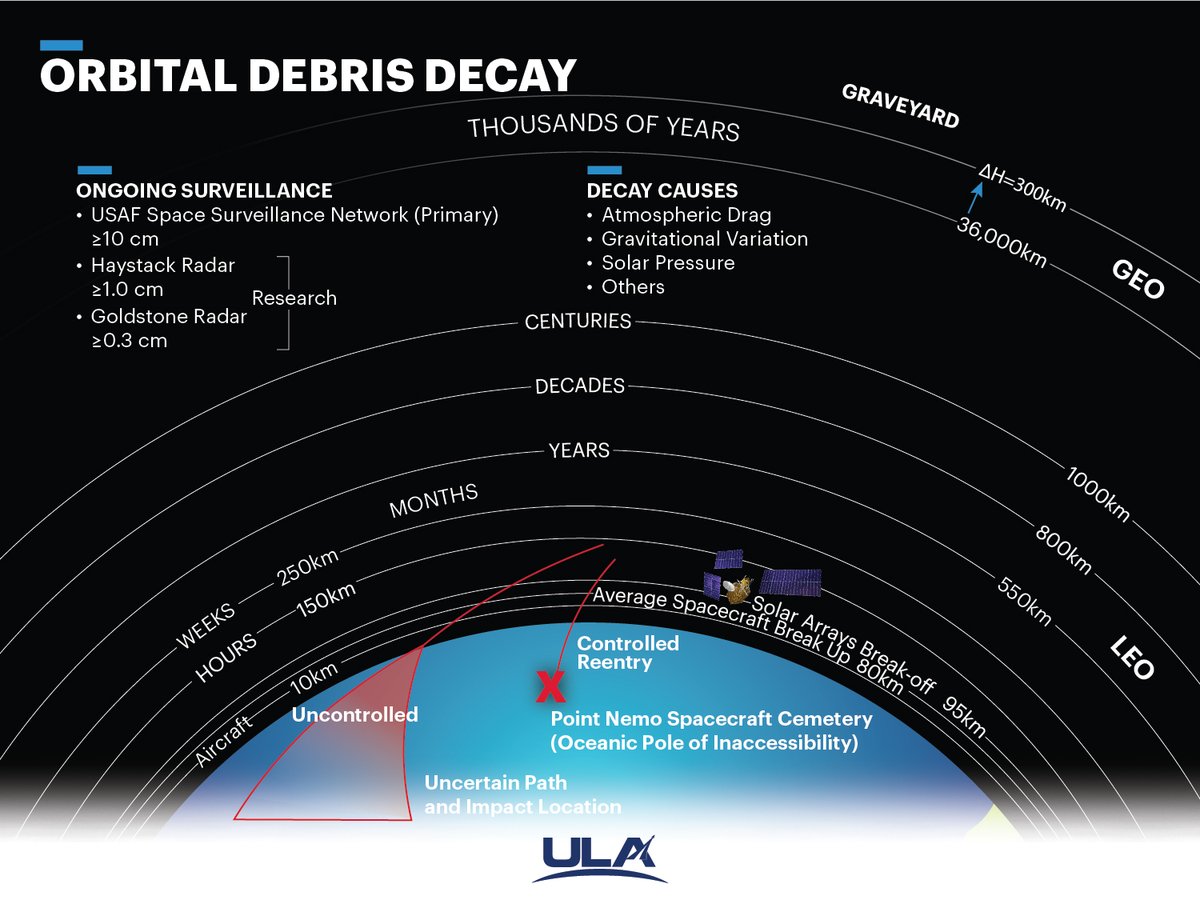
Upvote
26
(26
/
0)
This great chart from Tory Bruno shows that a satellite at 450 km deorbits in the span of months.When I asked, after India did theirs, you guys gave me really great details, so I will ask again- What is the prognosis here?
How long will debris at this height take to deorbit? Are we talking about months? Years? Decades? How long until (most of) the debris descends enough to at least get out of the ISS orbit?
The one India shot was a big deal for anything in the immediate path, but I believe it was low enough to clear up after a few weeks.
Is Russia’s mess closer in severity to what India did a few years ago? Or is this closer to the infamous incident from China?
Thanks! This is a really great resource.
I guess the good news here (less bad news?), is that this debris field won’t be a long term problem, as long as nothing disastrous happens in the next several months.
Upvote
13
(13
/
0)
Interesting: Monday - launch of Musks manned rocket, meaning Russia is out of spacefare monney for the next decades. Wednesday - Russia pollutes lower orbit for the next decades. I bet there were phone calls with biden before the rockets. Russians aren´t stupid at all.
Only an expansive cleanup programm might help now avoiding worst case scenarios. We´re already paying Russia/former Russia for their nuclear pollution in Tschernobyl, so why not for polluting space? In Korea this kind of game works well. Kim stays in power, his people don´t starve.
Now the russians might gain financial sources for space programm, we (west) gain lower orbits for whatever kind of monney waits there. That´s the source of all problems. They want monney, give it to them and take profits of russian tetris-developing engineers. What´s monney for the USA? They print it themselves. "Developing markets in Russia" might help the US economy as well.
At least higher orbits where GPS and military sits are still useable. They are harder to pollute, as they are much bigger. But they might give it a try.
Only an expansive cleanup programm might help now avoiding worst case scenarios. We´re already paying Russia/former Russia for their nuclear pollution in Tschernobyl, so why not for polluting space? In Korea this kind of game works well. Kim stays in power, his people don´t starve.
Now the russians might gain financial sources for space programm, we (west) gain lower orbits for whatever kind of monney waits there. That´s the source of all problems. They want monney, give it to them and take profits of russian tetris-developing engineers. What´s monney for the USA? They print it themselves. "Developing markets in Russia" might help the US economy as well.
At least higher orbits where GPS and military sits are still useable. They are harder to pollute, as they are much bigger. But they might give it a try.
Upvote
-12
(0
/
-12)
I haven't been able to find any earlier instance of Russia blowing up any satellites with anti-satellite weapons [Correction in edit]. China, USA and India have contributed to the space debris with such tests (altitudes 865 km, 247 km and 283 km). The 2021 Russian test destroyed a satellite at the altitude of 450 km for comparison.
NASA estimates that 30% of the >10 cm (i.e. trackable) debris from the 2007 Chinese test will remain in orbit come 2035. Project West Ford was conducted 1961-1963. It placed needles to an altitude of 3500-3800 km. Last year 36 clumps of needles remained in orbit. In short, the debris from the Chinese test is decaying as expected (many decades), while the needles from the American project is decaying faster than expected (centuries) from looking at the chart alone. The Russian test is more similar to the Chinese test, which would suggest that 30% would be left after 3 months [edit 2: more likely 6-12 months]
Edit: Cthel informed me of the Russian tests performed in 1968-1971 and 1976-1982. I counted 4 instances of successful satellite destructions.
In addition, USA performed a successful test in 1985 (525 km).
Edit 2: It took ~20 years for all debris from the 1985 test at 525 km to deorbit, suggesting that all debris at 450 km could deorbit within a decade.
Edit 3: Simulations show that it will take decades for the debris to all deorbit. Hugh Lewis on Twitter
Edit 4: Last edit, Jonathan McDowell estimates that the debris will cause problems for 5 to 10 years. I trust an astronomer's estimate way more than my own.
NASA estimates that 30% of the >10 cm (i.e. trackable) debris from the 2007 Chinese test will remain in orbit come 2035. Project West Ford was conducted 1961-1963. It placed needles to an altitude of 3500-3800 km. Last year 36 clumps of needles remained in orbit. In short, the debris from the Chinese test is decaying as expected (many decades), while the needles from the American project is decaying faster than expected (centuries) from looking at the chart alone. The Russian test is more similar to the Chinese test, which would suggest that 30% would be left after 3 months [edit 2: more likely 6-12 months]
Edit: Cthel informed me of the Russian tests performed in 1968-1971 and 1976-1982. I counted 4 instances of successful satellite destructions.
In addition, USA performed a successful test in 1985 (525 km).
Edit 2: It took ~20 years for all debris from the 1985 test at 525 km to deorbit, suggesting that all debris at 450 km could deorbit within a decade.
Edit 3: Simulations show that it will take decades for the debris to all deorbit. Hugh Lewis on Twitter
Edit 4: Last edit, Jonathan McDowell estimates that the debris will cause problems for 5 to 10 years. I trust an astronomer's estimate way more than my own.
Upvote
14
(14
/
0)
Kind of sad how politically blind Ars is.
Writing an entire article about this particularly matter and yet failing to mention the US did this long ago, in the end its aresholes all around, American, Russian, Chinese and whatever.
I always thought the first rule of journalism was not be personally involved and be objective, and yet here is yet another example of an article with a clear bias. Whats the bet if the history was changed, and it was USA and not R.
Or a reflection of how much knowledge they do have instead.
Lower the orbit the denser the atmosphere. The denser the atmosphere the higher the drag. So once something starts being dragged by atmosphere it begins to lower quicker and quicker.
So yes, the USA has in the past done such a test. But the last one was done at half the height of the Russian test, beneath the orbit of the ISS. That height difference is significant in how long the debris would stay in orbit and the danger the debris field represents. USA no danger to ISS, short period of existence. Russian danger to ISS and Chinese Space Station and for a significantly longer period. It’s like comparing someone testing a rifle on a firing range versus testing it in shopping mall car park.
Same as the SpaceX mega constellation they are so low in orbit they will passively go lower and burn up in a relatively short time.
So if a Katholic priest rapes half the boys of another Trussian Orthodox priest thats ok ?
That really hurts my feelings. Your emotional daggers deal massive damage to my heart where your lack of facts failed.
Wait, I don’t have feelings at all for the poorly framed counter argument, as I am an atheist.
I do have feelings however seeing such a great engineering nation fall so low. That I could shed a tear for it, if it wasn’t so much self inflicted corruption.
Upvote
5
(11
/
-6)

I haven't been able to find any earlier instance of Russia blowing up any satellites with anti-satellite weapons. China, USA and India have contributed to the space debris with such tests (altitudes 865 km, 247 km and 283 km). The 2021 Russian test destroyed a satellite at the altitude of 450 km for comparison.
NASA estimates that 30% of the >10 cm (i.e. trackable) debris from the 2007 Chinese test will remain in orbit come 2035. Project West Ford was conducted 1961-1963. It placed needles to an altitude of 3500-3800 km. Last year 36 clumps of needles remained in orbit. In short, the debris from the Chinese test is decaying as expected (many decades), while the needles from the American project is decaying faster than expected (centuries) from looking at the chart alone. The Russian test is more similar to the Chinese test, which would suggest that 30% would be left after 3 months.
The USSR launched and detonated multiple anti-satellite weapons in orbit between 1968 & 1980, testing them using target satellites launched for the purpose.
And those tests used a 300kg explosive warhead, so the debris produced was significant (some of it is still in orbit - for example Cosmos 1174)
Upvote
12
(12
/
0)
Thanks! This is a really great resource.
I guess the good news here (less bad news?), is that this debris field won’t be a long term problem, as long as nothing disastrous happens in the next several months.
It's a terrible news as this is a potentially catastrophic event. Currently, there are no way to predict the long term consequences of this action. While it is possible to predict collisions with trackable debris, the collision might not be avoidable if a satellite is not able to steer away (dead or decommissioned satellites). If you also consider that non-trackable debris are capable of destroying spacecrafts, this is a terrible news. 1. It's going to be a long-term problem, we will definitely see some of these debris in the next 10 years. 2. It will increase operational costs of current constellations/satellites, potentially reducing their lifetime due to propellant being consumed for debris-avoidance maneuvers. 3. I believe it will increase assurance costs for placing new satellite into LEO.
One bad player and everybody pays the consequences. I hope severe financial measures will be taken against Russia.
Upvote
0
(4
/
-4)
Missiles? So uncivilized... this is how you properly take a satellite out of orbit:
https://www.youtube.com/watch?v=_qixtjMoMUA
https://www.youtube.com/watch?v=_qixtjMoMUA
Upvote
3
(4
/
-1)
This great chart from Tory Bruno shows that a satellite at 450 km deorbits in the span of months.When I asked, after India did theirs, you guys gave me really great details, so I will ask again- What is the prognosis here?
How long will debris at this height take to deorbit? Are we talking about months? Years? Decades? How long until (most of) the debris descends enough to at least get out of the ISS orbit?
The one India shot was a big deal for anything in the immediate path, but I believe it was low enough to clear up after a few weeks.
Is Russia’s mess closer in severity to what India did a few years ago? Or is this closer to the infamous incident from China?
Is that true regardless of size? If it created very small particles do they decay at the same rate? How much higher do we think the blast force of the explosion could have flung debris?
Upvote
0
(0
/
0)
if its denser it may stay longer but its a fairly consistent averageThis great chart from Tory Bruno shows that a satellite at 450 km deorbits in the span of months.When I asked, after India did theirs, you guys gave me really great details, so I will ask again- What is the prognosis here?
How long will debris at this height take to deorbit? Are we talking about months? Years? Decades? How long until (most of) the debris descends enough to at least get out of the ISS orbit?
The one India shot was a big deal for anything in the immediate path, but I believe it was low enough to clear up after a few weeks.
Is Russia’s mess closer in severity to what India did a few years ago? Or is this closer to the infamous incident from China?
Is that true regardless of size? If it created very small particles do they decay at the same rate? How much higher do we think the blast force of the explosion could have flung debris?
Upvote
7
(7
/
0)
never attribute to malice what can adequately be explained by incompetence, of course those aren't mutually exclusiveI hope heads roll on the Russian side for endangering everyone, as well as two Russians on board (that's gotta mean something to them).
I doubt they will, this added drama and publicity is likely exactly what Russia wanted out of this. Endangering the station takes this event from getting a brief mention in the president's security briefing, to a full fledged prime-time international incident; Putting Cosmonauts in danger simply gives them cheeky plausible deniability. This satellite was likely deliberately selected for destruction due to it's ability to cause ongoing risk to the station, and the whole operation was definitely signed off by Putin himself.
Yeah, given Russia, apparent/alleged?, slide into unfettered oligarchy I can imagine some clueless scion of the well connected who'd been installed in a position of authority deciding to show off for some friends by deciding to launch a rocket and it just happened to be configured for this ASAT test.
Unlikely I admit but having witnessed the venal, malignant incompetence of the very, very wealthy just recently in the US I can't shake the feeling that there's a tiny chance I'm close.
Upvote
-2
(3
/
-5)
Seems obvious (to me) that this is Putin flexing his muscle: "We can shoot down your satellites." I doubt the "civilian" space folks had any advance notice and are just toeing the party line.
I don’t think so. I think it is incompetence or a failure.
I would not be surprised if the launch was meant as a flexing of the muscles, but that the amount and orbit of the debris is not as predicted. A bit of embarrassment probably.
Upvote
-7
(0
/
-7)
Russian military seems to 'fessed up:
https://twitter.com/katlinegrey/status/ ... 85728?s=20[b:1wfcpqop said:Katya Pavlushchenko[/b]":1wfcpqop]The Russian military confirmed that they destroyed the Soviet Tselina-D satellite in orbit. They claim its debris did not and will not pose a threat to orbital stations and space activities. https://interfax.ru/russia/803293
Upvote
13
(13
/
0)
I don't know if this has been posted already, but here is NASA's call to the ISS regarding this:
https://twitter.com/NStewCBS2/status/14 ... 7273820168
https://twitter.com/NStewCBS2/status/14 ... 7273820168
Upvote
8
(8
/
0)