
You are using an out of date browser. It may not display this or other websites correctly.
You should upgrade or use an alternative browser.
You should upgrade or use an alternative browser.
Climate change sucks, but at least it won’t kill your EV battery
- Thread starter JournalBot
- Start date

jm_leviathan
Ars Scholae Palatinae
I get that it's important to distinguish between the capacity degradation curves of newer vs older batteries, but it's still a little weird to be talking about the performance of older batteries under climate conditions to be encountered a half-century or more from now, even in the abstract. The current state of the commercial art is clearly at least a relevant baseline for analysis owing to the uncertainty that attaches to notional future developments, but those older batteries and the vehicles they're in simply won't exist on the relevant timescales.
Last edited:
Upvote
9
(9
/
0)
I don't regret the passing of Windows ME, but I'm glad it existed. If MS hadn't produced that awful OS, then I might have not gotten so fed up with it that I figured out how to get Linux working on our craptastic PackardBell, which eventually resulted in me being able to switch careers in my mid fifties resulting in a significant increase in salary - something almost unheard of for career changes in your fifties.Many people don't want convinced--rather they just want affirmation that they way things always was--has to be better than this New Fangled Stuff. Rose colored glasses for days that never were--no one laments the passing of WindowsME, yet, and hopefully never does.
But Windows ME was the Yugo of OSs. Or maybe Yugo was the Windows ME of cars.
Upvote
1
(3
/
-2)

How would that help exactly?We should stop subsidizing car drivers. We should tax fossil fuels and push people to use electric cars, not subsidize driving.
You can't punish people who can't afford things into solutions.
Upvote
5
(7
/
-2)

Gnafu the Great
Ars Centurion
I guess what I'd like to see is some kind of requirement for businesses to provide EV charging for on-site employees or face fines. Or some other combination that encourages businesses to both allow more people to work from home and properly support employees that need to be on-site. Don't want to foot the bill for EV charging? Don't make so many people come into the office. Fewer people driving to work is even better than driving EVs to work.How would that help exactly?
You can't punish people who can't afford things into solutions.
Upvote
2
(3
/
-1)

I forgot that your non-IEC system is so complicated with its 80% and 100% rated breakers and its 80% breakers that can run at 100% for 3 hours before tripping.US circuits are rated differently: the amperage rating is the point where the breaker trips, long term loads are required to be under 80% the rating. So a 30 amp circuit == 24 amp charging. 12 hours is around 70 kWhr, less losses in the wiring and charger which is typical of entry level EVs in the US.
IEC 60898-1 rates the breaker continuously for its stated current.
So, apologies and I recuse myself.
Upvote
1
(1
/
0)
And yet it seems to be the American Way (TM).How would that help exactly?
You can't punish people who can't afford things into solutions.
Upvote
3
(4
/
-1)
Beginning of the story states the newer batteries will lose only 2% capacity per year. Later it says those same batteries have a 17 year life. Finally it says they will only lose 4% over the life of the battery. What?!?!
2 x 17 = 34. 34 does not equal 4. It seems that either A) both the author and the editor failed grade school arithmetic, or B) there was a typo and 2% should really be 0.2%
2 x 17 = 34. 34 does not equal 4. It seems that either A) both the author and the editor failed grade school arithmetic, or B) there was a typo and 2% should really be 0.2%
Last edited:
Upvote
-4
(0
/
-4)
The usable capacity of my EV is 88kWh. It's big, but it's nowhere near the biggest.Our 240/30A box charges a 50kWh battery in around 8 hours, 12 hours would imply 84kWh which is surely a lot more than even the US average?
The charge rate drops off quite suddenly when the car is reading 99%.
Supplying 7kW does not of course imply 7kW charging due to charge losses, but the difference is not more than 10%.
I forgot that your non-IEC system is so complicated with its 80% and 100% rated breakers and its 80% breakers that can run at 100% for 3 hours before tripping.
IEC 60898-1 rates the breaker continuously for its stated current, and that's what I am used to,
So, apologies and I recuse myself.
Our circuits have to be oversized for continuous loads, but that just means a theoretical 30A EVSE needs a 40A rated circuit (technically 37.5A, but breakers stick to nice round numbers). So since you have to go up to 40A anyway, 32A is a common EVSE rating here. L2 EVSEs are commonly 32, 40, or 48A. Of course you can go lower and higher. My 40A can be turned all the way down to 16A, which would be code on a 20A circuit. That would still be plenty for most daily commutes. That should be good for 100+mi of range every night in most EVs, even if you were only home for 10 hours a night.
Upvote
3
(3
/
0)
It seems like we’re going to get a new oil crisis. It will be interesting to see if that leads people to switch to EVs. In the 1970s, there was no choice other than waiting in lines.How would that help exactly?
You can't punish people who can't afford things into solutions.
Upvote
3
(4
/
-1)
Swapping a plug is no big deal. A trip to the hardware store and 5 minutes with a screwdriver should do it.Yeah, I glossed over the bit about plug in EVSEs. The issue with the plug-in type is that an electrician will (or should) refuse to put a 50 amp outlet on a 30 amp circuit. So if you have a plug-in EVSE with a 50 amp plug you have a few options. You can install a 50 amp circuit + outlet. You can replace the plug on the EVSE (some have modular plug options that automatically set the current limit). Or you can just get an EVSE that comes with the right plug.
Upvote
-4
(0
/
-4)
Are you someone's nephew Thomas, who is very handy?Swapping a plug is no big deal. A trip to the hardware store and 5 minutes with a screwdriver should do it.
Upvote
3
(3
/
0)
Tactical Finesse
Wise, Aged Ars Veteran
I mean... "Small" EVs still exist... Hyundai Kona, Kia Niro, and the limited run Chevy Bolt are all under 175" long and got liquid cooled/heatpump heated/cooled batteries... I got a 2023 Hyundai Kona before the refresh and no issues for around town or day trips at all and also at 168" long so it even qualifies for the small vehicles "discount" on the ferries around WA lol.
Or I guess if you don't need 200+ mile range, Fiat 500e and electric Mini Cooper is always a option for something even smaller. And the Kona/Niro were available back in 2017 with liquid cooled batteries...
I don't think it's a warranty issue since all the warranties are always 8 years/100k miles to be within 80% original battery capacity... Recent research has shown that it's not nearly as bad for high cycle degradation or aging degradation, and 20% degradation with so few miles/years is pretty much from either manufacturing flaw or extreme environmental temperatures...
The FIat500 hasn't been sold in the USA for years. Stellantis effectively yanked the entire Fiat brand from the USA. And Mini has refused to sell their 2025 MY Cooper EV in the USA because of the Dumb trade war.
Upvote
0
(0
/
0)

I guess what I'd like to see is some kind of requirement for businesses to provide EV charging for on-site employees or face fines. Or some other combination that encourages businesses to both allow more people to work from home and properly support employees that need to be on-site. Don't want to foot the bill for EV charging? Don't make so many people come into the office. Fewer people driving to work is even better than driving EVs to work.
Also there are probably tax breaks for providing employee parking, link those to EV parking.
America is carbrained, punishing drivers gets a "boo" from the voters. Lots of stick! No cawwot!
(carbrain data from world transport mode data here: https://citiesmoving.com/visualizations/) ant it's like, wow, such an outlier.
Upvote
1
(3
/
-2)
"Only"? Where I live, that would power four or five recently built houses (needless to say, EVs aren't terribly popular around here)My old house only has 100 amp service and the breaker panel is full. Also don't have a garage big enough to house an EV. How can I cost effectively charge such a vehicle?
Upvote
-2
(0
/
-2)
200A service has been the norm for houses here for decades. That's single phase though."Only"? Where I live, that would power four or five recently built houses (needless to say, EVs aren't terribly popular around here)
Upvote
4
(4
/
0)
The FIat500 hasn't been sold in the USA for years. Stellantis effectively yanked the entire Fiat brand from the USA. And Mini has refused to sell their 2025 MY Cooper EV in the USA because of the Dumb trade war.
Huh? At least the 2025 Fiat 500e was sold in the US, and it looks like some are still available new. I'm not sure how the dumb trade war is affecting it, so maybe 2026 vehicles won't show up.
The ICE 500 hasn't been sold in the US for years.
Upvote
0
(0
/
0)
"Only"? Where I live, that would power four or five recently built houses (needless to say, EVs aren't terribly popular around here)
Where is that? Because that doesn't sound right. It would be odd to even bother electrifying a house with so little power which would be about 5 kW. I suspects it's a difference in labelling. In the US residential locations have single phase power, and the service rating is the breaker size which as I mentioned above is labeled differently in the US than Europe. So an EU "25 amp three phase " service would be equivalent power to about 90 amps in the US.
200 amps is the standard now for single family housing but 100 and 150 both used to be very common and multi family dwellings might have less. I lived in a duplex with 60 amp service. It depends on when it was built and what gas vs electric appliances are common in the region.
Upvote
4
(4
/
0)
Personal testimony: losing just over 2% of range per year is exactly what happened in my model 3 tesla that I traded in after 7+ years of ownership. My stated range (on the display) with 100% charge was 20% less than when I bought it. Having range go from 310 to 250 is no bueno. After owning a tesla in Pennsylvania you realize you'll only get 66% of your stated range in the winter (with the cabin temp at 68F). I just bought a Camry. It is a lazy dog, but gets 40mpg in the real world and has 400+ mile range with 7 minute refuel.
Upvote
-6
(1
/
-7)
AngusMacGyver
Ars Centurion
We should stop subsidizing car drivers. We should tax fossil fuels and push people to use electric cars, not subsidize driving.
Yes, let’s make things harder on folks in lower economic levels. They’ve had it way too easy lately.
Upvote
1
(1
/
0)

Thanks for this article!
My mind is made up to get an EV as my next vehicle and this has alleviated my battery concerns.
My mind is made up to get an EV as my next vehicle and this has alleviated my battery concerns.
Upvote
3
(3
/
0)
Having to spend time huffing gasoline fumes is bueno?Personal testimony: losing just over 2% of range per year is exactly what happened in my model 3 tesla that I traded in after 7+ years of ownership. My stated range (on the display) with 100% charge was 20% less than when I bought it. Having range go from 310 to 250 is no bueno. After owning a tesla in Pennsylvania you realize you'll only get 66% of your stated range in the winter (with the cabin temp at 68F). I just bought a Camry. It is a lazy dog, but gets 40mpg in the real world and has 400+ mile range with 7 minute refuel.
Upvote
6
(6
/
0)
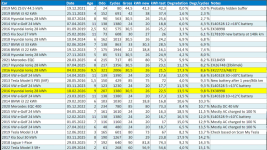
Just saw a video the other day by Norwegian YouTuber Bjørn Nyland testing a 2017 Hyundai Ioniq (28 kWh) with over 300,000 km (~180k miles) on it. This means the tiny battery has done well over 2000 cycles, and according to his test it had around 17% degradation. Which is really a testament to good engineering on Hyundai's part here! (though not an indication of all EVs, early Kia Soul EVs had really bad degradation, up to 50% in some instances).
Edit: added screenshot of table shared in the video for reference.
Edit: added screenshot of table shared in the video for reference.
Attachments
Last edited:
Upvote
3
(3
/
0)
Southern Europe. 3kW is the standard. Gas or central heating, of course.Where is that? Because that doesn't sound right. It would be odd to even bother electrifying a house with so little power which would be about 5 kW. I suspects it's a difference in labelling. In the US residential locations have single phase power, and the service rating is the breaker size which as I mentioned above is labeled differently in the US than Europe. So an EU "25 amp three phase " service would be equivalent power to about 90 amps in the US.
200 amps is the standard now for single family housing but 100 and 150 both used to be very common and multi family dwellings might have less. I lived in a duplex with 60 amp service. It depends on when it was built and what gas vs electric appliances are common in the region.
Upvote
0
(0
/
0)

We don't have 80% and 100% rated breakers. We just have breakers of ratings, and you have to know that you need to leave 20% headroom if you're running a continuous load.I forgot that your non-IEC system is so complicated with its 80% and 100% rated breakers and its 80% breakers that can run at 100% for 3 hours before tripping.
IEC 60898-1 rates the breaker continuously for its stated current.
So, apologies and I recuse myself.
Your breakers don't just magically trip instantly the second you hit 101% current. There are current vs time curves for all breakers and fuses that indicate how long it will take them to open at a given current. You can alter these curves somewhat, but there will always be a curve.
Electrical codes simplify how these things work and provide standard margins in the systems. That way you don't need an engineer for every electrical installation. The actual allowable currents are far more complicated than the circuit breaker value on either of our systems.
Upvote
3
(3
/
0)
You would not be able to use electric appliances like stoves and ovens on a service like that. Its only 12.5 A on a single phase of 240V service.Southern Europe. 3kW is the standard. Gas or central heating, of course.
Upvote
2
(2
/
0)
My own home begs to differ. Different perspectives, I guess.You would not be able to use electric appliances like stoves and ovens on a service like that. Its only 12.5 A on a single phase of 240V service.
Upvote
0
(0
/
0)
I wonder how many of the "older" 2010-2018 batteries were in Nissan Leaf EVs. Nissan's commitment to save cost in the early Leafs (Leaves?) by removing any active thermal management certainly shortened the battery's service life. The same battery pack chemistry in an EV with thermal management would probably see less degradation over time.
Upvote
0
(0
/
0)
Please don't talk down to me. I know. I worked in the industry for years and had to understand both US and IEC approaches. I was a BSi subject expert, I was on the relevant IEC committee.We don't have 80% and 100% rated breakers. We just have breakers of ratings, and you have to know that you need to leave 20% headroom if you're running a continuous load.
Your breakers don't just magically trip instantly the second you hit 101% current. There are current vs time curves for all breakers and fuses that indicate how long it will take them to open at a given current. You can alter these curves somewhat, but there will always be a curve.
Electrical codes simplify how these things work and provide standard margins in the systems. That way you don't need an engineer for every electrical installation. The actual allowable currents are far more complicated than the circuit breaker value on either of our systems.
The simple fact is that it is idiotic that a US 40A domestic breaker is only 32A continuous rated while an IEC one is rated 40A continuous. I suspect it is because it is more expensive to make a breaker to meet the B curves if it actually were to handle the rated current continuously.
Upvote
-2
(0
/
-2)
You’d trip the main breaker by making toast and tea in the morning if the fridge happens to start the compressor.My own home begs to differ. Different perspectives, I guess.
Alternately: You couldn’t reheat a TV dinner while playing call of duty.
Upvote
2
(2
/
0)
If I had a 2.5kW TV, that would be exactly the case. Luckily, I don't. I understand it can sound baffling if you are used to 20kW or so but standard domestic powers in Portugal, Italy, Spain etc. are a google search away. Different world, I know.You’d trip the main breaker by making toast and tea in the morning if the fridge happens to start the compressor.
Alternately: You couldn’t reheat a TV dinner while playing call of duty
Upvote
1
(1
/
0)
For Portugal I got 6.9kVA for a single family home, 4.6kVA for an apartment, and 3.45kVA for a studio. That's with machine translation because I don't know a lick of Portuguese. Looks like according to this, you get the same rate for 6.9kVA and below.If I had a 2.5kW TV, that would be exactly the case. Luckily, I don't. I understand it can sound baffling if you are used to 20kW or so but standard domestic powers in Portugal, Italy, Spain etc. are a google search away. Different world, I know.
https://simuladorpotencia.erse.pt/en-GB?hl=en-US#tab-what_contraced_power_should_i_hire_
Looks like 3kW is a out right for Southern Italy. Of course my living room is larger than a Southern Italian house,.so it's not all that surprising we use more power. My house is pulling 1.3kW right now and nothing particularly exciting is happening. My oven can pull more than 3kW.
Upvote
1
(1
/
0)
It's 2026, if you cannot handle basic facts about climate change without throwing a fit it's time to find a different site to leave comments on
Here is a statement in this article --> We all know the planet is undergoing human-caused warming,....
THAT IS AN OUTRIGHT LIE. Global warming?! Bring it on!
I would expect that most people that work for or with meincmagazine.com and most readers there-of know how to use Google. Here is what a simple Google search brings up:
GLOBALLY, COLD TEMPERATURES CAUSE SIGNIFICANTLY MORE DEATHS THAN HEAT, with studies estimating about 4.5 to 4.6 million annual deaths are linked to cold, compared to roughly 300,000 to 500,000 from heat.
Global Impact: Roughly 9.4% of global deaths (over 5 million annually) are associated with non-optimal temperatures, with the vast majority being cold-related.
Regional Differences: In the US, cold-related deaths are approximately 13 times higher than heat-related deaths (approx. 46,000 vs 3,400 per year).
THAT IS AN OUTRIGHT LIE. Global warming?! Bring it on!
I would expect that most people that work for or with meincmagazine.com and most readers there-of know how to use Google. Here is what a simple Google search brings up:
GLOBALLY, COLD TEMPERATURES CAUSE SIGNIFICANTLY MORE DEATHS THAN HEAT, with studies estimating about 4.5 to 4.6 million annual deaths are linked to cold, compared to roughly 300,000 to 500,000 from heat.
Global Impact: Roughly 9.4% of global deaths (over 5 million annually) are associated with non-optimal temperatures, with the vast majority being cold-related.
Regional Differences: In the US, cold-related deaths are approximately 13 times higher than heat-related deaths (approx. 46,000 vs 3,400 per year).
Upvote
-13
(0
/
-13)
That's what happens when you live in countries which do not get too cold in winter, work out how to deal with summer without massive A/C, and where people live in moderate sized houses.If I had a 2.5kW TV, that would be exactly the case. Luckily, I don't. I understand it can sound baffling if you are used to 20kW or so but standard domestic powers in Portugal, Italy, Spain etc. are a google search away. Different world, I know.
Part of the problem faced by the USA is that a lot of it is not good for human habitation all year round without energy intensive assistance. Great when energy was very cheap, now becoming a driver of lack of competitiveness compared to China and India.
Upvote
0
(0
/
0)
That is not dead which can eternal lie.I didn't know there were still people here that didn't understand climate change. Who wakes up the lurkers for this kind of shit?
Though in this case it is an example of quoting a single fact out of context and imagining there is a simple relationship between average Earth temperature, and heat and cold related deaths. It isn't even about not understanding climate change, it's having the mindset that everything is controlled by, as it were, simple volume knobs.
Upvote
0
(0
/
0)
I guess they proved the article wrong. Turns out some people don’t know the planet is warming.I didn't know there were still people here that didn't understand climate change. Who wakes up the lurkers for this kind of shit?
In this case, because they are unable to achieve knowledge. They can memorize slogans is all. Sad.
Upvote
0
(0
/
0)