
You are using an out of date browser. It may not display this or other websites correctly.
You should upgrade or use an alternative browser.
You should upgrade or use an alternative browser.
Boeing will build the US Air Force’s next air superiority fighter
- Thread starter JournalBot
- Start date

People say that all the time about the F-35, but I have yet to see a reference to someone of importance in the military saying it. I would agree that many probably breathed a sigh of relief that the better-looking plane won, but there’s really little question that Lockheed’s plane actually performed better in the fly-off.Unfortunately, the military does buy based on looks. they wanted the F-117 black because no pilot was going to fly a pastel colored airplane. The F-35 was more aesthetically pleasing and was a factor in the selection as dumb as that sounds
The F-117 wasn’t going to be painted pastel. The production paint was going to be a desert camo, and the Air Force went with black to make it harder for a daylight picture to show the exact faceting — the faceting being key to its stealth. The pastel used on one of the prototypes turned out to not particularly make a difference in visibility.
Last edited:
Upvote
4
(4
/
0)
Yes, but the desert camo had pastel like colors. Lockheed said the pastels helped reduce visibility at night, the air force wanted it black and said the black made it harder to see the faceting. According to Ben Rich anyway.
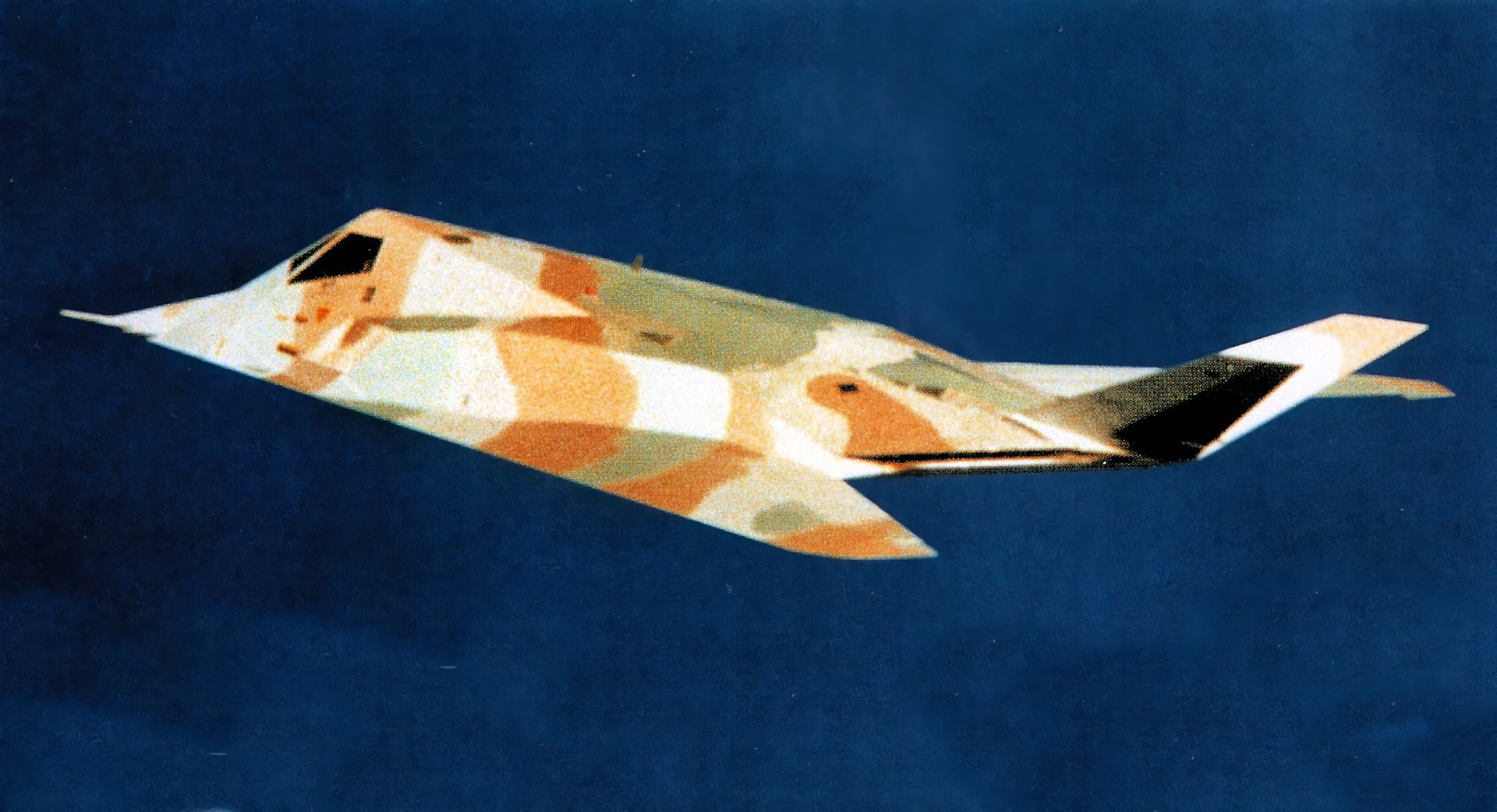
As far as the F35, there were several articles out at the time the selection was made that mentioned it and when I have time I will track one or two down. The X35 was the better aircraft, but that doesn't mean that the Air Force isn't snobby.
As far as the F35, there were several articles out at the time the selection was made that mentioned it and when I have time I will track one or two down. The X35 was the better aircraft, but that doesn't mean that the Air Force isn't snobby.
Upvote
3
(4
/
-1)
Those aren’t pastels, and you’ve just confirmed it was hiding the faceting that the Air Force was going for, not the looks.Yes, but the desert camo had pastel like colors. Lockheed said the pastels helped reduce visibility at night, the air force wanted it black and said the black made it harder to see the faceting. According to Ben Rich anyway.
As far as the F35, there were several articles out at the time the selection was made that mentioned it and when I have time I will track one or two down. The X35 was the better aircraft, but that doesn't mean that the Air Force isn't snobby.

On the X-35, there were lots of articles speculating about the looks. That’s not the same thing as the Air Force having made the decision based on the looks. Yeah, it’s easy to claim it was over the looks, but no one has shown anything of the sort. Lockheed won the fly-off handily. Boeing simply left too much development risk on the table. Their plane was already over-weight and was in the middle of a complete tail redesign.
Last edited:
Upvote
1
(1
/
0)

Re: Title, probably not, more likely they will take hundreds of billions or perhaps even a few trillions of taxpayer dollars and miss milestone after millestone. The US will continue its rapid implosion and the global biome and global economy will all collapse, leaving a desperate human population to fight over the few remaining resources, (mostly access to fresh water). That's my optimistic take. You don't want to hear my pessemistic take.
Upvote
-4
(0
/
-4)

Or, it'll be delivered by the 2050's at four times the original budgetProject to be scrapped a few dozen billion dollars from now.
Upvote
-1
(2
/
-3)
CanardDeCourse
Wise, Aged Ars Veteran
I know one thing about it. It will be exclusive to the US as her traditional allies no longer trust American kit.Very little is known about the NGAD
Upvote
6
(6
/
0)
Honest question - are such aircraft going to even be relevant long term? Given the rapid development of drone warfare, remote or autonomous systems, and very accurate long range weapons - the idea of a multimillion dollar airplane plus the cost, safety risks, and design considerations of pilots onboard seems to me like an increasingly dated concept.
What can such a fighter do that a cheaper and pilot-free (or at least not onboard) alternative can't?
This.
The General Atomics and Anduril products will be the things which actually see combat.
The drones will be AI piloted, no human in the loop, using quantum compasses and swarm strategies at a scale humans simply can't comprehend . All while doing 30G maneuvers, and at couple million dollars each, cheap by air combat standards.
Given that there is a reasonably high probability of a shooting wat with a near-peer power in the 2030s, Boeing is going to look pretty bad if their planes aren't ready or operational. Hopefully that will be the end of them.
Upvote
-10
(0
/
-10)
It will be an expensive plane. And now the USA won't be able to recover some of the investment since the old allies lost trust in the once democratic superpower. Nobody will buy a super expensive super weapon, that can be turned off at the whim of an old, senil, would be dictator, carcass.
Upvote
7
(8
/
-1)

KoshcheiTheDeathless
Ars Praetorian
The US effectively shut down operational HIMARS systems that were protecting Ukrainian civilians from Russian drones when they turned off their satellite imaging without warning. Hundreds died as a result of this. I'm not sure what the intended message was that they were sending to Zelenskyy, but the one that we all heard loud and clear is that the US is a backstabbing kakistocracy whose word means nothing.And then there are the countries cancelling their F-35 orders because they can no longer trust the USA as a reliable partner: https://theaviationist.com/2025/03/13/portugal-f-35-plans/
Why would we buy anything at all from Americans, much less military equipment that we need to rely on to defend our people from aggressive neighbours?
Upvote
7
(10
/
-3)
This.
The General Atomics and Anduril products will be the things which actually see combat.
The drones will be AI piloted, no human in the loop, using quantum compasses and swarm strategies at a scale humans simply can't comprehend . All while doing 30G maneuvers, and at couple million dollars each, cheap by air combat standards.
A "simple" AA missile like AIM-120D already costs 1-2 million each and a slow UAV like the MQ-9 is ~4 million each.
You're not going to get those UCAV for a couple of million.
Upvote
9
(9
/
0)
Very little is known about the NGAD, which the Air Force actually refers to as a "family of systems,"
Almost certainly just meaning "several variations of the same aircraft", which is the DoD learning from its attempt with the F-35 program to have "one aircraft that fits all needs", which sounded great until the rubber hit the road and the different branches all said "no, wait, we really do need different capabilities than the other branches and we don't want their cruft in our variation".
This backpedaling and need for redesign was a big reason for the delay and the overrun on costs for the F-35 program, and honestly probably the only reason Lockheed Martin didn't win this one.
OK, well one of two reasons: Boeing very well may have fallen to the realm of "looking to be acquired" if it didn't land another huge defense contract like this, which is something the DoD probably does not have the stomach for.
Upvote
-1
(2
/
-3)
Even if you build an aircraft that is otheriwse identical to a manned one, but that can fly autonomously or via drone pilot, here are a few things it can't do that an in-situ pilot can:Honest question - are such aircraft going to even be relevant long term? Given the rapid development of drone warfare, remote or autonomous systems, and very accurate long range weapons - the idea of a multimillion dollar airplane plus the cost, safety risks, and design considerations of pilots onboard seems to me like an increasingly dated concept.
What can such a fighter do that a cheaper and pilot-free (or at least not onboard) alternative can't?
- look around and observe in nearly any direction, including above itself
- problem solve/make determinations on the fly, especially about information that a drone may not be equipped to record or transmit
- keep flying and operating the aircraft in the event of signal/gps jamming
Whether it's worth it to have these capabilities in the future remains to be seen, but the DoD is absolutely also pursuing advanced drone aircraft at the same time. One common sense thing the US military has always been adamant about is "if a capability can exist, we want it". It's always better to have the option or tool, even if you don't end up needing it.
Upvote
2
(3
/
-1)
good point - see the current concerns amongst our “allies” that the F-35 “may” have US-controlled kill switches (just like a John Deer combine?).In recent years, US defense procurement assumed some sales outside the US in addition to what the US bought. "Sales" is squishy, because some foreign "sales" were in fact foreign aid - paid for with US dollars - not foreign dollars. But some non-US revenue paid for some of what the US defense industry built, and that assumed revenue reduced unit costs. With the current turmoil provoked specifically by valid concerns about tariffs, I'd be cautious about assuming ANY foreign sales. The US is no longer perceived as 'reliable'. Specific to this story - and US defense procurement generally - any potential foreign sales (and the effect on unit costs) are probably illusory.
Upvote
1
(2
/
-1)
Even if you build an aircraft that is otheriwse identical to a manned one, but that can fly autonomously or via drone pilot, here are a few things it can't do that an in-situ pilot can:
- look around and observe in nearly any direction, including above itself
Isn't a drone better at observing in not just "any" direction, but "all" directions at once? And it doesn't have to divide its limited attention among multiple threats or points of interest, it can focus on all of them equally at once.
The drone has one big advantage in that it doesn't need to keep a fragile pilot alive, and even if it doesn't make it back home, it's just a monetary loss.
Upvote
4
(6
/
-2)
It's all quite Freudian. Trump heard himself being called a "felon." That triggered in him the subconscious desire to go and "F" Elon.The F-elon.
Upvote
1
(1
/
0)
Someone mention Potus 47 announced this. NOW having Boeing do it makes PERFECT sense. I could not imagine another company that could shit the bed worse than Boeing so it is a match made in heaven after all.
Upvote
0
(1
/
-1)
Painting something a flat color is not how you hide faceting.Yes, but the desert camo had pastel like colors. Lockheed said the pastels helped reduce visibility at night, the air force wanted it black and said the black made it harder to see the faceting. According to Ben Rich anyway.
An irregular camo pattern would actually do a better job.
Upvote
0
(0
/
0)

No amount of camo can hide that big boot.Painting something a flat color is not how you hide faceting.
View attachment 105793
An irregular camo pattern would actually do a better job.
Upvote
3
(3
/
0)
joecompute
Smack-Fu Master, in training
Did Trump get the president's approval for this? After all he's on record as saying that manned aircraft are already obsolete. I'm sure he can't approve the spending of the billions of dollars just to build a toy for his assistant!
Upvote
0
(0
/
0)
A "quantum compass" is just a lower drift INS. It still drifts, and still needs to be compensated for by some outside reference. Similarly, INS has been a thing for the better part of the past century, and works plenty fine as it is so long as you can periodically update with an outside reference.The drones will be AI piloted, no human in the loop, using quantum compasses and swarm strategies at a scale humans simply can't comprehend.
No fighter jet, manned or not, is going to be doing 30G maneuvers. It's just not worth it. Humans cannot handle over 10Gs, but then neither can the aircraft they're flying, and not because of the humans in them. An F-16 is limited to 9Gs, with a full internal fuel load and limited external stores. Start adding tanks and weapons and that limit drops, because the aircraft itself isn't strong enough. That same dirty F-16 might only have a 5:1 glide ratio, and with 30klbs thrust wet, can only sustain ~4Gs without slowing down or descending. You could improve the glide ratio, but that will negatively affect strength and roll rates. You can make the aircraft stronger, but that makes it heavier, reducing range and stores. You can add a bigger engine, but that adds cost and weight.All while doing 30G maneuvers, and at couple million dollars each, cheap by air combat standards.
You will not see a fighter aircraft doing 30Gs, and it's not even theoretically possible to do so sustained.
Upvote
8
(8
/
0)
Keep in mind that the car paint they are covering up is not a flat paint, but glossy, which makes a huge difference. The way to best camouflage a surface would be to cover it with something like vantablack.Painting something a flat color is not how you hide faceting.
View attachment 105793
An irregular camo pattern would actually do a better job.
The kind of patterning in that pic works better for curves, where you’re hiding the slow specular changes that occur along curved surfaces, and would be much less effective for facets, where the specular changes occur at sharp edges.
Upvote
2
(2
/
0)

I never really understood why car manufacturers bother with this anyway. Is anyone really trying to steal the exact curvature of their C-pillar?Keep in mind that the car paint they are covering up is not a flat paint, but glossy, which makes a huge difference. The way to best camouflage a surface would be to cover it with something like vantablack.
The kind of patterning in that pic works better for curves, where you’re hiding the slow specular changes that occur along curved surfaces, and would be much less effective for facets, where the specular changes occur at sharp edges.
Upvote
2
(2
/
0)
It’s possible for a night attack aircraft to be too dark. It’s needs to match the sky it’s flying in. As it is, F-117 often wouldn’t fly dying a full moon, because the sky was too bright, and they would stand out.Keep in mind that the car paint they are covering up is not a flat paint, but glossy, which makes a huge difference. The way to best camouflage a surface would be to cover it with something like vantablack.
I’m not suggesting dazzle paint is correct, but fundamentally, all camo is designed to break up any natural lines. For F-117, it would provide false shadows to anything that might be observing from above. Being completely black would certainly do that, but with other problems already mentioned.The kind of patterning in that pic works better for curves, where you’re hiding the slow specular changes that occur along curved surfaces, and would be much less effective for facets, where the specular changes occur at sharp edges.
Operationally, I doubt it mattered. No one is going to see those facets from the bottom. EO systems on 1980s aircraft weren’t great, and decent odds they’re IR where shadows and camo patterns don’t matter. For satellites, you never come out during the day. For fans in lawn chairs outside the fence line… you never come out during the day. The RAM needed a lot of tending, and it was probably kept flat for logistical reasons as much as anything else.
Upvote
2
(2
/
0)
I recently watched this Mentour Pilot clip about the new Air Force One planes that gives some plausible reasons why they are taking so long:Guys, this neither a commercial airliner nor a space vehicle. Boeing always executes on government aircraft orders!
https://www.cnbc.com/2025/02/17/boe...until-2029-or-later-senior-official-says.html
View: https://www.youtube.com/watch?v=lMmET2XA1vQ
Upvote
0
(0
/
0)
I always thought it was for publicity. They want to control the terms of their first public unveiling.I never really understood why car manufacturers bother with this anyway. Is anyone really trying to steal the exact curvature of their C-pillar?
Upvote
3
(3
/
0)
The F-15 is a more generally useful aircraft. The F-22 is stealth, but only if there's nothing hanging off the wings. Internal stores are extremely limited, and once you add external stores, then you're no better off than a modernized 4th gen.Replace the F-22, but the F-15 IS STILL FLYING.
Upvote
2
(2
/
0)
Yeah. The point I was thinking of adding is that the F-22's two-tone paint job probably ends up as a much better compromise paint job than black. It's low contrast against a variety of backgrounds, still has some element of breaking up the outline from the two-tone, isn't a complex pattern to maintain, etc.It’s possible for a night attack aircraft to be too dark. It’s needs to match the sky it’s flying in. As it is, F-117 often wouldn’t fly dying a full moon, because the sky was too bright, and they would stand out.
I’m not suggesting dazzle paint is correct, but fundamentally, all camo is designed to break up any natural lines. For F-117, it would provide false shadows to anything that might be observing from above. Being completely black would certainly do that, but with other problems already mentioned.
Operationally, I doubt it mattered. No one is going to see those facets from the bottom. EO systems on 1980s aircraft weren’t great, and decent odds they’re IR where shadows and camo patterns don’t matter. For satellites, you never come out during the day. For fans in lawn chairs outside the fence line… you never come out during the day. The RAM needed a lot of tending, and it was probably kept flat for logistical reasons as much as anything else.
Upvote
0
(0
/
0)

A "quantum compass" is just a lower drift INS. It still drifts, and still needs to be compensated for by some outside reference. Similarly, INS has been a thing for the better part of the past century, and works plenty fine as it is so long as you can periodically update with an outside reference.
No fighter jet, manned or not, is going to be doing 30G maneuvers. It's just not worth it. Humans cannot handle over 10Gs, but then neither can the aircraft they're flying, and not because of the humans in them. An F-16 is limited to 9Gs, with a full internal fuel load and limited external stores. Start adding tanks and weapons and that limit drops, because the aircraft itself isn't strong enough. That same dirty F-16 might only have a 5:1 glide ratio, and with 30klbs thrust wet, can only sustain ~4Gs without slowing down or descending. You could improve the glide ratio, but that will negatively affect strength and roll rates. You can make the aircraft stronger, but that makes it heavier, reducing range and stores. You can add a bigger engine, but that adds cost and weight.
You will not see a fighter aircraft doing 30Gs, and it's not even theoretically possible to do so sustained.
I wish people would understand this. We do have hyper-maneuverable drones that only cost a $1 million. They’re called air-to-air missiles. There is a reason those “drones” have to be hauled around by a carrier aircraft to get them close to their target.
The size and weight of fighter aircraft is defined much more by what performance you want out of it, not by having to fit in a pilot. The pilot isn’t the major limiting factor on performance, the laws of physics are. They’re a bitch and won’t be changing any time soon.
Upvote
9
(9
/
0)
I am just paraphrasing what Ben Rich said about the program. Those colors are not far off a pastel since all pastel means is a soft muted look.Those aren’t pastels, and you’ve just confirmed it was hiding the faceting that the Air Force was going for, not the looks.
On the X-35, there were lots of articles speculating about the looks. That’s not the same thing as the Air Force having made the decision based on the looks. Yeah, it’s easy to claim it was over the looks, but no one has shown anything of the sort. Lockheed won the fly-off handily. Boeing simply left too much development risk on the table. Their plane was already over-weight and was in the middle of a complete tail redesign.
I never said the F35 decision was made entirely by the looks, just that the Air Force does consider looks when making a decision. I also said that the X35 was clearly the better aircraft.
Upvote
0
(0
/
0)
You gave two examples of how the Air Force considered looks and both turn out to be wrong, yet you’re insisting they were relevant and that you’ve proven the Air Force considers looks. You don’t see the issue here?I am just paraphrasing what Ben Rich said about the program. Those colors are not far off a pastel since all pastel means is a soft muted look.
I never said the F35 decision was made entirely by the looks, just that the Air Force does consider looks when making a decision. I also said that the X35 was clearly the better aircraft.
Upvote
1
(1
/
0)
 Boeing
Tangentially related ... the Sukhoi Su-57 has the NATO nickname "Felon".F 47 for FELON47?
Trump with a Felon47 and Putin with his Felons seems so apt. Partners in crime.
Upvote
1
(1
/
0)

The USAF provided (very fast) flights from [redacted] to [redacted] and accommodation so that Ars could fly the new [redacted]. Ars does not accept paid editorial content.Can't wait for your test flight and review Jonathan if this thing ever gets off the ground/s
Mr Gitlin, unfortunately, swears that he didn't see anything.
Upvote
3
(4
/
-1)