
Includes Intel Xeon W-11955M, Nvidia RTX A5000 graphics, and a tall OLED screen.
Read the whole story
Read the whole story
No, it's still emulation.That is why the games run at playable clips at all. If Rosetta also emulated the GPU, they would run like molasses in Russian winter.The M1 Max beats a great many discrete GPUs in "actual performance". It's not going to beat an RTX 3080 at everything, no, but it's very much competitive with anything from a 3060 to 3080 depending on workload.
It doesn't even beat mobile 3060's in actual perf, only in synthetic benchmarks. Anandtech tested it. It's good perf for the wattage, but if you need performance, power be damned, Apple does not offer you any options.
Yes, at "Shadow of the Tomb Raider" and "Borderlands 3", games which always ran better under Windows than macOS even on the same hardware and are running under Rosetta, the M1 Max is beaten by a 3060 Windows machine. There is no shortage of other productivity benchmarks that show it's capable of much more, including basically everything else Anandtech tested.
not to refute your point but i think Rosetta is for CPU emulation only, GPU dependent workload on those games is running natively with Metal.
Rosetta doesn't emulate. It decompiles x86 to LLVM opcode and then targets the opcode to ARM and saves the resulting binary. That's why it gets the performance that it does - it's effectively native code, just not optimized native code.
The M1 Max beats a great many discrete GPUs in "actual performance". It's not going to beat an RTX 3080 at everything, no, but it's very much competitive with anything from a 3060 to 3080 depending on workload.
It doesn't even beat mobile 3060's in actual perf, only in synthetic benchmarks. Anandtech tested it. It's good perf for the wattage, but if you need performance, power be damned, Apple does not offer you any options.
Yes, at "Shadow of the Tomb Raider" and "Borderlands 3", games which always ran better under Windows than macOS even on the same hardware and are running under Rosetta, the M1 Max is beaten by a 3060 Windows machine. There is no shortage of other productivity benchmarks that show it's capable of much more, including basically everything else Anandtech tested.
not to refute your point but i think Rosetta is for CPU emulation only, GPU dependent workload on those games is running natively with Metal.
You’re spot on, in fact Xeons are often clocked lower than regular Core CPUs with the same core count, thus perform slower.The whole mac comparison seems a bit weird and irrelevant, but maybe there's a connection I'm not seeing.
Apple grabbed the crown of laptop performance with the M1 Pro & M1 Max MacBooks they introduced this year. Everyone else will be measured against them for a while. I'm interested to see how a Xeon does head to head on similar workloads.
My (admittedly completely uninformed) impression was that Xeon chips do not offer a performance advantage core for core over Intel's comparable i-series chips. They allow the use of ECC RAM, and they came in higher core counts. But from a raw clock speed perspective, they generally did not outperform the regular i-series cpu's.
But I could very well be wrong or out of date on this.

Given Xeon desktops have terrible single core performance compared to i9 desktops, and i9 desktops have terrible single core performance compared the the M1...The whole mac comparison seems a bit weird and irrelevant, but maybe there's a connection I'm not seeing.
Apple grabbed the crown of laptop performance with the M1 Pro & M1 Max MacBooks they introduced this year. Everyone else will be measured against them for a while. I'm interested to see how a Xeon does head to head on similar workloads.
95W CPUAverage battery life: 6 hr 7 min. MacBook Pro 16in average battery life: 14 hr 8 min.
Hmm.
Discrete GPU vs. integrated GPU. I'm honestly surprised they could get more than 4 hours.
With that much storage available, how the hell do you transfer that to/from a storage system without a 10G NIC ? Even a 2.5G nic would have been better, but a standard 1G nic? Come on. You'll need to buy an external TB4/10G adapter.
You’re spot on, in fact Xeons are often clocked lower than regular Core CPUs with the same core count, thus perform slower.The whole mac comparison seems a bit weird and irrelevant, but maybe there's a connection I'm not seeing.
Apple grabbed the crown of laptop performance with the M1 Pro & M1 Max MacBooks they introduced this year. Everyone else will be measured against them for a while. I'm interested to see how a Xeon does head to head on similar workloads.
My (admittedly completely uninformed) impression was that Xeon chips do not offer a performance advantage core for core over Intel's comparable i-series chips. They allow the use of ECC RAM, and they came in higher core counts. But from a raw clock speed perspective, they generally did not outperform the regular i-series cpu's.
But I could very well be wrong or out of date on this.
The M1 Max MBP consumes 120W of power at peak load based on Anandtech's testing, and OLED displays have basically the same power consumption as comparable Mini-LED.95W CPUAverage battery life: 6 hr 7 min. MacBook Pro 16in average battery life: 14 hr 8 min.
Hmm.
Discrete GPU vs. integrated GPU. I'm honestly surprised they could get more than 4 hours.
110W GPU
3840x2400 OLED at 550 nits (that's what 25W?)
Already reached 230W and we haven't listed all the components that draw power. Presumably it has a 100Wh battery or else you can't take it on an airplane.
4 hours seems highly generous to me. The display alone can drain the battery in that time at fullbrightness (which is half the brightness of a MacBook Pro... OLEDs need a lot of power. Seriously most OLED PC laptops are also available with an LCD and you should probably get the LCD).
I'm pretty sure this thing could drain the battery in half an hour if you pushed it hard enough. Assuming it isn't severely throttled while on battery - which it might be.
Now I know you weren't using a Mac. The trackpad is not off center and the false-touch protection is amazing, near perfect.
The most reasonable analogy between OnShape and something like Solidworks or PTC Creo is that OnShape is G Suite and the incumbents are Office.That's a sweeping statement. The domain of media (music production for example) and photography and very well served by "native" mac apps with Metal support. I suspect Apple's strategy is to entice competing sw developers to target the Mac market for those areas currently best served within the Windows/intel space.
No reason why Solidworks (to take a old fashion software vendor model example - you know, contact your sales man for a price of $10k per user) shouldn't be undermined by an App store vendor with a $10 / month offering that's better.
Just go look at Pixelmator pro as a model.
Yeah, that's OnShape. Runs in the cloud. Works great on everything from an iPhone up. Solidworks has the longer pedigree and built up ecosystem, but its also horribly outdated conceptually. OnShape looks like a modern application in the sense that it can hook into modern SAAS systems, has modern methods of scaling performance (buying compute time, etc.) and so on.
Apple's strategy is more to tie the Mac and iOS to the same APIs and code experience so you instead scale from highly portable to high performance, and benefit from the 1B iOS devices out there to help developers scale.
For what it's worth, this is not a 14nm CPU. It's Tiger Lake / 10nm Superfin.The Xeon W and RTX A series warrants a mention, if nothing else, IMO.I'm not sure why a windows VAR laptop seller like Asus rates a story about their new product. Unless its so incredibly awesomely better than everything else on the market that it's a real scoop.
I'm not feeling it.
Anyone remember the last time there was a Xeon in a laptop? I don't.
It's been possible to buy Zbooks for a long time with Xeons, but what makes this awkward is we have a 14nm chip trying to beat out 5nm, and you can really see it in the battery life and likely thermals here. I'd be much more interested in seeing a top-end Ryzen or Threadripper in this scenario (especially since at this price range they could just pay for a Thunderbolt controller).
Apple's process node advantage is glaring vs. Intel's offerings in this area, at least vs Ryzen it's a good bit less.
https://ark.intel.com/content/www/us/en ... 0-ghz.html
It is a bit awkward being released now, given that Alder Lake-P laptops - including some big, bad options - will almost certainly be hitting shelves in Q1/2022, which may be around the same time as this one does. And Xeon or not, the top-tier Alder Lake-P options will almost definitely completely outclass this CPU.
The really important story behind this laptop, ultimately, is the Quadro graphics card. Whether it ultimately amounts to mostly driver engineering or not, a lot of functionality in many professional CAD packages is locked behind that Quadro / Radeon Pro designation. And on top of functionality, if you're having any kind of stability issues, tech support is going to be hesitant to give you much more than the time of day if you're running a GeForce card, even something top-tier like an RTX 3080.
Those kinds of capabilities are also enough to make the comparison to the Macbook Pro moot for a lot of engineers. Whether we like it or not, if you design and manufacture physical products, the software you use generally doesn't run on any Macs.
Now I know you weren't using a Mac. The trackpad is not off center and the false-touch protection is amazing, near perfect.
The trackpad is centered on the keyboard but not on your hands. With fingers on the home row the trackpad is more under the right hand.
The false touch protection is good. I would not call it near perfect. I have to type with my wrists raised a bit
This has nothing to do with the M1 or ARM or anything hardware related, and everything to do with MacOS. It's always been a niche operating environment, so it's not a surprise that many enterprise- and industrially-focused companies have never bothered to port software for it. Windows 11 on Arm can emulate x64 apps now (really, it is a Rosetta-like translation, but tomato / tomahto) so if you wanted to, you could bumble along running these software packages on a Mac using Windows 11, but that's sort of irrelevant.For what it's worth, this is not a 14nm CPU. It's Tiger Lake / 10nm Superfin.The Xeon W and RTX A series warrants a mention, if nothing else, IMO.I'm not sure why a windows VAR laptop seller like Asus rates a story about their new product. Unless its so incredibly awesomely better than everything else on the market that it's a real scoop.
I'm not feeling it.
Anyone remember the last time there was a Xeon in a laptop? I don't.
It's been possible to buy Zbooks for a long time with Xeons, but what makes this awkward is we have a 14nm chip trying to beat out 5nm, and you can really see it in the battery life and likely thermals here. I'd be much more interested in seeing a top-end Ryzen or Threadripper in this scenario (especially since at this price range they could just pay for a Thunderbolt controller).
Apple's process node advantage is glaring vs. Intel's offerings in this area, at least vs Ryzen it's a good bit less.
https://ark.intel.com/content/www/us/en ... 0-ghz.html
It is a bit awkward being released now, given that Alder Lake-P laptops - including some big, bad options - will almost certainly be hitting shelves in Q1/2022, which may be around the same time as this one does. And Xeon or not, the top-tier Alder Lake-P options will almost definitely completely outclass this CPU.
The really important story behind this laptop, ultimately, is the Quadro graphics card. Whether it ultimately amounts to mostly driver engineering or not, a lot of functionality in many professional CAD packages is locked behind that Quadro / Radeon Pro designation. And on top of functionality, if you're having any kind of stability issues, tech support is going to be hesitant to give you much more than the time of day if you're running a GeForce card, even something top-tier like an RTX 3080.
Those kinds of capabilities are also enough to make the comparison to the Macbook Pro moot for a lot of engineers. Whether we like it or not, if you design and manufacture physical products, the software you use generally doesn't run on any Macs.
That's a pretty narrow category. Sure the list of CAD programs you can run on a Mac is pretty slim, requiring the continued use of an Intel Mac with Bootcamp if you want to run such stuff. But give software developers time to adjust to this new paradigm. The M1 Macs were only shipping a year ago. Software development on this level is highly complex. And 1990s attitudes about computers still linger. You're in good company there.

I'll also posit that in the GSuite vs MS Office argument that Microsoft 365 has a huge array of features that Google doesn't offer, or that you have to worry about disappearing if they're a niche service.The most reasonable analogy between OnShape and something like Solidworks or PTC Creo is that OnShape is G Suite and the incumbents are Office.That's a sweeping statement. The domain of media (music production for example) and photography and very well served by "native" mac apps with Metal support. I suspect Apple's strategy is to entice competing sw developers to target the Mac market for those areas currently best served within the Windows/intel space.
No reason why Solidworks (to take a old fashion software vendor model example - you know, contact your sales man for a price of $10k per user) shouldn't be undermined by an App store vendor with a $10 / month offering that's better.
Just go look at Pixelmator pro as a model.
Yeah, that's OnShape. Runs in the cloud. Works great on everything from an iPhone up. Solidworks has the longer pedigree and built up ecosystem, but its also horribly outdated conceptually. OnShape looks like a modern application in the sense that it can hook into modern SAAS systems, has modern methods of scaling performance (buying compute time, etc.) and so on.
Apple's strategy is more to tie the Mac and iOS to the same APIs and code experience so you instead scale from highly portable to high performance, and benefit from the 1B iOS devices out there to help developers scale.
If the former has the features you need, it's amazing and works great, can improve collaboration, and potentially reduce costs (depending on your use case). But there are many hundreds of billions of dollars of value that are tied up in using those "outdated" programs and the myriad supporting plug-ins and tools that have been developed for those programs.
There might come a time when those new tools can replace all the functionality built into these behemoths, but at the moment it's a bit like predictions from 2012 that tablets were going to replace laptops entirely. We saw how that panned out - the tablets have become laptops just as much as the other way around.
The M1 Max beats a great many discrete GPUs in "actual performance". It's not going to beat an RTX 3080 at everything, no, but it's very much competitive with anything from a 3060 to 3080 depending on workload.
It doesn't even beat mobile 3060's in actual perf, only in synthetic benchmarks. Anandtech tested it. It's good perf for the wattage, but if you need performance, power be damned, Apple does not offer you any options.
Yes, at "Shadow of the Tomb Raider" and "Borderlands 3", games which always ran better under Windows than macOS even on the same hardware and are running under Rosetta, the M1 Max is beaten by a 3060 Windows machine. There is no shortage of other productivity benchmarks that show it's capable of much more, including basically everything else Anandtech tested.
not to refute your point but i think Rosetta is for CPU emulation only, GPU dependent workload on those games is running natively with Metal.
Sure, but CPU performance will impact game frame rates as well. Not sure about BL3 and SotTR specifically, but in my experience most Mac game ports are essentially Wine wrappers rather than actual native ports. Plus, OpenGL support on macOS is dead and Vulkan is not supported, so a common strategy these days is to use MoltenVK on top of DXVK. All these layers of abstraction and translation inevitably take a significant toll on performance, even before you factor in Rosetta.
That is why the games run at playable clips at all. If Rosetta also emulated the GPU, they would run like molasses in Russian winter.The M1 Max beats a great many discrete GPUs in "actual performance". It's not going to beat an RTX 3080 at everything, no, but it's very much competitive with anything from a 3060 to 3080 depending on workload.
It doesn't even beat mobile 3060's in actual perf, only in synthetic benchmarks. Anandtech tested it. It's good perf for the wattage, but if you need performance, power be damned, Apple does not offer you any options.
Yes, at "Shadow of the Tomb Raider" and "Borderlands 3", games which always ran better under Windows than macOS even on the same hardware and are running under Rosetta, the M1 Max is beaten by a 3060 Windows machine. There is no shortage of other productivity benchmarks that show it's capable of much more, including basically everything else Anandtech tested.
not to refute your point but i think Rosetta is for CPU emulation only, GPU dependent workload on those games is running natively with Metal.
Rosetta doesn't emulate. It decompiles x86 to LLVM opcode and then targets the opcode to ARM and saves the resulting binary. That's why it gets the performance that it does - it's effectively native code, just not optimized native code.
Average battery life: 6 hr 7 min. MacBook Pro 16in average battery life: 14 hr 8 min.
Hmm.
Discrete GPU vs. integrated GPU. I'm honestly surprised they could get more than 4 hours.
I think the "discrete" versus "integrated" terminology should be re-examined considering Apple is changing peoples' expectations of what an integrated GPU is capable of.
With the dGPU shortage there has been a lot of call for AMD to sell something like that outside of consoles, but the closest is the 5000G series, which is the same iGPU as in mobile units. Which is admittedly still better than Intel's stance, which is that desktop CPUs will only get 32 EU iGPUs and the 96 EU ones only in i7 mobile chips.Average battery life: 6 hr 7 min. MacBook Pro 16in average battery life: 14 hr 8 min.
Hmm.
Discrete GPU vs. integrated GPU. I'm honestly surprised they could get more than 4 hours.
I think the "discrete" versus "integrated" terminology should be re-examined considering Apple is changing peoples' expectations of what an integrated GPU is capable of.
Intel and AMD have the capability to do just that. The xboxX/PS5 APU is bigger and faster and could probably be made into a mobile 100ish watt package. Intel also tried that with crystalwell and Iris pro but the only vendor that bought them was apple. No one else wanted to pay additional money for bigger graphics.
I'm honestly hoping that the new M1 Max shows there is in fact demand for this and either intel or AMD goes for it.
The fact that AMD and Intel CPUs generate more heat does not automatically mean that they are throttling. As Apple fans love to mention PC laptops run fans more often. What do the fans do? They dissipate heat. You'd need to come up with specific numbers to prove your point.Why? Because most people use laptops on battery only? Who are they? Salesmen? Those do not need this class of laptop to begin with. In corporate world (which this laptop is targeting), many people are getting laptops as main computers but the main mobility factor they care about is being able to move the laptop from office to home and back. And most rarely run the laptop on battery (just for occasional meetings, and those who have too many meetings do not need the powerful laptop either for they are not really doing creative/development work either).Reviews and comparisons should compare laptop performance when on battery only. The MacBooks have no performance hit on battery. Intel laptops have an enormous performance hit when on battery.
The problem is that the high power consumption of INTEL/AMD chips generate a lot of heat and they throttle even when plugged into the wall, so the maximum performance is not sustainable. The M1 on the other hand can run full tilt on battery power alone with little heat and is almost dead silent.
What the point of having a powerful laptop if it can only give you maximum performance in spurts with fan noise blazing in the background? Did I mention that excessive heat shortens the life of computer components? What's the impact on your electrical bill when the laptop is consuming 2x to 3x more power?

That's an issue I've had for years with the larger MacBook Pros. The trackpads are so enormous and off-center to the right, that my right palm heel often triggers cursor motion. I have to consciously keep my wrist raised. Or use an external trackpad.That 10key looks awful. I think that would put the heel of my right hand right on the touch pad, and probably would be a dealbreaker for me.
And it can be argued that Apple has a bad history when it comes to designing machines to effectively remove heat, like the i9 MBPs that were slower than the i7 models.The fact that AMD and Intel CPUs generate more heat does not automatically mean that they are throttling. As Apple fans love to mention PC laptops run fans more often. What do the fans do? They dissipate heat. You'd need to come up with specific numbers to prove your point.Why? Because most people use laptops on battery only? Who are they? Salesmen? Those do not need this class of laptop to begin with. In corporate world (which this laptop is targeting), many people are getting laptops as main computers but the main mobility factor they care about is being able to move the laptop from office to home and back. And most rarely run the laptop on battery (just for occasional meetings, and those who have too many meetings do not need the powerful laptop either for they are not really doing creative/development work either).Reviews and comparisons should compare laptop performance when on battery only. The MacBooks have no performance hit on battery. Intel laptops have an enormous performance hit when on battery.
The problem is that the high power consumption of INTEL/AMD chips generate a lot of heat and they throttle even when plugged into the wall, so the maximum performance is not sustainable. The M1 on the other hand can run full tilt on battery power alone with little heat and is almost dead silent.
What the point of having a powerful laptop if it can only give you maximum performance in spurts with fan noise blazing in the background? Did I mention that excessive heat shortens the life of computer components? What's the impact on your electrical bill when the laptop is consuming 2x to 3x more power?
And it can be argued that Apple has a bad history when it comes to designing machines to effectively remove heat, like the i9 MBPs that were slower than the i7 models.The fact that AMD and Intel CPUs generate more heat does not automatically mean that they are throttling. As Apple fans love to mention PC laptops run fans more often. What do the fans do? They dissipate heat. You'd need to come up with specific numbers to prove your point.Why? Because most people use laptops on battery only? Who are they? Salesmen? Those do not need this class of laptop to begin with. In corporate world (which this laptop is targeting), many people are getting laptops as main computers but the main mobility factor they care about is being able to move the laptop from office to home and back. And most rarely run the laptop on battery (just for occasional meetings, and those who have too many meetings do not need the powerful laptop either for they are not really doing creative/development work either).Reviews and comparisons should compare laptop performance when on battery only. The MacBooks have no performance hit on battery. Intel laptops have an enormous performance hit when on battery.
The problem is that the high power consumption of INTEL/AMD chips generate a lot of heat and they throttle even when plugged into the wall, so the maximum performance is not sustainable. The M1 on the other hand can run full tilt on battery power alone with little heat and is almost dead silent.
What the point of having a powerful laptop if it can only give you maximum performance in spurts with fan noise blazing in the background? Did I mention that excessive heat shortens the life of computer components? What's the impact on your electrical bill when the laptop is consuming 2x to 3x more power?

Being able to run "normal" Windows 10/11 on the Xbox Series X (or PS5) would be so very interesting. I really want to see how much better the whole is than the sum of its part (a same clocked Zen2 + same CU/clock speed RDNA2 graphics card PC).Average battery life: 6 hr 7 min. MacBook Pro 16in average battery life: 14 hr 8 min.
Hmm.
Discrete GPU vs. integrated GPU. I'm honestly surprised they could get more than 4 hours.
I think the "discrete" versus "integrated" terminology should be re-examined considering Apple is changing peoples' expectations of what an integrated GPU is capable of.
Intel and AMD have the capability to do just that. The xboxX/PS5 APU is bigger and faster and could probably be made into a mobile 100ish watt package. Intel also tried that with crystalwell and Iris pro but the only vendor that bought them was apple. No one else wanted to pay additional money for bigger graphics.
I'm honestly hoping that the new M1 Max shows there is in fact demand for this and either intel or AMD goes for it.
Plenty of PC laptops ran that part without throttling constantly, because the device designers weren't running on the constant dictates that the only design decisions had to be around "lighter and thinner" like Apple has.And it can be argued that Apple has a bad history when it comes to designing machines to effectively remove heat, like the i9 MBPs that were slower than the i7 models.The fact that AMD and Intel CPUs generate more heat does not automatically mean that they are throttling. As Apple fans love to mention PC laptops run fans more often. What do the fans do? They dissipate heat. You'd need to come up with specific numbers to prove your point.Why? Because most people use laptops on battery only? Who are they? Salesmen? Those do not need this class of laptop to begin with. In corporate world (which this laptop is targeting), many people are getting laptops as main computers but the main mobility factor they care about is being able to move the laptop from office to home and back. And most rarely run the laptop on battery (just for occasional meetings, and those who have too many meetings do not need the powerful laptop either for they are not really doing creative/development work either).Reviews and comparisons should compare laptop performance when on battery only. The MacBooks have no performance hit on battery. Intel laptops have an enormous performance hit when on battery.
The problem is that the high power consumption of INTEL/AMD chips generate a lot of heat and they throttle even when plugged into the wall, so the maximum performance is not sustainable. The M1 on the other hand can run full tilt on battery power alone with little heat and is almost dead silent.
What the point of having a powerful laptop if it can only give you maximum performance in spurts with fan noise blazing in the background? Did I mention that excessive heat shortens the life of computer components? What's the impact on your electrical bill when the laptop is consuming 2x to 3x more power?
As we now know the INTEL processor was the design flaw. I had a 2020 13” MBP i7 and it always ran hot and noisy and topped out at 4-5 hours of battery life. Then I switched to the M1 and it runs cool and silent giving me 10-12 hours under the exact same workload in the exact same chassis as the INTEL model but with one less fan, which I’ve never heard. On top of that it’s simply faster with double the graphics power to boot.
While heat doesn’t always mean a laptop will throttle, the heat, noise extra weight and short battery life of INTEL equipped laptops are annoying.
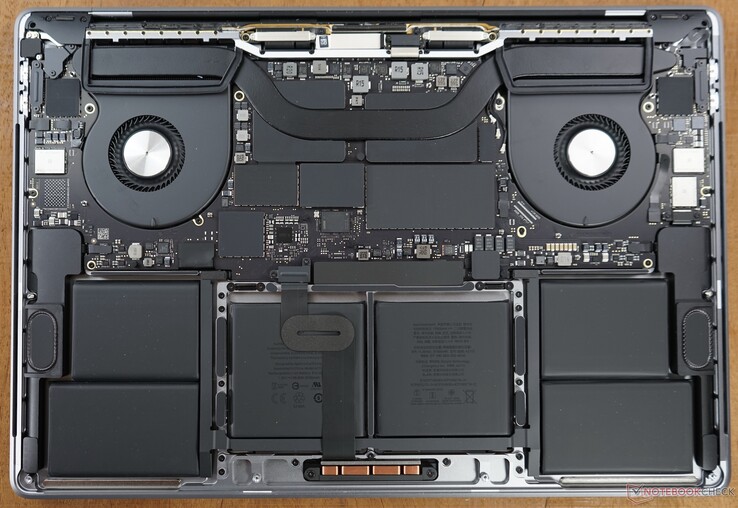

Plenty of PC laptops ran that part without throttling constantly, because the device designers weren't running on the constant dictates that the only design decisions had to be around "lighter and thinner" like Apple has.And it can be argued that Apple has a bad history when it comes to designing machines to effectively remove heat, like the i9 MBPs that were slower than the i7 models.The fact that AMD and Intel CPUs generate more heat does not automatically mean that they are throttling. As Apple fans love to mention PC laptops run fans more often. What do the fans do? They dissipate heat. You'd need to come up with specific numbers to prove your point.Why? Because most people use laptops on battery only? Who are they? Salesmen? Those do not need this class of laptop to begin with. In corporate world (which this laptop is targeting), many people are getting laptops as main computers but the main mobility factor they care about is being able to move the laptop from office to home and back. And most rarely run the laptop on battery (just for occasional meetings, and those who have too many meetings do not need the powerful laptop either for they are not really doing creative/development work either).
The problem is that the high power consumption of INTEL/AMD chips generate a lot of heat and they throttle even when plugged into the wall, so the maximum performance is not sustainable. The M1 on the other hand can run full tilt on battery power alone with little heat and is almost dead silent.
What the point of having a powerful laptop if it can only give you maximum performance in spurts with fan noise blazing in the background? Did I mention that excessive heat shortens the life of computer components? What's the impact on your electrical bill when the laptop is consuming 2x to 3x more power?
As we now know the INTEL processor was the design flaw. I had a 2020 13” MBP i7 and it always ran hot and noisy and topped out at 4-5 hours of battery life. Then I switched to the M1 and it runs cool and silent giving me 10-12 hours under the exact same workload in the exact same chassis as the INTEL model but with one less fan, which I’ve never heard. On top of that it’s simply faster with double the graphics power to boot.
While heat doesn’t always mean a laptop will throttle, the heat, noise extra weight and short battery life of INTEL equipped laptops are annoying.
It feels a bit weird to me to compare Intel parts from 2017-2019 against an Apple parts released in late 2020-2021, completely glossing over the fact that the competitive landscape at Intel and AMD has changed dramatically in that intervening time, and that Alder Lake-P components are what are going to be competing in the same product cycle with the M1 Max, not 14nm components from half a decade ago.The M1 has solved this problem for Apple, they now have the best of both worlds. While you can improve the cooling system in the PC laptop, it doesn't solve the noise, weight, bulk or battery life issues which are substantial. The INTEL MBP i7 was easily twice as noisy and with half the battery life as the M1 in the exact same chassis. Plus, we already know that the M1 Max can run full tilt on the battery without throttling, while remaining nearly silent in a chassis only a few mm larger than its predecessor.
"After 20 minutes of full throttle, the MacBook Pro continues to operate almost completely silently - only with the ear on the case can a quiet whisper be heard. The case temperature on the upper side is around 110° degrees at this point. The Intel-based device (MacBook Pro 2017) is quite different, as it already made noise at full volume after three minutes. At the same time, it got so hot on the bottom that you can hardly put it down on your thighs."
"After 30 minutes, the temperature of the aluminum part above the keyboard increased to 125° degrees, and the underside is at 97° degrees. It can still be used as a "lap"top, though."
"After 40 minutes, the situation was exactly the same as before: no fans, no unpleasant waste heat and certainly no throttling due to excessive heat development. At this point we ended the test, because there were no more changes."
MacBook Pro 2021 M1 Max Under Heavy Load: Heat, Fans - And The "Throttling" Question
https://www.mtech.news/article/MacBook- ... ion-175275
It feels a bit weird to me to compare Intel parts from 2017-2019 against an Apple parts released in late 2020-2021, completely glossing over the fact that the competitive landscape at Intel and AMD has changed dramatically in that intervening time, and that Alder Lake-P components are what are going to be competing in the same product cycle with the M1 Max, not 14nm components from half a decade ago.The M1 has solved this problem for Apple, they now have the best of both worlds. While you can improve the cooling system in the PC laptop, it doesn't solve the noise, weight, bulk or battery life issues which are substantial. The INTEL MBP i7 was easily twice as noisy and with half the battery life as the M1 in the exact same chassis. Plus, we already know that the M1 Max can run full tilt on the battery without throttling, while remaining nearly silent in a chassis only a few mm larger than its predecessor.
"After 20 minutes of full throttle, the MacBook Pro continues to operate almost completely silently - only with the ear on the case can a quiet whisper be heard. The case temperature on the upper side is around 110° degrees at this point. The Intel-based device (MacBook Pro 2017) is quite different, as it already made noise at full volume after three minutes. At the same time, it got so hot on the bottom that you can hardly put it down on your thighs."
"After 30 minutes, the temperature of the aluminum part above the keyboard increased to 125° degrees, and the underside is at 97° degrees. It can still be used as a "lap"top, though."
"After 40 minutes, the situation was exactly the same as before: no fans, no unpleasant waste heat and certainly no throttling due to excessive heat development. At this point we ended the test, because there were no more changes."
MacBook Pro 2021 M1 Max Under Heavy Load: Heat, Fans - And The "Throttling" Question
https://www.mtech.news/article/MacBook- ... ion-175275
It feels a bit weird to me to compare Intel parts from 2017-2019 against an Apple parts released in late 2020-2021, completely glossing over the fact that the competitive landscape at Intel and AMD has changed dramatically in that intervening time, and that Alder Lake-P components are what are going to be competing in the same product cycle with the M1 Max, not 14nm components from half a decade ago.The M1 has solved this problem for Apple, they now have the best of both worlds. While you can improve the cooling system in the PC laptop, it doesn't solve the noise, weight, bulk or battery life issues which are substantial. The INTEL MBP i7 was easily twice as noisy and with half the battery life as the M1 in the exact same chassis. Plus, we already know that the M1 Max can run full tilt on the battery without throttling, while remaining nearly silent in a chassis only a few mm larger than its predecessor.
"After 20 minutes of full throttle, the MacBook Pro continues to operate almost completely silently - only with the ear on the case can a quiet whisper be heard. The case temperature on the upper side is around 110° degrees at this point. The Intel-based device (MacBook Pro 2017) is quite different, as it already made noise at full volume after three minutes. At the same time, it got so hot on the bottom that you can hardly put it down on your thighs."
"After 30 minutes, the temperature of the aluminum part above the keyboard increased to 125° degrees, and the underside is at 97° degrees. It can still be used as a "lap"top, though."
"After 40 minutes, the situation was exactly the same as before: no fans, no unpleasant waste heat and certainly no throttling due to excessive heat development. At this point we ended the test, because there were no more changes."
MacBook Pro 2021 M1 Max Under Heavy Load: Heat, Fans - And The "Throttling" Question
https://www.mtech.news/article/MacBook- ... ion-175275
That's exaggerated. Intel made the 12900k draw power to the max (probably because they were DESPERATE for a big win against AMD). The other Alder Lake CPUs are much saner, and still very good.It feels a bit weird to me to compare Intel parts from 2017-2019 against an Apple parts released in late 2020-2021, completely glossing over the fact that the competitive landscape at Intel and AMD has changed dramatically in that intervening time, and that Alder Lake-P components are what are going to be competing in the same product cycle with the M1 Max, not 14nm components from half a decade ago.The M1 has solved this problem for Apple, they now have the best of both worlds. While you can improve the cooling system in the PC laptop, it doesn't solve the noise, weight, bulk or battery life issues which are substantial. The INTEL MBP i7 was easily twice as noisy and with half the battery life as the M1 in the exact same chassis. Plus, we already know that the M1 Max can run full tilt on the battery without throttling, while remaining nearly silent in a chassis only a few mm larger than its predecessor.
"After 20 minutes of full throttle, the MacBook Pro continues to operate almost completely silently - only with the ear on the case can a quiet whisper be heard. The case temperature on the upper side is around 110° degrees at this point. The Intel-based device (MacBook Pro 2017) is quite different, as it already made noise at full volume after three minutes. At the same time, it got so hot on the bottom that you can hardly put it down on your thighs."
"After 30 minutes, the temperature of the aluminum part above the keyboard increased to 125° degrees, and the underside is at 97° degrees. It can still be used as a "lap"top, though."
"After 40 minutes, the situation was exactly the same as before: no fans, no unpleasant waste heat and certainly no throttling due to excessive heat development. At this point we ended the test, because there were no more changes."
MacBook Pro 2021 M1 Max Under Heavy Load: Heat, Fans - And The "Throttling" Question
https://www.mtech.news/article/MacBook- ... ion-175275
To be fair, in everything I've seen thus far, heat and power efficiency aren't exactly Alder Lake's strong suit.
I think it'll at least manage well against Tiger Lake. The mobile chips are a bit reversed in core counts versus the desktop ones, with more prioritization of the presence of E cores over P-Cores. And I'll expect that the E-cores in the mobile version will probably at least manage the performance of Comet Lake, with the 2-6 P-cores in the U class range. On Desktop, Intel's sole goal was to finally get a proper 10nm/Intel 7 CPU out that could beat AMD, and they did succeed.It feels a bit weird to me to compare Intel parts from 2017-2019 against an Apple parts released in late 2020-2021, completely glossing over the fact that the competitive landscape at Intel and AMD has changed dramatically in that intervening time, and that Alder Lake-P components are what are going to be competing in the same product cycle with the M1 Max, not 14nm components from half a decade ago.The M1 has solved this problem for Apple, they now have the best of both worlds. While you can improve the cooling system in the PC laptop, it doesn't solve the noise, weight, bulk or battery life issues which are substantial. The INTEL MBP i7 was easily twice as noisy and with half the battery life as the M1 in the exact same chassis. Plus, we already know that the M1 Max can run full tilt on the battery without throttling, while remaining nearly silent in a chassis only a few mm larger than its predecessor.
"After 20 minutes of full throttle, the MacBook Pro continues to operate almost completely silently - only with the ear on the case can a quiet whisper be heard. The case temperature on the upper side is around 110° degrees at this point. The Intel-based device (MacBook Pro 2017) is quite different, as it already made noise at full volume after three minutes. At the same time, it got so hot on the bottom that you can hardly put it down on your thighs."
"After 30 minutes, the temperature of the aluminum part above the keyboard increased to 125° degrees, and the underside is at 97° degrees. It can still be used as a "lap"top, though."
"After 40 minutes, the situation was exactly the same as before: no fans, no unpleasant waste heat and certainly no throttling due to excessive heat development. At this point we ended the test, because there were no more changes."
MacBook Pro 2021 M1 Max Under Heavy Load: Heat, Fans - And The "Throttling" Question
https://www.mtech.news/article/MacBook- ... ion-175275
To be fair, in everything I've seen thus far, heat and power efficiency aren't exactly Alder Lake's strong suit.
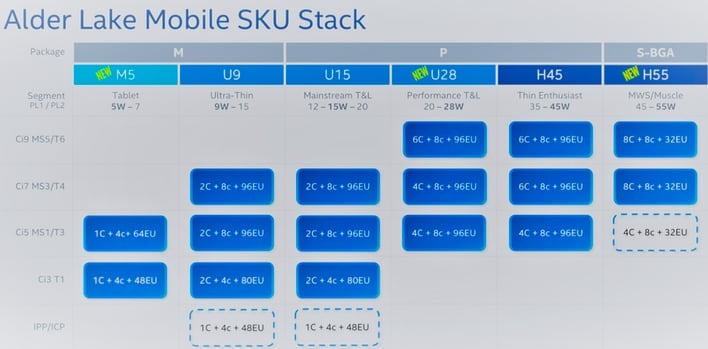
Plenty of PC laptops ran that part without throttling constantly, because the device designers weren't running on the constant dictates that the only design decisions had to be around "lighter and thinner" like Apple has.And it can be argued that Apple has a bad history when it comes to designing machines to effectively remove heat, like the i9 MBPs that were slower than the i7 models.The fact that AMD and Intel CPUs generate more heat does not automatically mean that they are throttling. As Apple fans love to mention PC laptops run fans more often. What do the fans do? They dissipate heat. You'd need to come up with specific numbers to prove your point.Why? Because most people use laptops on battery only? Who are they? Salesmen? Those do not need this class of laptop to begin with. In corporate world (which this laptop is targeting), many people are getting laptops as main computers but the main mobility factor they care about is being able to move the laptop from office to home and back. And most rarely run the laptop on battery (just for occasional meetings, and those who have too many meetings do not need the powerful laptop either for they are not really doing creative/development work either).
The problem is that the high power consumption of INTEL/AMD chips generate a lot of heat and they throttle even when plugged into the wall, so the maximum performance is not sustainable. The M1 on the other hand can run full tilt on battery power alone with little heat and is almost dead silent.
What the point of having a powerful laptop if it can only give you maximum performance in spurts with fan noise blazing in the background? Did I mention that excessive heat shortens the life of computer components? What's the impact on your electrical bill when the laptop is consuming 2x to 3x more power?
As we now know the INTEL processor was the design flaw. I had a 2020 13” MBP i7 and it always ran hot and noisy and topped out at 4-5 hours of battery life. Then I switched to the M1 and it runs cool and silent giving me 10-12 hours under the exact same workload in the exact same chassis as the INTEL model but with one less fan, which I’ve never heard. On top of that it’s simply faster with double the graphics power to boot.
While heat doesn’t always mean a laptop will throttle, the heat, noise extra weight and short battery life of INTEL equipped laptops are annoying.
