The cabin was colder on Thursday, but the crew has been able to adjust the temperature.
See full article...
See full article...
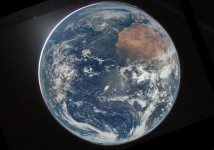
That's correct, people of the Northern Hemisphere are completely unused to seeing their planet 'upside down'.
I thought the ice wall goes all the way around the edge?Here it is, "corrected" with my feeble MS-Paint skills.

Someone on social media was skeptical of the photo because the Sun is over 400,000 times brighter than the moon, so I decided to test it and check out the math.Even with a long exposure, I'm surprised the night side of the Earth looks that bright and detailed. Could some false color have been applied? And, if that is an extended exposure, then the small bright dot can't be the Sun, more likely Venus.
I think this is actually worse: this is the "sky is the limit" budget before the realities of appropriations sink in, and yet the US gov's take is: we don't care about the science, we want half of you gone. It still feels that your parents want to abandon you, it is just that the law doesn't let them.The budget hasn’t been cut. The White House’s budget request has NASA cuts in it but Congress can ignore that, just like the last budget.

There are reams of studies about space adaptation syndrome. Certain physical causes aside, anything that adversely impacts the vestibular system will cause it. Almost every astronaut has had some level of it at some point. My understanding is that the variables which play into when an individual are likely to get it are really hard to predict.Lucky dice roll! I'm under the impression that this is quite common, as many as 1 in 2 or 1 in 3 astronauts on a mission typically end up getting it. Something like that.
Also, apparently, it's variable? People can get it initially for some missions, but not get it during others.
A bit like altitude sickness, in that respect—sometimes people who have been up a mountain multiple times can come down with a severe case on a subsequent summit attempt without apparent supporting cause. (Luckily, afaik, space adaptation syndrome is not usually the medical emergency that altitude sickness can be.)
Degrees K is also not a unit. It'd just be 3 KTerrestrial HVAC is also not millimeters separated from a 3° K vacuum.

Except that isn’t the US gov’t’s take, and that’s the reason the cuts didn’t happen. That’s the president’s take, or at most, the president and some of the executive branch.yet the US gov's take is: we don't care about the science, we want half of you gone.
My guess is that it's a reflection of some sort in the window.What is the bright yellowish splotch off center on the Earth image? Obviously not a Sun glint; a Moon glint?
Swimmingly... what a perfect descriptor for aquanauts. All of this is so fake. Disgustingly fake. I'm so sick of the extreme deception in this country.
they already beat you to it.When will the flat earthers start claiming it was all faked?
What the... I was familiar with older DSLRs having max usable ISO 6400 before blotchiness and noise turned the image into a digital suggestion. But ISO 51,200 and 1/4s at f4? The real scene must have been pretty dim.This Earth photo was taken at 1/4s F4 at ISO 51200. That increases the recorded brightness by a factor of 409,600.

Well, the scene is essentially the same brightness as down here outside on a full moon night, to give you some idea.What the... I was familiar with older DSLRs having max usable ISO 6400 before blotchiness and noise turned the image into a digital suggestion. But ISO 51,200 and 1/4s at f4? The real scene must have been pretty dim.
How about we not jinx it eh?
Is that photo the one described, of the Earth's night side? It can't be, but some of the details mentioned match the image... I'm confused
You switched it the wrong way though, Fahrenheit doesn't exist in space.
I hope so, otherwise there are some rather baked crew members.
Toilet's working, video streams going...
When will the flat earthers start claiming it was all faked?
Looks like you never boarded a commuter train here (Italy).Isn’t temperature control a closed loop system that keeps temperature in a narrow band? Why does it need manual adjustment? And why does that adjustment cause a massive 10 degree change? House/car/hotel room HVAC is better than that at 1/millionth(? pick a number) the cost.
Yes, it is a night side long exposure picture. The Moon is currently pretty much full (98.5%) which means the Sun is “behind” the Earth and Orion is between the Earth and the Moon, hence the bright arc from sun lit side.
The Planets Today
I can’t imagine it helps having so many people in a cabin for this: as soon as one person notices it and comments it’s going to hit the others, and this is 4 versus 3 in Apollo.The crew is reporting the smell of something burning. Apparently some amount of that is expected but the crew and ground team are unsure of how much is expected. It's worse than the last time they smelled it (apparently that was related to the toilet).

Just long exposure. Keep in mind the moon makes a nice light source. The dot is not the sun. Eric was saying the sun is lighting the atmosphere. The sun is on the far side of the Earth in this picture but you can see a gleam of sunlight in the atmosphere glow on the lower right hand side. One thing I like about this photo is it shows just how low Low Earth Orbit is. Using some pixel counting the edge of the atmosphere glow is right around 100 km and the ISS would be only 4x further. With LEO we have barely left the shore.Even with a long exposure, I'm surprised the night side of the Earth looks that bright and detailed. Could some false color have been applied? And, if that is an extended exposure, then the small bright dot can't be the Sun, more likely Venus.
Ha! I thought something felt off. Thanks for the correction.Degrees K is also not a unit. It'd just be 3 K
I think it is a reflection of something from inside Integrity on the window.What is the bright yellowish splotch off center on the Earth image? Obviously not a Sun glint; a Moon glint?
The night side of the Earth was lit by moonlight. After that, a little Photoshop can go a long way.
I am a little surprised by the claim that the bright object to the left of the Earth was the sun; I thought it was probably Venus, but I haven't fired up a skymapping app to check. Annoyed at myself for not recognizing the zodiacal light (my apologies to Dr. May), but then I think I've only seen and recognized it once or twice with my own eyes.
Though I'm past one hundred thousand miles
I'm feeling very still
And I think my spaceship knows which way to go
- "Space Oddity", David Bowie
View: https://www.youtube.com/watch?v=iYYRH4apXDo
tI can’t imagine it helps having so many people in a cabin for this: as soon as one person notices it and comments it’s going to hit the others, and this is 4 versus 3 in Apollo.
Maybe future missions need some sort of pre mission exposure to a similar smell for the last few days on earth to make it acclimatised and stop the brain from noticing it. I.e. a drop of lotion or balm just inside the nostrils.
I was an avid watcher of " Cosmos ". Later in life I was diagnosed with a medical condition which my consultant diagnosed as a " Cinderella " disease in that research into it didn't get a lot of resources because it was quite rare and quite low profile. She said the only two well known people to have died with the condition were Larry Hagman, and Carl Sagan. It may seem a bit weird, but I remember thinking, I've got the same medical condition as Carl Sagan, that's quite cool.I miss Carl Sagan!
Larry Hagman? Sounds like it could have been a plot from Dallas. "You've got a condition so rare we hardly know anything about it." They could have run an entire season with it.I was an avid watcher of " Cosmos ". Later in life I was diagnosed with a medical condition which my consultant diagnosed as a " Cinderella " disease in that research into it didn't get a lot of resources because it was quite rare and quite low profile. She said the only two well known people to have died with the condition were Larry Hagman, and Carl Sagan. It may seem a bit weird, but I remember thinking, I've got the same medical condition as Carl Sagan, that's quite cool.
It seems to be required that a cold-natured person will marry a hot-natured person. The cold-natured person is then condemned to live as a mummy.Of course it's too cold on the cabin. There is a woman on board. I've lost track of how many men have said something about how much colder the women in their lives want the temperature set at. My late wife used to say "I can only take so much off. Put on a sweater."
One of my character flaws is that I hate metric supremacists. The idea that out of all the invented measuring systems, Metric is the One True System just because we happen to have ten fingers is just so ludicrous to me.You switched it the wrong way though, Fahrenheit doesn't exist in space.