
Presumably the new approach means that Apple is making smaller, cheaper dies. It’s a shame that it hasn’t resulted in lower prices for the MBPs. But I guess RAM/SSD costs are soaring, and likely TSMC’s prices too. Has the AIpocalypse averted ARMaggedon?
You are using an out of date browser. It may not display this or other websites correctly.
You should upgrade or use an alternative browser.
You should upgrade or use an alternative browser.
ARMageddon
- Thread starter Devil's Advocate
- Start date
The individual dies are smaller, which I'm sure helps yields, but the total area is probably larger than what it would be for a monolithic chip made on the same process. You still need all of the same functional blocks, and you have to add whatever logic and external interfacing is needed to drive the inter-die communications. Also, now every Pro and Max chip needs one of those silicon interposer things, rather than just the Ultras.
Advantages are that you can make a 2-chip module whose total size is bigger than the single-reticule limit, you have more flexibility in binning chips and managing yields, and you at least open the pathway towards larger ensembles of dies in a single package.
Advantages are that you can make a 2-chip module whose total size is bigger than the single-reticule limit, you have more flexibility in binning chips and managing yields, and you at least open the pathway towards larger ensembles of dies in a single package.

I guess the logic behind the new Pro/Max CPU scheme is that there are few workloads that fully use more than 6 “Super” cores, and that those workloads that do are super parallel in a way that the new “performance” cores actually give you more compute per watt and/or die space? I’ve seen claims that the new “performance” cores (I prefer to think of them as “workhorse” cores) give 70% performance of the super cores. So presumably they do so while using less than 70% of the watts and/or transistors (ideally both).

I wouldn’t be surprised if thermals also play a role. It’s not easily the get an actively cooled Arm Mac to throttle, but lighting up the whole chip is the one way to do it. The 14” MBP with a Max chip was particularly vulnerable to this under highly threaded workloads that could saturate the chip. Having a smaller number of cores that sacrifice efficiency for all-out single threaded/lightly threaded performance but then a large number of somewhat slower but much more tightly power optimized for sustained heavily multithreaded performance (but still much faster than the efficiency cores that put efficiency above all other considerations) makes some degree of sense. Apple’s had different clock speeds for their performance cores depending on how many are active for years, this just lets them further optimize that approach.
With M5 Apple have chosen to increase overall CPU core count and implement a third core variant. But whither symmetrical multithreading?
It is possible this new performance core implements SMT as a strategy of catering to wide, multithreaded workloads. Do we think this is likely?
It is possible this new performance core implements SMT as a strategy of catering to wide, multithreaded workloads. Do we think this is likely?
Last edited:
El Capitano
Ars Praefectus
No.It is possible this new performance core implements SMT as a strategy of catering to wide, multithreaded workloads. Do we think this is likely?
No.It is possible this new performance core implements SMT as a strategy of catering to wide, multithreaded workloads. Do we think this is likely?
M5 series: super cores are 10-wide @ 4.6GHz, performance cores 7-wide at 4.4Ghz, efficiency cores 6-wide @ 3GHz.
M5 Pro/Max: super cores are 10-wide @ 4.6GHz, performance cores 7-wide at 4.4Ghz.
Interresting, thanks! And what was the M4 Pro/Max?
Is this your guess or has it been reported somewhere?M5 series: super cores are 10-wide @ 4.6GHz, performance cores 7-wide at 4.4Ghz, efficiency cores 6-wide @ 3GHz.
As has been 'reported'. Were it personal speculation I would make that clear.Is this your guess or has it been reported somewhere?
To be specific, this comes from Quinn Nelson's recent video where he cites the following from Baidu:
According to Quinn these folks on Baidu have been accurate for several chip generations now.
Last edited:
educated_foo
Ars Scholae Palatinae
Ten-wide?! The branch prediction, speculative execution, and prefetch behind that must be insane.M5 series: super cores are 10-wide @ 4.6GHz
Yeah, it's pretty impressive. The big cores on M4 are also 10-wide and run at... I think 4.4 GHz, but check my work on that.Ten-wide?! The branch prediction, speculative execution, and prefetch behind that must be insane.
@Bonusround, did I miss some of your older posts on that? That's great info on the M5 cores, and I'd just like a comparison with the M4 Pro/Max. I can't seem to find the info elsewhere easily.
Oh, thanks. And I didn't notice all the edits to the other posts.
And do you know about the M4 Pro/Max efficiency cores vs the new M5 Pro/Max performance cores?
Edit:
In any case, I guess I just need to wait a few days for reviews and measurments. There will be plenty of data and benchmarks then
And do you know about the M4 Pro/Max efficiency cores vs the new M5 Pro/Max performance cores?
Edit:
In any case, I guess I just need to wait a few days for reviews and measurments. There will be plenty of data and benchmarks then
Last edited:
Oh, thanks. And I didn't notice all the edits to the other posts.
And do you know about the M4 Pro/Max efficiency cores vs the new M5 Pro/Max performance cores?
I don't, but Howard at Eclectic Light can help:
Like P cores, E cores can be set to run at any of 5 values between the minimum of 1,020 MHz and maximum of 2,592 MHz (1.0-2.6 GHz). When running macOS, cluster frequency is set by macOS at a kernel level; other operating systems may offer more direct control. This range of frequencies is significantly narrower than that of E cores in the M3, which range between 744-2,748 MHz.
E cores idle at 1,020 MHz, and although they can be shut down altogether, that’s exceptional given the steady demand for macOS background threads to be run on them. Nevertheless, powermetrics still reports their ‘down’ residencies separately from idle residencies.
No idea on M4 e-core instruction window size.
M4: Performance = 10-wide @ 4.4GHz, Efficiency = 6-wide (est) @ 2.6GHz
M5: Super = 10-wide @ 4.6GHz, Performance = 7-wide @ 4.4GHz
M4 Max: 12P + 4E = (12*10*4.4 + 4*6*2.6) = 590.4
M5 Max: 6S + 12P = (6*10*4.6 + 12*7*4.4) = 645.6
Just some stupid math.
M5: Super = 10-wide @ 4.6GHz, Performance = 7-wide @ 4.4GHz
M4 Max: 12P + 4E = (12*10*4.4 + 4*6*2.6) = 590.4
M5 Max: 6S + 12P = (6*10*4.6 + 12*7*4.4) = 645.6
Just some stupid math.
An interesting article on interposer technology and how AI spend is driving investment in this technology. I can’t help but see consequences for us: https://www.chipstrat.com/p/advanced-packaging-intels-emib-vs

Is Asahi Linux running on these yet?I don't, but Howard at Eclectic Light can help:
When running macOS, cluster frequency is set by macOS at a kernel level; other operating systems may offer more direct control.
No idea on M4 e-core instruction window size.
First die shots of the M5 and some initial analysis at the Anandtech forums: https://forums.anandtech.com/threads/apple-silicon-soc-thread.2587205/page-495

Grabbed the full-res shots for those without an anandtech forum login.
M5 Pro:


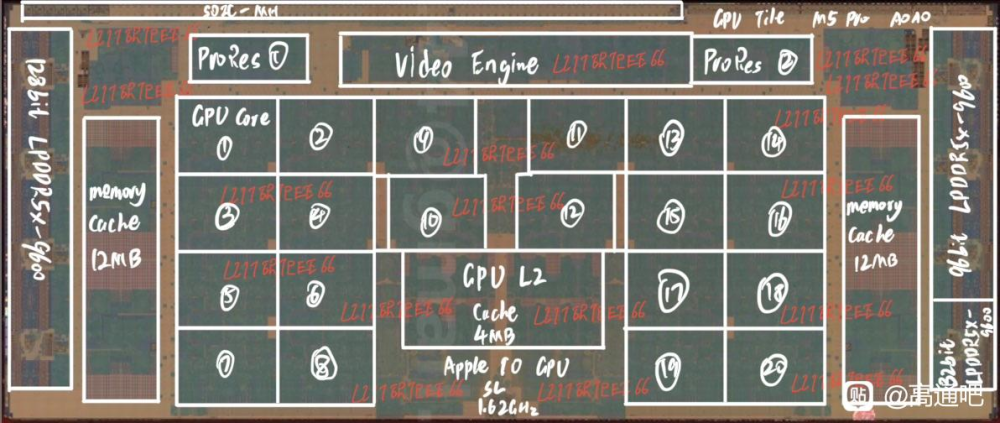
M5 Pro:
Nice!
The obvious next question is what does the Max GPU die look like. One could certainly imagine that the Max die is what TSMC actually fabs, 2x what we're seeing here for the Pro (with the second copy rotated 180 degrees), and then either cut in half to make two Pro chips or left intact to make 1 Max. If that's the case, then the Max has an "extra" UltraFusion port, which of course immediately suggests daisy-chaining a couple of the things together...
The obvious next question is what does the Max GPU die look like. One could certainly imagine that the Max die is what TSMC actually fabs, 2x what we're seeing here for the Pro (with the second copy rotated 180 degrees), and then either cut in half to make two Pro chips or left intact to make 1 Max. If that's the case, then the Max has an "extra" UltraFusion port, which of course immediately suggests daisy-chaining a couple of the things together...
So I think this tells us a few things about the M5 Ultra.
The connection is face to face. And the existing CPU die has one connection side. So to get to 2X Max, either a) the Max GPU tile has 2 connection sides to allow a CPU<->GPU<->GPU<->CPU configuration, b) there’s a new ultra-specific tile with 2 connection faces allowing GPU<->CPU<->GPU or c) there’s a new massive GPU tile that allows for CPU<->GPU<->CPU.
At this point my money is on a new tile. GPU is probably easier to lay out than CPU. And since GPU is really the core asset of the Ultra, why stop at 80 GPU blocks? A dedicated GPU tile for the Ultra could be essentially as big as they want it up to the reticle limit - say 120 GPU blocks? 160?
The connection is face to face. And the existing CPU die has one connection side. So to get to 2X Max, either a) the Max GPU tile has 2 connection sides to allow a CPU<->GPU<->GPU<->CPU configuration, b) there’s a new ultra-specific tile with 2 connection faces allowing GPU<->CPU<->GPU or c) there’s a new massive GPU tile that allows for CPU<->GPU<->CPU.
At this point my money is on a new tile. GPU is probably easier to lay out than CPU. And since GPU is really the core asset of the Ultra, why stop at 80 GPU blocks? A dedicated GPU tile for the Ultra could be essentially as big as they want it up to the reticle limit - say 120 GPU blocks? 160?
All the memory controllers are on the GPU die(s). With the GPU–CPU–GPU option that means some memory accesses would need to run across the CPU die, so I don't think b) is a likely option. My vote is for c).
Another option might be C-G-G, one common CPU die and two Max GPUs.