Company has previously tested its technology on the International Space Station.
See full article...
See full article...
The bag only needs to be strong enough to hold against the thrust of the tug.It does seem like car and trailer physics on steroids. I think a rocket engine on a frame type structure, with the bag attached inside would be the best bet, particularly if they are aiming to bring smaller asteroids. I can't imagine any bag being strong enough to stop the mass of a 100ton asteroid.
That depends entirely on how the bag is constructed. If it can be pulled snug enough to support the sand against the thrust of the engine then it's fine. A sandbag that is properly packed isn't that hard to handle.Imagine the asteroid as a bag full of dry sand. What's going to happen when you try to push that bag? You're just going to push chaotically into the middle of it, which is what we've experienced to date from existing asteroid intercepts. Pulling is the far more stable, far more controllable orientation.
My point is that if you say something is "at the L2 point", it's not actually at the L2 point, because it takes too much propellant to remain at the L2 point. It's much cheaper to follow a lissajous "orbit" around that point. It's not a true orbit, in the sense that NRHO is not actually orbiting the Moon, but appears to revolve around it in certain reference frames. As mentioned, the "orbital diameter" is several hundred thousand kilometers, so you could have both JWST and this captured asteroid "at the L2 point", but never closer to each other than the Earth and the Moon.I'm assuming SEL2 means Sun-Earth Lagrange point 2 to precisely identify it, as opposed to a generic Lagrange point somewhere else?

It seems to be inviting a problem where one did not exist. Using your example (thank you!), mining cobalt is a nasty, vile, horrific business; better to put that sort of mess skyward rather than on Earth. And while a fictional Cobaltvania might have no legal recourse, that wouldn't stop them exercising more 'kinetic' ways to address their grievances, wirh all the unpleasanness that implies.It doesn't matter if they oppose it unless they are a space power. The DRC is largest exporter of cobalt. Say someone finds an asteroid loaded with thousands of tons of cobalt. A company in the US decides to mine it. The DRC says you can't. The US does it anyways. Then what? What resource does the DRC have?
That would require a significant fraction of the world's yearly xenon production. Argon would be a better propellant choice for the tug.I will try. Every asteroid will be different. There is no single orbit or DeltaV requirement. Psyche for example requires about 11 km/s but there are NEO which have a one way DeltaV of ~2 km/s beyond escape velocity and the aggregate point at an L2 puts it right at escape velocity. Climbing out of our gravity well with ion drive is a pain in the ass it takes forever. So lets assume the plan is to chuck the spacecraft to escape velocity and it does the rest of the round trip from L2 to asteroid and back to L2 itself. Lets also assume the easiest NEO asteroids.
Initially for first order approximation let's assume a massless spacecraft just to see what size spacecraft it would require.
Final mass is 100t
Inbound deltaV = 2,000 m/s.
Specific impulse 2000s (using NASA latest PPE design for gateway station)
ve (exit velocity) = 2000 * 9.8 = 19.6 km/s
m0 = mf * e^(dV/ ve)
m0 = 100t * e^(2000 / 19,600)
m0 = 111t
prop mass = m0 - mf = 11t
So even with a massless spacecraft we need at least 11t of xenon propellant to apply 2 km/s DeltaV to a 100t rock. However we will need prop for the outbound trip, prop for the spacecraft mass, station, and a margin so let's go with 15t. NASA PPE module is 5t dry mass and has most of what we need (deep space comms, flight computer, radiators, large solar arrays and ion thrusters) but tanks only hold about 2t of xenon not 15t. So let scale it up a bit. If tank mass is 7% of prop then tanks add another 1t and maybe the deployment mechanism and other fiddly bits add another 2t so nice even (and likely wrong) total is 8t dry mass plus 15t of prop for 23t wet mass spacecraft.
Now we can compute true round trip prop mass with our spacecraft and rock
Inbound trip (mf = 100t rock + 8t spacecraft = 108t)
m0 = mf * e^(dV/ ve)
m0 = 108t (100t rock + 8t spacecraft) * e^(2000 / 19,600)
m0 = 120t
prop mass = m0 - mf = 12t.
Outbound trip (mf = 8t dry + 12t return prop = 20t)
m0 = mf * e^(dV/ ve)
m0 = 20t * e^(3000 / 19,600)
m0 = 22t
prop mass = m0 - mf = 2t
Total round trip prop from L1 to asteroid and back to L1 = 12t + 2t = 14t. So our spacecraft with 15t prop capacity checks out. Total initial mass at escape velocity would be 23t (8t dry + 15t prop). Single launch is not possible. NG or reusable FH can do 7t to escape velocity (C3=0), Vulcan VC6 can do 10t, expendable FH can do 15t
View attachment 130891
So you would need to a multi launch mission OR more likely you start with a smaller target. The size of everything scales pretty linearly to the asteroid mass because it is so large compared to spacecraft non-propellant mass. A 25t asteroid would likely be doable with a spacecraft that is 10t wet.
Later on if you want to go bigger you probably want some combination of a reusable rock hauler with fuel in standardized drop tanks. The hauler endlessly cycles between L2 and a target rock and back. Then you launch multiple fuel tanks with a disposable insertion engine to dock with your rock tug in L2 after each rock delivery. Even the big version is mostly prop. So having 10t prop tanks with hypergolic insertion motor that carry say 8t of prop each means you could refuel the big rock hauler with thee launches or four launches of prop for each rock.
Much later on you might be able to use SpaceX & BO lunar tugs to haul stuff up to L2 for cheaper than a launch directly there and end up with less disposable bits. You end up with some 100t xenon prop depot in L2 orbit and rock haulers refuel off that. Now you can have multiple rock haulers, everything reusable, and refueling missions don't have to line up with the haulers return.
This is very very back of napkin but it puts you in the ballpark.
On edit: originally computed to LEO not C3. Fixed. Said L1 not L2. Fixed.
https://meincmagazine.com/science/201...gs-new-sim-room-for-the-starliner-spacecraft/The real question here: is this the most cartoonish, least credible render Eric has ever used for an article header image?
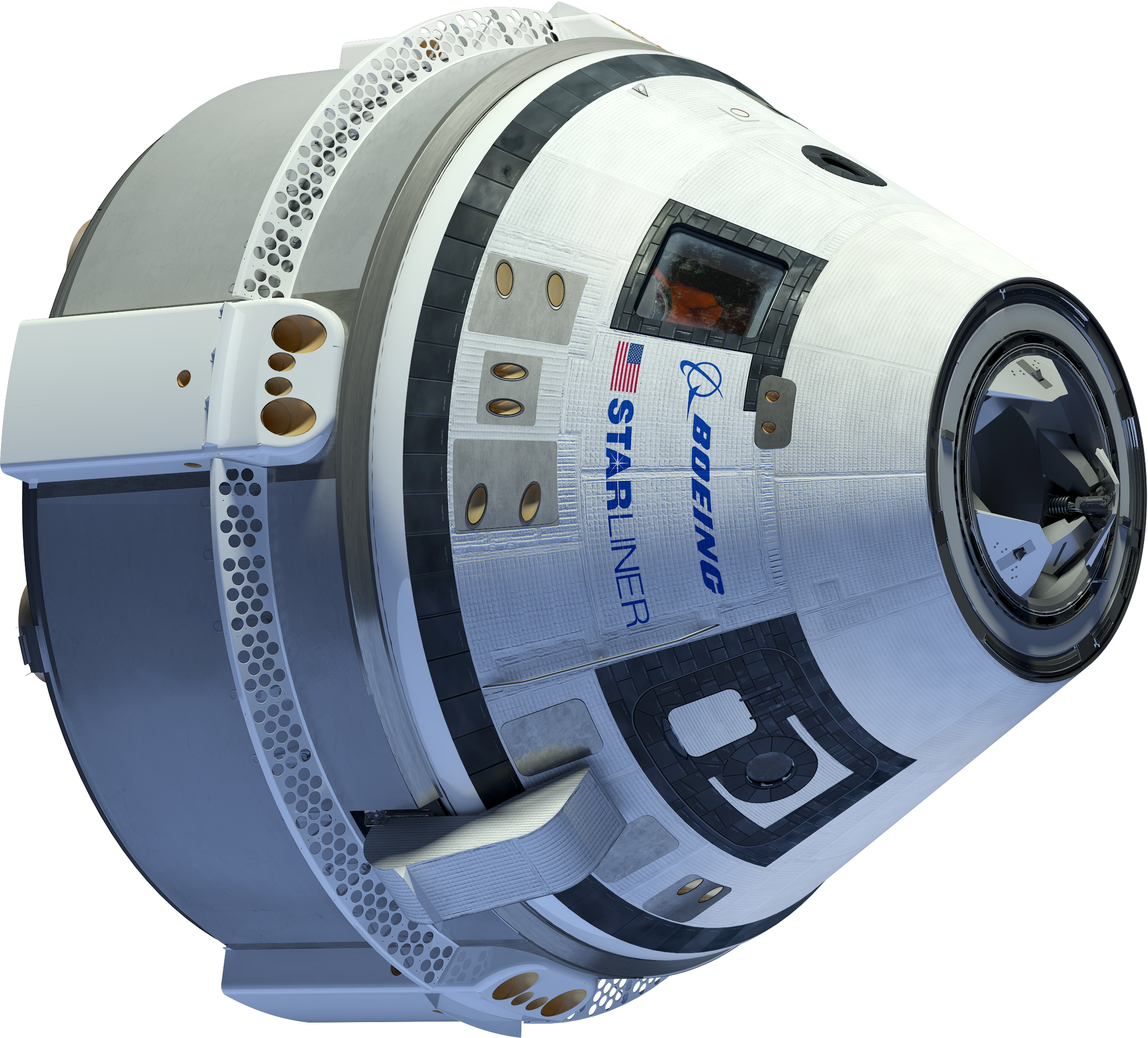
Boeing: “Legitimate chance” of Starliner launch in February 2018
"Yes, yes, they built an incredible spacecraft, but it would have been nothing without our big bag!"Okay, they're testing their asteroid capture bag. Let's assume the scaled-up version of it works perfectly. Great!
However, that seems like the easy part. They say they're planning to "partner with another provider for a spacecraft capable of traveling into deep space and making a rendezvous with an asteroid" and then hauling it back. That is the hard part IMHO, and they seem to be hand-waving it away.
Could you use solar energy to ionise some of the rock itself as propellant?I will try. Every asteroid will be different. There is no single orbit or DeltaV requirement. Psyche for example requires about 11 km/s but there are NEO which have a one way DeltaV of ~2 km/s beyond escape velocity and the aggregate point at an L2 puts it right at escape velocity. Climbing out of our gravity well with ion drive is a pain in the ass it takes forever. So lets assume the plan is to chuck the spacecraft to escape velocity and it does the rest of the round trip from L2 to asteroid and back to L2 itself. Lets also assume the easiest NEO asteroids.
Initially for first order approximation let's assume a massless spacecraft just to see what size spacecraft it would require.
Final mass is 100t
Inbound deltaV = 2,000 m/s.
Specific impulse 2000s (using NASA latest PPE design for gateway station)
ve (exit velocity) = 2000 * 9.8 = 19.6 km/s
m0 = mf * e^(dV/ ve)
m0 = 100t * e^(2000 / 19,600)
m0 = 111t
prop mass = m0 - mf = 11t
So even with a massless spacecraft we need at least 11t of xenon propellant to apply 2 km/s DeltaV to a 100t rock. However we will need prop for the outbound trip, prop for the spacecraft mass, station, and a margin so let's go with 15t. NASA PPE module is 5t dry mass and has most of what we need (deep space comms, flight computer, radiators, large solar arrays and ion thrusters) but tanks only hold about 2t of xenon not 15t. So let scale it up a bit. If tank mass is 7% of prop then tanks add another 1t and maybe the deployment mechanism and other fiddly bits add another 2t so nice even (and likely wrong) total is 8t dry mass plus 15t of prop for 23t wet mass spacecraft.
Now we can compute true round trip prop mass with our spacecraft and rock
Inbound trip (mf = 100t rock + 8t spacecraft = 108t)
m0 = mf * e^(dV/ ve)
m0 = 108t (100t rock + 8t spacecraft) * e^(2000 / 19,600)
m0 = 120t
prop mass = m0 - mf = 12t.
Outbound trip (mf = 8t dry + 12t return prop = 20t)
m0 = mf * e^(dV/ ve)
m0 = 20t * e^(3000 / 19,600)
m0 = 22t
prop mass = m0 - mf = 2t
Total round trip prop from L1 to asteroid and back to L1 = 12t + 2t = 14t. So our spacecraft with 15t prop capacity checks out. Total initial mass at escape velocity would be 23t (8t dry + 15t prop). Single launch is not possible. NG or reusable FH can do 7t to escape velocity (C3=0), Vulcan VC6 can do 10t, expendable FH can do 15t
View attachment 130891
So you would need to a multi launch mission OR more likely you start with a smaller target. The size of everything scales pretty linearly to the asteroid mass because it is so large compared to spacecraft non-propellant mass. A 25t asteroid would likely be doable with a spacecraft that is 10t wet.
Later on if you want to go bigger you probably want some combination of a reusable rock hauler with fuel in standardized drop tanks. The hauler endlessly cycles between L2 and a target rock and back. Then you launch multiple fuel tanks with a disposable insertion engine to dock with your rock tug in L2 after each rock delivery. Even the big version is mostly prop. So having 10t prop tanks with hypergolic insertion motor that carry say 8t of prop each means you could refuel the big rock hauler with thee launches or four launches of prop for each rock.
Much later on you might be able to use SpaceX & BO lunar tugs to haul stuff up to L2 for cheaper than a launch directly there and end up with less disposable bits. You end up with some 100t xenon prop depot in L2 orbit and rock haulers refuel off that. Now you can have multiple rock haulers, everything reusable, and refueling missions don't have to line up with the haulers return.
This is very very back of napkin but it puts you in the ballpark.
On edit: originally computed to LEO not C3. Fixed. Said L1 not L2. Fixed.
There's no real good options. You really want to use volatiles, but going after near-Earth asteroids inside the frost line, you won't find any. Older ion thrusters used liquid metals, but it was just too much effort to avoid deposition inside the thruster. Your best bet would probably be to crack oxygen out of the rock, but that's going to require a tremendous power consumption.Could you use solar energy to ionise some of the rock itself as propellant?
No, it really won’t, because even though SpaceX is planning another magnitude reduction in cost, launching towing systems, mining and processing equipment, and returning materials to Earth will make such venture prohibitively expensive for a long time.Finding an alternative source among asteroids would be an existential crisis for them immediately, resulting in them opposing such plans almost irrationally.
Sure, but then you need to accurately push against the center of mass of the asteroid, otherwise you’re gonna flip end over end or burn your RCS a lot preventing it.Just push it. Build some hard points into the bag for attaching to and if needed for support and just push. Whatever they use to move it will probably be high impulse low thrust and taking the long road to wherever they're processing it. Engine type and fuel would be the much more interesting question.
Joke falls flat in vacuum.Either this works, or it's a bag of hot air.
I don't believe these bags will do anything for out gassing. It's merely to make sure debris don't become a hazard in near-space. The material would have to be entirely gas tight, with risks of over inflation and failure. I also believe managing the out gassing as a form of propulsion wouldn't work either as you can't be sure what's in the pile of rubble you've just grabbed, and how much and the types of frozen volatiles it contains. Sounds too chaotic to be useful.Could also be to handle outgassing.
One kind of important thing not mentioned here is: even small asteroids must have pretty significant momentum as they fly through the space, so the tug spacecraft will need to have pretty powerful engines to be able to significantly change/cancel the asteroid’s momentum.
I imagine it would be one of the metrics used in the go-nogo of whether to harvest an asteroid now or later. For one chosen as a "later" rock, we could equip a chosen 'roid with a solar sail or other means of slowing it down over time. That way, valuable asteroids could be marked with a tracking beacon to keep pace with its progress, and when it slows enough and the position/time is right-- voila!....
One kind of important thing not mentioned here is: even small asteroids must have pretty significant momentum as they fly through the space, so the tug spacecraft will need to have pretty powerful engines to be able to significantly change/cancel the asteroid’s momentum.

Asteroid mass doesn't matter.It does seem like car and trailer physics on steroids. I think a rocket engine on a frame type structure, with the bag attached inside would be the best bet, particularly if they are aiming to bring smaller asteroids. I can't imagine any bag being strong enough to stop the mass of a 100ton asteroid.

If the tow is a non-rigid cable, what happens when the tug makes a course correction?Sure, but then you need to accurately push against the center of mass of the asteroid, otherwise you’re gonna flip end over end or burn your RCS a lot preventing it.
So now you need to secure the asteroid in the bag in such a way that the center of mass of what’s now an impromptu part of your spacecraft aligns with your thrust vector.
Of course if you have a system that swivels your engines on the fly as a control loop narrows down until it found the center of mass through ever decreasing corrections..
That’d be the big upside of a tow; it’s passively stable.
It seems to be inviting a problem where one did not exist. Using your example (thank you!), mining cobalt is a nasty, vile, horrific business; better to put that sort of mess skyward rather than on Earth. And while a fictional Cobaltvania might have no legal recourse, that wouldn't stop them exercising more 'kinetic' ways to address their grievances, wirh all the unpleasanness that implies.
IIRC, a proposed solution revolved around a sort of global Bank, leveling a small tax on extraterrestrial resources (rather than the Law of the Sea method that squelched seabed mining in large part). Fund from this bank would go to nations most affected by asteroid mining, allowing even nations without a proper space program to profit. In short, a way to nullify the Haves and Have-nots argument.
Which also does not exist. This is a "visionary" VC and eventually a governmental money grab. Comic book level, it has worked for years, for migrating to Mars to save humanity, which has suddenly become unimportant, and now to the moon instead.Great way to ride a few years on sweet sweet VC money. Very Sci-fi, totally plausible right after we get Hollywood Space Propulsion.
Now, if someone can show the math for the fuel required to safely and quickly move a mere 100t random-spin "aggregate of rock in a bag" from $random_orbit to a central processing Earth-adjacent location ...
Because resources produced in space have to compete on a cost basis with resources lifted from Earth. If Starship were free, then asteroid mining would never be economical because it would always be cheaper to make things on Earth and then send them into orbit. Because space is a hostile environment so making things there will cost more. High cost of launch from Earth is what justifies producing resources in space.Why? Arguably it is the cost of lift to orbit becoming cheap that makes this kind of thing possible.
From "vibe" program coding to "vibe" space solutions. Nothing could possibly go wrong. Does no one remember how revolutionary Spinlaunch was going to be? /SThis gives off some serious Seveneves vibes! I love it. Hope there craziness is successful
Haha. Wonder how the Trump dynasty will react to the Mars colonies declaring their independence.For All Mankind.
... Now all they have to do is compete with Mars.
I assume they chose L2 for energy reasons. It's cheaper to get from Earth to L2. It's easier to perform a low-thrust capture into L2. L1 would provide more solar power, being closer to the Sun, but it's functionally little more than a rounding error.Not L2, L1
Why L1? Because that's where the (moved) mini-asteroid could do something USEFUL. A smallish probe, capable of moving the mini-asteroid to L1 could then, slowly or quickly (depending on the size of its solar panels) melt or grind it in some way to ultimately produce something useful.
"Space is big" may be a bit overused, but in regards to space around the L1/L2 saddle points, space is really big. There's no worry about debris, and will not be for a long long long time, particularly because those are unstable, and uncontrolled debris will not remain there.L2 is getting too crowded (probably not but whatever). Let's use L1!
Megastructures suck, and they're just fundamentally unnecessary. There are bizarre structural resonance issues that arise when you try to build something that large, and that's assuming tidal forces don't get you first. You build a swarm of smaller shades, and have them collectively provide the degree of shading you want.A sun shade. A BIG sun shade. An absolutely GIGANTIC sun shade. (1,000km x 1,000km?)
You can't sit at L1. It's unstable. You can minimize your propellant usage by flying a wide orbit around the L1 point, but then you won't be eclipsing the Earth.L1 just so happens to ALWAYS be between the earth and sun. So putting something there will block sunlight, which is converted into heat once it passes into our atmosphere and bounces around a bit which make the temperature go higher... you get the point.

As mentioned, it's unstable. All that dust would drift away anyway.In case all of this is too ambitious, you could just grind them into dust and spray them into the space near L1. It'll produce a diffuse shade, which still works, but the solar wind will blow it away in... So it'll need to be replenished constantly.
Better idea for the bag tech attach it to a controllable solar sail use it to collect space junk in earth orbit and lift it to the prossesing sp facility. Paid for by earth entities that want to eliminate the trash and because space trash will be much easier and cheaper to make useful stuff.I think it would be cool to put spin launch on the moon. Maybe 4 of them and use solar power to yeet a constant stream of the moon into earth orbit to be mined to build and put spin launchers on the moon.
My problem is I don’t know how to get someone to give me money to plan it. Nor do I know how to plan it. But that seems easier to solve, somehow.
Works once then the facility needs to be moved millions of miles and probably needs to change orbit to rendezvous with the new target. Then do it again. Not good.How much of an asteroid is useful stuff? Why pay to move the not useful portion? Move the processing facility out to where the materials are and process the asteroids in situ. Then pay to move the refined stuff to where it is needed.
Which weights more, the facility or the asteroid? if the facility weighs more, why are you even bothering?Works once then the facility needs to be moved millions of miles and probably needs to change orbit to rendezvous with the new target. Then do it again. Not good.
Accidents can happen.I can't be the only one picturing a damaged space tractor and a house sized asteroid hurling towards Earth.
An off-axis pull is just as unstable as an off-axis push. Neither is passively stable. What matters is payload structural stability and sufficient TVC to align with its center of mass. For a loosely bound aggregate asteroid reefing the bag into tension is necessary for controllable handling regardless of thrust arrangement.Sure, but then you need to accurately push against the center of mass of the asteroid, otherwise you’re gonna flip end over end or burn your RCS a lot preventing it.
So now you need to secure the asteroid in the bag in such a way that the center of mass of what’s now an impromptu part of your spacecraft aligns with your thrust vector.
Of course if you have a system that swivels your engines on the fly as a control loop narrows down until it found the center of mass through ever decreasing corrections..
That’d be the big upside of a tow; it’s passively stable.
How are you taking that 100t asteroid to the Moon surface? It's easier for the facility to be in orbit, outside of gravity wells that need a controlled descent.I could see something like this being useful if we ever get to where we have a space based facility that can process raw ore from the asteroid and turn it into finished products. But that's going to be some kind of massive smelter/factory. Have fun building that in orbit or on the moon. Until that happens I don't see collecting asteroids serving any purpose. You can't bring it back to Earth so what are you going to do with it?
I think some kind of processing facility like that would make the most sense as a fully automated factory on the moon. I don't really see a manned station being all that viable unless it has a crew that is frequently rotated out and replaced with fresh people every month or two. Part of the problem though is that asteroids are not all made of the same materials. So you can't necessarily use the same facility to process an asteroid that is mostly ice as you can for an asteroid that is mostly iron or mostly silicon or whatever. The processing requirements are not going to be the same.
Are you saying that the DRC is going to declare war on China because they are building more and more cobalt less batteries?It seems to be inviting a problem where one did not exist. Using your example (thank you!), mining cobalt is a nasty, vile, horrific business; better to put that sort of mess skyward rather than on Earth. And while a fictional Cobaltvania might have no legal recourse, that wouldn't stop them exercising more 'kinetic' ways to address their grievances, wirh all the unpleasanness that implies.
IIRC, a proposed solution revolved around a sort of global Bank, leveling a small tax on extraterrestrial resources (rather than the Law of the Sea method that squelched seabed mining in large part). Fund from this bank would go to nations most affected by asteroid mining, allowing even nations without a proper space program to profit. In short, a way to nullify the Haves and Have-nots argument.