
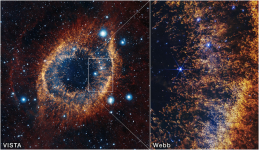
The colors show the star’s final breath transforming into the raw ingredients for new worlds.
See full article...
See full article...

Basically, this is the outer layer of the star flying through space after being blasted off by the nova.What an awesome image. I am trying (and failing) to comprehend what it is showing me.
Sorry, no. Those are "just" places where the gas is moving at different speeds. This is the nebula thrown out from a dying star, not the growth of a new one. It is called a planetary nebula because they look a little like planets in old telescopes.You can also SEE spirals and discs of star systems forming! Stunning! I presume that's what some of those are.
Thank you. I was trying to figure out why it looked like a swarm of small comets(?) heading towards the center but your explanation clears that up. I assume that I am looking at planetary debris as well, or is that really just gas and the false colouring makes it look that way.Basically, this is the outer layer of the star flying through space after being blasted off by the nova.
The cloud heads, based on the scale on the NASA site, are of the order of 100 billion kilometers wide"A touch of a blue hue marks the hottest gas in this field, energized by intense ultraviolet light from the white dwarf. Farther out, the gas cools into the yellow regions where hydrogen atoms join into molecules. At the outer edges, the reddish tones trace the coolest material, where gas begins to thin and dust can take shape."
This is what happens when you let a physics major choose the color scale...
Seriously, though - that is one spectacular image! At a guess those granules in the expanding gas are about ten times the size (but only a small fraction of the actual mass) of Jupiter.

Thanks for the link, never heard of them before. It also says there are around 40,000 of them in the Helix Nebula. The scale is insane.<snip>
ETC: Wow, did I ever get that wrong! Those globules are each about the size of the orbit of Pluto! At least I was right on the mass - they are roughly 1/100th the mass of Jupiter.
Probably not. When the original star moved into the asymptotic giant branch of the H-R, it expanded rapidly and probably "devoured" all of the planets orbiting it. We still don't have a great explanation for the cometary knots/globules/little chunky bits. The current leader is that as the gas expands, it does so in a non-laminar fashion, leading to local instabilities (think of them as three-dimensional eddies) where some material moves slower than the rest.Thank you. I was trying to figure out why it looked like a swarm of small comets(?) heading towards the center but your explanation clears that up. I assume that I am looking at planetary debris as well, or is that really just gas and the false colouring makes it look that way.
No need for apologies. Everyone is ignorant of something.(Apologies for my ignorance about beautiful things like this.)
Oh wow. That makes this even more zoomed in than I had though. What an incredible image.Sorry, no. Those are "just" places where the gas is moving at different speeds. This is the nebula thrown out from a dying star, not the growth of a new one. It is called a planetary nebula because they look a little like planets in old telescopes.

I believe it’s the bottom right if I correctly followed the star locations.I'd love to see a little red box over the Hubble image to show where the Webb is pointed.
 , they make each day more livable.
WEBB ability to discern some background galaxy beyond this mess up nebula materials. So Incredible!Looks like galaxies playing hide-and-seek in a blurry fisheye version of Bryce NP.
See my earlier comment - very, very roughly 100 billion km wide at the head.What is the scale of those "small" pillars that resemble the Eagle Nebula? Are they large enough to form stars/planetary systems, or are they thought to be too small for that?
A small correction, this star was too small to explode. At that size, the outer layers are blown away in a relatively sedate manner.Basically, this is the outer layer of the star flying through space after being blasted off by the nova.
https://assets.science.nasa.gov/dyn.../2026/01/STScI-01KCMATAPPC5QXWSD5BM6VRT9M.pngI'd love to see a little red box over the Hubble image to show where the Webb is pointed.
Blasted off by a red giant. Novas are what happens when a white dwarf is accreting from its binary companion, and have no relationship with planetary nebulas.Basically, this is the outer layer of the star flying through space after being blasted off by the nova.
Your first intuition is correct. The formation is roughly spherical. The red stuff is dim/diffuse enough that it only shows up well when you’re looking through a greater volume of it, as at the edges.I have a question about the Hubble image: Is the formation rooughly spherical, so we are looking at the blue part through a cloud like we see surrounding it? Or is the formation flatish, so there's no red cloud in the way. If the latter, why? For example, is the originating dwarf star rotating about an axis that happens to be pointing in our direction?
The spirals you are seeing are galaxies behind the nebula.You can also SEE spirals and discs of star systems forming! Stunning! I presume that's what some of those are.
Oh they are? Huh, so bright! Wow JWST!The spirals you are seeing are galaxies behind the nebula.
This is the remains of the outer layers of a roughly Sun-sized star. There is too little mass for what you described, by multiple orders of magnitude.Looking closely at the picture of the Helix nebula, I'm thinking that each one of those millions of little blobs is a planet, or star forming. This picture could portray millions of new planets and stars.


