
George Carlin’s heirs sue comedy podcast over “AI-generated” impression

After buying?
It's the "other than" part - "other than distribute copies or derived works."

First sale doctrine says that if you buy a CD of Metallica music you can sell that CD to someone else. It doesn't let you sell copies of the CD to someone else, nor does it let you rip individual tracks off and sell them to someone else.

What's more it also doesn't allow you to take those tracks and transform them into a derived work - like by incorporating them as a sample into a work you're creating. (which is why samples are licensed works).

Generative AI is all about sampling and creating derived works. The question that is still open is whether it's being done in a way that is going to be considered "fair use" or if it's being done in a way that ultimately model makers are going to need to be paying for. The same way that musicians have to license samples to create new works.
 
Upvote
3 (4 / -1)

IncorrigibleTroll

Ars Tribunus Angusticlavius
9,228
It's the "other than" part - "other than distribute copies or derived works."

First sale doctrine says that if you buy a CD of Metallica music you can sell that CD to someone else. It doesn't let you sell copies of the CD to someone else, nor does it let you rip individual tracks off and sell them to someone else.

What's more it also doesn't allow you to take those tracks and transform them into a derived work - like by incorporating them as a sample into a work you're creating. (which is why samples are licensed works).

Generative AI is all about sampling and creating derived works. The question that is still open is whether it's being done in a way that is going to be considered "fair use" or if it's being done in a way that ultimately model makers are going to need to be paying for. The same way that musicians have to license samples to create new works.

The sampling regime as it currently stands is rank bullshit that stifles creativity in service of capitalism and is not something to model in other areas. Toxic rentseeking power games.
 
Upvote
-7 (1 / -8)

s73v3r

Ars Legatus Legionis
25,618
It doesn't matter by who.
It absolutely the fuck does. It was made by a bunch of tech bros with absolutely no artistic talent, who are upset at that fact, but not capable of actually working and practicing to get better at it. So instead of paying actual artists to create art, they decide to put actual artists out of business.
 
Upvote
7 (8 / -1)
As opposed to people like you who never chose to get the skills to actually create art? People who want to make it completely unviable to make a living creating art, meaning the rest of us have nothing but your shitty, derivative, AI crap?

Your argument overlooks a key aspect of AI's evolution: the democratization of creativity. So what if someone lacks the skills of a musician, artist, or filmmaker!? Should their creative aspirations be stifled? AI's advancements will enable people like me, and many others, to bring our ideas to life, without the traditional barriers of skill or budget, this is about opening the gates of creativity wider than ever before. Dismissing this potential is not only a failure of imagination but also a refusal to acknowledge the inevitable progress and accessibility AI brings.

Furthermore, the concern about AI undermining current artists misses a crucial point: innovation often elevates the field. The introduction of AI into creative spaces is not a zero-sum game. I'll use Alpha Go as an example:

file-XQ3hy7DDHkGg0F8bzXREJJmT.png


- The red dashed line marks the year 2016, symbolizing the introduction of AI programs like AlphaGo.
- After 2016, there is a noticeable decrease in the Human-AI Gap, indicating that human decision quality in Go has improved significantly, getting closer to the level of AI decisions.

Much like Go players who improved their game by learning from AI, artists can similarly benefit from AI. This technology can reveal new techniques and perspectives, challenging artists to expand their creative horizons. The interaction with AI in the arts isn't just about new tools; it's about fostering a dynamic learning environment, where human artists can draw inspiration and evolve their craft. This isn't limiting the art world but enriching it, creating a virtuous cycle of creativity.

Now, Imagine the leap in quality for mediums like anime when AI overcomes resource constraints. Currently, high-quality animation is often reserved for key scenes due to budget limitations. With AI, this constraint will diminish in the future, allowing for consistently high-quality animation throughout. This revolution isn't limited to anime. Consider indie filmmaking, where budget often restricts production value. AI could enable these filmmakers to realize their visions without financial barriers. Music production, too, will see a transformation, with AI providing tools for complex compositions that were once the domain of only those with access to expensive studios.

This would also extend into games, where just about anyone would now be able to create high quality games once AI gets fast and good enough, with no more than just a prompt to create a new world. You could even just 'modernize' old games, for example:

GE0FEU0XQAA06jC.png


And have it look like this instead:

GE0FEU3WYAAMQsb.jpeg

The problem here, is that people like you have no lack of imagination for doom scenarios. While at the same time, have a complete lack of imagination of how AI could improve the current state of affairs.
 
Upvote
-13 (0 / -13)

s73v3r

Ars Legatus Legionis
25,618
While your view reflects caution, it seems to miss the broader historical trend of technological democratization.
Ahh yes, the whole "democratization" which only serves to put hard working artists out of business so that rich white guys can get richer. Fan fucking tastic world you're promoting. Instead of having the machines do manual labor so we can create art, you're having the machines create "art" while the rest of us are forced to manual labor.
 
Upvote
15 (16 / -1)

s73v3r

Ars Legatus Legionis
25,618
People got offended because the world is full of reactionary idiots who think they need to protect a dead millionaire celebrity. Same as the idiots who got upset with the very clearly fake AI Taylor Swift porn.
Sounds like your issue is that you don't understand consent.
 
Upvote
6 (7 / -1)

s73v3r

Ars Legatus Legionis
25,618
The sampling regime as it currently stands is rank bullshit that stifles creativity in service of capitalism and is not something to model in other areas. Toxic rentseeking power games.
Why do you feel you're entitled to use the work of others without their permission?
 
Upvote
6 (7 / -1)

s73v3r

Ars Legatus Legionis
25,618
Your argument overlooks
And you ignore the fact that your shitty AI isn't creative, and the shitty output it has is the result of you being unwilling to actually practice art, instead wanting an "easy button" which serves primarily to put people out of work.


a key aspect of AI's evolution: the democratization of creativity.
It absolutely the fuck is not. Creativity was already democratized. You're just too damn lazy to actually learn how to create art.


So what if someone lacks the skills of a musician, artist, or filmmaker!? Should their creative aspirations be stifled?
No, they should fucking learn. There is no excuse to not learn those skills, given that there are many sources available, most for free. You, and people like you who want to use AI are just too fucking lazy to do it.


AI's advancements will enable people like me, and many others, to bring our ideas to life, without the traditional barriers of skill or budget
So without actually putting any effort into things, and with the side effect of putting actual artists out of work.

The problem here, is that people like you have no lack of imagination
No, the problem here is that not only do you not have any imagination, you're too damn lazy to actually put in the work to be an artist. You think that having an easy button means you can claim to be one, but the only thing you output is soulless, shallow, derivative crap. Just like every one of your comments on this site.
 
Upvote
13 (14 / -1)

hillspuck

Ars Scholae Palatinae
2,179
It's funny that the idea of "democratizing creativity" would come up in the context of stand up comedians. The entirety of the craft is taking an idea and figuring out how to best express it. To pare it down to the bare minimum to make it funny. If you've got an AI to do that for you, what's left? The premise? Because just coming up with premises isn't being a comedian. Is it delivering the lines, much in the way a late night host will tell the jokes the writers wrote for them? Because in this case, an AI voice is telling the jokes, too.

It seems like you're less "democratizing creativity" and more "creating a content firehose." People have confused content for art for a while now. They see art and since it's content, they think all content must also be art.
 
Upvote
10 (10 / 0)
Ahh yes, the whole "democratization" which only serves to put hard working artists out of business so that rich white guys can get richer. Fan fucking tastic world you're promoting. Instead of having the machines do manual labor so we can create art, you're having the machines create "art" while the rest of us are forced to manual labor.

Let's be clear: AI in art isn't about 'forcing artists into manual labor'. It's about enhancing and broadening the scope of what's possible creatively. To equate AI in art to manual labor is as misplaced as saying the invention of the wheel was a disservice to those building the pyramids.

image.png


And yes... I am aware that they didn't just carry those boulders around, that was just a variation of the original meme I saw to get my 'backbone' joke to work, this was the original meme, which was very similar in wording:
a721916c-e10e-45da-a445-c89077ec8a4b.png

Technological advancements have historically opened up more avenues for creative and intellectual pursuits, not less. Your 'rich white guys getting richer' narrative oversimplifies a complex evolution that, in reality, empowers a more diverse range of voices and creators.

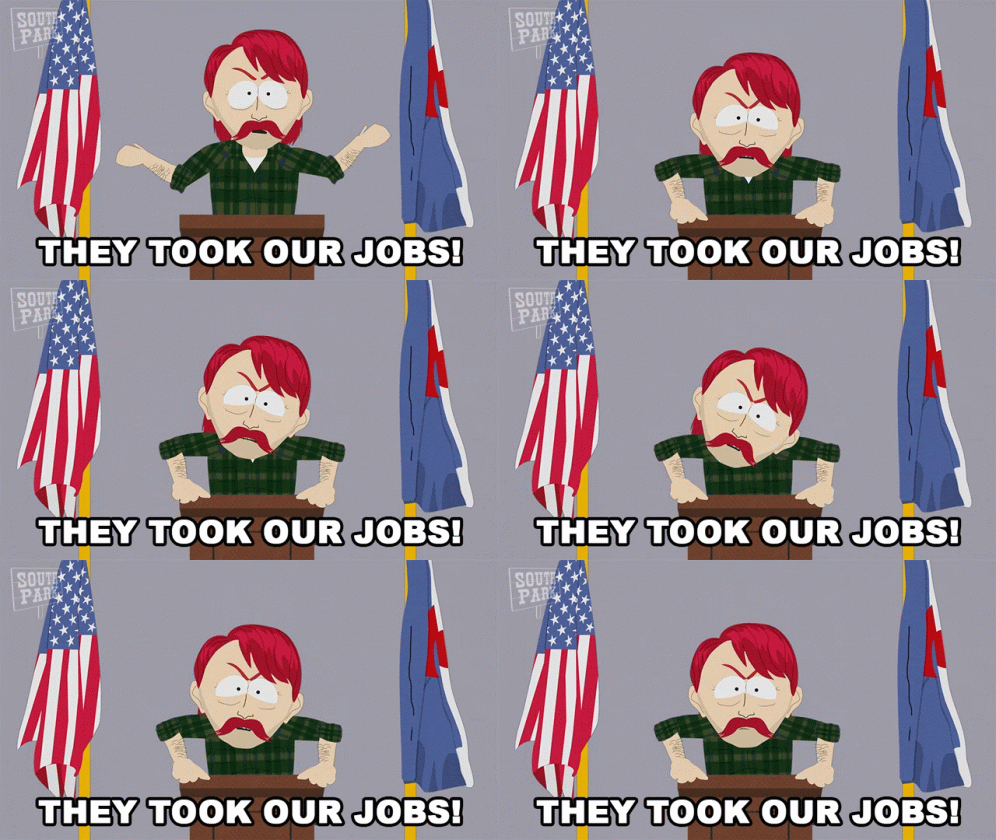
There really is no way to get doomers/luddites/decels like you to think positively about the future is there? If you're not complaining about how AI is going to kill us like a doomer, then you'll just complain about how AI is going to 'take our jobs' like a luddite/decel.

they-took-our-jobs-darryl-weathers.gif


But since (p) doom hasn't happened, you'll just get mad about this instead:

image.png
 
Upvote
-15 (1 / -16)
Ahh yes, the whole "democratization" which only serves to put hard working artists out of business so that rich white guys can get richer. Fan fucking tastic world you're promoting. Instead of having the machines do manual labor so we can create art, you're having the machines create "art" while the rest of us are forced to manual labor.
Remember that his last obsession peaked with "pay to earn" games that literally attempted to recreate feudalism and colonialism, where rich white landlords profited hugely off the labour of poor non-whites who only earned pennies.

That troll has been mask off for some time.
 
Upvote
7 (8 / -1)

hillspuck

Ars Scholae Palatinae
2,179
Let's be clear: AI in art isn't about 'forcing artists into manual labor'. It's about enhancing and broadening the scope of what's possible creatively. To equate AI in art to manual labor is as misplaced as saying the invention of the wheel was a disservice to those building the pyramids.
When you take away the ability to work in a field of art for a living wage, that's what people mean by forcing them into manual labor (because that's often what's left). It's already hard to even be an artist for a living. Mostly, you have to do a bunch of corporate art that you don't want to do so you can afford to do the non-corporate art that you'll struggle for years trying to make any money off of. And some artists will eventually hit it big with their personal art but most won't. Now corporate can just use all the art it vacuumed up to make an AI do the corporate art instead.

And while people attack you for trolling, I don't actually think you are stupid. But it's stupid to use the analogy of bringing the invention of the wheel to pyramid building. You're making the exact point the people you are disagreeing with are making. They're fine with automation that's actually just doing the manual labor.

Of course, that's a totally different debate, as it's questionable that the entirety of mankind can be trained for and capable of jobs that don't involve manual labor. But in any case, it's a different argument altogether.
 
Upvote
6 (6 / 0)
And you ignore the fact that your shitty AI isn't creative, and the shitty output it has is the result of you being unwilling to actually practice art, instead wanting an "easy button" which serves primarily to put people out of work.

AI in art isn't about an 'easy button' or replacing human creativity. It's a tool, like a brush to a painter. The creativity lies in how you use it. AI doesn't put people out of work; it changes the nature of work and opens new creative possibilities.

It absolutely the fuck is not. Creativity was already democratized. You're just too damn lazy to actually learn how to create art.

Democratization of creativity means making artistic expression accessible to all, regardless of their initial skill level. It's not about laziness but about enabling a wider range of voices and visions. Learning to create art is valuable, but so is using tools that extend one's ability to express creatively.

No, they should fucking learn. There is no excuse to not learn those skills, given that there are many sources available, most for free. You, and people like you who want to use AI are just too fucking lazy to do it.

The goal of using AI isn't to avoid learning skills but to complement the skills you do have. And AI can be a stepping stone for those who wish to express themselves artistically but may not have the conventional skills or resources to do so.


So without actually putting any effort into things, and with the side effect of putting actual artists out of work.

AI isn't about putting artists out of work, but about expanding the artistic landscape. Just as photography didn't replace painting, AI won't replace artists; it will coexist and collaborate with them. And again, you fail to see the upside of what making these technologies accessible to everyone will bring. I already gave you more than a few examples, you just chose not to engage with them.

No, the problem here is that not only do you not have any imagination, you're too damn lazy to actually put in the work to be an artist. You think that having an easy button means you can claim to be one, but the only thing you output is soulless, shallow, derivative crap. Just like every one of your comments on this site.

Dismissing AI-generated art as 'soulless' or 'shallow' is a narrow view of what art can be. Art evolves with technology, and AI is part of that evolution. True creativity often involves embracing new tools and possibilities.
 
Upvote
-12 (0 / -12)
When you take away the ability to work in a field of art for a living wage... that's often what's left.

The introduction of AI into the art world isn't about taking jobs away but transforming them. Like any disruptive technology, AI will change the landscape, but it also creates new opportunities and markets. It's a shift, not an eradication.

Mostly, you have to do a bunch of corporate art... Now corporate can just use AI for this.

The use of AI in corporate art could indeed change the dynamic, but it also frees up human artists to focus on more creative and personal projects. AI can handle more routine or formulaic tasks, allowing human creativity to focus elsewhere. (feel free to use your imagination... we'll be able to do more, not less.)

But it's stupid to use the analogy... They're fine with automation that's actually just doing the manual labor.

The analogy was intended to illustrate how technological advancements can fundamentally change the methods and efficiency of work. With AI, we're not replacing artists but enhancing their toolkit. AI in art is more about expanding creative horizons than replacing human creativity.

It's questionable that the entirety of mankind can be trained for and capable of jobs that don't involve manual labor.

The transition to a more automated world is indeed a complex issue. However, history shows that as some jobs become obsolete, new ones emerge, often in areas we hadn't anticipated. The challenge is to adapt our education and training systems to prepare for these changes.
 
Upvote
-13 (0 / -13)

IncorrigibleTroll

Ars Tribunus Angusticlavius
9,228
Why do you feel you're entitled to use the work of others without their permission?

Because it's inherently transformative (assuming you put in the work to properly flip it. I'll never stand in defense of laziness like Ice Ice Baby). Because masterpieces like It Takes A Nation of Millions or Paul's Boutique are basically impossible now. Because some of the most original and unique artists I've ever heard sample heavily. Because commercial considerations must always be weighed as secondary to creative expression. Because using samples imposes certain interesting creative problems to solve. Because copyright is a form of rent and rent is unproductive deadweight even by capitalism's own precepts. Because ultimately all sound is potential grist for the creative mill. Because I do not accept that ephemera can be owned. Because I don't give a rat's ass about anyone's ability to commercially exploit creative endeavors. Because I find copyright morally and ethically despicable.

I can keep going like this for pages.
 
Upvote
-6 (3 / -9)
I like when the defense boils down to “I’m not talented and I don’t want to accept that, work hard at becoming talented, or have to reward people fairly for their talents”. Really hits right when the talent under discussion is “have social skills” and “make convincing arguments”.

The thing is that that IS democratized. Some people have better ideas. Others more talent. Most often, meshing the two or becoming the best at one requires practice, learning, and hard work. We, as a society, deem what’s better. People can learn from those with talent or grow from taking ideas and learning to formulate their own. That’s democracy: people with different ideas and talents benefitting from those things, generally with lots of hard work.

Forcibly taking the output of people with talent with the goal of giving it to everyone is COLLECTIVIZING talent. It’s APPROPRIATING talent for the benefit of other parties. That takes no talent and it provides no benefit to those that have it.

If artists want to sell the rights to derivative works? I’m for it. That’s no problem for me. AI work is always going to be soulless until you reach actual AGI, and that’s not happening in my lifetime. But if they can monetize their work, artists should feel free to participate. It isn’t AI that’s evil, after all.

Being creative isn’t for everyone. Having useful things to say isn’t for everyone. And AI can cheapen those things. But it doesn’t actually help those people much. They’ll never actually be smarter if they let a machine sounds smart for them. They’ll never learn to create if a computer does it for them. And the fact that they don’t put the effort in to try is all the indictment of their character they’ll ever need.

I suck at singing. Oh well. I do it when I want regardless, and try my best. I’ve gotten better. I can’t draw very well. When I took a class, I got better. Not great, but I learned that charcoal is clearly my medium (easier to cover mistakes). My shitty singing and mediocre art aren’t worth much. But the work I put into them is.

I don’t mind that there are tools for people that don’t have the capacity for growth and need immediate gratification. I don’t mind that they exist only on the backs of real people who put in that work. I mind when they appropriate talent without compensation, and when people try to pass of their output as the equivalent of real people.

I also think they stunt the development of people that use their output as their own. AI could be a great tool for teaching. It’s a shame the biggest AI supporters don’t use it as a way to cure themselves of deficiencies and instead treat them as a spackle to cover them. All potential for improvement goes out the window.
 
Upvote
11 (11 / 0)
The sampling regime as it currently stands is rank bullshit that stifles creativity in service of capitalism and is not something to model in other areas. Toxic rentseeking power games.
That's true (though I would argue that it's mostly true only because the artists whose work gets sampled only get a pittance of the licensing fees and it's the studios who collect most of the money and our form of capitalism is so inherently broken that even good ideas mostly can't be implemented in any way but destructively) but it doesn't mean that the law as it currently exists won't end up being applied to AI models in the same way. And if it comes down to the recording and film/tv industries vs. the AI companies I find it hard to believe the AI companies win the argument that they should be allowed to use anything free and clear without licensing it.
 
Upvote
-1 (0 / -1)
Because I find copyright morally and ethically despicable.
The problem with copyright boils down to money. And it both helps and hurts. Same idea with any intellectual property rights.

You have a great idea in a world without patents. BigCo sees it, uses their money to copy it and mass produce it….you lose money. You have a great idea and it touches on a broad, stupidly granted patent, BigCo sues you…you lose money (and then they probably amends their claims to include you unique ideas). Write a great character in a great book in a world without copyright. Well, BigCo has a million cheap shitty copycats who will ape your book and exclude you. Of course, in a world with copyright, their size will let them blockade works and stifle creativity so they get money.

Every protection you strip from rich entities will also be ripped from small ones, and the big ones will be more than happy to exploit the lack of protections.
 
Upvote
6 (6 / 0)

hillspuck

Ars Scholae Palatinae
2,179
The introduction of AI into the art world isn't about taking jobs away but transforming them. Like any disruptive technology, AI will change the landscape, but it also creates new opportunities and markets. It's a shift, not an eradication.

The use of AI in corporate art could indeed change the dynamic, but it also frees up human artists to focus on more creative and personal projects. AI can handle more routine or formulaic tasks, allowing human creativity to focus elsewhere. (feel free to use your imagination... we'll be able to do more, not less.)
Reading these replies makes me wonder if you know any actual working artists, and if they ever talk to you about their life.

The problem with trying to survive as an artist isn't not being able to focus on more creative and personal projects. It's getting things like health insurance and food while doing that.
 
Upvote
8 (8 / 0)

hillspuck

Ars Scholae Palatinae
2,179
Good to see, you're already up to the bargaining stage. But remember, AI's seismic shift is inevitable, not about defeating talent but expanding creativity. 🌊🎨 It's time to adapt and ride the wave, not try to stop it. 🏄‍♂️🤖
It's not inevitable if you can't copyright its output. That makes its usefulness to corporate America far, far less.
 
Upvote
4 (4 / 0)
Reading these replies makes me wonder if you know any actual working artists, and if they ever talk to you about their life.

The problem with trying to survive as an artist isn't not being able to focus on more creative and personal projects. It's getting things like health insurance and food while doing that.

That's a valid point, and the struggle of working artists shouldn't be overlooked. However, the introduction of AI into the art world is part of a larger, unstoppable shift. While it does pose challenges, it also opens up unprecedented opportunities.

The upside of AI in art is about expanding possibilities and reaching wider audiences, potentially creating new revenue streams and markets. This isn't about diminishing the struggles artists face but about acknowledging a transformation that can ultimately benefit a larger number of people.

We should indeed think about those displaced or affected by this shift. Yet, focusing solely on the potential negatives misses the significant potential for positive change. You also have to think about how artists and society can leverage AI, not just as a tool for creation, but as a means to open new doors.

This change is happening, with or without our consent; it's the most important thing to understand. Our opinions won't change the outcome of this shift, and I'm not only here to warn people that are skeptical that this is happening, but I've also shown them quite a few examples of how AI is already very useful, and how it will become even more useful in the near future.
 
Upvote
-10 (0 / -10)

marsilies

Ars Legatus Legionis
24,390
Subscriptor++
This would also extend into games, where just about anyone would now be able to create high quality games once AI gets fast and good enough, with no more than just a prompt to create a new world. You could even just 'modernize' old games, for example:

GE0FEU0XQAA06jC.png


And have it look like this instead:

GE0FEU3WYAAMQsb.jpeg
You actually inadvertently gave an example for why it'd be crap for upscaling games, at least on the fly. Note how the AI converted the background from an extended floor with an alcove to a wall instead of a floor, and ledge instead of an alcove. The AI image is graphically impressive, but it totally messed up the geometry of the room, making it basically unusable for actually playing the game.
 
Upvote
6 (6 / 0)
You actually inadvertently gave an example for why it'd be crap for upscaling games, at least on the fly. Note how the AI converted the background from an extended floor with an alcove to a wall instead of a floor, and ledge instead of an alcove. The AI image is graphically impressive, but it totally messed up the geometry of the room, making it basically unusable for actually playing the game.

Oh, that was just an example (and not my own) the tech to make it happen already exists, it just needs to get faster and better. We should see rudementary examples of this tech in the next couple of years, if not sooner.

OIG2.png
 
Upvote
-8 (0 / -8)

hillspuck

Ars Scholae Palatinae
2,179
The upside of AI in art is about expanding possibilities and reaching wider audiences, potentially creating new revenue streams and markets. This isn't about diminishing the struggles artists face but about acknowledging a transformation that can ultimately benefit a larger number of people.
I don't think this is going to work out the way you think it is. "Yay, now everyone can be an artist. This will open up so many opportunities!"

Yeah, but now everyone can be an artist. So now you'll be competing with the billion other people in the world using the same tools to crank out "art." This isn't going to be much of an opportunity to do the same thing every single other person can do if they can afford a genAI subscription/tool.

And that's without even touching on the fact that genAI remixes rather than innovates. It can't even get the text on that plaque correct, much less come up with a new and interesting art style. We're eventually going to wind up with a billion people being able to remix all the art they sucked up, with a lot less people producing new art for the next wholesale vacuuming. Eventually, it's going to become degenerative AI.
 
Upvote
10 (10 / 0)

marsilies

Ars Legatus Legionis
24,390
Subscriptor++
Oh, that was just an example (and not my own) the tech to make it happen already exists, it just needs to get faster and better. We should see rudementary examples of this tech in the next couple of years, if not sooner.

OIG2.png
Ah yes, posting an image rife with spelling and grammatical errors to "refute" that AI image creation is crap at what you claim it can feasibly do.

The big thing with the faulty video game "upscale" image is that it shows it's not just an issue of processing power, but those developing image generating AI will have to solve other significant issues first in order to do what you proposed.

That said, something like Nvidia's DLSS is an example of machine learning that's not total crap at providing some benefit to video games.
https://en.wikipedia.org/wiki/Deep_learning_super_sampling
 
Last edited:
Upvote
11 (11 / 0)
Ah yes, posting an image rife will spelling and grammatical errors to "refute" that AI image creation is crap at what you claim it can feasibly do.

The big thing with the faulty image is that it shows it's not just an issue of processing power, but those developing image generating AI will have to solve other significant issues first in order to do what you proposed.

That said, something like Nvidia's DLSS is an example of machine learning that's not total crap at providing some benefit to video games.
https://en.wikipedia.org/wiki/Deep_learning_super_sampling

It wasn't meant to refute anything. You're being confrontational for no reason. Is the spelling better on this one? (keep clicking until you see it, and if that doesn't work, squint your eyes until it hurts!)

ComfyUI_34318_.png


[...] it's going to become degenerative AI.

It's a familiar argument: AI democratizing art leads to an oversaturated market. But creativity isn't a one-size-fits-all, even with AI. The tools might be the same, but individual creativity will always stand out. AI's role? It's more of an enhancer than a suppressor.

And on AI's current capabilities, yes, it's in its remix phase, but all tech evolves. What starts as remixing often leads to unforeseen innovation. AI's just getting started.

Lastly, props for the 'degenerative AI' comment – gotta love the edginess. It's always refreshing to see someone taking the dystopian view to new heights.
 
Last edited:
Upvote
-8 (0 / -8)

Derecho Imminent

Ars Legatus Legionis
16,255
Subscriptor
Buying WHAT?

Because if you buy digital content, you’re only buying the rights specifically agreed upon in the contract you agreed to. If you bought a CD, first sale doctrine applies to the physical products, not the right to make copies of the contents (e.g., ripping it to add it to your training data).
You can upload it to your car hd, you can copy it to a new cd to take with you to work, you can upload it to ipods (if thats still a thing). You do have the right to copy. You just dont have the right to distribute copies.

Its going to be a weight to lift trying to prove that training amounts to distributing copies.
 
Last edited:
Upvote
-6 (0 / -6)

hillspuck

Ars Scholae Palatinae
2,179
It's a familiar argument: AI democratizing art leads to an oversaturated market. But creativity isn't a one-size-fits-all, even with AI.
I don't think you understood the argument. It was based on the way these models are built. They remix existing elements but definitionally cannot create new style.

The tools might be the same, but individual creativity will always stand out. AI's role? It's more of an enhancer than a suppressor.
It's not an enhancer. It's a fabricator. You the untalented artist aren't created "enhanced" versions of your art. You're creating art the way the tool likes to make it, with your input on the subject matter and direction of which version of the tool's styles you like best.

And on AI's current capabilities, yes, it's in its remix phase, but all tech evolves. What starts as remixing often leads to unforeseen innovation. AI's just getting started.
This is poppycock. It's like saying "sure, this Eliza thing is crude now, but eventually it will be able to code." Which, like your statement, has no basis in fact. You're using "AI" in the most scifi categorical way. Not the thing we have now with LLMs and stable diffusion, etc. But just some imaginary future AI that you have no idea how (or even if) you'll get to.

Lastly, props for the 'degenerative AI' comment – gotta love the edginess. It's always refreshing to see someone taking the dystopian view to new heights.
And yet it wasn't even meant to be edgy. It referring to the very specific problem that generative AI has in lacking its own creativity. It is built off sucking in a bunch of creativity of other people. But if and when genAI starts spewing its firehose of content out there on all the sites it would have scraped for training data, it's gonna have a real problem. Or just a dead end. Unfortunately, I don't think that will stop its use as the most unoriginal corporate art generator.
 
Upvote
9 (9 / 0)
I don't think you understood the argument. It was based on the way these models are built. They remix existing elements but definitionally cannot create new style.

Much of what we consider 'original work' is, in fact, a creative remixing of existing influences. Take electroswing, for instance (where it came from is in the name!) it's a fusion of vintage swing and modern electronic music, forming a distinctly new style. This concept extends beyond music. Artists in various fields often always blend different styles, techniques, and inspirations to create something uniquely their own. AI, in this context, is just another tool in the artist's kit, capable of mixing and remixing elements in novel ways that can lead to new styles and expressions.

The principle of remixing and reinterpreting isn't confined to art; it's a fundamental aspect of all human innovation. Whether it's in science, technology, literature, or art, new developments often arise from building upon the work of those who came before us. We're indeed standing on the shoulders of giants. Newton, Einstein, Shakespeare, Picasso – each of them drew upon and transformed the knowledge and ideas of their predecessors. AI represents the next step in this continuum. It's not just about remixing art; it's about synthesizing vast arrays of information and patterns, potentially leading to breakthroughs in various fields. This iterative process of creation and innovation is how humanity evolves and progresses.

It's not an enhancer. It's a fabricator. You the untalented artist aren't created "enhanced" versions of your art. You're creating art the way the tool likes to make it, with your input on the subject matter and direction of which version of the tool's styles you like best.

Even if AI were as you say, 'just a fabricator,' its utility can't be dismissed. When AI follows your directions or creates something appealing, it becomes a valuable tool, transforming you into a 'director' of creativity. This role is still immensely useful. And as AI systems improve in accurately interpreting and executing instructions, they bring visions to life that might otherwise be unattainable for some. For those without clear ideas, AI can offer unexpected and inspiring results. The essence here isn't about replacing artists but providing a platform where more people can realize their creative potential, whether they're guiding the process or discovering new ideas through AI's capabilities.

I'm going to give you a very simple example, this is from a popular fantasy book:

"Black stout and yellow beer and wines red and gold and purple, brought up from the warm south on fat-bottomed ships and aged in his deep cellars. The wedding guests gorged on cod cakes and winter squash, hills of neeps and great round wheels of cheese, on smoking slabs of mutton and beef ribs charred almost black, and lastly on three great wedding pies, as wide across as wagon wheels, their flaky crusts stuffed to bursting with carrots, onions, turnips, parsnips, mushrooms, and chunks of seasoned pork swimming in a savory brown gravy."

That is enough to get you to imagine how that would look like, but if what if you wanted to bring that vision to life, but HBO didn't buy the rights to your books, or no one wanted to publish a graphic novel for you? Well, using that exact text, you get this:

file-rCFhlqUlJ70lIeM7XTvvYw3O.png


or this:

OIG4.png


You may not be the 'artist' of this image, but if it helps you bring your idea to life, who cares?

This is the same 'prompt' but for the people going on random 'insecurity' tangents, that seem to have missed what the last blurred image was about. Now I'm hungry:

view.png

The reason I'm blurring it is to help you see it. But if you can't, you have to squint your eyes REALLY HARD to see it, and you'll see it eventually...
EDIT: I think I just realized what you thought I meant when I said 'keep clicking until you see it' 😂

And if that didn't do it, maybe some spaghetti arms will help you see it:

ComfyUI_34383_.png


This is poppycock. It's like saying "sure, this Eliza thing is crude now, but eventually it will be able to code." Which, like your statement, has no basis in fact. You're using "AI" in the most scifi categorical way. Not the thing we have now with LLMs and stable diffusion, etc. But just some imaginary future AI that you have no idea how (or even if) you'll get to.


And yet it wasn't even meant to be edgy. It referring to the very specific problem that generative AI has in lacking its own creativity. It is built off sucking in a bunch of creativity of other people. But if and when genAI starts spewing its firehose of content out there on all the sites it would have scraped for training data, it's gonna have a real problem. Or just a dead end. Unfortunately, I don't think that will stop its use as the most unoriginal corporate art generator.

Reverse God of the Gaps

The skepticism surrounding AI's capabilities often reminds me of a term I came up with a long time ago, which I call the 'reverse god of the gaps'. Critics focus on what AI can't do today, using these gaps as evidence of its inherent limitations. Yet, history tells a different story. With chess, Jeopardy, and notably Go, skeptics claimed these games required uniquely human intelligence and could never be mastered by computers/AI. When computers did surpass human performance in these fields, the goalposts shifted every time, with skeptics quickly dismissing these achievements and pointing to new frontiers that computers, or AI 'could never conquer.'

This pattern is similar to the traditional 'god of the gaps' argument, where every scientific explanation closes a gap previously attributed to a divine cause. In AI's case, each technological advance closes a gap once thought to be an insurmountable barrier for artificial intelligence.

Today, we hear claims like 'AI isn't conscious' or 'it can only do what we program it to do' or 'it can only remix its training data'. True as they may, or may not be now, they echo past sentiments about AI's inability to play Go or compose music. Just as we've seen these barriers fall, it's plausible that what we consider exclusive domains of human consciousness or creativity may also be areas where AI will make significant strides in the future.

In both the traditional and reverse 'god of the gaps,' there's a failure to recognize the dynamic nature of knowledge and capability. Just as science fills gaps in our understanding of the natural world, AI is rapidly filling gaps in what we consider the exclusive domain of human intellect and creativity.

If you can read between the lines, the writing is on the wall. It's only a matter of time before AI not only does what we tell it to do, but also starts inventing and discovering things on its own. And when AI can match or surpass humans in all economically productive activities, I'm sure there will still be people clinging to the 'reverse god of the gaps' in the same way creationists do. But I think all but the most cynical among us will recognize AI, or at that point, AGI, as an intelligent and sentient entity.
 
Last edited:
Upvote
-12 (0 / -12)

DeschutesCore

Ars Scholae Palatinae
1,079
While your view reflects caution, it seems to miss the broader historical trend of technological democratization. Take computers for example: once colossal machines exclusive to corporations and governments, they now sit in our homes. The internet, initially a government project, has become a global village accessible by pretty much everyone (consider the fact that a kid in Africa, has access to far more information than Bill Clinton did when he was president). Cell phones, which then became smartphones, once a luxury, are now ubiquitous, revolutionizing communication and access to information.

Regarding hydrogen fuel cells, I share your skepticism. My belief leans towards technologies like PVs and batteries, whose costs have drastically reduced, benefiting everyone. The takeaway here is that despite corporate involvement in these technologies, it's the everyday user who reaps the benefits. This conversation itself is a testament to that – we're using devices and networks that were once out of reach for the average person. (it really takes an incredibly pessimistic view of the world to not see this as you were drafting your response, without giving a second thought to how impossible this would have been just a few decades ago)

And when it comes to AI, it is advancing at a staggering pace, far outstripping the rates we saw even during the heydays of Moore's Law. This isn't just about raw computing power becoming cheaper; it's about the entire ecosystem of AI – from data accessibility and storage to algorithmic efficiency and open-source contributions – all converging to make AI faster, smarter, and more accessible.

People sharing your views (which seems to be just about everyone except for me and another person in this thread) couldn't have picked a worst time to have the views of a luddite. All of these technologies are converging as we speak, and the marginal costs for these technologies are trending towards zero.

Look, I get where some of those points are coming from, because yes, they are factual and they did happen. That's not what your point was though. You stated that AI will be in the hands of common man. I am telling you no, it will not, and I'll explain why, but let me point out some very obvious dishonesty in your reply.

YOU brought up Bitcoin as being an example. Bitcoin is a TERRIBLE example of not being what was promised, not achieving any of its goals outside of the complexity increasing exactly as designed and not remotely being in common man's hands.

Now, back to AI. You are foretelling a future based on an illusion, that AI is real and that it is here. It is not. The current models do not approach what passes for a true test of intelligence. It's a scary good simulation, and it takes INSANE resources to achieve this trick. Every single token processed cost someone money, power, and equipment. Common users can't run AI on anything y
Sorry, Kamus, but I've given up on reading your replies when they go for pages. It's not an exhaustive rebuttal. It's just exhausting. Maybe GPT could help you edit.
Pretty sure they're using ChatGPT for the replies to begin with.
 
Upvote
10 (10 / 0)
Sorry, Kamus, but I've given up on reading your replies when they go for pages. It's not an exhaustive rebuttal. It's just exhausting. Maybe GPT could help you edit.

🔄🎨 AI remixes inspire new art. 📈💡 AI's evolution opens innovation. 🛠️🎭 AI's a tool, not a replacement. 🚀🧠 AI surpasses limitations, like in chess & Go. 🔮🤖 Future AI will invent, not just follow. 🌌🧑‍🎨 AI expands creative horizons for all.

Look, I get where some of those points are coming from, because yes, they are factual and they did happen. That's not what your point was though. You stated that AI will be in the hands of common man. I am telling you no, it will not, and I'll explain why, but let me point out some very obvious dishonesty in your reply.

YOU brought up Bitcoin as being an example. Bitcoin is a TERRIBLE example of not being what was promised, not achieving any of its goals outside of the complexity increasing exactly as designed and not remotely being in common man's hands.

Now, back to AI. You are foretelling a future based on an illusion, that AI is real and that it is here. It is not. The current models do not approach what passes for a true test of intelligence. It's a scary good simulation, and it takes INSANE resources to achieve this trick. Every single token processed cost someone money, power, and equipment. Common users can't run AI on anything y

Pretty sure they're using ChatGPT for the replies to begin with.


Your skepticism about AI's future in the hands of the common man is noted. However, remember, I did say AI would make Bitcoin look like a warm-up act. Let's address your points:

1. On Bitcoin: Acknowledging your point, Bitcoin indeed hasn't achieved all its envisioned goals. However, its role as a groundbreaking technology cannot be overstated. Much like the early internet, Bitcoin's protocol has shown a potential similar to the foundational stages of a major technological shift. Its growth in value and adoption is a testament to its expanding influence. Furthermore, a fascinating aspect of Bitcoin, and where it might intersect significantly with AI, lies in its ability to enable software, including autonomous AI agents, to 'own' and transact with money independently. This capability opens up new avenues for how AI can interact with and contribute to economic systems, using Bitcoin and other cryptocurrencies. Such developments hint at a future where AI's integration with 'hard money' could lead to unforeseen economic transformations. I repeat... with Bitcoin, AI agents can 'own' money. Let that sink in...

2. On AI's Reality: The assertion that AI isn't 'real' overlooks its current applications. Chat GPT, for example, grew by 9900% in just two months. This isn't just a 'scary good simulation' – it's a practical tool being used by millions. And that's just Chat GPT, the open source movement will end up being bigger in the end. You have to think of these AI systems as infrastructure.

3. On Efficiency of LLMs: The view that LLM outputs are prohibitively expensive misses the broader efficiency they bring. These models can process and analyze vast amounts of data in seconds, a task that would be immensely time-consuming for humans. And consider the creation of a complex image: a skilled artist might need days to produce a high-quality piece, while an AI image generator can produce similar results in a fraction of the time. This efficiency extends beyond just time-saving; it's about the ability to generate multiple iterations, explore various creative avenues, and provide rapid insights that would be otherwise unfeasible for a human alone.

LLM training on the other hand, is very resource intensive. But once the model has been trained, the complete opposite is true, and it can make even obsolete hardware seem like it's from the future.

4. Accessibility of AI: The trajectory of technology suggests increasing accessibility over time. The rapid growth and evolving capabilities of AI point towards a future where it becomes a common tool, much like the internet or smartphones.

Wrapping up, the evolution of the internet serves as a prime example of how advanced technologies become ubiquitous. Initially a complex and costly endeavor, the internet is now an integral part of daily life for billions. This transformation is not unique to the internet. We see similar trends across various technologies, each following a path from exclusivity to ubiquity.

Take personal computing, for instance. Early computers were large, expensive, and limited to specific uses in business and academia. Today, powerful computing devices fit in our pockets, and are much more powerful and useful. Similarly, the first mobile phones were bulky and expensive, yet now smartphones are widespread and affordable.

Photovoltaic (PV) technology and renewable energy sources also follow this pattern. Once expensive and inefficient, they are now increasingly affordable and efficient, revolutionizing energy consumption.

These trends are interconnected and self-reinforcing. Advances in one area, like compute power, fuel improvements in others, such as AI development. As technologies like AI and blockchain (evidenced by Bitcoin as a protocol) mature, their marginal costs trend towards zero, making them more accessible.
 
Upvote
-9 (0 / -9)
D

Deleted member 1064244

Guest
Ahh yes, the whole "democratization" which only serves to put hard working artists out of business so that rich white guys can get richer. Fan fucking tastic world you're promoting. Instead of having the machines do manual labor so we can create art, you're having the machines create "art" while the rest of us are forced to manual labor.
This is the thing that profoundly offends me about the AI discussion. The lack of honesty.

The argument that it threatens to give people who can't dedicate the time and discipline the ability to fully realize their ideas, that's "democratization", and that's valid. But I haven't seen that in motion. Just a moneysaving tool for the bosses to devalue the skill and labor of people with a certain skillset.

Only one AI flaunter I've engaged with was honest enough to admit it's simple tribal revenge for him: "owning artists who laughed at NFTs". I think this is more what this drive is motivated by than any altruistic purpose, "Effective" or otherwise.

Is it that hard to be honest? Their idols/men (and it's always men) of vision make no secret of their plans ruining people's lives, why do they think they need to lie to anyone skeptical? Is it just a veiled insult ("you're dumb, here's a stupid placating argument HAHA you engaged with it #owned")?
 
Last edited by a moderator:
Upvote
7 (7 / 0)
I watched a few minutes and it was nearly a full repeat of old material. Carlin was smarter than that, he created new material all the time. Usually when someone recreates an artist, they add something to the library of the past and add to the experience. This is just someone hoping for views and a payout.
And it worked. You watched it.
 
Upvote
-7 (1 / -8)