
You are using an out of date browser. It may not display this or other websites correctly.
You should upgrade or use an alternative browser.
You should upgrade or use an alternative browser.
iPhone XR review: Keeping compromises to a minimum
- Thread starter JournalBot
- Start date

Translation: "CJ is right".
Pro-tip: 60% of the time, I'm right 100% of the time.
Pro-tip: 60% of the time, I'm right 100% of the time.
Upvote
-7
(0
/
-7)
...
People can argue specs all they want. What you see with your own eyes is what you get. DisplayMate’s testing isn’t going to change what I see. You can subjectively think I’m wrong, but you can’t objectively tell me I am wrong. It’s my opinion and I’ve done the research and comparisons to understand what this screen offers and I’m not happy with Apple’s decision to use such a low resolution on the Xr.
Again, your brain is tricking you. Any difference you see is psychological. Stop advertising to the world that you've tricked yourself.
The subpixel density on the XR is only 14% lower than the Galaxy S9. Why are you characterizing that as "such a low resolution" when it's only 14% lower?
If somebody ran a double-blind test on you to see which display you thought was sharper, I'd bet $100 that you'd pick the XR...
Also BTW, did you know that out-of-the-box, Samsung's latest devices don't even run at their screen's native resolution? So if you're looking at Samsung screens in a store, you're almost certainly looking at them running at non-native resolutions. Meaning you have the antialiasing artifacts that are generated by the OS's software stack multiplied by scaling artifacts from running at a non-native resolution multiplied by OLED artifacts from only having two subpixels per logical pixel. So basically you have s**t times s**t.
Now that I think about it, you might prefer the Samsung displays because up-close, everything looks like blurry, s**tty crap, and you might be thinking "hey I can't make out the pixel boundaries so that must mean the resolution is so high that everything is perfectly smooth!" when in reality you're just looking at a s**tty picture up-close.
Upvote
4
(7
/
-3)
At the current prices and the current new features, I think I'll stick with the 6S. Hopefully, a cheaper phone does come out next year. With some sort of TouchID, I do recall that Apple won't go back to TouchID since "FaceID is so much better".
Which part of Apple's strategy do you not understand?
The cheaper phone is the iPhone 8. The much cheaper phone is the iPhone7, bought on refurb.
That's not going to change next year, except the cheaper phone becomes iPhone XR, and cheapest phone becomes the 8.
My guess is, 8 becomes entry level, XR steps down to the $599 range, there's a replacement XR (11R, let's say) that stays at the $749 price point but improves the screen and performance, and 11/11 Max that take the top end.
Upvote
0
(0
/
0)
...
People can argue specs all they want. What you see with your own eyes is what you get. DisplayMate’s testing isn’t going to change what I see. You can subjectively think I’m wrong, but you can’t objectively tell me I am wrong. It’s my opinion and I’ve done the research and comparisons to understand what this screen offers and I’m not happy with Apple’s decision to use such a low resolution on the Xr.
Again, your brain is tricking you. Any difference you see is psychological. Stop advertising to the world that you've tricked yourself.
The subpixel density on the XR is only 14% lower than the Galaxy S9. Why are you characterizing that as "such a low resolution" when it's only 14% lower?
If somebody ran a double-blind test on you to see which display you thought was sharper, I'd bet $100 that you'd pick the XR...
Also BTW, did you know that out-of-the-box, Samsung's latest devices don't even run at their screen's native resolution? So if you're looking at Samsung screens in a store, you're almost certainly looking at them running at non-native resolutions. Meaning you have the antialiasing artifacts that are generated by the OS's software stack multiplied by scaling artifacts from running at a non-native resolution multiplied by OLED artifacts from only having two subpixels per logical pixel. So basically you have s**t times s**t.
Now that I think about it, you might prefer the Samsung displays because up-close, everything looks like blurry, s**tty crap, and you might be thinking "hey I can't make out the pixel boundaries so that must mean the resolution is so high that everything is perfectly smooth!" when in reality you're just looking at a s**tty picture up-close.
I'm guessing you're this objective about Monet paintings

Whilst we have objective tools for measuring light, I'm unaware of detailed objective measurement of human vision beyond our understanding that it varies, a lot.
Upvote
-4
(1
/
-5)

We've had a look at XS for my wife and it was just too large for her to use comfortably (that's what she said). And XR is even larger than that...
Yeah, I wish they'd add an updated model the same size as the 8. I've given up on an updated SE, but the 8 is, just barely, small enough for me to use one-handed, which it turns out is a thing I want in a phone. But it's a year old. I don't really want to pay new-phone prices for a year-old model.
Upvote
0
(1
/
-1)
the_frakker
Ars Praefectus
Again, your brain is tricking you. Any difference you see is psychological. Stop advertising to the world that you've tricked yourself.
My wishes didn’t happen and so it’s a hypothetical anyway and so it really doesn’t matter. I’m a bit surprised how much of a response my comment has gotten. It was a wishful thought about my annoyance with the resolution. I’m arguing personal preference against specs and that’s not really going to get us anywhere.
I get it, y’all are fine with it. Just don’t be demanding I change my opinion because you don’t like it. Y’all insist I would see it different if only...
 I don’t know what to say to people who won’t accept that other people might actually not like the new XR screen as much as them.
 I’m annoyed, but it doesn’t really affect me. I’m not buying an XR. I’m not going to continue this back and forth about my opinion. I’ll take it under advisement to take another look just because I’m a reasonable person. I just don’t expect it to be different since I spent a good chunk of time investigating the device last time.
Upvote
1
(3
/
-2)
...
I'm guessing you're this objective about Monet paintings
Whilst we have objective tools for measuring light, I'm unaware of detailed objective measurement of human vision beyond our understanding that it varies, a lot.
If you look at close-up photographs of OLED vs. LCD, I think everybody can agree that OLED looks inferior (due to the PenTile subpixel arrangement).
So if you're going to claim that your vision is so good that you can essentially see what a close-up photograph would capture, and you think OLED looks better, then either you're lying to yourself or you're lying to others. Your vision isn't really that good, or you're convincing yourself that OLED is better because you read some statistic about resolution somewhere, or you don't like Apple, or something.
If there's a flaw with my reasoning here I'd be happy to hear about it.
Upvote
4
(5
/
-1)
At the current prices and the current new features, I think I'll stick with the 6S. Hopefully, a cheaper phone does come out next year. With some sort of TouchID, I do recall that Apple won't go back to TouchID since "FaceID is so much better".
Which part of Apple's strategy do you not understand?
The cheaper phone is the iPhone 8. The much cheaper phone is the iPhone7, bought on refurb.
That's not going to change next year, except the cheaper phone becomes iPhone XR, and cheapest phone becomes the 8.
It's not clear at this point if that's how this is going to go anymore. While the iPhone 8 dropped down a level, the iPhone X disappeared and the iPhone XR sort of took it's place in the lineup. Are they going to have an iPhone XR 2 and the iPhone XR in the same lineup?
Over the last couple years they've really broken up their regular cadence.
Upvote
1
(1
/
0)
...
I'm guessing you're this objective about Monet paintings
Whilst we have objective tools for measuring light, I'm unaware of detailed objective measurement of human vision beyond our understanding that it varies, a lot.
If you look at close-up photographs of OLED vs. LCD, I think everybody can agree that OLED looks inferior (due to the PenTile subpixel arrangement).
So if you're going to claim that your vision is so good that you can essentially see what a close-up photograph would capture, and you think OLED looks better, then either you're lying to yourself or you're lying to others. Your vision isn't really that good, or you're convincing yourself that OLED is better because you read some statistic about resolution somewhere, or you don't like Apple, or something.
If there's a flaw with my reasoning here I'd be happy to hear about it.
There are many flaws with the arguments you have presented, not least that you seem to be claiming universal 'objective truths' for visual perception, these aren't especially reasonable.
As I said earlier, my preferred phone LCD screen was an £86 Maze alpha's, it's not objectively 'better' than numerous other screens, it has a fairly stunning brightness and contrast compared to the many other phone LCD screens I've seen/used. That brightness likely opens up a huge number of 'objective flaws' compared to alternatives, none of which I care about enough in my usage to accept reduced brightness / contrast, as I perceive them. I'll say that the P2's oled was even better for my usage. In any case, that's all it is, my opinion, based on my eyes, my perception and my usage scenario. I also hate low colour temperature white, others love a bit of red in their white, once we're in a ballpark the 'measures' are pretty irrelevant.
Don't get me wrong, I'm fairly interested in attempts to measure and standardise screens, I've calibrated more than one monitor myself, I just understand the limitations in the objective measurements when attempting to apply them to individual perception, just the same as many prefer looking at a Monet to a Gainsborough.
Upvote
-6
(0
/
-6)
D
Deleted member 330960
Guest
...
I'm guessing you're this objective about Monet paintings
Whilst we have objective tools for measuring light, I'm unaware of detailed objective measurement of human vision beyond our understanding that it varies, a lot.
If you look at close-up photographs of OLED vs. LCD, I think everybody can agree that OLED looks inferior (due to the PenTile subpixel arrangement).
So if you're going to claim that your vision is so good that you can essentially see what a close-up photograph would capture, and you think OLED looks better, then either you're lying to yourself or you're lying to others. Your vision isn't really that good, or you're convincing yourself that OLED is better because you read some statistic about resolution somewhere, or you don't like Apple, or something.
If there's a flaw with my reasoning here I'd be happy to hear about it.
There are many flaws with the arguments you have presented, not least that you seem to be claiming universal 'objective truths' for visual perception, these aren't especially reasonable.
As I said earlier, my preferred phone LCD screen was an £86 Maze alpha's, it's not objectively 'better' than numerous other screens, it has a fairly stunning brightness and contrast compared to the many other phone LCD screens I've seen/used. That brightness likely opens up a huge number of 'objective flaws' compared to alternatives, none of which I care about enough in my usage to accept reduced brightness / contrast, as I perceive them. I'll say that the P2's oled was even better for my usage. In any case, that's all it is, my opinion, based on my eyes, my perception and my usage scenario. I also hate low colour temperature white, others love a bit of red in their white, once we're in a ballpark the 'measures' are pretty irrelevant.
Don't get me wrong, I'm fairly interested in attempts to measure and standardise screens, I've calibrated more than one monitor myself, I just understand the limitations in the objective measurements when attempting to apply them to individual perception, just the same as many prefer looking at a Monet to a Gainsborough.
You're talking a bunch of nonsense and sound like an audiophile. There isn't proper colorspace support in Android to this day, so I'm not sure that it matters whether you prefer a $100 android phone over a Pixel 2.
Upvote
10
(11
/
-1)
...
I'm guessing you're this objective about Monet paintings
Whilst we have objective tools for measuring light, I'm unaware of detailed objective measurement of human vision beyond our understanding that it varies, a lot.
If you look at close-up photographs of OLED vs. LCD, I think everybody can agree that OLED looks inferior (due to the PenTile subpixel arrangement).
So if you're going to claim that your vision is so good that you can essentially see what a close-up photograph would capture, and you think OLED looks better, then either you're lying to yourself or you're lying to others. Your vision isn't really that good, or you're convincing yourself that OLED is better because you read some statistic about resolution somewhere, or you don't like Apple, or something.
If there's a flaw with my reasoning here I'd be happy to hear about it.
There are many flaws with the arguments you have presented, not least that you seem to be claiming universal 'objective truths' for visual perception, these aren't especially reasonable.
As I said earlier, my preferred phone LCD screen was an £86 Maze alpha's, it's not objectively 'better' than numerous other screens, it has a fairly stunning brightness and contrast compared to the many other phone LCD screens I've seen/used. ...
At the end of the day, a computer/phone screen is a piece of objective equipment. It's supposed to display certain colors with certain luminance at certain points. What you prefer is frankly kind of irrelevant, sorry.
I would also prefer it if my bathroom scale showed me a number that's ~10 less than it does right now but I also understand the inanity of that preference.
Upvote
4
(5
/
-1)
...
I'm guessing you're this objective about Monet paintings
Whilst we have objective tools for measuring light, I'm unaware of detailed objective measurement of human vision beyond our understanding that it varies, a lot.
If you look at close-up photographs of OLED vs. LCD, I think everybody can agree that OLED looks inferior (due to the PenTile subpixel arrangement).
So if you're going to claim that your vision is so good that you can essentially see what a close-up photograph would capture, and you think OLED looks better, then either you're lying to yourself or you're lying to others. Your vision isn't really that good, or you're convincing yourself that OLED is better because you read some statistic about resolution somewhere, or you don't like Apple, or something.
If there's a flaw with my reasoning here I'd be happy to hear about it.
There are many flaws with the arguments you have presented, not least that you seem to be claiming universal 'objective truths' for visual perception, these aren't especially reasonable.
As I said earlier, my preferred phone LCD screen was an £86 Maze alpha's, it's not objectively 'better' than numerous other screens, it has a fairly stunning brightness and contrast compared to the many other phone LCD screens I've seen/used. That brightness likely opens up a huge number of 'objective flaws' compared to alternatives, none of which I care about enough in my usage to accept reduced brightness / contrast, as I perceive them. I'll say that the P2's oled was even better for my usage. In any case, that's all it is, my opinion, based on my eyes, my perception and my usage scenario. I also hate low colour temperature white, others love a bit of red in their white, once we're in a ballpark the 'measures' are pretty irrelevant.
Don't get me wrong, I'm fairly interested in attempts to measure and standardise screens, I've calibrated more than one monitor myself, I just understand the limitations in the objective measurements when attempting to apply them to individual perception, just the same as many prefer looking at a Monet to a Gainsborough.
You're talking a bunch of nonsense and sound like an audiophile. There isn't proper colorspace support in Android to this day, so I'm not sure that it matters whether you prefer a $100 android phone over a Pixel 2.
I'm talking like someone who made their living in this field!
Upvote
-7
(0
/
-7)
...
I'm guessing you're this objective about Monet paintings
Whilst we have objective tools for measuring light, I'm unaware of detailed objective measurement of human vision beyond our understanding that it varies, a lot.
If you look at close-up photographs of OLED vs. LCD, I think everybody can agree that OLED looks inferior (due to the PenTile subpixel arrangement).
So if you're going to claim that your vision is so good that you can essentially see what a close-up photograph would capture, and you think OLED looks better, then either you're lying to yourself or you're lying to others. Your vision isn't really that good, or you're convincing yourself that OLED is better because you read some statistic about resolution somewhere, or you don't like Apple, or something.
If there's a flaw with my reasoning here I'd be happy to hear about it.
There are many flaws with the arguments you have presented, not least that you seem to be claiming universal 'objective truths' for visual perception, these aren't especially reasonable.
As I said earlier, my preferred phone LCD screen was an £86 Maze alpha's, it's not objectively 'better' than numerous other screens, it has a fairly stunning brightness and contrast compared to the many other phone LCD screens I've seen/used. ...
At the end of the day, a computer/phone screen is a piece of objective equipment. It's supposed to display certain colors with certain luminance at certain points. What you prefer is frankly kind of irrelevant, sorry.
I would also prefer it if my bathroom scale showed me a number that's ~10 less than it does right now but I also understand the inanity of that preference.
Can you explain the human visual system, colour blindness, the colour reception system, cataract influence on light perception, astigmatism effects on light perception, the functioning of the brain for visual perception.
No you can't and you hate Monet oh and your 'belief' about what 'all people' can and will agree regarding OLED and LCD is garbage!
Upvote
-7
(1
/
-8)
...
I'm guessing you're this objective about Monet paintings
Whilst we have objective tools for measuring light, I'm unaware of detailed objective measurement of human vision beyond our understanding that it varies, a lot.
If you look at close-up photographs of OLED vs. LCD, I think everybody can agree that OLED looks inferior (due to the PenTile subpixel arrangement).
So if you're going to claim that your vision is so good that you can essentially see what a close-up photograph would capture, and you think OLED looks better, then either you're lying to yourself or you're lying to others. Your vision isn't really that good, or you're convincing yourself that OLED is better because you read some statistic about resolution somewhere, or you don't like Apple, or something.
If there's a flaw with my reasoning here I'd be happy to hear about it.
There are many flaws with the arguments you have presented, not least that you seem to be claiming universal 'objective truths' for visual perception, these aren't especially reasonable.
As I said earlier, my preferred phone LCD screen was an £86 Maze alpha's, it's not objectively 'better' than numerous other screens, it has a fairly stunning brightness and contrast compared to the many other phone LCD screens I've seen/used. ...
At the end of the day, a computer/phone screen is a piece of objective equipment. It's supposed to display certain colors with certain luminance at certain points. What you prefer is frankly kind of irrelevant, sorry.
I would also prefer it if my bathroom scale showed me a number that's ~10 less than it does right now but I also understand the inanity of that preference.
If you have specific eyes (we all do) you will experience light in different ways (we all do).
Personally I have a cataract, contrast and luminance are pretty important in my case.
If you have some form of colour blindness (many do) colour reproduction accuracy may have less or more importance to your use.
If you have astigmatism or other refractive 'error' (virtually everyone does) you may find the sharpness of an image more or less important.
It's almost as if you're attempting to suggest that the obviously individual requirements (balance of numerous trade offs in technologies and implementations) of people with clearly individual and varying visual systems are somehow, the same as wanting scales that say 11 when they mean 10, of course that would be a pretty closed minded wanky thing to do, no?
Upvote
-5
(0
/
-5)
I guess when you've heard the discussion and arguments of dozens of professional screen calibrators over which screen is 'best', having just calibrated their CRTs in the magnetic field you just set up to simulate the southern hemisphere (whilst being located in the northern hemisphere), it tends to 'colour' your view
Crack on telling me about colour space support on a 6 inch reflective screen, I generally use in direct sunlight, mostly for making calls, reading text, touching the ui and driving places, all with my (as with most humans) increasingly shitty but different to your eyes.
Remember folks, which one works 'best' for you, is unrelated to your preference, just like the chaps calibrating screens for a living, in utter disagreement, in far less variable environments!
Crack on telling me about colour space support on a 6 inch reflective screen, I generally use in direct sunlight, mostly for making calls, reading text, touching the ui and driving places, all with my (as with most humans) increasingly shitty but different to your eyes.
Remember folks, which one works 'best' for you, is unrelated to your preference, just like the chaps calibrating screens for a living, in utter disagreement, in far less variable environments!
Upvote
-4
(1
/
-5)
...
I'm guessing you're this objective about Monet paintings
Whilst we have objective tools for measuring light, I'm unaware of detailed objective measurement of human vision beyond our understanding that it varies, a lot.
If you look at close-up photographs of OLED vs. LCD, I think everybody can agree that OLED looks inferior (due to the PenTile subpixel arrangement).
So if you're going to claim that your vision is so good that you can essentially see what a close-up photograph would capture, and you think OLED looks better, then either you're lying to yourself or you're lying to others. Your vision isn't really that good, or you're convincing yourself that OLED is better because you read some statistic about resolution somewhere, or you don't like Apple, or something.
If there's a flaw with my reasoning here I'd be happy to hear about it.
There are many flaws with the arguments you have presented, not least that you seem to be claiming universal 'objective truths' for visual perception, these aren't especially reasonable.
As I said earlier, my preferred phone LCD screen was an £86 Maze alpha's, it's not objectively 'better' than numerous other screens, it has a fairly stunning brightness and contrast compared to the many other phone LCD screens I've seen/used. ...
At the end of the day, a computer/phone screen is a piece of objective equipment. It's supposed to display certain colors with certain luminance at certain points. What you prefer is frankly kind of irrelevant, sorry.
I would also prefer it if my bathroom scale showed me a number that's ~10 less than it does right now but I also understand the inanity of that preference.
If you have specific eyes (we all do) you will experience light in different ways (we all do).
Personally I have a cataract, contrast and luminance are pretty important in my case.
If you have some form of colour blindness (many do) colour reproduction accuracy may have less or more importance to your use.
If you have astigmatism or other refractive 'error' (virtually everyone does) you may find the sharpness of an image more or less important.
It's almost as if you're attempting to suggest that the obviously individual requirements (balance of numerous trade offs in technologies and implementations) of people with clearly individual and varying visual systems are somehow, the same as wanting scales that say 11 when they mean 10, of course that would be a pretty closed minded wanky thing to do, no?
If you have certain preferences re: how you like to see content on your screens, then go ahead and calibrate your own screens to your own preferences.
Don't tell me that an objectively inferior piece of equipment is superior because its flaws coincidentally suit your preferences. Listen to yourself. It's absurd. Inferior is inferior.
Upvote
3
(4
/
-1)
...
I'm guessing you're this objective about Monet paintings
Whilst we have objective tools for measuring light, I'm unaware of detailed objective measurement of human vision beyond our understanding that it varies, a lot.
If you look at close-up photographs of OLED vs. LCD, I think everybody can agree that OLED looks inferior (due to the PenTile subpixel arrangement).
So if you're going to claim that your vision is so good that you can essentially see what a close-up photograph would capture, and you think OLED looks better, then either you're lying to yourself or you're lying to others. Your vision isn't really that good, or you're convincing yourself that OLED is better because you read some statistic about resolution somewhere, or you don't like Apple, or something.
If there's a flaw with my reasoning here I'd be happy to hear about it.
There are many flaws with the arguments you have presented, not least that you seem to be claiming universal 'objective truths' for visual perception, these aren't especially reasonable.
As I said earlier, my preferred phone LCD screen was an £86 Maze alpha's, it's not objectively 'better' than numerous other screens, it has a fairly stunning brightness and contrast compared to the many other phone LCD screens I've seen/used. ...
At the end of the day, a computer/phone screen is a piece of objective equipment. It's supposed to display certain colors with certain luminance at certain points. What you prefer is frankly kind of irrelevant, sorry.
I would also prefer it if my bathroom scale showed me a number that's ~10 less than it does right now but I also understand the inanity of that preference.
If you have specific eyes (we all do) you will experience light in different ways (we all do).
Personally I have a cataract, contrast and luminance are pretty important in my case.
If you have some form of colour blindness (many do) colour reproduction accuracy may have less or more importance to your use.
If you have astigmatism or other refractive 'error' (virtually everyone does) you may find the sharpness of an image more or less important.
It's almost as if you're attempting to suggest that the obviously individual requirements (balance of numerous trade offs in technologies and implementations) of people with clearly individual and varying visual systems are somehow, the same as wanting scales that say 11 when they mean 10, of course that would be a pretty closed minded wanky thing to do, no?
If you have certain preferences re: how you like to see content on your screens, then go ahead and calibrate your own screens to your own preferences.
Don't tell me that an objectively inferior piece of equipment is superior because its flaws coincidentally suit your preferences. Listen to yourself. It's absurd. Inferior is inferior.
Absurd would be attempting to measure 'inferior' across a range of objective dimensions and then trying to argue each dimension is equal, when different tech and implementations frequently have obvious strengths and weakness, especially so when the people using the device are utterly dissimilar in needs.
If you're colour blind is colour space coverage as important as brightness?
If you are missing part of the light to the receptor in your eyes, is contrast more valuable than screen flicker?
If you have a refractive error, is level of black as valuable ppi?
I'm sure all the most expensive phone screens are all excellent. On larger screen monitors, you'd have to have ripped my CRT ultrascan out of my cold dead hand to replace it with any form of flat panel until more recently.
Lower contrast, luminance and black can literally make a 'great' screen unusable for me.
Upvote
-5
(0
/
-5)
60fps looks shit in Europe. Please allow 50fps/25fps video.
(For those who don't know it, we have 50Hz AC frequency in europe -> our bulbs flicker at that frequency. If the camera is not synced -> flickering image.)
(For those who don't know it, we have 50Hz AC frequency in europe -> our bulbs flicker at that frequency. If the camera is not synced -> flickering image.)
Upvote
-3
(0
/
-3)
D
Deleted member 174040
Guest
the lack of 3D Touch is probably a deal breaker for me.
Yeah, no one really believes this.
Upvote
-2
(2
/
-4)
Not 99% of all smartphones but 99% of flagship smartphones.The bad
The glass back and front pose a risk for fall damage.
Something tells me 99% of smartphones suffer from this "flaw".
Glad that ars mentioned it in their review bcoz everyone else seems to overlook this issue in their reviews. A smartphone is one of the most used gadgets in anyone's life yet just for looks it is made of fragile glass. Mishaps happen & Glass front and back smartphones are more prone to getting damaged that any other types of construction, which ends up costing user unavoidably. Glad that someone see's what it really is.
Upvote
-3
(2
/
-5)
I have to wonder when personal computers came out every year was a new, faster model with more features that was cheaper. Now we have basically a handheld personal computer that every year has a new, faster model with more features but is way more expensive than the previous year.
Can cell phones go to the early PC model where tech gets cheaper every year?
Can cell phones go to the early PC model where tech gets cheaper every year?
Upvote
-4
(0
/
-4)
I have to wonder when personal computers came out every year was a new, faster model with more features that was cheaper. Now we have basically a handheld personal computer that every year has a new, faster model with more features but is way more expensive than the previous year.
Can cell phones go to the early PC model where tech gets cheaper every year?
LMAO. Phones are the only tech since 1982 that I have known to go up as millions more are made. CD players? Down. Computers? Laptops? Digital cameras? Down. VHS? DVD? Down. Printers? Down. Massive LCD TVs? Down. iPhone? Originally $499. Up.
Upvote
-3
(2
/
-5)
I still own a iPhone 6S Plus and don't really feel the need to change...
Spec is here https://productz.com/en/tablets
Spec is here https://productz.com/en/tablets
Upvote
1
(2
/
-1)
Reading reviews for the xr screen, is the black level as black as oled, the answer is like all lcd versus oled, no.
That contrast measurement looks awesome, I judge which Id prefer to use by looking at the screen in the environment I'm going to use it in, as did every single one of our professional calibrators, after they'd used objective measurements to calibrate to 'best'.
I've not read a single coherent answer as to why anyone should believe human visual needs are universally identical to the devices measuring performance. On top of that, once in a ballpark, screens and screen tech generally have varying strengths and weakness and know nothings don't get to decide which measure is universally more important. 80% of Asia likely have some form of refractive 'error' 5% of kids have cataract (mine included) a figure growing with age.
Fanboy ignorance and 'audiophile' garbage aside, you simply don't know wtf you are talking about!
That contrast measurement looks awesome, I judge which Id prefer to use by looking at the screen in the environment I'm going to use it in, as did every single one of our professional calibrators, after they'd used objective measurements to calibrate to 'best'.
I've not read a single coherent answer as to why anyone should believe human visual needs are universally identical to the devices measuring performance. On top of that, once in a ballpark, screens and screen tech generally have varying strengths and weakness and know nothings don't get to decide which measure is universally more important. 80% of Asia likely have some form of refractive 'error' 5% of kids have cataract (mine included) a figure growing with age.
Fanboy ignorance and 'audiophile' garbage aside, you simply don't know wtf you are talking about!
Upvote
-8
(0
/
-8)
Oh OK, maybe the around 7% of males who might not read the number below (ON ANY SCREEN) think coverage of the Adobe RGB colour space is identically important to those that can, what do you think?
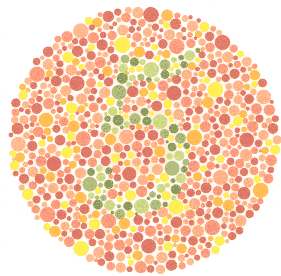
Or better yet, whatever they say, you just tell them they are wrong un's.
Or better yet, whatever they say, you just tell them they are wrong un's.
Upvote
-11
(0
/
-11)
The downvotes continue, at least the false/biased (all measurable dimensions to all of human vision are equal) this screen is universally the 'greatest' screen 'counter arguments' have stopped being posted.
Upvote
-10
(1
/
-11)
Go on, DownVote again, those with not even the humility to admit or address their own obvious bias.
Yes the differing ranking/value of black levels, contrast, brightness, resolution and colour accuracy to an individual user.
An individual actually being able to see something well, it's like asking for scales that read 10kilo's less. Despite just the known huge variation in our biological visual receptors, people who find something you don't find important, important, are just deceiving themselves. I think we can all agree that position is not objective reality!
Yes the differing ranking/value of black levels, contrast, brightness, resolution and colour accuracy to an individual user.
An individual actually being able to see something well, it's like asking for scales that read 10kilo's less. Despite just the known huge variation in our biological visual receptors, people who find something you don't find important, important, are just deceiving themselves. I think we can all agree
that position is not objective reality!
Upvote
-9
(1
/
-10)
D
Deleted member 1
Guest
I hear you but who, these days, does not use a case? Almost a crazy idea when you’re paying £700+ for your phone.
I have never put my phones in cases. I have also never broken a phone, despite over-zealous nephews knocking my 4S out of my hands onto concrete.
Sure, 700 pounds is heavy, but you know what's more important than that? One's head. Yet, do most people wear helmets everywhere?
I’ve never used a case or dropped my phone (the trick is to remember how much the device costs everytime you reach for it). That is UNTIL I forked out £1200 on the XS Max. Fantastic phone but terrifying to use!
Upvote
5
(5
/
0)
Low Resolution Fox
Smack-Fu Master, in training
Huawei phones more than enough for most people.
£250 for the P20 lite phone, it even has the face ID feature from the iPhone.
£250 for the P20 lite phone, it even has the face ID feature from the iPhone.
Upvote
-7
(0
/
-7)
Wrong.I have to wonder when personal computers came out every year was a new, faster model with more features that was cheaper. Now we have basically a handheld personal computer that every year has a new, faster model with more features but is way more expensive than the previous year.
Can cell phones go to the early PC model where tech gets cheaper every year?
LMAO. Phones are the only tech since 1982 that I have known to go up as millions more are made. CD players? Down. Computers? Laptops? Digital cameras? Down. VHS? DVD? Down. Printers? Down. Massive LCD TVs? Down. iPhone? Originally $499. Up.
That original price was on top of an expensive 2-year contract, so adding that up and 11 years of inflation the XR as its mainstream iPhone successor is cheaper than the first iPhone!
Upvote
-2
(2
/
-4)
You've just completely lost the plot on your weird crusade here, hence the downvotes (at least mine).Oh OK, maybe the around 7% of males who might not read the number below (ON ANY SCREEN) think coverage of the Adobe RGB colour space is identically important to those that can, what do you think?
Or better yet, whatever they say, you just tell them they are wrong un's.
Upvote
3
(6
/
-3)
At the current prices and the current new features, I think I'll stick with the 6S. Hopefully, a cheaper phone does come out next year. With some sort of TouchID, I do recall that Apple won't go back to TouchID since "FaceID is so much better".
Which part of Apple's strategy do you not understand?
The cheaper phone is the iPhone 8. The much cheaper phone is the iPhone7, bought on refurb.
That's not going to change next year, except the cheaper phone becomes iPhone XR, and cheapest phone becomes the 8.
It's not clear at this point if that's how this is going to go anymore. While the iPhone 8 dropped down a level, the iPhone X disappeared and the iPhone XR sort of took it's place in the lineup. Are they going to have an iPhone XR 2 and the iPhone XR in the same lineup?
Over the last couple years they've really broken up their regular cadence.
Jesus, some people just refuse to understand.
They have NOT broken their cadence.
The old cadence was 6, 6S, 7, 8, XR with three of these available at any given time. This will continue.
What has changed is the addition of a new PREMIUM tier (call it iPhone Edition...) which took the form last year of iPhone X, and this year of iPhone XS and iPhone XS Max.
Note
(a) iPhone X and iPhone XS aren't for sale simultaneously because people who buy premium don't buy "kinda sorta" premium.
(b) If you can't afford the premium range, you don't buy it. Simple. Just like if you can't afford an aWatch Hermes, or business class airplane tickets, you don't buy them. They are nicer than the standard options (whether iPhone or airline tickets), but the standard options are just fine, and they are what MOST people buy.
(c) The X was something of an experiment in multiple ways. Obviously there was the technical experimentation (FaceID, OLED), but there was also price experimentation (again, like price experimentation with the aWatch Edition). The clear verdict was that there ARE enough people willing to pay for premium to justify continuing the program.
So this year the experiment is two sizes. I suspect this will be successful, and two sizes will continue.
Maybe next year there will be an experiment around a super-premium camera, and Apple will see whether people are willing to pay more (or simply accept more thickness) for an iPhone XC with extreme quality lenses and sensors?
(Apple is running something of the same experiment wrt Macs, though there is too much confusion there to really understand what they think. Even getting past the chaos of the MacBook/MacBook Air/MacBook Pro Esc craziness --- which I will in NO way defend, it's utter lunacy --- more interesting is the iMac Pro and now mac mini "Pro".
The iMac Pro is, IMHO, not ideally named --- it's less "Pro" than a premium iMac --- a nicer (and more expensive!) version of an old staple. Likewise the mac mini has been replaced by the mac mini "pro", again much nicer (and more expensive).
The mac versions of this floundering are ridiculous --- they should hire me as brand manager! But there is a kind of vague logic discernible in the background. And I hope that when the ARM transition comes, it will result in the pattern they SHOULD have:
- MacBook
- iMac
- mac mini
each in a "standard" and a "pro/premium" edition, with premium giving you faster IO, more cores, the option for more RAM, and whatever new goodness has been thought up for that year but is still too expensive for the mainstream. )
Upvote
-2
(1
/
-3)
/sYou've just completely lost the plot on your weird crusade here, hence the downvotes (at least mine).Oh OK, maybe the around 7% of males who might not read the number below (ON ANY SCREEN) think coverage of the Adobe RGB colour space is identically important to those that can, what do you think?
Or better yet, whatever they say, you just tell them they are wrong un's.
Cogent response to the individuality / requirements of human vision and the varying qualities of OLED LCD and other display technology, would read again.
Upvote
-8
(0
/
-8)
You've just completely lost the plot on your weird crusade here, hence the downvotes (at least mine).Oh OK, maybe the around 7% of males who might not read the number below (ON ANY SCREEN) think coverage of the Adobe RGB colour space is identically important to those that can, what do you think?
Or better yet, whatever they say, you just tell them they are wrong un's.
Yes suggesting personal preferences in consumer choice of screens as not automatically delusional when disagreeing with alternate opinions. Weird crusade, I know right?
Of course much more productive to just ad hom me on the point, that human vision clearly varies, as do the many dimensions we can measure in screen tech that the OP was cherry picking.
Upvote
-5
(1
/
-6)
At the current prices and the current new features, I think I'll stick with the 6S. Hopefully, a cheaper phone does come out next year. With some sort of TouchID, I do recall that Apple won't go back to TouchID since "FaceID is so much better".
Which part of Apple's strategy do you not understand?
The cheaper phone is the iPhone 8. The much cheaper phone is the iPhone7, bought on refurb.
That's not going to change next year, except the cheaper phone becomes iPhone XR, and cheapest phone becomes the 8.
It's not clear at this point if that's how this is going to go anymore. While the iPhone 8 dropped down a level, the iPhone X disappeared and the iPhone XR sort of took it's place in the lineup. Are they going to have an iPhone XR 2 and the iPhone XR in the same lineup?
Over the last couple years they've really broken up their regular cadence.
Jesus, some people just refuse to understand.
They have NOT broken their cadence.
The old cadence was 6, 6S, 7, 8, XR with three of these available at any given time. This will continue.
What has changed is the addition of a new PREMIUM tier (call it iPhone Edition...) which took the form last year of iPhone X, and this year of iPhone XS and iPhone XS Max.
The fact that they introduced a premium phone is itself breaking their cadence.
(a) iPhone X and iPhone XS aren't for sale simultaneously because people who buy premium don't buy "kinda sorta" premium.
(b) If you can't afford the premium range, you don't buy it. Simple. Just like if you can't afford an aWatch Hermes, or business class airplane tickets, you don't buy them. They are nicer than the standard options (whether iPhone or airline tickets), but the standard options are just fine, and they are what MOST people buy.
Nonsense. There are even people on this thread who would like the iPhone X at $100 less than the iPhone XS.
Apple doesn't want to continue selling the iPhone X because it would cannibalize sales of the iPhone XS and almost certainly has lower margins than the XS. The most expensive components on the X and the XS are the OLED display, the stainless enclosure, and the dual lens camera; all things which both the X and the XS share. They discontinued the iPhone 5 for exactly the same reason.
That's where the iPhone XR comes in. The lower cost case, the single lens camera, and most important the much less expensive display allows them to have a lower end SKU that preserves their margins.
As with many design/ product decisions at Apple, it boils down to margins.
Upvote
1
(1
/
0)
No, because that premium tier is an addition to, not a replacement for the regular base model.At the current prices and the current new features, I think I'll stick with the 6S. Hopefully, a cheaper phone does come out next year. With some sort of TouchID, I do recall that Apple won't go back to TouchID since "FaceID is so much better".
Which part of Apple's strategy do you not understand?
The cheaper phone is the iPhone 8. The much cheaper phone is the iPhone7, bought on refurb.
That's not going to change next year, except the cheaper phone becomes iPhone XR, and cheapest phone becomes the 8.
It's not clear at this point if that's how this is going to go anymore. While the iPhone 8 dropped down a level, the iPhone X disappeared and the iPhone XR sort of took it's place in the lineup. Are they going to have an iPhone XR 2 and the iPhone XR in the same lineup?
Over the last couple years they've really broken up their regular cadence.
Jesus, some people just refuse to understand.
They have NOT broken their cadence.
The old cadence was 6, 6S, 7, 8, XR with three of these available at any given time. This will continue.
What has changed is the addition of a new PREMIUM tier (call it iPhone Edition...) which took the form last year of iPhone X, and this year of iPhone XS and iPhone XS Max.
The fact that they introduced a premium phone is itself breaking their cadence.
And only for the base model it makes some sense to discount it to reach lower pricing tiers.
A discounted X would be pointless – the XR is already in the spot where that would go and the XR is better than the X at almost everything.
That contention makes no sense since they've stuck to the same enclosure for the 5S which has then been discounted the year after that.(a) iPhone X and iPhone XS aren't for sale simultaneously because people who buy premium don't buy "kinda sorta" premium.
(b) If you can't afford the premium range, you don't buy it. Simple. Just like if you can't afford an aWatch Hermes, or business class airplane tickets, you don't buy them. They are nicer than the standard options (whether iPhone or airline tickets), but the standard options are just fine, and they are what MOST people buy.
Nonsense. There are even people on this thread who would like the iPhone X at $100 less than the iPhone XS.
Apple doesn't want to continue selling the iPhone X because it would cannibalize sales of the iPhone XS and almost certainly has lower margins than the XS. The most expensive components on the X and the XS are the OLED display, the stainless enclosure, and the dual lens camera; all things which both the X and the XS share. They discontinued the iPhone 5 for exactly the same reason.
The 5C was just an experiment. They did it, they saw the response (decent, but not overwhelming) and they dropped it again.
Even the discounted models have decent margins, but not on the scale of the premium ones.That's where the iPhone XR comes in. The lower cost case, the single lens camera, and most important the much less expensive display allows them to have a lower end SKU that preserves their margins.
As with many design/ product decisions at Apple, it boils down to margins.
Upvote
3
(4
/
-1)
...
Yes suggesting personal preferences in consumer choice of screens as not automatically delusional when disagreeing with alternate opinions. Weird crusade, I know right?
Of course much more productive to just ad hom me on the point, that human vision clearly varies, as do the many dimensions we can measure in screen tech that the OP was cherry picking.
Are you kidding me right now?
This whole thing started with the_frakker saying that the XR screen is disappointing because it's low-resolution. My last umpteen posts were addressing the_frakker and this point about resolution specifically.
All of this b**lshit you're banging on about with black levels and refresh rates and cataracts and astigmatism is completely f**king irrelevant to the point of the resolution of the XR screen.
You are the definition of off-topic, and you're wondering why you're getting downvoted? Give me a break.
Upvote
-1
(3
/
-4)
Even the discounted models have decent margins, but not on the scale of the premium ones.As with many design/ product decisions at Apple, it boils down to margins.
In previous years margins have been relatively flat due to declining component prices (and likely depreciation on the CPU IP). That's not the case this year. Just the OLED screen itself is a much larger percentage of the total cost of the phone and it's cost is relatively flat Y/Y.
By dropping the iPhone X, they force people to choose between a few phones with good margins: The iPhone XR and the iPhone XS/ XS Max. If they'd kept the iPhone X, they might choose the middle phone with lower margins.
Upvote
1
(1
/
0)
What would be any point in that from Apple's perspective?Even the discounted models have decent margins, but not on the scale of the premium ones.As with many design/ product decisions at Apple, it boils down to margins.
In previous years margins have been relatively flat due to declining component prices (and likely depreciation on the CPU IP). That's not the case this year. Just the OLED screen itself is a much larger percentage of the total cost of the phone and it's cost is relatively flat Y/Y.
By dropping the iPhone X, they force people to choose between a few phones with good margins: The iPhone XR and the iPhone XS/ XS Max. If they'd kept the iPhone X, they might choose the middle phone with lower margins.
Discounted models are always and only below the basic model, so below the iPhone 8 last year and below the iPhone XR this year. And that's it.
There has never been a discounted Plus-Model either, for the exact same reason!
Upvote
1
(1
/
0)