Skip to content
Urban runaround

With the Heybike Ranger S, the S stands for scooter

A very fast and foldable e-bike with brake lights, directionals, and a horn.

John Timmer | 65
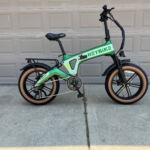
Image of a foldable bicycle with a low seat and tall handlebars.
Credit: John Timmer
Credit: John Timmer
Story text

The arrival of e-bikes has blurred the lines between bicycles, mopeds, and scooters. Depending on what country or state you’re in, some e-bikes can legally hit 45 km/hour (28 mph), yet they don’t require a license, registration, or insurance, unlike their competitors. Whether that’s a good or bad thing depends on whether the bike riders in your area ride like lunatics or not.

Regardless of how you feel about the state of things, it’s definitely true that most e-bikes are relatively bike-like compared to mopeds and scooters, lacking things like brake lights, directionals, and other components that make navigating in urban environments a bit safer. Most, but not all. Heybike offers a number of scooter-substitute e-bikes that come with a powered horn, brake lights, directionals, and a zippy motor. As a bonus, they’re foldable. We checked out its latest model, the $1,499 Ranger S.

A foldable heavyweight

Let’s address one thing right away: In our review of the Ranger S’s sibling (the Tyson), we ran into a number of mechanical problems that threatened to make the bike unusable. The only real issue we saw on the Ranger S was a rapidly fluctuating reading of battery capacity. Otherwise, the bike was solid.

Another minor problem we had was with a metal loop that Heybike includes to protect the rear derailleur from damage. Apparently, it served that role during shipping, as it was bent in such a way that it kept the derailleur from reaching the smallest two gear rings. This was pretty easy to spot, and also easy to bend back into its normal position, after which all seven gears were accessible.

Image of a latch on a bike frame.
The hinge in the center of the frame that allows the bike to fold. The release will only move if the silver metal slider embedded in it is pushed upward from beneath.
The hinge in the center of the frame that allows the bike to fold. The release will only move if the silver metal slider embedded in it is pushed upward from beneath. Credit: John Timmer

The bike’s folding mechanism worked without issue—the frame folds in half so that the front and rear wheels wind up next to each other, and the handlebars fold down to the side. When folded, a different metal loop keeps the front gear ring from resting on the ground.

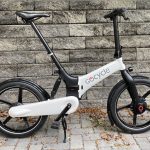
This is not, however, a “fold it and carry it up the stairs to your apartment” bike. The Ranger S weighs over 32 kg (72 lbs). That’s over 15 kg more than the Gocycle folding bike we reviewed earlier, and it’s enough to make moving it around a challenge. It also lacks any sort of mechanism for holding the bike in a folded position (I’d recommend investing in a bungee cord if you get one), meaning it has a tendency to flop back open as you’re shifting it, adding to the challenge.

This is not to say the folding is pointless. You can definitely store it in a smaller space than many other e-bikes. And it was a snap to lift it into the hatchback I drive, allowing me to take the car in for service without needing to find a place to sit for a few hours. But it doesn’t open up the full range of use cases that an easier-to-manage folding bike would.

Image of a bicycle folded in half.
When fully folded, the Ranger S is fairly compact but awkwardly heavy.
When fully folded, the Ranger S is fairly compact but awkwardly heavy. Credit: John Timmer

The upside of the robust construction is that the Ranger S can haul a lot of stuff. The total capacity is listed as 180 kg (400 lbs) between rider and cargo. Heybike offers panniers for the rear rack, with 30 liters of capacity, and you can place up to 13 kg (28 lbs.) in an optional front basket. This isn’t a cargo bike, but it can definitely haul some groceries home, even if you’re a heavy rider.

The drivetrain

The Ranger S is a Class 3 e-bike, meaning it has a maximum speed of 45 km/hour (28 mph). That comes thanks to a 750-watt motor that can hit a peak output of 1,200 W. Heybike rates its 14.4 Ah battery as providing enough juice to provide pedal assist for up to about 90 km (55 miles), but that is presumably at its lowest assist setting. It’s clear that running it on its maximum assist setting burned through the battery far more quickly than that, although the rapidly fluctuating battery meter on the display made it difficult to tell just how much more quickly—or how much further I could go before the battery went flat. Range anxiety joined me for many of my rides.

The motor is tied to a cadence sensor, which registers when you’re turning the pedals and kicks in the assist if you are. Since you have to pedal an otherwise very heavy bike for a bit before the sensor triggers the motor, there’s also a throttle that will take you up to 32 km/hour (20 mph) before cutting out.

Image of the rear wheel of a bicycle.
A bunch of the Ranger S’s features: the motor, hydraulic disk brakes, and small but thick tires.
A bunch of the Ranger S’s features: the motor, hydraulic disk brakes, and small but thick tires. Credit: John Timmer

The non-electric portion of the e-bike is a standard single-gear ring crank coupled to seven gears on the rear hub, controlled by a Shimano indexed shifter. Once the derailleur protector was bent back into its original shape, all of this worked properly. On the low side, the gearing was set up so that it was relatively easy to keep the bike moving even with the motor shut off. The high gears, however, came up a bit short, as there was no way to pedal fast enough to exert force when the assist was maxed out.

As a result, most of the time spent with the assist maxed out involves gently spinning the cranks to signal to the cadence sensor that it needs to keep the motor active. The downside is that, should you stop pedaling briefly, the speed will usually drop considerably before you can pedal enough to get the motor moving again.

Overall, I was left with the impression that there were two ways to ride the Ranger S. One is as a standard e-bike, where the middle levels of assist worked in concert with your pedaling to keep the bike moving at moderate speeds. The second option was to max out the assist and treat it as a scooter, with the pedals being used to keep the motor on.

For tall riders like me, the bike more or less forced the latter option. The seat simply can’t be raised far enough to let me extend my legs much while pedaling, so I struggled to generate much power. The ride itself was fine; the wheels have a small radius but are pretty fat, and there’s a front suspension, so bumps weren’t a problem. But I couldn’t shake the feeling that I looked like I had stolen a young kid’s bike.

The fun stuff

If the Ranger S had the tendency to ride more like a scooter, Heybike is doing nothing to spoil the impression, outfitting it with lots of hardware that is normally found on strictly motorized vehicles. Rather than a thumb-powered bell, the bike has an electric horn that you press a button to trigger. Front and rear lights are on a dedicated switch instead of requiring you to remember which control doubles as the light switch when you press and hold it. The rear light includes brake lights, presumably triggered by the same signal that causes the motor to cut out whenever you pull the brakes. (All of these are present on the Tyson model we tested, so it seems to be Heybike’s signature.)

Image of a bike's handlebars with a large display screen at right, and a series of switches and controls at left.
Heybike’s electronics need a lot more switches because of the bike’s capabilities.
Image of a headlight perched on top of a wheel, with orange lights on either side of it.
The front headlight has directional indicators as well.

Both the front and rear lights also contain directional signals. These are controlled by a small three-way switch right near the controls for the lights and horn. While I think the concept is great, I struggled to remember I had them most of the time (I’m sure I’d get better if I rode this exclusively for a while). And the three-way switch provides no indication of what position it’s in, nor are there any reminders that your directionals are on. Since I forgot to turn them off nearly as often as I forgot to turn them on, I probably covered a lot of miles while indicating I was going to turn left any minute now.

All of these features are nice things to have if you’re rolling around crowded, urban environments. More than that, I was happy to see a company doing some interesting things with the e portion of an e-bike. There are many compelling things that you could do that wouldn’t create any significant drain on the batteries most bikes come equipped with. It’s been disappointing to see how few companies were taking advantage of that. Full credit to Heybike for being an exception.

As for the bike itself, it’s not great. The heavy weight, limited seat height, and narrow gearing range mean that it isn’t a lot of fun to pedal, even when helped by moderate levels of assist. But if local laws allow Class 3 bikes, it’s a great scooter alternative, with lots of zip and good cargo capacity combined with some nice safety features for sharing crowded streets. Heybike just needs to get its battery monitoring sorted out so people can actually understand how long the zip will last.

At its standard price of $1,499, it’s a bit on the pricey side for what you get, but holiday sales have cut that to $1,299, which is more in line with competitor’s offerings. Whether it makes sense for you depends a lot on whether its two main features—Class 3 top speeds and foldability—are important to you. Beyond that, I’d say that its fun electronic features more or less balance out its quirks. Ideally, the company will sell enough to stick around for a few years because it seems to have some good ideas that would really benefit from iteration and refinement.

Listing image: John Timmer

Photo of John Timmer
John Timmer Senior Science Editor
John is Ars Technica's science editor. He has a Bachelor of Arts in Biochemistry from Columbia University, and a Ph.D. in Molecular and Cell Biology from the University of California, Berkeley. When physically separated from his keyboard, he tends to seek out a bicycle, or a scenic location for communing with his hiking boots.
65 Comments