Skip to content
Velotric T1 e-bike review

Velotric T1 e-bike review: Slick, barely-an-ebike look hides some real power

A winning combination of a hidden battery, smooth ride, and slick look.

Kevin Purdy | 176
Velotric T1 e-bike against gray background
Credit: Velotric
Credit: Velotric
Story text

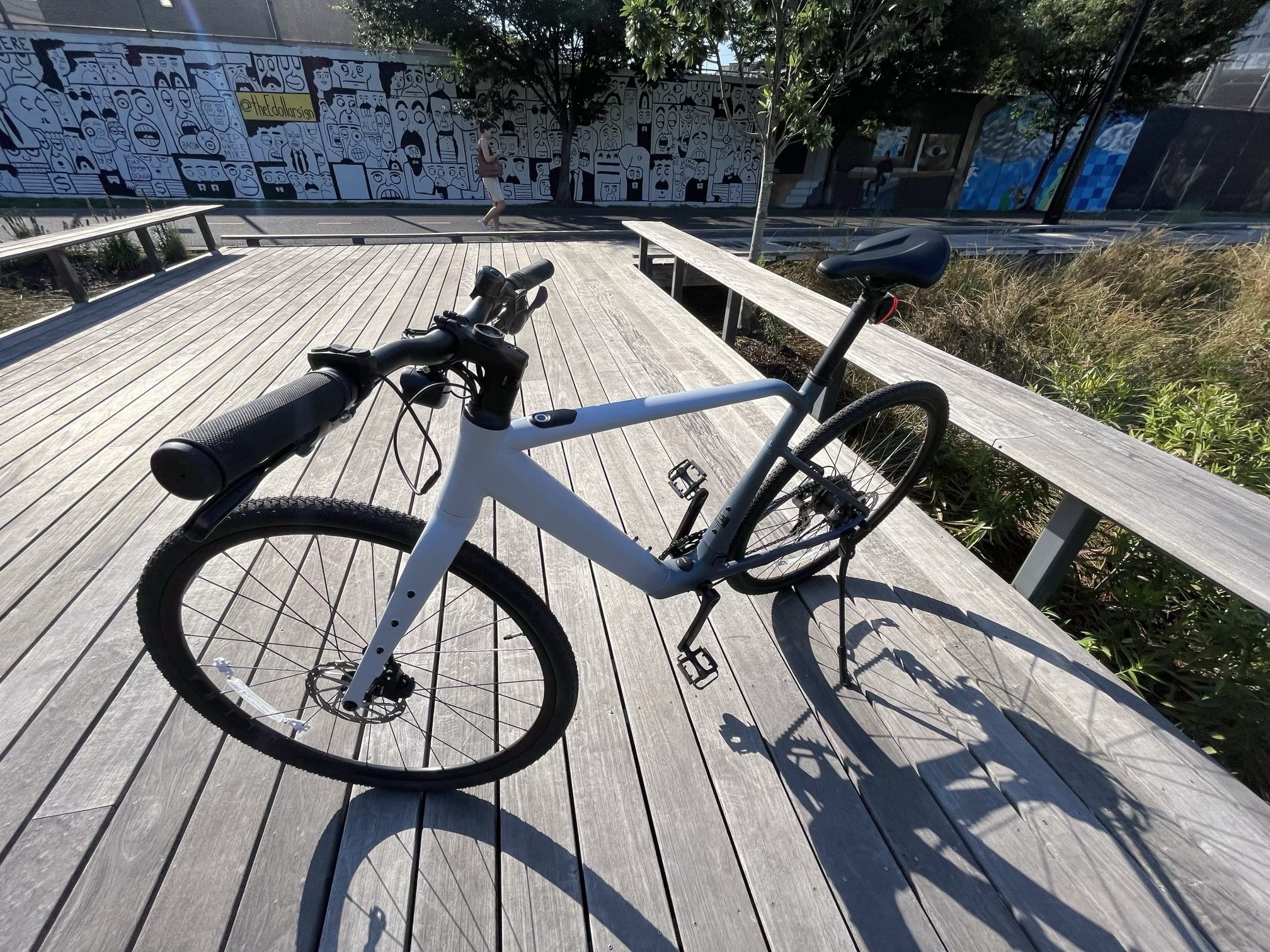
I can’t get over how good the T1 looks. It’s a beautiful bike, especially in the two-tone frosted blue color of my test ride. It’s so smoothly contoured, devoid of wires and generally eye-catching that, for once, I’m more afraid of it getting stolen for its looks than for the powerful motor and battery that are well-hidden inside it. So it’s a good thing the Thunder 1 comes with a number of anti-theft features installed.

Over weeks of testing, the $1,800 T1 (initially the “Thunder 1” at launch, since renamed by Velotric) has been a fun ride. The bike has a responsive torque-sensing motor and a wide range of power options paired with actual gears. The app is about as reliable as any other Bluetooth-based single-device app (i.e., not wholly), but it provides useful data, configuration, and anti-theft options. Most of the cables, settings, and other obvious parts of an e-bike can’t be seen. You just ride and notch the assist up or down when you want.

You can’t entirely forget the T1 is an e-bike, as every time you look down while riding, you see a thumbprint sensor. But riding it around on a steady power level and shifting gears—with it looking for all the world like a standard flat-bar bike—you can get most of the benefits of electric assist with very few of its signifiers. It quietly flattens hills and shortens miles.

Velotric T1 inside its box.
How the Veltotric T1 is packed in its box. No scratches or dents were noticeable on my unit.
Velotric T1 taken out of box.
The T1, unpacked from its box.

The T1 as a box you receive

The T1 ships similarly to other e-bikes you can order online and have delivered to your door. Most people who have done some hex wrench projects should be able to get the bike in working order using Velotric’s instructions and the provided tools. My kit ended up one bolt short for the kickstand, so I had to fish out a hex-head bolt that fit. Other than that, I had no real problems. Getting the bike tuned up and ready to ride, however, requires either some familiarity with bike repair or a brief stop at your local bike shop.
After finishing my initial T1 assembly, my fork was a bit too tight, the handlebar was off-center from the wheel, the gears needed indexing, and the front disc brake was lightly but audibly rubbing. I was able to fix all these things with a bit of monkeying, but if you’re not familiar with those jobs (or don’t want to learn them on YouTube), you’ll need some help.

This is a common issue with boxed bikes that ship directly. I stopped into my local bike shop to get the mechanics’ opinions. They told me that every e-bike they sell from the store—and many of those customers thought they could assemble themselves—requires a half-dozen tweaks after unboxing. (They also lamented, unprompted, the custom headsets on many e-bikes that prevent any real resizing option for someone who’s just a bit too tall).

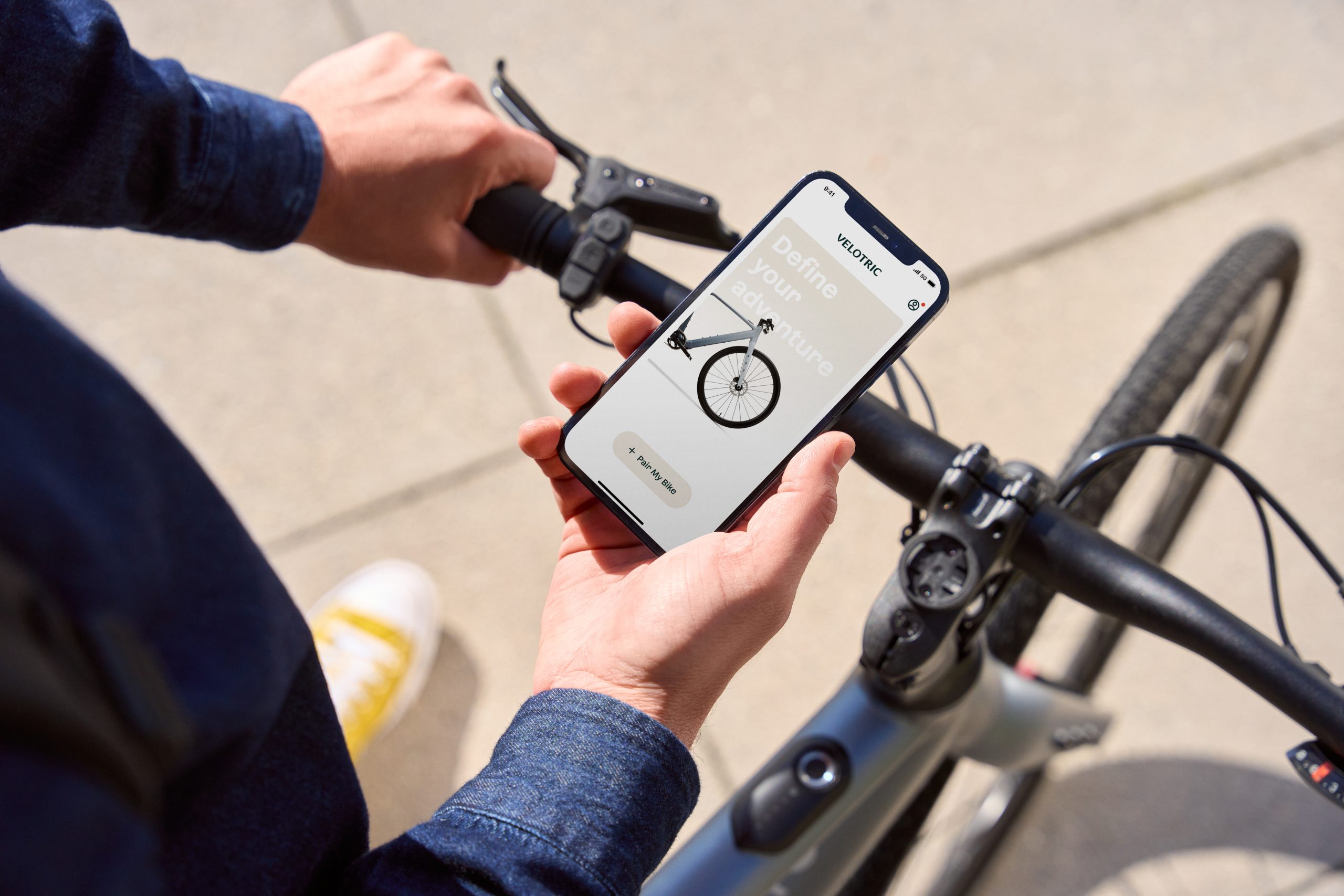
Person holding Velotric app over the T1 bike
Velotric’s app is relatively smooth and easy to grasp, compared to some other e-bikes we’ve tested. Credit: Velotric

The Velotric app and anti-theft features

After putting the T1 together, I tried to pair it with Velotric’s iOS app. I was immediately informed that the bike and its battery needed firmware updates. These happen through a Bluetooth connection with your phone. Updates have been hit or miss in the three months I’ve had the T1. Sometimes the app says an update failed to go through, only for the app to report the firmware is up to date the next time I check.

You’ll need Velotric’s app to set up the bike, but after configuring a few things, you can mostly leave it alone if you like. Your phone’s Bluetooth connection can automatically lock and unlock the bike’s battery assist and theft alert. It changes the bike’s “mode” between battery-efficient “City,” torque-minded “Adventure,” and “MAX,” which is what it says. Most importantly, the app lets you enroll fingerprints on the bike’s top tube sensor, which lets you use the bike without having to even have your phone nearby.

I had about 60 percent success with my thumb after first setting up the T1. Then, using a trick I’ve picked up from a few hesitant fingerprint readers over the years, I enrolled my thumb again as if it was a different finger. I did the same one-finger-twice setup with my index finger. It’s still imperfect, but I usually get it on the second try.

The T1 has a built-in GPS tracker accessible from the app, and the bike seems to regularly check in and register its location every few hours. That works so long as there’s a decent view of the sky. The T1’s lower-slung, lower-height, slightly thriftier cousin, the T1ST, works with Apple’s Find My to provide latent nearby device tracking. It’s too bad the T1 doesn’t integrate both, though you’re only $30 away from fixing that.

The Velotric app offers plenty of ways to configure locks and unlock the bike. You can set it up to lock one minute after you walk away and unlock as soon as you walk up with your phone and nudge it, and you can lock and unlock it using your fingerprint or the app’s buttons. “Lock” and “unlock,” however, aren’t mechanical. A locked bike can still be moved, pedaled, and wheeled; it just won’t offer any assist, and it will alert and update the owner with its location. At a minimum, registering the T1 with the Velotric app prevents anybody else from doing the same until you release it.

You’ll still want a serious lock for this bike and to follow all common sense about where and how long you lock it. The T1 isn’t the most obvious e-bike around, but as noted earlier, it looks appealing and slick. At least if the worst happens, you’ve got a fighting chance to find it.

Rear hub and motor on Velotric T1
The rear hub motor, with its 350 W average power, peak power of 600 W, and 45 Nm of torque.
Smart core of Velotric T1
Inside this bottom bracket is a two-sided torque sensor, and nearby is the plug, which turns out to be a real dirt magnet.

The T1 as a bike you ride

I’m a little too tall for the T1, even in the “Large” size, but at least Velotric knows that. The last e-bike I reviewed, the Vanpowers City Vanture, claimed to cover a vast-for-a-bike range from 5 feet, 8 inches to 6-foot-3, and it absolutely did not fit my 6-foot-2 frame. Velotric’s geometry stats for the T1 suggest a 6-foot maximum and ideally someone who has more leg height than torso reach. I am the opposite, so I had to do a good deal of tinkering with seat height to reach a compromise between hand and knee pressure. If you’re on the edges of the T1’s range (or any direct-ship e-bike, for that matter), see if you can check out a test model or do some serious self-measurement before committing.

After building the bike, tuning it up, and adjusting it as best I could, I got to actually ride it. It’s a treat.

It’s hard to oversell the upgrade from a cadence sensor (power kicks in when pedals are moving) to a torque sensor (power when you press the pedal). It makes the most difference when you have to stop, whether at intersections or trail points. When you use an e-bike with gears in an assist mode, you’re often cruising while set on a gear far higher (tougher) than you’d use if it were just your two legs. Having to stop means either planning ahead by shifting down as you roll to a stop or having to stand on your pedals when you start again. A cadence sensor can’t do much to help with this. A torque sensor feels your struggle, quite literally, and can help you push through that first stroke to get moving again.

When you’re moving, the Velomotor E35+ drivetrain’s push feels fluid, with far less jumpiness than I would expect from a hub-based wheel motor. In the lowest-power City Mode, you’ll feel the motor drop off when you’re approaching the 20 mph speed limit. The dropoff isn’t sudden, however, unless you’re pushing hard at the top assist levels. You’re not as likely to feel it in your hands as you would with a front hub motor. In Adventure Mode, the motor seems to give you more boost at lower levels and helps with hill-climbing efforts.

In MAX Mode, the 350-watt, 36-volt motor will frequently come up against the speed limit, and you’ll feel it rev and fade as you pedal along after a huge boost. If you have long, mostly unoccupied, safe stretches in which you want to get the most out of your T1, you can unlock up to 25 mph. Holding a button for 20 seconds to unlock feels like Velotric asking you to count each odometer mark and really think about it. It’s not like you can’t reach 25 mph without the unlock if you have the right legs or hills. But I never re-locked the speed after unlocking it; I felt fine letting my brain and brakes decide the top speed.

Velotric T1, hanging out on a park ramp
Credit: Kevin Purdy

The base no-power ride is great

Given the three modes, five assist levels, and two different speed limits, the T1 offers 30 kinds of electric rides, plus the no-assist version. I’ll say a bit about the last one since it underpins all the others.

Even though I’m too tall for this bike, it felt secure underneath me, whether on hip-swinging climbs or rapid downhills. Between the hydraulic disc brakes and the mildly knobby 38c tires, stopping even at full MAX/5/unlocked speed didn’t rattle my nerves. The T1 is well-balanced, even with its battery hidden in the downtube. I don’t tend to lean into turns as much on heavier e-bikes, but I felt comfortable angling corners on the T1. It’s the closest an e-bike has come to the “extension of my body” feeling I used to get from a perfectly sized road bike.

The eight gears, at 11–32T, combined with a 40-tooth chainring, give you a gearing ratio range of 3.6 to 1.25, covering most city, trail, and other bike applications outside of races and mountains. After tuning them during the initial setup, I could click between gears with little effort. I rode the Velotric with the assist turned off for about five miles one night after realizing too late that my wife had unplugged its charger before the last two rides in favor of a vacuum cleaner (hard to get mad about that one). It rode like a simplified city bike, just with an automatic front headlight enabled. It’s not the main mode I’d ride in on the T1, but it’s more than viable if you need to really stretch your range, on purpose or by accident.

At 36 pounds, the T1 is on the lighter side of e-bikes, but it still isn’t the kind of bike you’ll want to hoist over your shoulder and lug around very often. I carried the T1 up and down my third-story apartment stairs a half-dozen times. The frame shape and the general lack of cables or accessories sticking out from the bike help a lot. At a minimum, you likely won’t mind having to hoist the T1 onto a curb, a bike rack, or up some office stairs.

Phone mounted on Velotric T1
Phone mounted on Velotric T1.
Fingerprint sensor on the Velotric T1
Fingerprint sensor and assist level indicator on the Velotric T1.

Battery, controls, and accessories

I believe Velotric’s claims of 70 miles for its battery, as long as you stick to the middle-of-the-road assist levels and non-MAX power levels. It’s not such a big battery (352.8 watt-hours) that I don’t want to immediately put it back on its charger after each ride. But it should be able to get you through a workweek’s worth of commuting, errands, or outings if you refuse to plug it in.

I wish Velotric had chosen a plusher material for the handlebars. Part of the issue was due to how much pressure I was putting on them with my hunched-over height, but I generally found them a bit rough on my hands and not padded enough for how hard potholes and small curbs feel with an aluminum frame.

There are only four real inputs on the T1: up and down buttons for adjusting the assist, a button for turning the front light on and off, and the thumbprint sensor. The up, down, and light buttons feel good, and the bike responds quickly (though I never turned off the uber-helpful automatic light). The fingerprint sensor, as noted, seems less gracious than the kind we’re used to from smartphones, but maybe that’s a good thing. Different-colored rings around the thumbprint circle indicate your assist level, and little LED notches show your battery level; if you rode this bike daily, you’d likely get used to them.

The rear light is included with the bike, but it’s separately activated and coin-battery-powered. I’m sure it would have meant extra cost and a tricky wire run to integrate that light into the system, but I would have preferred it.

Velotric has its own proprietary phone mount system, one that requires you to stick a coupling bit onto the back of your phone (or case). As something that comes free with the bike, it’s not bad, though I wouldn’t have felt particularly comfortable taking a newer phone on a bumpier ride. Phone cameras and their tiny focus and stabilization bits are susceptible to vibration damage over prolonged exposure. The T1’s mount seems good enough for a short ride, but I’d get something sturdier for long trips.

The charger that comes with the T1 is a fairly common brick, and the plug fits snugly into the bike. The kickstand, a newer variety that folds down from a chainstay instead of from underneath the cranks, works fine, as does the included bell.

A bike that might last beyond its maker

After VanMoof, one of the “most funded” e-bike startups, went bankrupt in July, journalists and customers started asking valid questions about what would happen to the bikes they made if the company disappeared and released all obligations.

The T1 doesn’t entirely rely on the Velotric app to function, but key elements of it do. Setting up your fingerprint on the bike’s scanner requires the app, as does changing the riding mode, enabling and disabling the automatic lock/unlock and alert features, viewing the bike’s location through the anti-theft GPS system, and, presumably, firmware updates. Some of this might be accessible if the user can retrieve and use an encryption key (similar to what VanMoof is asking of its customers at the moment).

I asked Velotric about the bike’s software durability should the company face a similar fate. To its credit, the company was willing to go all the way down that road with me.

Without Velotric servers (and if set up in the app), the bike would still have fingerprint unlocking, Bluetooth-range auto lock and unlock, automatic headlights, and, through the handlebar buttons, locking, assist level, and headline controls. What would go missing is fairly obvious: the GPS-based tracking, app alerts about the bike being moved, the riding mode controls, route data, and firmware updates.

“It’s important to note that Velotric occupies a very different segment in the market than other, more troubled players and has grown steadily since its inception,” said Ted Li, Velotric co-founder and head of marketing, in a statement. “It currently offers eight e-bike models, only one of them being app-integrated (T1). All our bikes are built to be long-lasting e-mobility solutions that are affordable and accessible.”

Besides having some functions tied to servers you don’t own, you have a decent chance at a long life with the T1 relative to other e-bikes. Velotric’s instructions for replacing the T1 battery are detailed, and they only require common tools and skills, give or take some fishing line cable guidance.

Hard to find real faults

Velotric T1

Beyond the issues that are tricky for any e-bike-maker to fully solve—rider dimensions, theft concerns, and the balance of app convenience against dependency—I couldn’t find much fault with the T1.

As a standard bike with eight gears, it’s a well-balanced ride, even before you factor in the motor. The assist kicks in quickly but applies itself smoothly, and the rider has a huge range of levels to dial in the kind of ride they want. The app is helpful, but you can ride the bike regularly without having to consider it much. Rear hub motors aren’t every e-bike enthusiast’s preference, but given the no-throttle, road-based nature of the ride, it does the job. Plus, you don’t get this kind of slick look with a big mid-drive motor.

If you need something a little smaller, a bit less costly, or just with a lower-slung, nearly-step-through frame, the T1 ST looks and specs out as a very similar bike. Velotric’s T line bikes look and ride like well-rounded products in a maturing market. The Thunder 1 is a real bike, made faster and easier to ride by technology, and that’s my best recommendation for it.

Listing image: Velotric

Ars Technica may earn compensation for sales from links on this post through affiliate programs.

Photo of Kevin Purdy
Kevin Purdy Senior Technology Reporter
Kevin is a senior technology reporter at Ars Technica, covering open-source software, PC gaming, home automation, repairability, e-bikes, and tech history. He has previously worked at Lifehacker, Wirecutter, iFixit, and Carbon Switch.
176 Comments