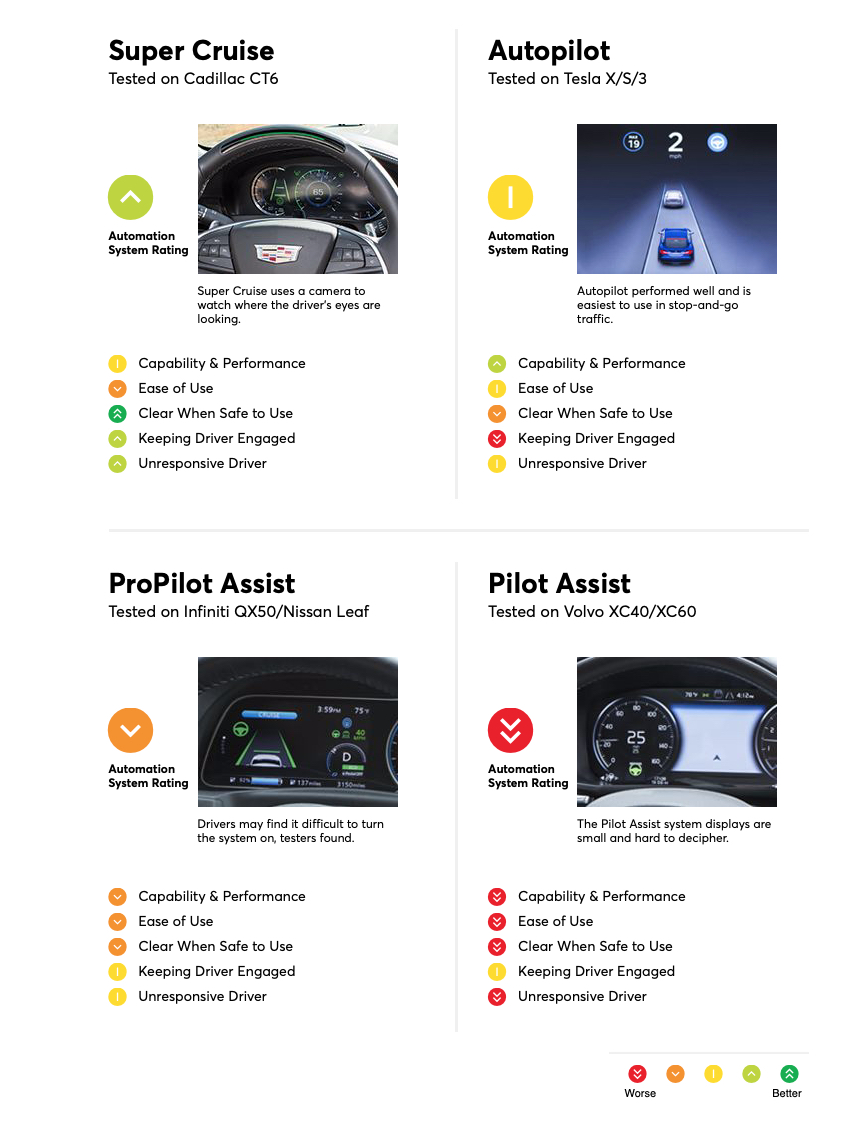
Back in February, I got very excited about the Cadillac CT6 sedan. It didn’t handle better than its competitors. It wasn’t faster or better put-together. But it did come with Super Cruise: a cutting-edge semi-autonomous driving assist that combines HD mapping and a proper driver monitoring system. Super Cruise is geofenced, so it only works on divided lane highways—and only when it knows you’re looking at the road ahead, thanks to that driver monitoring system. That made it the best such system on the market—yes, even better than Tesla’s Autopilot—and it seems Consumer Reports agrees. On Thursday it published its first-ever ranking of semi-automated driving systems, putting Super Cruise in at the top.
The proliferation of advanced driver assistance systems (ADAS) across the auto industry has been quite a thing to watch. Some features are there for driver convenience, like adaptive cruise control and lane keeping. Others—collision warning or emergency braking for example—are more consciously safety features. But the rollout can also be a bit bewildering, particularly when it comes to relative performance. The problem is that comparative testing is easier said than done, at least without the right resources.
The Insurance Institute for Highway Safety is one of the few groups to have been doing this with some rigor. Now Consumer Reports joins the fray. Like IIHS, its first results are from a rather limited sample—in this case, it tested Super Cruise in a Cadillac CT6; Autopilot in Tesla Models S, X, and 3; ProPilot Assist in an Infiniti QX50 and Nissan Leaf; and Pilot Assist in a Volvo XC40 and XC60. (With regard to software versions, Consumer Reports says it evaluated the systems as they were operating in September 2018.)
“We have been evaluating these systems on a case-by-case basis for a few years, but we are at a tipping point where they are now going mainstream,” says Jake Fisher, director of Auto Testing at Consumer Reports. “Stacked up against each other, you can really see significant differences. The best systems balance capability with safeguards—making driving easier and less stressful in the right situations. Without proper safeguards, over-reliance on the system is too easy, which puts drivers at risk.”

 Loading comments...