Skip to content
shooting brake

The GTC4Lusso T is a Ferrari you really could drive every day

This $256,000 wagon has style, pace, and cargo space—who needs an SUV?

Jonathan M. Gitlin | 135
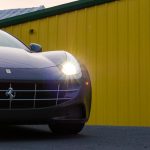
Blue Ferrari GTC4Lusso T
The $256,000 Ferrari GTC4Lusso T is the company's cheaper, more efficient four-seater. Credit: Jonathan Gitlin
Story text
Blue Ferrari GTC4Lusso T
The styling is an evolution of the FF, which we tested in 2015.
Blue Ferrari GTC4Lusso T
Yes, that’s a hatch. Yes, this is a practical Ferrari.

Spending a few days with a Ferrari is a treat, even if you get to drive as diverse an array of vehicles as we do here at Ars. As a small manufacturer with perhaps the best brand recognition in the auto industry, Ferrari doesn’t really need to lend journalists its cars to sell them. And with a small press fleet and a big country to cover, the opportunity to drive one therefore remains rare. So it’s perhaps not surprising that having recently scheduled such a loan, it’s something I still look forward to immensely. That was certainly the case for this car, the $256,000 Ferrari GTC4Lusso T.

The new vehicle is the replacement for the Ferrari FF, and the prospect of four days with a Lusso T offered a chance to see how the legendary Italian automaker evolves and iterates its ideas. Ferrari’s goal with the Lusso T was to build on the success of the FF, which sold well by the standards of four-seat Ferraris. The car maker wanted to create something that was both “sporty and versatile, as well as perfect for driving on a daily basis.”

After spending some time with it, calling the Lusso T a replacement for the FF doesn’t feel entirely accurate. The FF was powered by a naturally aspirated V12 and not one but two transmissions (a seven-speed dual-clutch gearbox for the rear wheels and a two-speed box for the front wheels that disengaged above 150mph). If you still want 680 prancing horses and all-wheel drive, Ferrari will accommodate you with the slightly shorter-named but $40,000 more expensive GTC4Lusso.

Blue Ferrari GTC4Lusso T
Credit: Elle Cayabyab Gitlin

The Lusso T ditches that heavy, thirsty V12 engine in favor of a 3.9L twin-turbo V8. If that sounds familiar, it should—one variant of the same engine is found in the California T, another sits behind you in the 488 GTB. In the Lusso T, it’s tuned to develop 602hp (449kW) at 7,500rpm and 561ft-lbs (760Nm) between 3,000-5,250rpm. And this car is unashamedly rear-wheel drive; that front transmission is gone. So if you open the hood to admire the engine’s distinctive red crackle-finished cam covers, you can’t help but notice how much empty space there is in the engine bay, with virtually nothing ahead of the front axle. (The weight savings from ditching four cylinders and several extra gears is less than you’d imagine, though; the Lusso T is just 110lbs/50kg lighter than the V12 version.)

Improvements over the old car were immediately apparent, even before putting the Lusso T into gear. The dashboard has been redesigned with some neat swiveling air vents and repositioned controls for the driver on either side of the main instrument display. There’s a new, much better infotainment system with a 10.25-inch capacitive touchscreen, and the (optional) digital display for the front passenger is now much higher resolution and in full color. And Ferrari has ditched the rubbery finish that used to adorn the panel of climate controls; the old finish would wear off, leaving a grubby looking mess in short order.

The multifunction steering wheel is also new. It loses the strip of LED  lights embedded in the rim that told you when to shift, and it now has scroll wheels in place of rocker switches to control the two multifunction displays on either side of the tachometer and the windshield wipers. The buttons to select neutral, reverse, or activate launch control have been moved to one side of the center console. One change that hasn’t been for the better involves the cupholders; installing anything taller than a medium coffee scared me enough to have the front seat passenger on overwatch to prevent a spill, and you’d be hard pressed to get two large sodas in there should you take the Lusso T to the drive-thru (which, of course, we did).

Ferrari GTC4Lusso T interior
The interior has some nicely evolved details from the FF. And no, I don’t know what that red string in the passenger footwell is.
Ferrari GTC4Lusso T interior
The infotainment system is still not as good as those from Volvo or Audi, but it’s not bad.

But these are detail changes; the theme is still the same as the FF: four seats, acres of thick leather trim, and a vast panoramic roof. That roof is partly what makes the rear seats of the Lusso T so welcoming. The other big comfort factor is that you sit a little higher up than in the front, so you have a view of more than just the back of the seat in front of you.

As comfortable and unclaustrophobic as those back seats are, they are not the best seat in the house. Nor is the front passenger’s, even with that new information display that lets you know by just how large a margin the driver is breaking their promise not to exceed the speed limit. (Seriously, I cannot think of an option I’d want less than this one.) No, the place to be is behind the multifunction steering wheel.

For such a big car—16.1 feet (4.9m) long, 6.5 feet (2.0m) wide, and at least 4,100lbs (1,865kg)—the Lusso T is remarkably agile. As is common to Ferraris of this era, the steering is extremely quick. The car comes with a full complement of Ferrari’s advanced driver aids, called Side Slip Control 3.0. The dampers are active ones from Magneride, and there’s also four-wheel steering for added agility at low speed and better directional stability at higher ones. Performance is suitably rapid; 0-62mph (0-100km/h) takes 3.5 seconds, and 0-125mph (0-200km/h) happens in 10.8 seconds. Find a straight enough stretch of derestricted Autobahn (or a convenient dry lake bed) and flat-out, the Lusso T should exceed 205mph (330km/h).

But—and this is actually important—you don’t have to go anywhere near those kinds of velocities to enjoy the driving experience. As with the 488 GTB we tested last year, this car is actually engaging to drive even when you’re not in danger of breaking the speed limit. The grip is ample, but direction changes are effortless—just a twitch of the wrists away. The flip side of that is that the car moves around a lot more than you might expect at first, wiggling its hips under hard acceleration and giving the suggestion that your contact patches are smaller than the area of the actual (245/35 front, 295/35 rear) 20-inch tires.

Unfortunately for us, the electronic wizardry that makes all this possible also proved to be the Lusso T’s undoing during our time with it. At 5mph, dodging tourists in Georgetown, the car’s warning lights lit up like a Christmas tree, followed by alerts that just about every onboard electronic system had shut down. The car went into limp mode for the two-mile journey home, where it stayed until being collected the following day. The problem was traced to a rear-wheel speed sensor problem.

Ferrari warning lights
Traction control? I’m sure I read on the Internets that macho men don’t need this.
Ferrari warning lights
Stability control? Again, the Internet tells me this is just for wimps. (Actually, even Ferrari’s test drivers find the current cars are faster around its test track with the electronic systems set to Race rather than disabled.)

The Lusso T is a difficult car to pigeonhole. It’s the most practical car that Ferrari makes. Four adults can sit for several hours in happy comfort as the continent outside speeds past. If you fold the rear seats flat, there’s even enough room to do a Costco run or fit a couple of mountain bikes. And compared to the car it replaced, it can be almost 40-percent more efficient. While most potential buyers won’t care about the cheaper running costs that results in, they will surely appreciate the additional range between fuel stops. If you had to pick a Ferrari to be your single go-anywhere, do-anything vehicle, it would be this one.

At the same time, it’s still definitely a Ferrari, with all that goes attendant: extreme performance, scalpel-sharp style, an eye-watering price tag. (With options, our test car would cost $337,830.) No one buys a Lusso T as their only car—most have at least four or five other vehicles, including something like a Mercedes-Benz S-Class for carrying four people long distances in comfort. And realistically, the only people filling up a Lusso T with three dozen paper towels and several kilos of laundry detergent at the cash and carry are journalists proving it’s possible. But owners are using their cars a lot more when compared to four-seat Ferraris of the past, and what’s practical for carrying bulk household goods is also practical for a week-long driving holiday.

Whether the Lusso T will see a further evolution in a few years is uncertain. For years, the company rejected the idea that it would build an SUV—when asked about it CEO Sergio Marchionne famously once replied “you’d have to shoot me.” But it’s hard to avoid the changing tide of consumer preference, particularly when rival Lamborghini has its Urus.

A Ferrari utility vehicle is therefore in the works to appear in 2020 if not sooner. Expect something that very much prioritizes on-road performance, and it’ll almost certainly be a hybrid (fleet-wide CO2 targets with hefty penalties are coming to Europe). We believe the FUV will be offered alongside the Lusso and Lusso T initially, but, faced with the choice of a shooting-brake/two-door wagon and a four-door crossover, it’s reasonable to expect the market these days will opt for the car on stilts. If that does doom the low-slung four-seat Ferrari, that will be a sad day indeed.

Photo of Jonathan M. Gitlin
Jonathan M. Gitlin Automotive Editor
Jonathan is the Automotive Editor at Ars Technica. He has a BSc and PhD in Pharmacology. In 2014 he decided to indulge his lifelong passion for the car by leaving the National Human Genome Research Institute and launching Ars Technica's automotive coverage. He lives in Washington, DC.
135 Comments