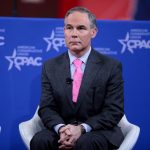
Scott Pruitt, Administrator for the Environmental Protection Agency (EPA), announced today that he had made a “final determination” to revise current vehicle emissions standards for model year 2022-2025 vehicles. Pruitt did not specify any new standards at this time; instead, he stated that he would start a joint rulemaking process with the National Highway Traffic Safety Administration (NHTSA), which manages a parallel set of rules called the Corporate Average Fuel Economy (or CAFE) standards.
The current emissions standards were approved by the Obama-era EPA in December 2016, two years ahead of time and just before the Trump administration took office. The standards had been years in the making, requiring research and discussions between policymakers and auto industry representatives. But at the change of leadership, the auto industry seized on an opportunity to roll back regulations that would cost it money. The industry also appealed to Trump to limit greenhouse gas (GHG) emission standards. Pruitt opened a public-comment period on revising the emissions standards last summer.
The stricter rules would have been beneficial from a climate change perspective. According to the Energy Information Agency, keeping the EPA’s fuel economy rules in place would have resulted in 1.2 million fewer barrels of gasoline consumed per day in 2025 than in 2017. Without knowing how Pruitt will revise the emissions standards, it’s unclear how his plan will compare to the previous one, but it will likely result in fewer barrels of gasoline saved per day.
There’s also the issue of cost: Obama’s EPA determined that car buyers would save money over the life of their cars because they would need to purchase less fuel to operate the cars. Trump’s EPA says that the regulations would make it more expensive for automakers to build emissions-compliant cars and that the price would get passed on to consumers. Rescinding the regulations, the administration figured, would keep the initial cost of a car down.
Still, according to the the International Council on Clean Transportation (ICCT), the cost of implementing the emissions has been overstated, in some cases by as much as 40 percent, given how quickly the costs of efficient engines, transmissions, accessories, and tires have come down.

 Loading comments...