Modern supercars and hypercars are blazingly fast. Ironically, the sensation of speed they generate is often dampened by the fact that you often can’t see a thing from the driver’s seat.
Blame a combo of safety priorities and style. Over the last decade, crash and rollover regulations have dictated more robust cabin structures characterized by ever thicker, vision-blocking A-pillars. The regulations coincided with an in-vogue design language that gave us “turret-style” cabins from which to peer out.
With the new NSX, then, it’s refreshing to see Honda put an emphasis on visibility in the design of its halo car rather than cobbling together a few sensors and a backup camera in the name of “safety.” It’s also not surprising. Cast your mind back to the 1980s/’90s heyday of Honda/Acura and you’ll recall the pride Honda took in its airy cabins with low beltlines and superior visibility. The first generation NSX was lauded for its performance, dependability, and functionality, including cockpit visibility.
“The original NSX was known for having great visibility. Because of this, optimum visibility was a key structural target when developing the all new-next generation Acura NSX,” said the Honda R&D team in Raymond, Ohio. “Therefore the goal became to reduce the field of visibility that is blocked by the pillar, what we call the obstructed view.”
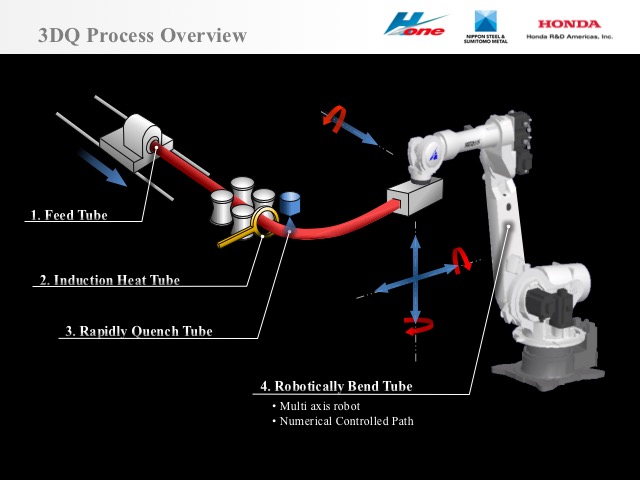
To achieve that goal, Honda designed the NSX’s A-pillar and the roof side rails as one contiguous piece—strong but thin. It could do so thanks to a process called Three-Dimensional Hot Bending and Quench Processing (3DQ), developed by Japan’s Sumitomo Metals Group.
Automobile components with hollow steel tubular structures have until recently been able to achieve a maximum high-tensile strength of 980 Megapascal (MPa). As a result, pieces like A-pillars have had to be enlarged to distribute the structural loads imparted in a crash or rollover. Prior to the NSX, the highest strength steel tubing that Honda had applied to one of its vehicles was hydro-formed 980MPa tube in the Japan-market Odyssey minivan.
Using 3DQ, the same components can achieve tensile strength as high as 1470MPa. The technique allows for components with complex shapes to be manufactured in one process. 3DQ is essentially a consecutive forming method; selected steel tube parts are heated and quenched with cooling water while a bending moment is simultaneously applied to the steel pipe with a movable roller-dice so that the pipe bends.
 Loading comments...