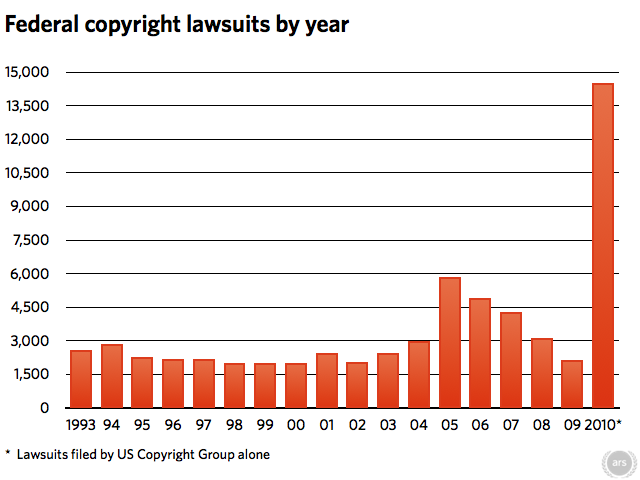
The big music labels and movie studios have stepped back from the lawsuit business. The MPAA’s abortive campaign against individual file-swappers ended years ago, while the RIAA’s more widely publicized (and criticized) years-long campaign against P2P swappers ended over a year ago.
So why have P2P lawsuits against individuals spiked dramatically in 2010? It’s all thanks to the US Copyright Group, a set of lawyers who have turned P2P prosecution into revenue generation in order to “SAVE CINEMA.” The model couldn’t be simpler: find an indie filmmaker; convince the production company to let you sue individual “John Does” for no charge; send out subpoenas to reveal each Doe’s identity; demand that each person pay $1,500 to $2,500 to make the lawsuit go away; set up a website to accept checks and credit cards; split the revenue with the filmmaker.
The lawsuits are brought in Washington, DC’s federal courthouse, and they all come from the same law firm: Leesburg, Virginia-based Dunlap, Grubb, & Weaver. In half a year, the group has proved surprisingly active and has managed the rare feat of making the RIAA campaign look slow-moving and small-scale.
No one seems quite sure how large this new pool of lawsuits has become, so we scoured the DC federal docket to find out just how many of these cases were brought already in 2010, and have collected them below for convenience. With a major new case filed only a week ago, it’s clear that this campaign is just ramping up.
As it does so, the cries of those who say they have been wrongly targeted will grow—but most people will probably just pay up.
January 2010
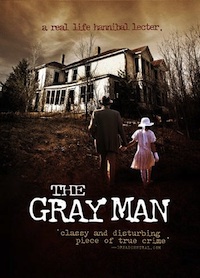
The Gray Man, 749 Does. Dunlap, Grubb, & Weaver went after its first set of targets in January, bringing suit on behalf of Worldwide Film Entertainment against 749 anonymous individuals. The Gray Man tells the story of an aging grandfather with a secret: “in actuality, he is a child murderer who tortures and cannibalizes his victims.” The film’s tagline reads, “A real-life Hannibal Lecter.”

 Loading comments...