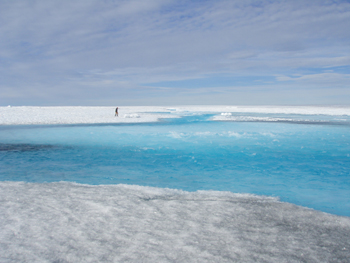
Melting on the Greenland ice cap. Sarah Das, Woods Hole
We tend to think of glacial as a synonym for slow, but summer on an ice sheet can be pretty dynamic. Lakes can form on ice sheets as melt water pools during warm summer days. These lakes decrease the albedo of the surface, leading to more melting. Once enough water collects, the pressure it creates can cause a fracture in the underlying (less dense) ice, allowing the lake to drain catastrophically.
These events take on added significance due to what happens to that water. If the lake drains to the bottom of the ice sheet, it can lubricate the bed of the ice sheet, and thus increase rates of movement. That movement can lead to an increased flux of water into the ocean, thus raising sea levels.
A report in today's Science describes how researchers recorded the drainage of one such lake in Greenland. The lake was roughly 5.6 km2, but drained completely in less than an hour and a half. The lake's contents rapidly made their way down to the bottom of the ice sheet, 980 m below the surface. During this period, the average drainage rate was 8700 m3/s. For reference, the average flow rate for Niagara Falls is only 5700 m3/s.
In the 16 hours prior to the catastrophic drainage, they noted a slow decrease in water level. They suggest that this corresponds to the slow initial fracturing of the ice. During this period, the lake was only filling the fracture it was creating. Once this fracture reached the base, the researchers believe that the water spread out in an existing subglacial network, which facilitated the rapid lake drainage.