Skip to content
Biz & IT

Technostalgia: Remembering our first computers

Ars editors remember the computers that began their digital lives.

Sean Gallagher | 288
Garbage in, garbage out really meant something when you had to store your code on punch cards.
Story text

Being a bunch of technology journalists who make our living on the Web, we at Ars all have a fairly intimate relationship with computers dating back to our childhood—even if for some of us, that childhood is a bit more distant than others. And our technological careers and interests are at least partially shaped by the devices we started with.

So when Cyborgology’s David Banks recently offered up an autobiography of himself based on the computing devices he grew up with, it started a conversation among us about our first computing experiences. And being the most (chronologically) senior of Ars’ senior editors, the lot fell to me to pull these recollections together—since, in theory, I have the longest view of the bunch.

Considering the first computer I used was a Digital Equipment Corp. PDP-10, that theory is probably correct.

The DEC PDP-10 and DECWriter II Terminal

The DEC LA36 DECWriter II was one of the most commercially successful terminals of its time—a time shared by wide ties and leisure suits. Credit: Digital Equipment Corp.

In 1979, I was a high school sophomore at Longwood High School in Middle Island, New York, just a short distance from the Department of Energy’s Brookhaven National Labs. And it was at Longwood that I got the first opportunity to learn how to code, thanks to a time-share connection we had to a DEC PDP-10 at the State University of New York at Stony Brook.

The computer lab at Longwood, which was run by the math department and overseen by my teacher Mr. Dennis Schultz, connected over a leased line to SUNY. It had, if I recall correctly, six LA36 DECWriter II terminals connected back to the mainframe—essentially dot-matrix printers with keyboards on them. Turn one on while the mainframe was down, and it would print over and over:

PDP-10 NOT AVAILABLE

Time at the terminals was a precious resource, so we were encouraged to write out all of our code by hand first on graph paper and then take a stack of cards over to the keypunch. This process did wonders for my handwriting. I spent an inordinate amount of time just writing BASIC and FORTRAN code in block letters on graph-paper notebooks.
One of my first fully original programs was an aerial combat program that used three-dimensional arrays to track the movement of the player’s and the programmed opponent’s airplanes as each maneuvered to get the other in its sights. Since the program output to pin-fed paper, that could be a tedious process.

Garbage in, garbage out really meant something when you had to store your code on punch cards.

At a certain point, Mr. Shultz, who had been more than tolerant of my enthusiasm, had to crack down—my code was using up more than half the school’s allotted system storage. I can’t imagine how much worse it would have been if we had video terminals.

Actually, I can imagine, because in my senior year I was introduced to the Apple II, video, and sound. The vastness of 360 kilobytes of storage and the ability to code at the keyboard were such a huge luxury after the spartan world of punch cards that I couldn’t contain myself. I soon coded a student parking pass database for my school—while also coding a Dungeons & Dragons character tracking system, complete with combat resolution and hit point tracking.

—Sean Gallagher

A printer terminal and an acoustic coupler

John Timmer remembers when dial-up modems were really dial-up.

I never saw the computer that gave me my first computing experience, and I have little idea what it actually was. In fact, if I ever knew where it was located, I’ve since forgotten. But I do distinctly recall the gateway to it: a locked door to the left of the teacher’s desk in my high school biology lab. Fortunately, the guardian—commonly known as Mr. Dobrow—was excited about introducing some of his students to computers, and he let a number of us spend our lunch hours experimenting with the system.

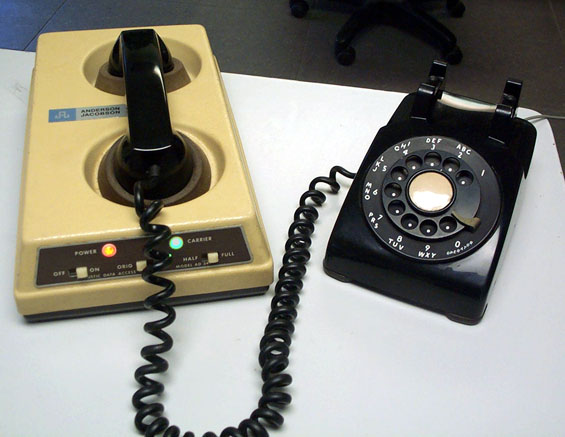
And what a system it was. Behind the physical door was another gateway, this one electronic. Since the computer was located in another town, you had to dial in by modem. The modems of the day were something different entirely from what you may recall from AOL’s dialup heyday. Rather than plugging straight in to your phone line, you dialed in manually—on a rotary phone, no less—then dropped the speaker and mic carefully into two rubber receptacles spaced to accept the standard-issue hardware of the day. (And it was standard issue; AT&T was still a monopoly at the time.)

That modem was hooked into a sort of combination of line printer and keyboard. When you were entering text, the setup acted just like a typewriter. But as soon as you hit the return key, it transmitted, and the mysterious machine at the other end responded, sending characters back that were dutifully printed out by the same machine. This meant that an infinite loop would unleash a spray of paper, and it had to be terminated by hanging up the phone.

It took us a while to get to infinite loops, though. Mr. Dobrow started us off on small simulations of things like stock markets and malaria control. Eventually, we found a way to list all the programs available and discovered a Star Trek game. Photon torpedoes were deadly, but the phasers never seemed to work, so before too long one guy had the bright idea of trying to hack the game (although that wasn’t the term that we used). We were off.

John Timmer

The Epson Equity 386SX

Dan Goodin: “If I remember correctly, the Epson Equity I had only had one floppy drive and a hard drive where this similar model has two floppies.”
Dan Goodin: “If I remember correctly, the Epson Equity I had only had one floppy drive and a hard drive where this similar model has two floppies.” Credit: http://ja-valdes.com

As a University of Massachusetts English major in the mid-1980s, my almost congenital inability to spell posed a serious threat to my prospects. The first time I heard about some sort of new-fangled “word processor” that used a computer to check the spelling of each word, I thought someone was surely putting me on. Then, one night in late 1986, I snuck into the computer lab at nearby Amherst College and talked one of the student aides into showing me how to use WordPerfect. That’s when I knew I absolutely had to have my own computer. A few months later, on June 4, 1987, I sent my faithful pen pal the following note:

“I hope you like my new word processor and printer. I chose an Epson Equity I computer and monitor, an NEC letter quality printer, and Word Perfect soft ware. The system is almost identical to the one I used at Amherst College, with the exception that my printer is far superior and I’m not forced to drive into Amherst every time I want to write. Buying it was a big step, for I took out a loan for $2,000. It’s worth it, though, for now I can write any time the muse descends upon me.”

In a separate letter that same week I wrote (though probably not accurately): “I especially like the DOS safety feature that prevents the user from inadvertently formatting his hard drive. Even IBM doesn’t offer that precaution.”

Yes, I really did take out a bank loan to buy my first computer, and yes, I really did use the word “for” instead of “because.” It’s not an overstatement to say that becoming a computer user changed my life. In part because of my new-found ability to turn in papers with perfect spelling, I graduated with honors. Using a computer also allowed me to save almost every letter and paper I’ve written in the past 26 years, thanks to the hard drive, which never failed and which was never backed up even once. By 1992, I bought a 2400 baud modem and was using my Epson to connect to bulletin board services. I didn’t replace the machine until 1994, when I bought a PC from Gateway 2000.

—Dan Goodin

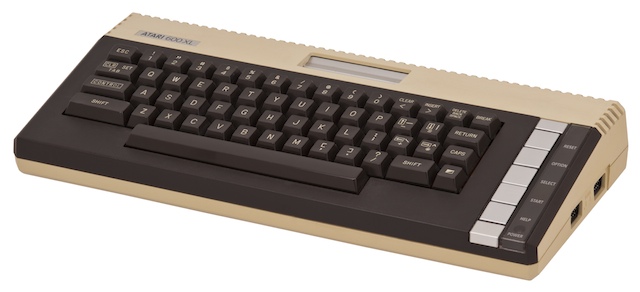
Atari 600XL

The Atari 600XL in all its glory. Note the cartridge slot up top and the two joystick controller inputs to the right side.

My parents—bless their hearts—endured a high-pressure time share pitch in order to secure a computer for me. The time share outfit had promised a VIC-20 but, when it came time to tell the salesman they would “need some time to think about” his no doubt compelling offer, my parents were handed an Atari 600XL instead. We brought it home, connected it to the family TV, and I was hooked.

With a cartridge slot and a mere 16KB of RAM, the machine wasn’t even cutting edge at the time, but I procured a used tape drive and endless books of BASIC programs from the library and was soon off coding my own rudimentary games. Then came a fixation with COMPUTE! Magazine, which published high-quality monthly programs that you could type in yourself—and that did far more (and looked far better) than any of the cross-platform, text-based code in those library books.

The machine could be frustrating, of course. Its memory was so small that one might spend several hours typing in the cramped code from those magazine pages only to find that it couldn’t be run; homebrew programs written on rainy afternoons and saved to ratty cassette tapes might prove inaccessible when you tried to retrieve them. But that machine gave me my love of computers, my willingness to tinker with them, and the ability to pop in a cartridge of Star Raiders when it was time to relax.

—Nate Anderson

Commodore Vic 20

Chris Lee says, “This was my first unboxing experience. Many would follow, but this will stick with me.”

I saved for a couple of years to get a used Commodore Vic 20 when everyone else was buying C64’s. I knew computers would be the future, and I was sooo going to be there. That beige beauty came with 3.5KB of RAM, a cartridge to expand the RAM to 16KB, and a tape drive.

Oh, the hours I spent realigning the heads on the tape drive and generating random read errors as the tape drive munched down another tape; the hours spent mindlessly attempting to program games from old magazines, only to discover that there was no way in hell I was going to be able to debug them. It was such fun. I spent a lot of time attempting to learn how to program, but no one else in the house had any experience, making it a slow and frustrating path.

Nevertheless, I got to the point where I could make little rockets shoot around the screen under my control while making weird farting noises—I hit peak funny at age 10. Mainly, though, the Vic 20 had two effects on my life: it introduced me to the idea of computer gaming, and it got a TV into the house for the first time. Bam, we reached the 1960s sometime in the mid-80s.

—Chris Lee

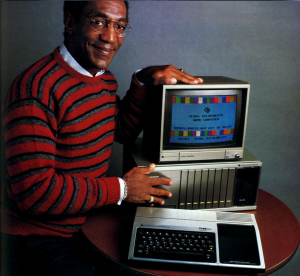
Texas Instruments TI-99/4A

Look at that sweater. Bill Cosby is never wrong! Photo courtesy of Retro Scan of the Week.

On Christmas Day in 1981, my brothers and I awoke to the most amazing thing to ever grace Santa’s sleigh: a Texas Instruments TI-99/4A personal computer. While all our friends were busy polishing the faux wood paneling on their Atari 2600s, we’d been introduced to something entirely different. My parents thought if we were going to have a box capable of playing those infernal arcade games at home, it better damn well be useful for something else. It was.

I’ll never forget painstakingly transcribing pages of fine-printed assembly code for a joystick-controlled drawing program. The random hexadecimal sequences were utterly foreign to my feeble seven-year old mind, and debugging meant re-reading each line again and again. Still, I persevered and was finally rewarded by a cursor that obeyed the joystick and left black lines when the button was depressed.

OK, so the joystick axes were inverted, but I didn’t care. It worked, I was a programmer! My joy was quickly followed by tears of agony as a thunderstorm perversely wiped the RAM on the very same day (lightning and I have always had issues). Parents: don’t let your kids program without a permanent storage medium. Luckily, Santa brought a data tape recorder the next Christmas.

Many amazing computers would follow, but I never felt the same sense of secret power that came with that TI-99/4A. Everyone else was playing popular titles like Pac-Man, but I had weird games like Car Wars. More than that, I’d been initiated into the mysterious world of programming, and, in a very tangible way, this first computer shaped the trajectory of the rest of my life. Thanks Santa; you’re a true visionary!

—Jason Marlin

IBM PC

Lee Hutchinson: “Yep, it looked just like this. Ahhh, memories.”
Lee Hutchinson: “Yep, it looked just like this. Ahhh, memories.” Credit: WikiMedia Commons

Near the end of 1986, when I was only eight years old, my dad sat me down in our living room and told me that he was going to be bringing home a very important piece of equipment from work: a computer. I threw my arms around his neck and started babbling about how excited I was. He calmly waited for my exuberance to subside and then told me that it was primarily for him to do work while he was at home, and that I would be allowed to use it, with supervision, some of the time.

Ha, ha, ha. That arrangement lasted maybe a week before it was clear I had taken to the machine and surpassed my dad; I quit watching TV after school and started playing DOS games instead. That original IBM PC, with its dual floppy drives and CGA graphics and 512KB of RAM, was a turning point in my little young life, and it became the first in an unbroken line of computers that I’d spend the majority of my waking moments with.

I cut my teeth on interactive fiction, quickly becoming lost in Zork and then moving on to Polarware titles like Oo-Topos and Transylvania and The Crimson Crown. Some of the most cherished and wonderfully rose-tinted memories I possess are of me hanging over the back of my dad’s chair while we “played” Starflight—really, it was him playing and explaining the occasional weird word (“Daddy, what does ‘landing sequence initiated’ mean?). Starflight and my dad taught me how to use a Cartesian coordinate system years before I learned about it in school; from my dad I learned how to take game notes and draw maps on graph paper.

Probably the most momentous game after Starflight was Sierra On-Line’s original Space Quest, which introduced me to 3D adventure games (or “Sierra games,” as we called them back then, regardless of who made them). That series, along with King’s Quest and Quest for Glory, occupied my mind wholly throughout my preteen years, and I can still quote entire reams of dialog from all of them.

In 1989, we swapped out that original IBM PC with an XT, which brought with it a full-height 10MB hard disk drive and EGA graphics. My world changed again as the new computer’s 16 glorious colors breathed new life into my games. But that original IBM PC will forever hold a special place in my heart—particularly the solid CHUNK its enormous big red power switch made, or the clatter of its 84-key keyboard with the function keys to the side instead of on top. She was my first obsession, and sometimes, when it’s late and the fire burns low, I still think of her.

—Lee Hutchinson

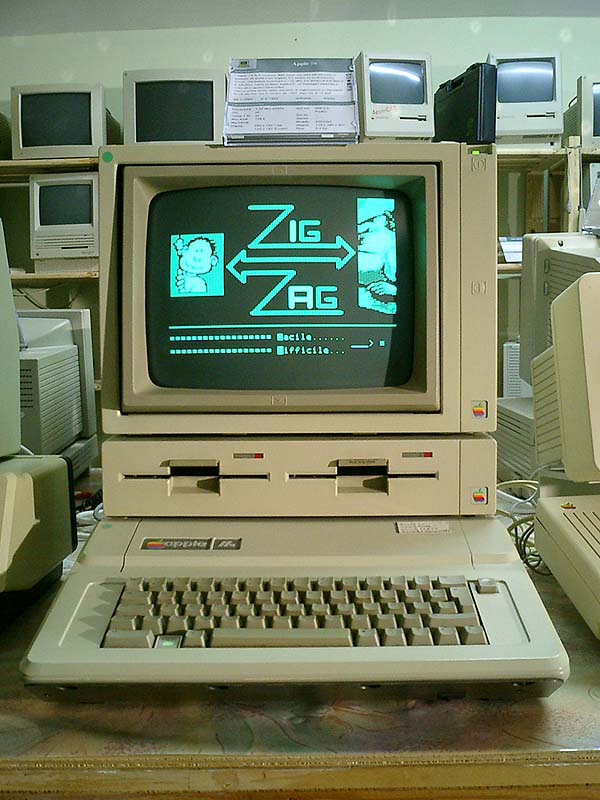
Apple IIe

Credit: Wackymacs

My parents brought home an Apple IIe when I was about five or six years old, and it was one of the most exciting moments of my childhood. On that glorious green monitor, I spent hours and days playing Montezuma’s Revenge, Sherwood Forest, Oregon Trail, Conan: Hall of Volta, and other games.

Later, I’d use the Apple IIe to write school papers, which wasn’t as much fun but helped prevent my terrible handwriting from getting me kicked out of school. At the time, computers were still a rare sight—I’m pretty sure we had a home computer before they made it into any of my classrooms. Later on my parents bought an IBM or IBM-compatible PC, and I would use only DOS and Windows for many years, but the Apple IIe is the device that brought me into the computing age.

As a side note, my father is still mad at my mother for getting rid of the old thing.

—Jon Brodkin

Tandy 1000 series

Remember when you had to read ads?

My memories of the first computer I used extensively are pretty vague—I scarcely even remember the word “Tandy,” Radio Shack’s brand of PCs sold in the 1980s, printed on the front of the case. Using the Internet, or even using it to do anything technical, was well into my future. When I was five years old, my relationship with computers was based entirely around games. My mom now laments that the Tandy was equipped with only a 3.5″ floppy drive; she’d bought all of her programs on 5.25″ disks for the older family computer, which I didn’t use much, as it lived in the basement and had a screechingly loud tractor-feed line printer.

My mom bought computer games like she bought books for us: she looked for the awards seal on the box that indicated it had been honored by some council of higher learning or received some critical acclaim. Hence, my computer experience was still vaguely educational. I remember playing a lot of Treasure Mountain! from The Learning Company then, and when I got a little older, Where in the World is Carmen Sandiego? and Gizmos and Gadgets figured heavily. I have faint memories of math games I’ve since forgotten the name of, but the Super Solvers series will always be near and dear to my heart.

—Casey Johnston

A no-name IBM clone

My memories of our family’s first computer are a little hazy, which isn’t surprising considering we got it in 1986 when I was just four years old. All I really knew about it was that if I asked mom and dad, they could make it play games like Tink!Tonk! and Cave-man Ugh-lympics. Later, my parents taught me how to use some very basic DOS command line commands so I could play these games without bugging them five times a day.

I had to consult my dad’s memory to find out that the computer I was playing these (relatively awful) games on was a no-name IBM clone built specially by a local computer store whose name (and existence) has been lost to the void of history. My dad recalls an 8088 processor, but he couldn’t recall specific numbers as far as RAM or hard drive space, let alone what kind of monitor we had (he thinks it was black and white, but I distinctly remember playing color games).

Dad also recalls a built-in emulator that was meant to let the computer support Apple II programs, but he says it never worked (my mom disagrees with this assessment). The specs weren’t that important though. What was important to me was the off-brand computer joystick that never worked quite right, the fact that the 5.25″ disk drive would fail to load my games sometimes for no apparent reason (“Mom, what does ‘Abort, retry, fail?’ mean?”) and the fact that I could print really simple banners using the dot-matrix printer and a copy of Print Shop.

—Kyle Orland

Apple Macintosh Plus

The Macintosh Plus.
The Macintosh Plus.

The first computer I ever laid hands on was probably the original 128k Macintosh. (It’s still in the house that I grew up in, in storage!) But the first computer that I have a strong memory of using was my mother’s Macintosh Plus. As I recall, it had a SCSI external hard drive (maybe 4MB or 8MB?) that sat below it, as a sort of physical platform for the Plus. I spent hours on the thing, first just playing games and messing around, but later using it to access Prodigy, an early online network.

I explored: I entered chatrooms, glanced at news headlines, and I have a strong memory of some labyrinth game. It gave me a good base from which to understand the Internet as a whole and created my own comfort with digital technology. Later on, our family upgraded to a Macintosh Classic II, where I spent days on end playing Kid Pix, Lemmings, and later, Civilization. Man, I nuked the crap out of my enemies, given the opportunity.

Cyrus Farivar

Acorn Archimedes family

Acorn Archimedes A3000.
Acorn Archimedes A3000. Credit: Binarysequence/Wikipedia

I was born and raised in the UK, going to school in the 1980s and 1990s. As such, like so many other UK schoolchildren of the time, my first computing experiences were with the Acorn Archimedes range, with a mix of 400 series and A5000s used throughout my formative years.

The Acorn range had a couple of defining features. First, it used the very first ARM processors. ARM processors are, today, computing mainstays, powering our smartphones and our tablets. But back then, they were niche processors designed by a small company in the UK for a line of systems that sold almost exclusively into the educational market.

Second, they shipped with a GUI operating system (initially named Arthur, later RISC OS) that was simultaneously clunky and awkward, and conceptually sound, consistent, and almost futuristic. RISC OS had a taskbar-cum-dock before Windows did, before even NeXTStep did. It had app bundles with drag and drop installation. It had a spatial file manager with drag-and-drop saving and a dedicated menu button on the mouse. A feature I still miss in operating systems today, it let you hit F12 and leap instantly into a command-line, with a BASIC interpreter available in ROM.

It was also substantially incompatible with everything else on the planet. Acorn was slow to add such features as high density floppy drives, and it had weird filesystem limitations (such as no more than 88 files in a directory) and its own non-standard networking system.

At the time, I never liked the Acorns. They felt as if they were simply gratuitously different, with the lack of PC compatibility particularly significant. We acquired a home PC in the early 1990s, and the fact that the Acorns couldn’t use the same software was a pain. But looking back, the design of the GUI in particular—its strong concepts and consistent design—makes me think that the machines weren’t bad. They just weren’t mainstream.

—Peter Bright

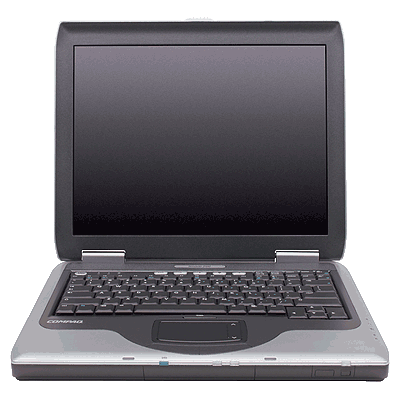
Compaq Presario 2175US

Credit: HP

My first laptop was a big deal. It wasn’t my first computer, and it wasn’t even the first computer that was my computer and not the family’s computer. It was, however, the first computer I owned that wasn’t pieced together in a generic beige case from spare parts, and it was the first one I paid for myself.

Late 2003 was right around the time when halfway-usable laptop computers were starting to become affordable for normal people. The laptop in question, a Compaq Presario 2175US, cost a mere $1000ish at the OfficeMax where I worked when I managed to scrape together the money to buy it. I could even mail in to get a free USB floppy drive (which I still have)!

The laptop felt like a powerhouse, coming from my own Pentium II tower or my family’s rapidly aging eMachines computer, and it was a slim-and-trim 7.25 pounds. It used a fast AMD Athlon XP-M 2400+, a chip from the days when AMD was still making Intel’s life difficult. It had a roomy 40GB hard drive, an expansive 512MB of RAM, and ran Windows XP Professional (not that lame old Home version). It even had an 802.11g Wi-Fi card; I would have been happy with 802.11b!

I quickly discovered that its integrated ATI Mobility Radeon M6 GPU couldn’t game for love or money, but it was my first college laptop. It was the first computer I ripped my CD library to, the beginnings of an iTunes library that still lives on my file server to this day. The best thing about it is that, to the best of my knowledge, it’s still kicking around some family member’s house somewhere, where it will happily browse the Internet and check e-mails until the end of its life.

—Andrew Cunningham

Photo of Sean Gallagher
Sean Gallagher IT Editor Emeritus
Sean was previously Ars Technica's IT and National Security Editor. After over 20 years in technology journalism, including over 9 at Ars, he pivoted to cybersecurity threat research, first at Sophos and now as a security research engineer at Cisco ‘s Talos Intelligence Group. A former Navy officer, he lives and works in Baltimore, Maryland.
288 Comments