Skip to content
Tech

Galaxy Alpha review: A Samsung phone with chrome

Galaxy gets a much-needed facelift, but is a hot new body enough?

Sam Machkovech | 96
Credit: Sam Machkovech
Story text

The last time Samsung released a newly designed smartphone that turned heads was in 2010—which we believe amounts to roughly 28 years ago in smartphone years. The debut Galaxy S, unlike most Android sets at the time, was noticeably clean and sleek. Users often compared its looks to the iPhone 4. But that comparison didn’t hold much muster, especially when considering Samsung’s love for cheap, plastic phone bodies. You only had to spin the first Galaxy around your palm once to be sure you hadn’t mistakenly grabbed an iPhone.

Subsequent Galaxy S upgrades stubbornly stuck to the line’s original design tenets, particularly an adherence to plastic shells. Most everyone else in the Android space upped their design game since, and while Samsung’s jump from the S4 to the S5 would have benefited hugely from an aesthetic overhaul, it didn’t receive one. As such, the April 2014 phone otherwise produced a collective yawn.

Finally, this fall, Samsung ticked the checkbox that drove Galaxy critics nuts for the past couple of years: a phone that looks good. The metal frame of the company’s newest model, the Samsung Galaxy Alpha, is distinct and different enough from its Galaxy S peers to make people wonder: Is this a new statement device from the Korean phone giant, or is it merely a redesign slapped onto the usual Galaxy experience? Does it belong among the rest of the $199-on-contract competition?

Not-so-heavy metal

A picture may be worth a thousand words, but we’re happy to elaborate a little further about the Galaxy Alpha’s updated design.

The top of the phone.
The left side, complete with a volume rocker.

Almost every time we pulled the Alpha out from a pocket or a messenger bag, friends were quick to say it looked like an iPhone. That’s mostly thanks to the silver, all-metal framing. From either the phone’s front or back, this looks like a super-thin metal protrusion, which catches light nicely without adding an extreme bezel. On the top and the bottom, the metal frame juts out with a visible bulge for the microphone jack and the USB port, respectively. Yet, running your finger over these juts doesn’t feel all that bumpy, because the phone’s plastic, textured backing meets these juts to smooth them out.

Specs at a glance: Samsung Galaxy Alpha
Screen 1280×720 4.7″(312 ppi) AMOLED
OS Android KitKat 4.4.4 with Touchwiz
CPU 2.5GHz quad-core Snapdragon 801
RAM 2GB
GPU Adreno 330
Storage 32GB, no MicroSD slot
Networking Dual Band 802.11b/g/n/ac, Bluetooth 4.0, GPS
Ports Micro USB 3.0, headphones
Camera 12MP rear camera with AF, 2MP front camera
Size 132.4mm x 65.5mm x 6.7mm
Weight 115g
Battery 1860 mAh
Starting price $200 on contract, $613 unlocked
Other perks RBG notification LED, NFC

The phone’s four corners have their own slight, rounded bulges, and these stick out about as far as the left side’s volume rocker and the right side’s power button. Overall, there’s no sense of bulge or protrusion when the phone sits in your pocket. In your hand, the bulges give your fingers a place to grip while holding the Galaxy with one hand. We liked that feeling, and we liked that the bulges looked distinctive without actually adding any unnecessary bulk.

Tiny plus signs have been etched into the plastic backing, and we liked the slate-gray color of our review model, along with the just-barely-there feeling of texture as our fingers ran across its back. The backing stays firm unless you peel it from the top-left corner, revealing a SIM card slot and a thin, removable 1840 mAH battery. However, there’s no SD card slot for additional storage. Currently, the Alpha maxes out at 32GB.

The volume rocker was a little longer than we’re used to, but it wasn’t too big for us to reach its up and down buttons in normal use, and we liked the way its long, recessed middle portion looked. The power button, on the opposite side, was thin and unremarkable. We couldn’t say the same about the giant camera lens sensor, which protrudes more than anything else on the phone’s backside and will scrape against any surface it rests on. That’s a problem with phones like the Galaxy S5 and the Galaxy Note III as well, but it feels especially out-of-place on an otherwise sleek phone.

The phone weighs just a hair above four ounces and is 0.26 inches thick. All the way around, the Samsung Galaxy Alpha is a smaller, thinner, and lighter offering than Apple’s iPhone 6—just barely so in each category, but it’s still a victory for Samsung’s camp.

The same can’t be said in comparing the Galaxy Alpha’s screen to that of the iPhone 6, even though both measure 4.7 inches. Rather than follow the Galaxy S line’s continued screen growth in size and density, Samsung scaled down for this model. It has a 720p resolution compared to the iPhone 6’s tiny bit denser resolution of 1334×750. However, we’re not concerned about it. Just as with the iPhone 6, the Galaxy Alpha’s pixel density—around 312 ppi—is fine for day-to-day phone use. Android apps generally have no qualms with 720p.

Our biggest beef was with the Galaxy Alpha’s Super AMOLED display, which gives you deep blacks in exchange for off-whites. The bluish tint seen on white space in messaging apps and white webpages made surrounding text and images look weird, an effect we never really got used to. High-end 1080p AMOLED screens like the one in the Galaxy S5 are less susceptible to this effect, but that’s not the case here.

Otherwise, the screen’s performance held up in general use, whether looking at the screen on a cloudless day—full brightness compared favorably to the Nexus 5 in our other hand—or turning brightness all the way down while browsing in bed—minimum brightness was even dimmer than on the Galaxy S5. Still, this phone’s price at launch is in premium, $199-with-contract territory, and its peers have noticeably better 1080p displays. Display hounds should consider where their phone dollar goes with this one.

The reduction in resolution wasn’t matched with a noticeable change in specs, as the Alpha employs the same quad-core Snapdragon 801 chipset as the S5, along with the return of the Adreno 330 GPU and 2GB in system RAM. As a result, performance tests see the Galaxy Alpha stand toe-to-toe with the fastest Android offerings on the market—which can feel even snappier on a system that maxes out at 720p.

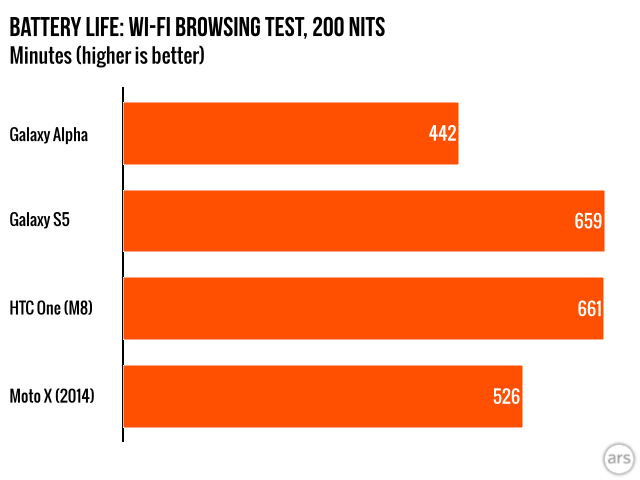
This phone’s smaller screen and high-end specs have been met with a wimpier battery, specced at 1860 mAh compared to the S5’s 2800 mAh. As a result, the Galaxy Alpha didn’t hold up nearly as well in our standard phone battery test, in which we set brightness to 200 nits (roughly about 70 percent on the Alpha’s brightness dial) and let the device load endless webpages over Wi-Fi while periodically syncing a Google account in the background.

In day-to-day use, though, we think most people will be fine. We’d consistently crawl into bed after a workday full of Web, message, and map use with at least 15 percent remaining, which compared pretty well to other Android devices.

Wiz kid

Have you used Samsung’s TouchWiz version of the Android OS before? How about Samsung fitness offerings like pedometers or heart rate monitors, or a home button that doubles as a fingerprint scanner, or the option to increase touch sensitivity while wearing gloves, or even gestures that let you wave your hand or finger just above the screen?

Samsung’s default keyboard, seen here e-mailing Ars Technica coworkers.
Holding our finger above the display gave us this blown-up gallery preview.

Those features and gimmicks will sound familiar to anyone who’s played with a Galaxy S5, and they’ve all returned to the Galaxy Alpha. What’s more, their problems in the older, bigger brother were handed down to the next generation. The heart rate monitor, found on the back of the phone, was just as inconsistent and inaccurate as the S5’s, and the returning fingerprint-scanning functions turned out just as touchy and wonky. (To be fair, the pedometer is still solid, and the option to boost touch sensitivity still works pretty well with a thin pair of gloves.)

Samsung fans hoping for the Galaxy Alpha to usher in another notable feature or two will come away from the latest handset pretty disappointed. Meanwhile, Android newbies who might have flocked to the Galaxy Alpha because of its new looks will be overwhelmed by the app selection and utter lack of welcome mat. Worse, the device comes pre-installed with Samsung’s typical redundant app categories: browsers (Chrome versus Samsung’s “Internet” offering), music (Play Music versus Samsung’s “Music”), and texting (Hangouts versus Samsung’s “Messages”), along with an extra, sluggish map app exclusive to AT&T customers.

So long as you’re willing to dig through the usual bloatware from carriers and Samsung and install your favorite third-party keyboard—Samsung’s has a dedicated row for numbers, which is nice, but the thing is otherwise unremarkable—you’re in for a perfectly snappy Android experience, fueled by some meaty specs. We made purchases using Google Wallet and NFC functionality; we tuned into our favorite streaming music and podcast services; we made phone calls with no hiccups in service; we enjoyed 4G LTE data speeds on par with any other device on the same carrier (in this case, AT&T, which enjoys Galaxy Alpha exclusivity at the time of this review).

The only major difference compared to other Samsung Android sets in general usability, beyond screen size, is the camera, which has been reduced from the S5’s 16MP offering to a still-respectable 12MP. In our first day of usage, the phone was very slow to focus on people and other objects in a given room, but that cleared up after our first power-off, and we couldn’t reproduce that issue.

LG Nexus 5
Samsung Galaxy Alpha

Our day-to-day use of the Galaxy Alpha’s camera didn’t leave us either particularly impressed or disappointed. We constantly felt the need to snap three photos at a time, compensating for the phone’s default tendency to produce blurry shots. Color reproduction felt a little artificially vibrant in outdoor scenes, while the display was sluggish to refresh in any dark rooms.

In the end, however, we walked away with some pretty sharp photos, and so long as we could keep our hand still in dark scenes, we could pull off competent shots. Still, any camera-snappy person consider the Galaxy Alpha a leading choice.

Very little, too late?

Any look at the Galaxy Alpha can best be summed up by encouraging people to re-read Galaxy S5 reviews from earlier this year, then imagine that experience delivered in a handsome, perfect-for-your-palm chassis. We poked and prodded in the hopes of finding great, new TouchWiz features or uncovering serious problems or gaps in performance, but our testing didn’t reveal anything groundbreaking or surprising.

If you’re a Samsung devotee who doesn’t want a giant phone or “phablet” and you skipped the S5 in the hopes that it’d see a superior second draft, this is the phone for you. And if Samsung hasn’t won you over in the past, we think the only thing that’ll turn your head with this device is the build quality, as much for looks as for size and lightness.

But this is the phone Samsung should have introduced in April when it could have competed with metal-framed phones with a better screen (like the HTC One M8) or a lower price (like this year’s Moto X). Instead, we’re stuck making such comparisons and wondering who would pick this Android phone as a $199-with-contract option (let alone a $600-plus option out of contract). Our tests were spent mostly using this side-by-side with the LG Nexus 5, and while performance and usability were comparable, Samsung’s 4.7-inch option never felt worth $300 more than an unlocked Nexus 5.

Had the Galaxy Alpha shipped with a top-of-the-line camera, complete with a wonderful sensor and other smart features, a competitive price, and a danged micro-SD card slot, we’d be shouting from the rooftops about this handset. As it stands, we’ll whistle politely about it.

The Good

  • Metal build is handsome enough to attract compliments, and bulges in the frame add a nice grip to the edges.
  • Thin and light build feels particularly premium in the hand, and size is perfect for one-handed use.
  • The 2.5GHz Snapdragon 801 feels even snappier when locked to a smaller 720p display.

The Bad

  • TouchWiz is almost exactly the same as other Galaxy offerings from this year, so issues with bloatware and visual design remain.
  • Heart rate monitor and fingerprint scanner remain wonky.
  • SuperAMOLED display continues Samsung’s streak of off-white displays.

The Ugly

  • Camera won’t cut it for anyone expecting premium performance from a high-priced phone.

Listing image: Sam Machkovech

96 Comments