It is September 1, 2660, and a genius sits in his study, resting up prior to a remarkable display of his scientific prowess. Tomorrow he will demonstrate to scientists that a dog three years technically dead, but preserved with rare elements, can be resuscitated back to life by a simple blood transfusion. He stretches, revealing a huge frame, much taller than the average human, his height approaching that of extraterrestrials.
“His physical superiority, however, was as nothing compared to his gigantic mind,” explained his biographer. “He was Ralph 124C 41+, one of the greatest living scientists and one of the ten men on the whole planet earth permitted to use the Plus sign after his name.”
So begins Hugo Gernsback’s nearly century-old novel, Ralph 124C 41+: A Romance of the Year 2660. First published in serial form in April 1911 in his magazine Modern Electrics, it was the magnum opus of the man who popularized the term “science fiction,” and in whose name the Hugo Awards are given to writers to this day.
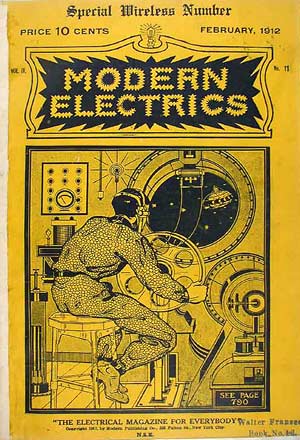
And romantic it is. No sooner does Gernsback introduce us to Ralph than he has his hero rescuing the girl of his dreams, Alice 212B423 of Switzerland, from a snow avalanche via high powered radio signals—she pleading for his help over a wireless video screen from 4,000 miles away. The novel ends (spoiler alert) with the scientist jetting around the solar system to save her from a lovesick Martian named Llysanohr’ (that apostrophe is not a typo). She revives following the application of his blood transfusion technique to her traumatized body.
“Dearest,” Alice declares upon awakening. “I have just found out what your name really means… ONE TO FORESEE FOR ONE.”
Indeed, Ralph’s creator took it upon himself to foresee for everyone. Gernsback’s novel is a gradually exhausting cavalcade of canny technological predictions—among them video conferencing, social networking, electrical cars, radar, solar power, and microfilm. Add to the list some that thankfully haven’t been attempted, the “subatlantic tube” among them: “a 3,470-mile underground train system that connects New York and Brest, France, in a direct line through the earth’s crust.”


 Loading comments...