Look, it’s not easy to predict the weather. And while it’s frustrating to have weekend plans spoiled by unexpected showers, the stakes are much higher for potentially catastrophic storms like hurricanes. The warning provided ahead of “Superstorm” Sandy’s arrival on the East Coast saved lives, without question, and that’s a success for weather science. But the story carries a reminder that there’s room for improvement in the US, where many argue forecasting tools have been neglected amid continual budget crunches.
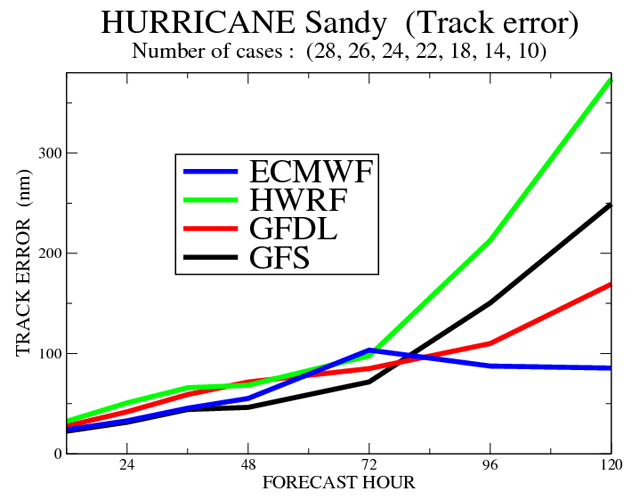
Seven days before Sandy made landfall in New Jersey, the atmospheric crystal ball was partly cloudy. The US National Weather Service forecast model showed a chance that Sandy might come ashore, but indicated that it was more likely the storm would spin off into the Atlantic. The European Centre for Medium-Range Weather Forecasts (ECMWF) model, however, definitely pointed the storm ashore. It would be about three days before the US model totally converged on the Europeans’ forecast.
The fact that the National Weather Service was able to issue detailed warnings well ahead of Sandy is both a testament to what these amazing models are able to do, and the hard work of the professionals behind the scenes.
Still, some in the US couldn’t help but wonder why the European model beat its American counterpart to the punch in predicting Sandy’s landward turn. Did it get lucky or is it a superior model? While it doesn’t always beat the competition (it got 2012’s Tropical Storm Debby wrong, for example), most scientists agree that the European model holds a clear advantage. Sandy just brought that fact before the public eye.
Weather wizard needs food, badly
Like any suburbanite who finds themselves coveting a neighbor’s flashy new gizmo, we first need to understand what, exactly, that gizmo is. Forecasting models are computer simulations of the global atmosphere. They’re similar to the models used by climate scientists, but with fewer components—leaving out slowly-changing factors like ocean circulation, vegetation, and atmospheric gas concentrations. Forecast models can also be run at a higher resolution that can better simulate local-scale weather. Data from around the globe is fed into the model, which then simulates the consequences of atmospheric physics into the near future.

 Loading comments...