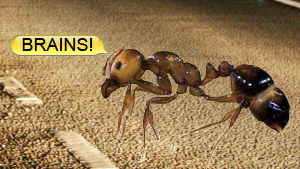
Release the fossilized zombie ant army: Okay, there are no actual ants involved, just evidence that ants have been turned into zombies for nearly 50 million years. The evidence comes in the form of fossilized leaves that bear distinctive bitemarks. These marks are the sign of ants infected with a fungus that, as it’s killing them, causes them to undergo an unusual behavioral change: the ants climb to the underside of a leaf, and clamp down with enough force that they remain there after their deaths. This gives the fungus’ spores a much better possibility of finding a new victim. The authors suggest they’ve probably found, “the first example of behavioural manipulation in the fossil record.”
Be honest about how tough you are, or you will be punished: Provided you’re a paper wasp, that is. Animals will tend to fight for dominance, but the risk of injury in these fights often puts a premium on avoiding it if it’s at all possible. One of the best ways of avoiding a fight is having something that signals your potency—a large set of antlers or a bright splash of color, for example. But these signals would seem to create a selective pressure in favor of cheating, where a weak animal intimidates its peers through potent-looking signals. Why have all our studies indicated that most species provide honest signals?
Apparently because cheaters will get punished. The authors work with paper wasps, where a hormonal treatment will make queens more potent, but most fights are avoided by the evaluations of colored markings. When the researchers manipulated the signal with paint, the animals ended up being targeted for aggression by peers. When a hormonally juiced wasp was introduced, it failed to form stable dominance relationships. Put the two together—hormonally juiced with paint to match—and social interactions returned to normal. “This simple behavioral mechanism provides a clear cost to signal inaccuracy that may maintain honest communication over evolutionary time,” the authors conclude.
Be very quiet, we’re hunting moths!: Bats are exceptional predators, being able to track small prey at night through echolocation. So it’s no surprise that some insects have evolved counter-defenses, including moths that can hear the bat’s chirps and take evasive action. But the predator-prey relationship never remains static for long, and there’s apparently a bat species, the barbastelle, that has become a specialized predator, dining primarily on moths with ears. It manges this trick by hunting in stealth mode. The barbastelle’s hunting echolocation calls are significantly quieter than those of its peers (by a factor of 10-100), and researchers showed this makes all the difference. By snooping on a neuron in the moth’s auditory system, they were able to confirm that the barbastelle remained undetected until almost on top of the moth.

 Loading comments...