Skip to content
Gaming

Ars’ favorite games of E3: From dueling VR wizards to calm underwater dives

Picking the finest titles from the game industry’s annual hype extravaganza.

Let's blow some Allied forces up. Credit: EA/DICE
Story text
Ars Technica’s six best games of E3 2016.

Another E3 is in the books, and it’s nearly impossible to distill the dozens and dozens of games on display into a few titles to keep an eye out for—but that won’t stop us from trying.

These 10 games in particular stood out from the crowded E3 show floor, and each has us excited to try out the full versions after a short taste this past week.

Abzu

Developer: Giant Squid
Publisher: 505 Games
Platforms: PS4, Windows
Expected Release Date: August 2, 2016

Like the brilliant Journey, Abzu isn’t so much a game as it is an experience. There’s no shooting, dialogue-heavy cut scenes, XP, or any of the other fluff that tends to make a game a game. Instead, there’s just your character—a cute, cel-shaded diver—and the open ocean. Everything else is up for discovery.

Abzu is beautiful, made with love by people who are passionate about exploring the oceans. The developers at Giant Squad have built the kind of world that feels magical when players, say, find a huge shoal of fish that flitters through the water as one unit or when they come across a group of freaky crabs walking across the depths of the ocean floor. A few subtle signposts will keep you on the right track, but for the most part you explore in Abzu because everything is fascinating, not because you’re explicitly told to.

That said, there is a narrative of sorts in Abzu, one that may explain exactly what you’re doing in the ocean in the first place. Without giving anything away, it involves sharks, weird mechanical structures, and eerily beautiful pools of deep ocean illuminated by a mysterious light. After just half an hour with Abzu, I’m convinced that Giant Squid is onto something special, and I can’t wait to see what the rest of the game has in store.
—Mark Walton

Battlefield 1

Let’s blow some Allied forces up.

Developer: DICE
Publisher: EA
Platforms: Windows, PS4, XB1
Expected Release Date: October 21, 2016

Five years on, and we’re all still weary of the Dead Island effect—when a video game announcement includes such a rollicking trailer that you can’t help but distrust the whole thing out of hand. Battlefield 1 seems like a prime candidate for this sort of unease. Its bombastic trailer promises some incredible visuals that seem impossible to live up to. However, we were fortunate enough to walk out of E3 with impressive, hands-on time with the game’s PC build (and that put at least some of our worries at ease).

Mock the game’s use of “One” in a sequel all you want, but our critics’ separate experiences with the multiplayer mode made us agree that, even in limited play, Battlefield 1‘s timeline rollback to the early 20th century was the right call. The game’s giant, muddy maps explode with the kind of shrapnel-spewing technology that changed the face of World War I, and its lumbering tanks organically juggle things like rocket firepower, reload speeds, armor strength, and acceleration of wheels and turrets.

The “domination”-styled mode blew us away with its destructible buildings, its bombastic flight sections, and its tide-turning, turret-mounted Zeppelin—which was granted to the losing team two-thirds of the way in our matches as a way to rain bombs on the winning team’s most entrenched positions. This didn’t feel cheap, honestly; the Zeppelin can be countered, but its appearance changes the flow of a long-running match in fun fashion. Ground forces must work out more surface-to-air strategies across the board at that point.

From a short demo, there’s no telling whether EA and DICE have learned lessons from things such as population-splitting expansion packs or humdrum single-player content. At the very least, Battlefield 1‘s multiplayer mode, even in an alpha-preview state, already builds upon prior games’ strengths and feels like a “best lessons from our past few games” show of force. And, holy cow, does this game’s PC build look slick in action thanks to the best particle, destruction, fire, and animation effects yet in a Frostbite engine game.
—Sam Machkovech

Call of Duty: Infinite Warfare

Developer: Infinity Ward
Publisher: Activision
Platforms: Xbox One, PS4, Windows
Expected release date: November 4, 2016

This could be a controversial choice, but hear me out: Call of Duty: Infinite Warfare actually looks pretty good. After that iffy first trailer—which famously had more downvotes than any other game trailer on YouTube—the demo shown at the Sony E3 press conference was surprisingly impressive. Behind closed doors at E3, I saw an even better-looking slice of gameplay.

The first demo showed Captain Reyes fighting through the streets of Geneva as an invading force of soldiers and robots fell into the city. Cue the usual array of well-timed COD explosions, set pieces, and fast-paced shooting. There are new weapons, too, including a brutal shotgun with multiple reticle points that locked onto the limbs and bodies of enemies, and a hacking weapon that allowed Reyes to slice into an enemy dropship and self-destruct one of the robots. (That sent the ship crashing into the ground, FYI.)

There’s nothing particularly new there, but what’s interesting is just how reminiscent Infinite Warfare is of other COD games. There’s a section in the demo where, after navigating the city, Reyes is tasked with making his way to the top of a small hill littered with enemy robots. Around its outer edges are small trenches embedded into the concrete, while in the sky are planes and ships dropping bombs and enemies. It has the same feel as the D-Day landings from COD2. Despite the sci-fi setting, it’s surprising how Infinite Warfare never feels like a sci-fi game. You still shoot real bullets, and you sprint through battles on foot looking for cover and picking off enemies.

Eventually, of course, you’re sent into space in a fighter jet. But again, this section is surprisingly good. There’s a real sense of acceleration in the ship, while the lock-on looks like lots of fun. More than that, Infinite Warfare really manages to capture the energy of full-on space dogfighting (or at least the energy you might imagine) in a way that even dedicated space shooters like Eve Valkyrie have failed to do. Despite the initial knee-jerk reactions, it’s worth giving Infinite Warfare a shot. Right now, it’s looking pretty great.
-Mark Walton

Chambara

Hide, little samurai chickens, lest you reveal yourselves in Chambara‘s monochromatic world.

Developer: Team OK
Publisher: Team OK
Platforms: PS4, XB1, PC
Expected release date: July 26, 2016

I’m Ars’ resident four-player, couch-gaming fanboy, which makes conventions like E3 a blast for me—it’s where a ton of indie developers show off their latest stabs at the party-game throne. This E3 was no exception, and I actually struggled to pick a favorite among three really, really good offerings. First was Videoball, a technicolor slam of Asteroids and NES Ice Hockey that I’ve seen previewed at roughly seven conventions over the past few years. Second was Inversus, an arcade-y battle game where you must split your slowly recharging ammunition between shooting at foes, clearing your own walking path, and blocking out enemies’ lanes.

I’m calling those both must-buys when they launch later this year, but my highest pick in the genre at this year’s E3 managed to blow away the other Ars critics, as well: Chambara. There haven’t been many good couch-friendly first-person shooters in recent years beyond the possible exception of Screencheat, whose “look at your opponents’ screens to find and kill them” gimmick was clever but lacked solid mechanics for repeat play.

Chambara starts with a much more clever idea—make everything in the game monochromatic. Players and level content are either entirely white or entirely black, and the only exceptions are a few flourishes that allow players to make out where they stand on the deathmatch maps. In order to find your opponents, you need to move around in such a way that their outlines clash with their surroundings… all while minding the fact that you may expose yourself in the same way. From there, players must dash-melee into foes in order to score a kill, or they can use throwing stars to stun an opponent before finishing them off.

Those stars are colorful and slow, however, so a miss will absolutely expose you on the battlefield. The same can be said for whiffing on a dash attack, which is just slow enough that players must account for how their foes are moving and dodging before trying to pounce. Combine those mechanics with some clever white-black level construction and cool, vertical structures that are easy to dash up to and perch upon, and you’ve got yourself a shout-worthy couch-battle game for the ages.
—Sam Machkovech

The Last Guardian

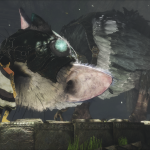
This Sony-provided scene of multiple Trico-beasts definitely was not in my demo.

Developer: Sony Japan Studio
Publisher: Sony
Platforms: PS4
Expected release date: October 25, 2016

You wake up in a dark cavern. Next to you sits a three-story-tall beast that looks like a mix between a dog, a horse, and a chicken. He whimpers in pain as he lies on the dirty ground, stuck there by huge, imposing chains. You walk up to the creature slowly, and he lets out a roar of defensiveness and suspicion. The force of the scream knocks you end over end, stumbling backwards. You get up and search for a way to gain the beast’s trust.

The first two minutes of The Last Guardian, described above, teem with more emotion than entire hours of many other games. The story here is not told primarily through dialogue (though a narration track gives some context to the actions). Instead, intricate animation and a painterly, light-infused art-style impart additional meaning into every scene. Your little-boy protagonist and the giant beast he befriends burst with the kind of life that’s missing from many games with more obviously canned animation.

The gameplay hearkens back to both Ico and Shadow of the Colossus, the two previous games from Last Guardian Lead Designer Fumito Ueda (who has been working on this new title for at least seven years). By befriending the beast, your young boy characters can climb up to unreachable platforms and knock down giant barriers. The gentle environmental puzzles are almost beside the point, though. We’ll take any excuse to spend some time exploring some wonderfully detailed settings with two intriguing and relatably lifelike characters. Based on our 30-minute E3 demo, The Last Guardian builds a compelling world and doesn’t rely on a load of boring exposition to do it.
-Kyle Orland

The Legend of Zelda: Breath of the Wild

We got a sneak peek at this magic-magnet power in the game’s demo, which had us use a mix of buttons and joysticks to move certain objects around to solve environmental puzzles.

Developer: Nintendo
Publisher: Nintendo
Platforms: Wii U, Nintendo NX
Expected release date: 2017

After writing two lengthy articles about the next Zelda game’s E3 presence, I still feel breathless as I process and discover more about this 2017 game for Nintendo’s home consoles. That is the polar opposite of my usual E3 game takeaway, where a perfectly presented demo doesn’t usually do enough to hide rough edges and unfinished boundaries.

Ars’ time with Legend of Zelda: Breath of the Wild was just long enough to let us look out at the game’s infinitely expanding horizon and wonder about the possibilities that lie beyond our 35-minute gameplay radius. We encountered newfound solid-feeling mechanics like free-climbing, stealth, physics-based puzzles, and crafting. And after our demos, Ars’ three E3 critics each talked about gameplay elements the others hadn’t seen. I boasted about using a new magnet-pull superpower to solve a puzzle; Mark Walton recounted a surf-on-a-shield dive down a hill. None of us even got to the demo zone’s surreal dungeon that we saw others discover.

The only hitch at this point—beyond Kyle’s worry that this “isn’t a Zelda game”—is that Breath of the Wild struggles to maintain a 30-frames-per-second refresh while rendering its giant, watercolored world. The four-year-old Wii U hardware grunted and sputtered to process so much content in this game’s preview version, and we can’t help but wonder whether the forthcoming Nintendo NX system will better handle this epic quest. At least the content is there, and it’s already fun, smooth, and huge.
—Sam Machkovech

Mafia III

Developer: Hangar 13
Publisher: 2K Games
Platforms: Xbox One, PS4, Windows, MacOS
Expected release date: October 7, 2016

Mafia III isn’t so much my favorite game of E3 as it is the one with the most potential. Just like when I saw it at last year’s Gamescom, Mafia III‘s fictional recreation of New Orleans (here, named New Bordeaux) has been meticulously researched and crafted, with little details like the cigarette posters on walls and the fine white suits of southern gentlemen being true to the game’s 1968 setting.

Mafia III also remains shockingly violent. The game stars Lincoln Clay, an African-American soldier who, having recently returned from fighting in the Vietnam War, finds a sense of family and belonging in the black mob of southern Louisiana. Soon, however, his new family is wiped out by the Italian mafia, and he begins to exact his revenge by going on a big killing spree. It’s standard crime-drama stuff, much like how Mafia III is essentially just a standard open-world shooter complete with various missions and areas of the city that you’re tasked with gradually bringing under your control.

But some neat touches, aside from its aesthetic charms, elevate Mafia III over its contemporaries. An intriguing underboss system tasks you with assigning one of three characters to look after a recently reclaimed portion of the city, with each underboss offering different buffs and bonuses. There’s a narrative attached to those choices, too. For instance, if you neglect to give any territory to a particular underboss, he or she eventually grows tired of being shunned and may decide to go at it alone, including attempting a hit on you.

It’s all backed up by a brutal, cover-based combat system. Melee takedowns often involve Clay gutting his victims with an oversized knife or kicking them down to the ground before blasting them in the face with a vicious shotgun. By the end of the E3 demo, Clay looked like he’d spent the best part of his day working in an abattoir hauling around cow carcasses. Such violence in games is nothing new, of course, though Mafia III hasn’t convinced me it’s able to contextualize it yet.

Neither Clay, nor anyone in the game, is a particularly likable character. And while on paper it seems like he has a good reason for slaughtering people, in practice Clay just comes across as a murderous monster. That’s why Mafia III is potentially a good game, not a straight-up great one at the moment. If 2K can match up the violent gameplay with convincing agency, there’s a chance this may be more than a violent shooter that gives moody teenagers cheap thrills.
—Mark Walton

Necropolis

Armor is hard to come by in the game, but it usually looks pretty sweet.

Developer: Harebrained Schemes
Publisher: Harebrained Schemes, Bandai Namco
Platforms: Windows, XB1, PS4
Expected release date: July 12, 2016

Harebrained Schemes was kind enough to invite Ars to its Seattle-area offices to test out a special build of its first-ever 3D action game—and I’m glad I eked out a little bit of pre-E3 time to do so. The RPG and strategy game studio has zero publishing expertise in genres such as dungeon crawlers, action-adventure games, or permadeath-loaded roguelikes, so it’s impressive that its first stab at all three of those genres, Necropolis, doesn’t fall apart at the seams.

What’s even more impressive is how those disparate elements have come together for a game that should prove to be one of the year’s most fun. That hinges largely on the development team’s happy accident of adding a multiplayer mode, which Harebrained admits was slapped on near the end of the dev cycle as a lark. It turns out a brutally hard, Dark Souls-like quest becomes a lot more interesting when its “cooperative” content adds the risk of friends accidentally killing each other in the middle of heated battles.

On the E3 floor, attendees got to see Necropolis‘ striking art design and satisfying, beat-to-beat combat system, but its 10-minute timer meant players didn’t get to discover most of its stunning, procedurally generated dungeons (which become much more architecturally striking as players descend further into each quest), its craziest enemies, or its hilarious multiplayer twists. We at Ars are antsy to dive back in and put those systems to the test, along with the game’s cumulative currency and bonus system. Those will theoretically let players selectively equip some weird boosts as they take yet another stab at the seven-floors-deep dungeons of Necropolis.
—Sam Machkovech

Statik Institute of Retention

Developer: Tarsier Studios
Publisher: Sony
Platforms: PlayStation VR
Expected release date: TBD

You’re sitting in a chair in a sterile, unfamiliar room. In front of you, you see a series of abstract pictures with weird patterns. To your left, a man in a lab coat sits, his face unnervingly blurred out by the kind of pixelation you usually see on the TV show Cops. You look down, and your hands are encased in a box, adorned with all manner of dials, levers, and screens.

Welcome to the Statik Institute of Retention, a new kind of puzzle game for the PlayStation VR hardware. This isn’t the kind of game where a tutorial elegantly describes how to solve straightforward and utterly logical puzzles. No, this is a game that immediately throws you in the deep end. You have to hit every button and joystick on the DualShock controller to somehow guess-and-check your way out of your predicament. Along the way, players need to carefully observe the reactions on the box (which means twisting the Dual Shock in your hands to get a better look at each side).

Eventually, you piece together a working understanding of how your puzzle box works and what’s expected of you. Even then, some logical intricacies require you to think outside the box (sorry) to succeed. Through it all, the PlayStation VR setting makes you feel truly and disquietingly trapped in your logical predicament. There’s no escape but to figure your way out (or to take off the headset, we suppose).

We only got to see one puzzle at E3, but that was enough to sell us on the game’s unsettling VR atmosphere and intricate, brain-bending gameplay. The developers promise that once a puzzle is solved, you’ll wake up in a new room with a new, completely different quandary in front of you.
-Kyle Orland

The Unspoken

Warp to a platform if it’s glowing with blue light.

Developer: Insomniac
Publisher: Oculus
Platforms: Oculus Rift/Touch
Expected release date: Holiday 2016

After launching without hand-tracking controllers earlier this year, Oculus is going to need some strong, exclusive software to prove the worth of its soon-to-arrive, position-sensitive Touch controllers. The Unspoken seems set to serve as that kind of killer app, making you feel like a powerful wizard that can bend reality with his or her hands.

Hurling fireballs and putting up magical shields is the kind of thing you’ve done in countless fantasy games before, but it feels quite different when you get to actually look down at your hand in VR and see a fiery ball of death growing in size above your palm. The feeling of actually hurling that fireball at an opposing player or of blocking an incoming attack with a translucent shield in your other hand, is much more thrilling than simply hitting a button on a controller and watching your character do the same. Ditto for ducking behind a wooden barrier or leaning out to unleash a quick attack.

Unlike some Vive games, which let you run around the room to dodge incoming attacks, The Unspoken offers a lot of in-game mobility while keeping your real-life position frozen to one spot (and occasionally leaning or moving slightly to the side). You can use a teleportation spell to warp between different in-game pillars, though, confusing your opponent’s aim and flanking their defenses. And beyond basic fireballs, you can take extra time to summon more powerful spells, though these require complex motions. Hammer a magical anvil to form an energy sphere, for instance, or fold a paper airplane to unleash a ghost jet bomber on your opponent.

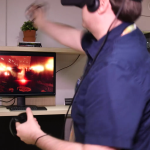
Dueling against an AI opponent during a tutorial was fine enough, but magically battling another human added some necessary spark to the proceedings. By the end of my five-minute duel with Ars’ Sam Machkovech, my heart was pounding—partly from physical exertion, but partly from the thrill of unleashing magical power from my bare hands.
—Kyle Orland

34 Comments