Skip to content
ne plus ultra

The last generation: Intel has new labels for its next major CPU architecture

Intel’s Meteor Lake CPUs make big changes on the surface—and under the hood.

Andrew Cunningham | 155
Intel's Core CPUs are about to get a bit more Ultra. Credit: Intel
Story text

As part of an effort to “simplify the Intel brand portfolio,” Intel has announced some changes to its processor branding starting with its next-generation Meteor Lake CPUs.

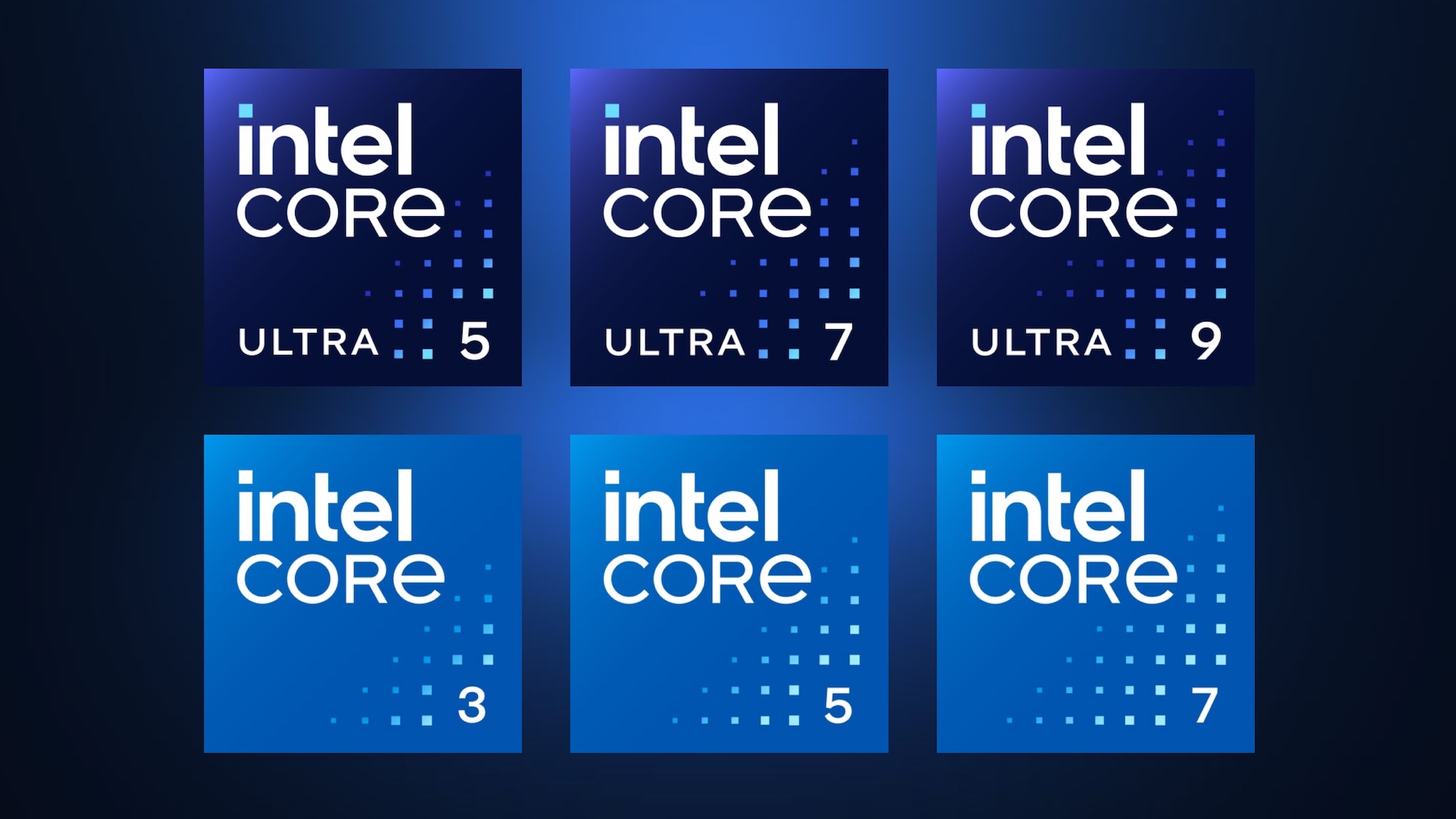
The smallest change is that Intel’s mainstream CPUs are losing their “i,” shifting from Core i3/i5/i7/i9 to simply Core 3/5/7/9. Intel will also stop using “generational” messaging in its processor branding—none of the new CPUs will be announced, released, or advertised as “14th-generation” anything.

Intel’s generational branding has always been a bit arbitrary, anyway. The “first-generation” Core chips followed several generations of Core and Core 2 processors, the branding Intel started using for its chips in the mid-2000s at the end of the Pentium 4 era. And the Core 2 Duo and Core 2 Quad branding was used for several distinct generations of chips that used different manufacturing technologies and revised architectures.

To make up for the words it’s removing from its branding, Intel is also adding a new one. Its high-end chips will be called Core Ultra 5, Core Ultra 7, or Core Ultra 9. The company didn’t go into detail about what makes a processor Ultra, though we do know that Core 3 chips cannot be Ultra, while Core 9 chips can only be Ultra.
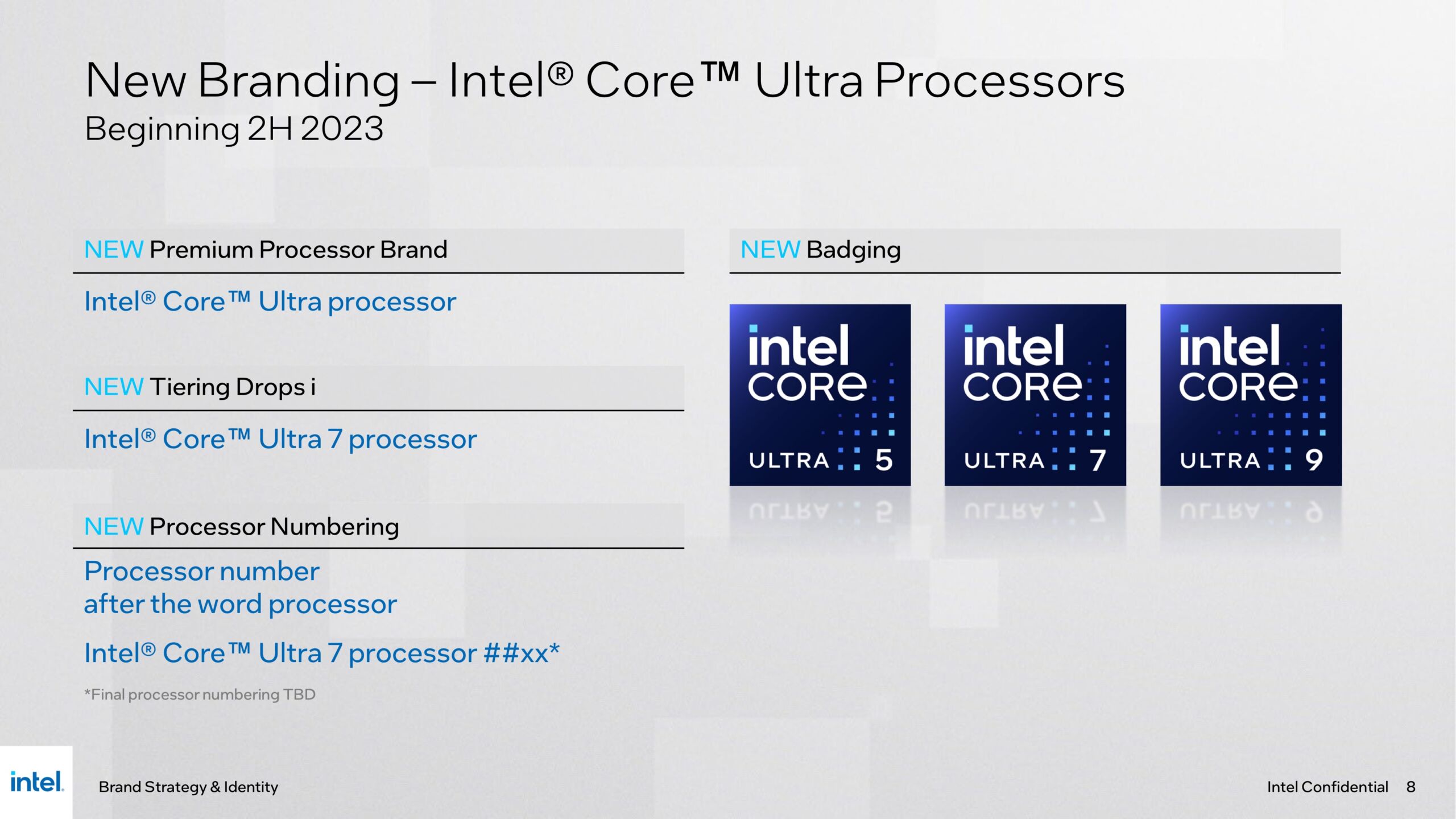
Processors will still have a “14” in the model number to denote their generation. Credit: Intel

Intel’s CPU model numbers will continue to include generational numbering to help distinguish them from one another, and the company will continue to use suffix letters to distinguish different product segments. So what would have been an “Intel Core i7-14700K Processor” might now be an “Intel Core Ultra 7 processor 14700K” (Intel says it prefers the word “processor” to sit in between the “Core Ultra 7” part and the CPU’s model number).
This is part of a wider shake-up of Intel’s processor branding strategy; last year, the company jettisoned the Pentium and Celeron brand names for low-end laptop CPUs. It now refers to those Intel processors as Intel Processors. AMD has also rejiggered its laptop processor model numbers to account for the fact that it’s shipping several different CPU and GPU pairings under the same “Ryzen 7000” umbrella.

What we know about Meteor Lake

Meteor Lake’s branding change is actually probably the least important of the architecture’s many changes—there are several historic firsts here, hidden among the expected CPU and GPU performance improvements.

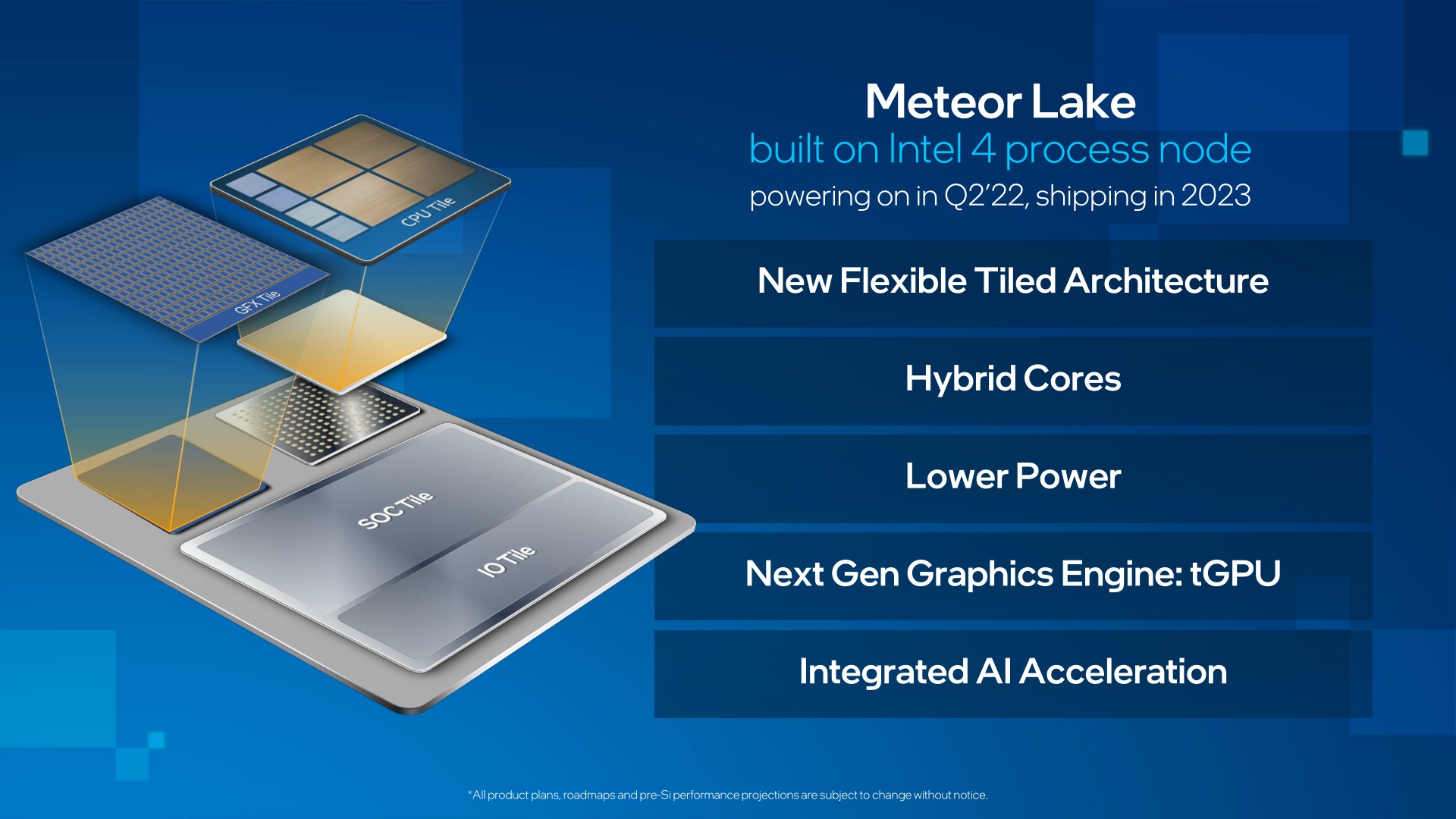
Much of what’s remarkable about Meteor Lake pertains to how the chip will be manufactured and packaged. It will be Intel’s first consumer CPU to use a chiplet-based design (Intel calls them “tiles”). This means Intel will be breaking its processors up into several silicon dies that use different manufacturing technologies with the goal of improving performance and efficiency.

This comes with benefits and drawbacks—you need to make sure those tiles can communicate just as quickly as they could if they were all part of the same piece of silicon, but you can also mix and match manufacturing processes to improve performance and power efficiency while reducing costs. Intel will be using Foveros technology to make Meteor Lake work; Foveros stacks chiplets directly on top of one another, facilitating quick communication between them and reducing the amount of physical space needed for packaging.

The main CPU tile in Meteor Lake will continue to use a hybrid approach, combining large high-performance P-cores and small efficiency E-cores. This tile is being manufactured by Intel itself, on the company’s new Intel 4 manufacturing process; current 13th-generation CPUs are made using Intel 7, which Intel has been using and refining since 2019 or so. But others, including the GPU tile, are being manufactured by TSMC, something that would have been unthinkable for Intel just a few years ago. The company’s Arc GPUs are also being manufactured by TSMC.

Intel claims that it will get its manufacturing back on track in the next few years, after largely squandering the lead it had a decade ago because of trouble with its 14 nm and 10 nm processes (Intel 7 is another name for a version of its 10 nm process). It also hopes to attract third-party clients to use its chip fabs, opening up an important and much-needed new revenue stream. For what it’s worth, the company does seem to be more or less on track to hit its original deadlines for the Intel 4 process, even if it is leaning on TSMC to help it get actual products to market.

Meteor Lake will be Intel’s first consumer CPU to use a chiplet-based approach. Credit: Intel

Speaking of the TSMC-made graphics tile, Meteor Lake will be Intel’s biggest GPU upgrade in years after using similar Iris Xe GPUs in the 11th, 12th, and 13th-generation chips. The Meteor Lake graphics chiplet is based on the same Alchemist architecture as Intel’s current Arc A-series dedicated graphics cards. Among other improvements, they should hopefully bring hardware-accelerated AV1 video encoding and decoding to Intel’s integrated graphics, plus ray-tracing support and better XeSS upscaling.

The other big addition will be hardware acceleration for AI workloads. Generative AI has attracted a deafening amount of buzz in the last year or so, but Meteor Lake’s AI acceleration will be a bit more like the “Neural Engine” that Apple has been building into its A- and M-series chips for years now, or what AMD and Qualcomm have included in some of their recent processors.

Though it can be used for language models and image generation, Apple has mostly used this hardware to do relatively simple, straightforward things like matching faces among photos in users’ camera rolls, transcribing voicemails, and separating foreground and background objects in photos and video streams. The ability to accelerate these kinds of workloads means that more processing can be done locally on your device without sending data to be crunched on by some server somewhere, though ultimately it will probably be Microsoft that determines exactly how this hardware is used.

New Meteor Lake processors, new case stickers. Credit: Intel

Desktop users may need to wait to benefit from any of these changes and improvements. Current rumors suggest that many 14th-generation desktop chips will be yet another revision of the Alder Lake architecture originally introduced in the 12th generation. The 13th-generation Raptor Lake chips improved the architecture with a larger number of E-cores, higher clock speeds, and (in some models) more cache memory. Another Alder Lake revision will probably use similar methods to increase performance, though early rumors suggest the chips will also come with increased power use, and power efficiency is already a weak point for Intel’s desktop chips relative to AMD’s and especially Apple’s.

We also don’t know whether the new desktop CPUs will be compatible with previous-generation 600- and 700-series motherboards or if Intel will require a newer motherboard to meet its power requirements. That’s what Intel did in the switch from 7th- to 8th-generation desktop CPUs: It kept using the same physical socket for the processors but required new motherboards with new chipsets to actually support them.

Intel is expected to launch its first Meteor Lake chips, along with its branding changes, in the second half of 2023.

Listing image: Intel

Photo of Andrew Cunningham
Andrew Cunningham Senior Technology Reporter
Andrew is a Senior Technology Reporter at Ars Technica, with a focus on consumer tech including computer hardware and in-depth reviews of operating systems like Windows and macOS. Andrew lives in Philadelphia and co-hosts a weekly book podcast called Overdue.
155 Comments