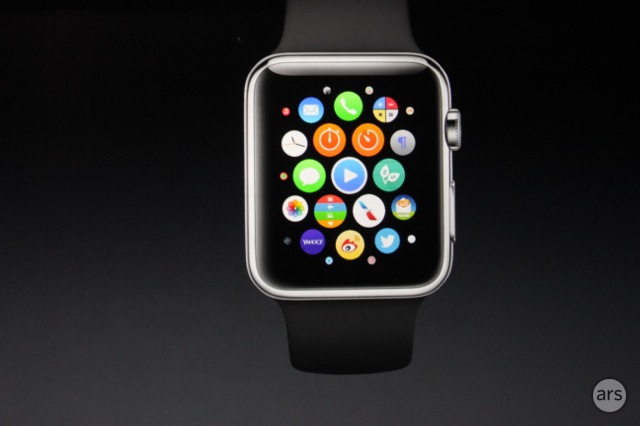
On Tuesday, Apple finally unveiled the Apple Watch, the company’s first dedicated wearable device.
Once rumored for an October reveal, the Watch was only recently linked to today’s iPhone announcement event, and while it follows devices from the likes of Samsung, Motorola, and LG, the Watch stands out thanks to its total integration with the iPhone and iOS ecosystem. The Apple Watch comes in two different sizes—one larger and one smaller.
According to CEO Tim Cook, the Apple Watch has been in development for a considerable amount of time and required a reassessment of how users interact with devices. Not content to take the iPhone experience and simply shrink it to wrist-like proportions, the Apple Watch discards traditional gesture controls like pinch-to-zoom, since they are impractical in the tiny form factor. Instead, the primary means of interaction is with the “digital crown,” the tiny dial on the watch’s side. Per Cook, it lets you interact with the watch without blocking its screen (although, confusingly, a screen-obscuring swipe appears to be the most common gesture used with the Watch). A press on the “digital crown” returns you to the home screen.

The Apple Watch has what Tim Cook describes as “an amazing and rich design story.” Apple design master Johnny Ive took to the stage in video form (as he often does) to talk through the device’s design philosophy, which is focused around the personal nature of a wearable device versus a thing you stuff in your pocket or hide in a desk drawer. The display activates as you raise your wrist, as with other devices like the Moto 360; the crown’s spin changes what it does based on the context in which it’s used. It allows zooming, control adjustment, and scrolling—and it’s also the home button. There’s also a button that allows you to call up your contact list.

 Loading comments...