
Consumer electronics heavyweights are betting big on 3D technology to help drive sales of new televisions and other hardware. Aside from the considerable cost of the hardware, one of the most significant impediments to broader 3D adoption at home is the glasses.
Active shutter glasses, the dominant glasses technology for consumer-oriented 3D-enabled televisions, come with a number of serious drawbacks. They are still relatively expensive and they use batteries that have to be replaced or recharged. There are also still a number of troubling interoperability issues that prevent some active shutter glasses from being fully compatible with products from different vendors.
None of the alternatives to active shutter technology are fully competitive for the living room 3D market yet, but the industry is exploring a number of options. One approach is to move the shutter technology into the television itself, allowing consumers to use cheaper passive glasses like the kind found in theaters. RealD and Samsung, which have teamed up to pursue this approach, are calling it RDZ. A more appealing long-term strategy is to eliminate the glasses altogether—a possibility that is attracting considerable interest among hardware vendors.
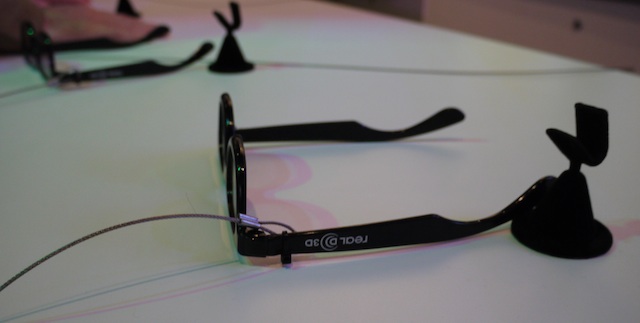
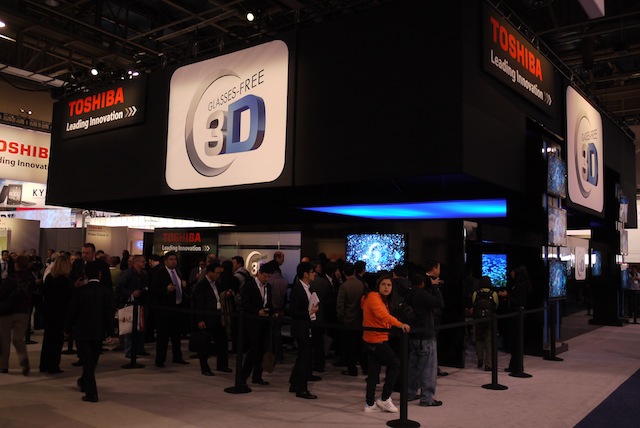
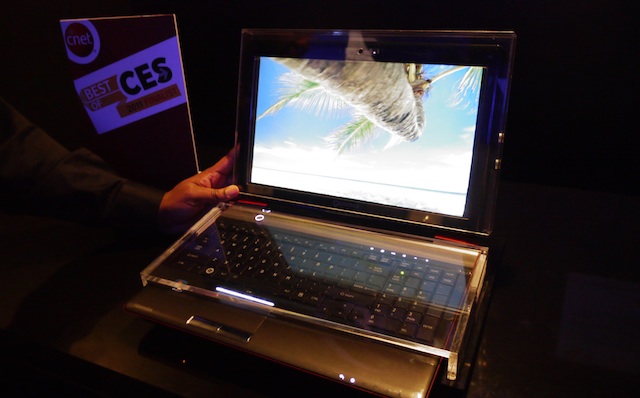
At the Consumer Electronics Show (CES) this month in Las Vegas, we got our first look at some of the experimental glasses-free 3D prototypes developed by Sony and Toshiba. The products we tested ranged from portable players to full-sized televisions. We found that glasses-free technology works very well on small-sized displays, but scaling it up to big screen televisions is proving difficult for the industry leaders.
How glasses-free 3D works
As many readers probably already know, the key to creating a 3D image is to display a slightly different version of the image to each eye, such that the viewer’s brain will combine them and perceive depth. Active shutter glasses achieve this by using a technique called alternate-frame sequencing—blocking vision out of one eye at a time and rapidly alternating so that each eye effectively only sees half of the frames. In order for this to work, you need a television with a high refresh rate (at least 120hz) and you need to be able to synchronize the image on the screen with the blocking mechanism in the glasses.


 Loading comments...