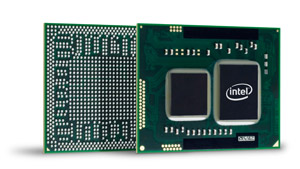
Intel finally took the wraps off its latest ULV mobile processors, aimed directly at the ultra-thin portable category. However, these new processors don’t present a clear upgrade path for the MacBook Air, leaving Apple with no good choices to make when it comes to refreshing its own ultra-thin laptop.
The most likely candidate from Intel’s latest Core i3, i5, and i7 mobile processors is the Core i5-540UM. Though its nominal speed rating is only 1.2GHz—much lower than the current MacBook Air’s LV Core 2 Duo at 1.86GHz or 2.13GHz—it can boost a single core up to 2GHz when conditions are right for Turbo Boost. Both cores are also hyperthreaded, so some performance advantages still exist on certain hyperthreading-friendly workloads even when running at a lower clockspeed.
However, there’s a slight potential performance disadvantage to going this route compared to the Core 2 Duos currently used. According to Intel’s specs for the 540UM, the processor comes with 3MB of cache, down from 6MB. This shrunken cache, when combined with hyperthreading, could be a recipe for some thrashing-induced slowdowns on more highly threaded workloads.
The cache issue is pretty trivial, though, compared to the choices Apple faces for graphics. Like the rest of Intel’s Arrandale-class mobile processors, these newest ULV models are still saddled with the fair-to-middling Intel HD integrated graphics processor stuck right on the processor package. This updated IGP is certainly an improvement over previous Intel offerings, but it won’t cut it as far as Apple is concerned—the IGP is roughly comparable to Apple’s last-generation NVIDIA 9400M integrated graphics, and isn’t compatible with OpenCL.

 Loading comments...