Skip to content
Features

Science of speed: in the pit with the world’s greenest racers

High oil prices and worries over climate change represent growing problems for …

Jonathan M. Gitlin | 0
Story text

The American Le Mans Series? That sounds French…

The world of motorsport spans many different levels, from the amateur enthusiast club racers all the way to the billion-dollar budgets of Formula One. Formula One might be seen as the zenith of racing technology, but in truth, the relevance of F1 racing to road cars is quite minor. And though NASCAR may provide gladiatorial thrills, as the all-but-identical machines jostle for position around the tracks in their modern-day arenas, carbureted V8s and 1960s suspension technology have just as little relevance to the cars we drive as F1 V8s that rev to 19,000 rpm.

No, to find the race series that arguably does the most to improve the breed, you have look to sports car racing, as conducted at the annual 24 Hours of Le Mans and in the American Le Mans Series. The ALMS, now in its tenth year, has more than just speed on its mind, though. This race series is also pushing its participants to go green, and some of them are responding successfully with alternative fuels and technologies that could eventually make their way from the racetrack into the wider auto fleet. The Corvette Racing team from General Motors is one such group, and we recently spent some time in the pit checking out their cars and talking with them about their approach to green racing.

The ALMS is a multi-format racing series with four distinct classes of car taking taking the track, the fastest of which are the two prototype classes, P1 and P2. These cars share some design features with F1 cars; a carbon fiber chassis, high levels of aerodynamic grip, and looks that don’t really resemble anything else on the road (with the exception of a few trackday specials). The other two classes, GT1 and GT2, are based on production cars with a greater (GT1) or lesser (GT2) degree of modification allowed. Although most of the entrants in the GT classes are privateers, General Motors fields a works team in GT1 with their Corvette C6.R. A few months back, I wrote about this team for Nobel Intent, where I described their plans to run the season powered by cellulosic ethanol E85 from the first operational cellulosic ethanol plant in the US.

In taking this greener turn, the ALMS is addressing a problem will be a growing one for racing enthusiasts in coming years. Oil will almost certainly continue to increase in price due to demand and scarcity, and this trend, especially combined with the problem of climate change, means that racing, an activity that automakers compete in partly for PR and marketing reasons, is going to be increasingly under the spotlight. In order to remain relevant to the general public, the motorsports world is going to have to adapt, and the ALMS is providing a venue for that to happen with an emphasis on green racing technology.

What’s racing got to do with green?

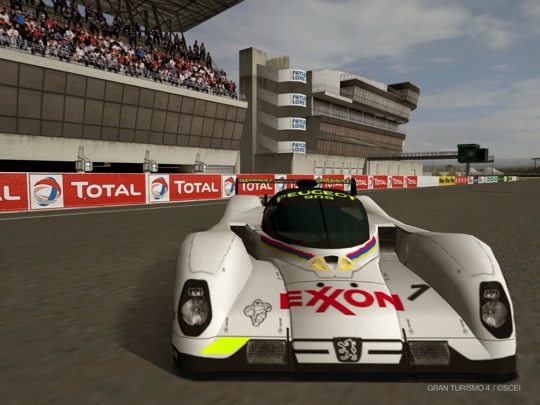
A similar move towards fuel efficiency happened in the wake of the 1970s oil crisis, when the governing body of the Le Mans 24-hour race revised their rules to make the race series an efficiency formula, where teams would be allowed only a set amount of fuel for each race. This grew into Group C, which raced during the 1980s before expiring due to the spiraling costs. Back then, the sanctioning body was only concerned about regular gas-powered engines. Now though, they're looking at multiple options. 


Peugeot 905, last of the Group C cars

In the prototype classes, Audi and Peugeot have been having great success with diesel powered engines, and the ALMS has been pushing other teams to green up their act. Ethanol-blend fuels were recently introduced, and many of the (gas-powered) grid now uses E85, which is 85 percent ethanol and 15 percent gasoline. But such biofuels, and bioethanol in particular, have come under attack recently. Critics point to the diversion of arable land from food production, which has led (in part) to an increase in grain prices. 

As ever, the truth lies somewhere in the middle, and not all bioethanol comes from corn. Corn ethanol relies on the high carbohydrate content of the corn kernels; these sugars are relatively easy for yeast to convert into ethanol, which can then be distilled. Cellulosic ethanol instead makes use of all the leftover bits. Cellulose is also made up of sugars, but in stiffer polysaccharide chains. These are quite strong and coated in lignin, so it's a real effort to first break them down and then to metabolize them into alcohol.

A lot of people have been working on this cellulosic ethanol problem, and several groups have arrived at solutions, often involving specially engineered enzymes or processes that break down the lignin and allow access to the cellulose. KL Process Design are one of the groups to arrive at a workable solution, and early this year, they brought the US' first cellulosic plant online in Wyoming. The plant uses forest waste from nearby pine forests; slash piles, dead trees, needles, and so on. It's even been successfully run on cardboard and paper, which is encouraging to know, given how much cardboard packaging we seem to be using as a society these days.

As already mentioned, Corvette racing announced their intention to run the season on cellulosic E85 obtained from KL Process Design. I got a chance to meet with the team at a recent round of the series, held at the Mid-Ohio course in Lexington, OH, and to have a look at these awesome machines and to speak to some of the engineers involved.

That’s a pretty mean-looking race car

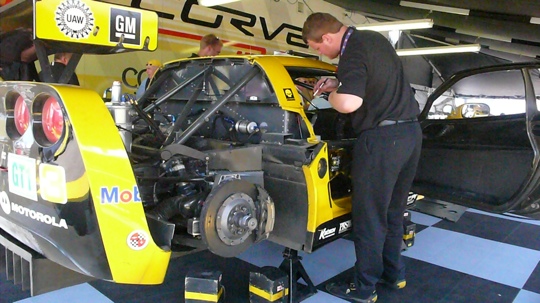
The ethanol-burning racecars are based on road-going Corvette Z06s, and unlike some other racing series, they aren't just silhouette cars (a tubeframed chassis clothed in body panels that match the roadgoing car). The two C6.Rs started life in Bowling Green, KY, just like every other Corvette, but where the street Z06 uses aluminum for its frame, the racing cars actually use the steel parts from the 'base' C6, since it's easier to fix the (steel) rollcage to other steel components.


Unlike your neighbor's Civic, the C6.R actually needs those wings.

The cars then travel to Pratt and Miller's Detroit base for transformation. Carbon fiber body panels replace fiberglass for both lightness and strength, and come complete with wings, splitters, and a massive rear diffuser to manage the airflow. Speaking to Steve Wesoloski, GM Racing's Road Racing group manager, I found out that, depending on the track, the cars will produce between 1,500 and 2,000 lbs of downforce. When you consider that the car itself only weighs 2,425 lbs, you can appreciate how that helps keep it on track.

As readers of the recent fuel efficiency article will remember, the shape of a car and the way that it manages airflow has a significant effect on performance and economy. In racing, this is more true than ever; you want low drag for the straights, but aerodynamic grip or downforce (think lift in reverse) to help the car in the turns. The work on the aerodynamic side of things is done by Corvid in North Carolina, who have worked on a number of racing projects when they're not busy applying that CFD knowledge to making more aerodynamic missiles.


Rear suspension

The suspension is a little different than that of the road cars, in that the transverse leaf springs are replaced by coil springs and dampers. There's nothing inherently wrong with the Corvette's leaf springs (which act in a different manner to the longitudinal leaf springs found underneath most pickup trucks), but since everyone else in racing uses coil springs and dampers, that's where the expertise is.


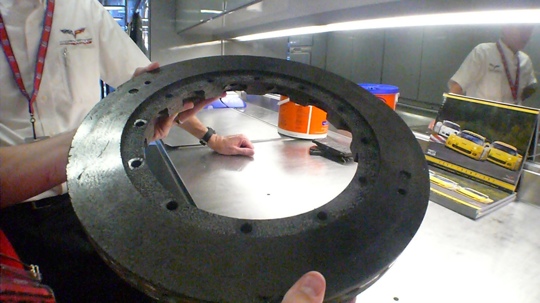
One way of looking at this brake disc is as several lbs of sequestered carbon. Remember to wash your hands after, though.

The brakes also differ from the road car's, in that the pads and the discs are made from carbon. This makes them lighter than steel or even carbon-ceramic road brakes, but they’re still able to cope with the heat of racing. Lighter brakes are especially important since this part of the braking mechanism is unsprung weight (not supported by the suspension), and reducing weight here has a large effect on handling. Between the carbon fiber bodywork and the carbon brakes, it's almost as if the car itself is doing its bit to sequester!

What’ll she do, mister?

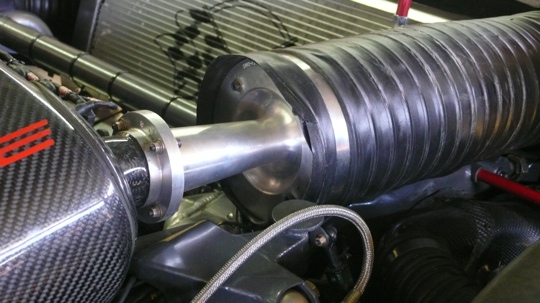
The seven-liter LS7R engine that powers the two racecars is closely related to the one in the Z06, although it produces 100 more horsepower. While 600 bhp from seven liters doesn't sound that impressive, consider that it's because the engine has to breathe through a pair of 32.8mm air restrictors, mandated by the technical regulations in order to keep speeds sensible. The engines are actually also tuned such that they'd still put out around 600 bhp if the restrictors were removed, but with a little rejiggering, 900 bhp wouldn't be out of the question!


That narrow pipe is the air restrictor.

In contrast to its NASCAR program, the ALMS offers GM a chance to develop engine technology that's directly applicable to the road cars it makes, and that's one of the reasons that the automaker jumped the chance to run the whole season on cellulosic E85. Very few modifications needed to be made compared to last year's conventionally-powered cars. Since E85 has a lower energy density (albeit a higher octane) than racing gas, the team was allowed to fit the racecars with a larger tank. They ran into problems at first, as the fuel cells were prone to leaking. But new adhesives were chosen that aren't degraded by the higher ethanol content, and now the only thing that drains the tank is the fuel pump.

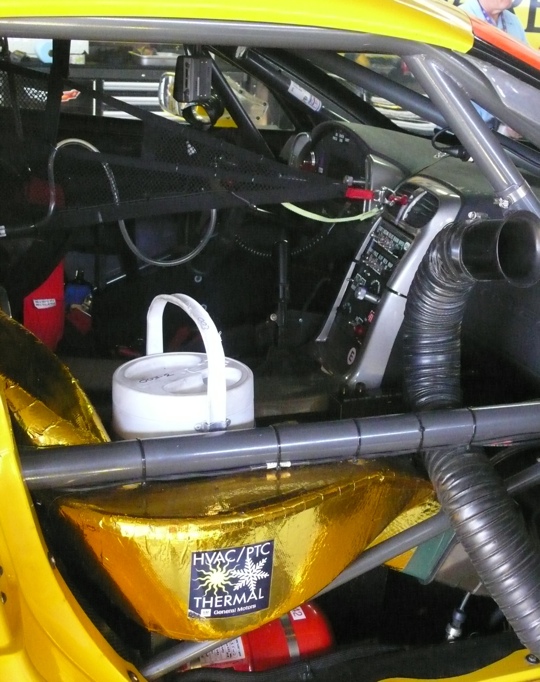
The engine doesn't just power the car down the road; this racing car comes complete with AC, and it's the same system used in other GM road cars (part of it can be seen in the foreground of the picture). The AC is mandated by the technical regulations, to prevent the insides of these cars from cooking the drivers as they race, and came with a slightly larger air restrictor to compensate.


Off-the-shelf AC system from the GM parts bin.

Air vents in the mirrors draw air through the doors and cool it, where it's piped directly into the drivers' helmets as well as into the car. On a day like the one we witnessed at Mid Ohio, with temperatures in the 90s, it would seem like a necessity, but I was told that in some of the cooler races the drivers have to remind the team to turn the system down a notch or too since it can get quite chilly.

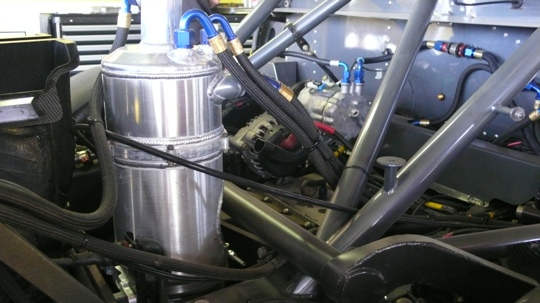
Behind the driver is a solid firewall, which means the rear view mirror is replaced by a rear-mounted camera with an LCD in the cockpit. The oil tank for the engine is also behind this firewall, for better weight distribution, along with not one but two starter motors. The rules state that the cars must be able to start themselves, and having a backup makes a lot of sense for a 24-hour race.


The oil tank and one of the two starter motors, sitting atop the gearbox

Sensors on the car record a host of telemetry data that's beamed back to the pit wall, monitoring everything from tire pressures to engine or oil temperature, fuel levels, and so on, so problems can be spotted and potentially fixed without having to retire.

When it comes to planning race strategy, the team use a custom software program (Pratt & Miller Lap Time Simulation) that can even take suspension set-up into account to work out optimum fuel loads and pit stop windows. According to Steve Wesoloski, the simulations are accurate enough to be able to tell the drivers if they should be going faster!

The Green Racing Challenge

Speaking of Corvette Racing's drivers (Ollie Gavin, Olivier Beretta, Johnny O'Connell, Jan Magnussen, and Ron Fellows) I managed to conduct a straw poll for the Opposable Thumbs crew, who wanted to know the answer to a simple question: "Gran Turismo or Forza?" Unfortunately for Microsoft and Turn 10, the score was GT 3, Forza 1, with only O'Connell preferring Forza (although he told me he'd rather play Call of Duty than a racing game anyway).


The #3 and #4 cars at Lime Rock

Sadly, this year has seen little competition in GT1 for the Corvettes away from Le Mans. Their archrivals, the UK-based Prodrive, only brought their Aston Martin DB9Rs to that race, and didn't compete a full season in the US. Prodrive are the only other team that are even capable of giving Pratt and Miller a run for their money, and this season has seen the occasional privateer GT1 car at a race, but always a distant third behind the two yellow monsters. Despite this, the #3 and #4 cars don't mess around on track—at Mid Ohio, they were both given stop-go penalties for barging into each other on the way out of the pits, with each car trying to make sure it was in the lead.

The next big challenge for the GM team is at the Petit Le Mans, a 10-hour race held in October at Road Atlanta, GA. The race will feature the "Green Racing Challenge" race within a race. This is being organized in conjunction with the Environmental Protection Agency, the Department of Energy, and SAE International, and will take into account various measures of energy consumption, greenhouse gas emissions, and other factors to calculate who went furthest and fastest the most cleanly. Corvette Racing won't be the only team looking for honors in this category; a UK-based team, Eco Racing, hope to contest with a P2 prototype that features solar panels for charging the battery and even hemp body panels!


The Eco Racing Radical during scrutineering at Sebring

With initiatives such as the Green Racing Challenge working to spur more environmentally-friendly racing cars, it is still possible to care about both the planet and going fast. And if green racing helps to develop road cars that have less of an environmental impact, the whole world wins.

Most recent ALMS race was held this past weekend, August 22-24 at Mosport in Canada. The next round will be held in Detroit on August 30th and can be seen on Speed TV live from 2.30 PM EDT on the 30th.

Photo of Jonathan M. Gitlin
Jonathan M. Gitlin Automotive Editor
Jonathan is the Automotive Editor at Ars Technica. He has a BSc and PhD in Pharmacology. In 2014 he decided to indulge his lifelong passion for the car by leaving the National Human Genome Research Institute and launching Ars Technica's automotive coverage. He lives in Washington, DC.
0 Comments