
You are using an out of date browser. It may not display this or other websites correctly.
You should upgrade or use an alternative browser.
You should upgrade or use an alternative browser.
Video demonstrates the marvel of CRT displays at 380,000 frames per second
- Thread starter JournalBot
- Start date
Post content hidden for low score.
Show…
VulcanTourist
Ars Scholae Palatinae
I just want a large OLED display that makes good on the old promise that it consumes far less electricity than even its LCD counterparts. I've been waiting for so many years now that I've lost count.
Upvote
24
(31
/
-7)
Digital Dud
Ars Praefectus
So if you had an LCD that ran at 380,000hz refresh rate you could emulate a CRT pretty accurately. Maybe even get light gun games to work.
Upvote
80
(82
/
-2)
Wow. That was pretty amazing, watching the CRT scanning.
Also, seeing the pixel grid on the LCD TV was intriguing. I had no idea that panels used 9 sub-pixels to better control the fine brightness levels. (It's not something he called out in the video, but you can clearly see the top dot in the sub-pixel lighting up, then the lower dots lighting up in sequence as the brightness of the pixel goes up.)
I'm happy to have learned something today!!
Also, seeing the pixel grid on the LCD TV was intriguing. I had no idea that panels used 9 sub-pixels to better control the fine brightness levels. (It's not something he called out in the video, but you can clearly see the top dot in the sub-pixel lighting up, then the lower dots lighting up in sequence as the brightness of the pixel goes up.)
I'm happy to have learned something today!!
Upvote
107
(107
/
0)
killerhurtalot
Ars Praefectus
I just want a large OLED display that makes good on the old promise that it consumes far less electricity than even its LCD counterparts. I've been waiting for so many years now that I've lost count.
OLED isn't energy efficient in producing bright colors though. I remember some study that after 250-300 nit, it consumes more power than LEDs.
Most of the content that people watch is bright because it pops out... So unless you change the way things are filmed, it's not gonna happen?
Upvote
23
(24
/
-1)
I just want a large OLED display that makes good on the old promise that it consumes far less electricity than even its LCD counterparts. I've been waiting for so many years now that I've lost count.
That's actually not possible. LED's are going to take roughly the same amount of energy to generate the same amount of light, and so OLED, Quantum Dot, and LED-lit LCD panels should all take roughly the same amount of energy.
OLED will use less energy than fluorescent-lit displays, but I think all new TVs have moved to LED backlighting these days.
Upvote
-15
(6
/
-21)
Hah, I eagerly clicked on the link expecting a CRT actually running at 380,000 Hz. That would have been something.
I would guess that most LCD PC monitors and laptops are also running at 60 Hz without black frame insertion / strobing backlight. To do better it seems you need more expensive freesync or g-sync monitors and video cards. But from what I've read, gamers prefer adaptive refresh rates over black frame insertion.
It seems that VR headsets are the most common place to find black frame insertion these days.
I would expect a display made of discrete regular (not organic) LEDs to be much more power efficient than the same size LCD.
A lot of LCD TVs have optional black frame insertion, but my impression is that it's off by default. Most TVs and their content run at 60 Hz, and 60 Hz flicker can be very noticeable and annoying. Anyone remember 60 Hz CRT computer monitors?The video illustrates CRTs fairly well and his subpixel shots of the LCD and OLED screens are fantastic. However, it is absolutely worthless at showing what he claims to be showing in the beginning of the video. Even a 120fps camera can show backlight strobing and black frame insertion, which are used in the vast majority of decent modern LCD sets to help ameliorate motion blur, but we see none of that.
As for CRTs, Engineering Connection's videos are better, though much less slickly produced.
I would guess that most LCD PC monitors and laptops are also running at 60 Hz without black frame insertion / strobing backlight. To do better it seems you need more expensive freesync or g-sync monitors and video cards. But from what I've read, gamers prefer adaptive refresh rates over black frame insertion.
It seems that VR headsets are the most common place to find black frame insertion these days.
Don't the polarizers in the LCD immediately throw out 50% of the backlight energy? I think that's the primary theoretical inefficiency that LED displays can avoid.I just want a large OLED display that makes good on the old promise that it consumes far less electricity than even its LCD counterparts. I've been waiting for so many years now that I've lost count.
That's actually not possible. LED's are going to take roughly the same amount of energy to generate the same amount of light, and so OLED, Quantum Dot, and LED-lit LCD panels should all take roughly the same amount of energy.
OLED will use less energy than fluorescent-lit displays, but I think all new TVs have moved to LED backlighting these days.
I would expect a display made of discrete regular (not organic) LEDs to be much more power efficient than the same size LCD.
Upvote
53
(53
/
0)

Statistical
Ars Legatus Legionis
I just want a large OLED display that makes good on the old promise that it consumes far less electricity than even its LCD counterparts. I've been waiting for so many years now that I've lost count.
Your not going to get that with W-OLED which is the only variant of OLED that anyone has gotten to work at the size, PQ, and endurance required for TVs. With W-OLED it starts with all subpixels as white OLEDs and then that white light is passed through red, green, and blue color filters to produce the subpixels. That color filter means you end up dropping about 2/3rds of the light (less if the panel has a 4th white subpixel).
Still even a 65" OLED is going be average somewhere around 120W which is pretty damn efficient compared to old CRT TVs.
Upvote
42
(42
/
0)
BigBadSubaru
Wise, Aged Ars Veteran
"The iPhone works from side-to-side: it uses the user's perspective, because the phone's display always works as if it's in portrait mode."
Can someone elaborate on this?
The phone's screen updates from top to bottom, so when you are holding the phone sideways even though the phone rotates the image to landscape mode, the screen itself is still updating top to bottom (which will be left to right or right to left depending on how you flipped it)
Upvote
60
(61
/
-1)
Statistical
Ars Legatus Legionis
I just want a large OLED display that makes good on the old promise that it consumes far less electricity than even its LCD counterparts. I've been waiting for so many years now that I've lost count.
That's actually not possible. LED's are going to take roughly the same amount of energy to generate the same amount of light, and so OLED, Quantum Dot, and LED-lit LCD panels should all take roughly the same amount of energy.
OLED will use less energy than fluorescent-lit displays, but I think all new TVs have moved to LED backlighting these days.
OLED in theory could use less in real world usage because content will be a mix of bright and dark scenes. In theory OLED power consumption would be based on the average luminance of all content watched while. LCD also end up blocking a significant amount of the light even if you are showing a white scene. In a mostly black scene you are using far more power than what is being emitted.
So OLED being emissive could cut down on energy however W-OLED uses a color filter in front of white subpixels so you end up blocking about 2/3rds of the light (a little less when a 4th white subpixel is used) and that pushes power consumption up. If you could make a RGB-OLED panel for a TV you could cut the power consumption by at least by half and possibly up to 2/3rds. Of course nobody has been able to do that. Still an 80" OLED using 80W would be nice.
Upvote
23
(23
/
0)
Sure they have!If you could make a RGB-LED panel for a TV you could cut the power consumption significantly at least by half and approaching 2/3rds. Of course nobody has been able to do that.

OK.... technically not a TV. No integral tuner.
On a more serious note, what ever happened with Sony's Crystal LED?
[edit]fixed image
Upvote
12
(13
/
-1)
Or rather ~29.97 HzMinor nitpick: The venerable NTSC standard had a refresh rate of 59.97 Hz, not 60.
Upvote
22
(29
/
-7)
There's The Wall, just recently shown at CES:Sure they have!If you could make a RGB-LED panel for a TV you could cut the power consumption significantly at least by half and approaching 2/3rds. Of course nobody has been able to do that.

OK.... technically not a TV. No integral tuner.
On a more serious note, what ever happened with Sony's Crystal LED?
https://news.samsung.com/global/samsung ... 46-inch-tv
Upvote
10
(10
/
0)
Refresh rate is not the problem. Old light guns won't ever work with LCD/LED displays unfortunately. https://en.wikipedia.org/wiki/Light_gun ... ray_timing explains in detail how the light guns work and why LCD/LED displays can't emulate the behaviour accurately. But it doesn't matter. We have better technology now to accurately determine the direction at which something is pointing, so it should be possible to build a new type of light gun that works with every new display technology and that fakes old style light gun behaviour in a way that is compatible with, say, an NES console. But I bet the market is too small and building the thing is too expensive.So if you had an LCD that ran at 380,000hz refresh rate you could emulate a CRT pretty accurately. Maybe even get light gun games to work.
Upvote
6
(15
/
-9)
"The iPhone works from side-to-side: it uses the user's perspective, because the phone's display always works as if it's in portrait mode."
Can someone elaborate on this?
The phone's screen updates from top to bottom, so when you are holding the phone sideways even though the phone rotates the image to landscape mode, the screen itself is still updating top to bottom (which will be left to right or right to left depending on how you flipped it)
OK, but isn't that how all displays work? Well except for my OP5, which is another story.
Upvote
6
(6
/
0)

CircleBreaker
Ars Scholae Palatinae
Huh, pretty incongruous for me seeing Gavin Free turn up on Ars.
Upvote
9
(9
/
0)
Do people really not understand how raster imaging works, and need a tutorial?
Maybe it's just me. I'm just barely old enough to remember when you fixed your TV by taking out the tubes and taking them to Woolworths to use the Tube Tester. And we wore an onion on our belt as was the fashion at the time.

Maybe it's just me. I'm just barely old enough to remember when you fixed your TV by taking out the tubes and taking them to Woolworths to use the Tube Tester. And we wore an onion on our belt as was the fashion at the time.
Upvote
69
(75
/
-6)
I just want a large OLED display that makes good on the old promise that it consumes far less electricity than even its LCD counterparts. I've been waiting for so many years now that I've lost count.
Given how LCD TV consume average somewhere around 100W for a 55", if you'd have it on for 10h a day and pay rather expensive Californian 12 cents per kilowatt-hour, that's still like $3.50 a month. Suppose you could save half of that. meh.
Upvote
9
(12
/
-3)
I just want a large OLED display that makes good on the old promise that it consumes far less electricity than even its LCD counterparts. I've been waiting for so many years now that I've lost count.
That's actually not possible. LED's are going to take roughly the same amount of energy to generate the same amount of light, and so OLED, Quantum Dot, and LED-lit LCD panels should all take roughly the same amount of energy.
No, they wouldn't. In case of OLED, there is no extra layer in from of the light source. In case of LCD, only small portion of the light passes through, because of the polarizing filters as well as the fact, that only there is black space between the pixels. And generally the smaller the LCD pixels, the more backlight is necessary for same screen brightness.
Upvote
8
(10
/
-2)
That’s the frame rate, not the refresh rate.Or rather ~29.97 HzMinor nitpick: The venerable NTSC standard had a refresh rate of 59.97 Hz, not 60.
Upvote
33
(33
/
0)

Reminds me of being a kid in the late 80's early 90's, and putting my dads binoculars backwards in front of CRT TV, and seeing all those individual RGB colors.
Upvote
14
(14
/
0)
Video demonstrates the marvel of CRT displays at 380,000 frames per second
Am I the only one who read this and immediately pulled out their wallet ready to buy this 380KHz CRT?
Now, if I can just find that GPU that can do 380K FPS.
Upvote
14
(16
/
-2)
SymmetricChaos
Ars Tribunus Militum
Do people really not understand how raster imaging works, and need a tutorial?
Most people have never even heard the word "raster" in their lives. Also this kind of stuff is great for kids.
Upvote
49
(49
/
0)
This is also why it is extremely hard to simulate the low persistence of CRT using a digital display -- even for strobed backlights and pulsed rolling-scan OLEDs.
CRT electron gun beam dot shines pretty much north of 10,000 nits for ~0.1 millisecond (from 50%-to-50%).
Display motion blur is related to persistence (pixel visibility time) from the ON-to-OFF, whereas 1ms of persistence translates to 1 pixel of display motion blur per 1000 pixels/second.
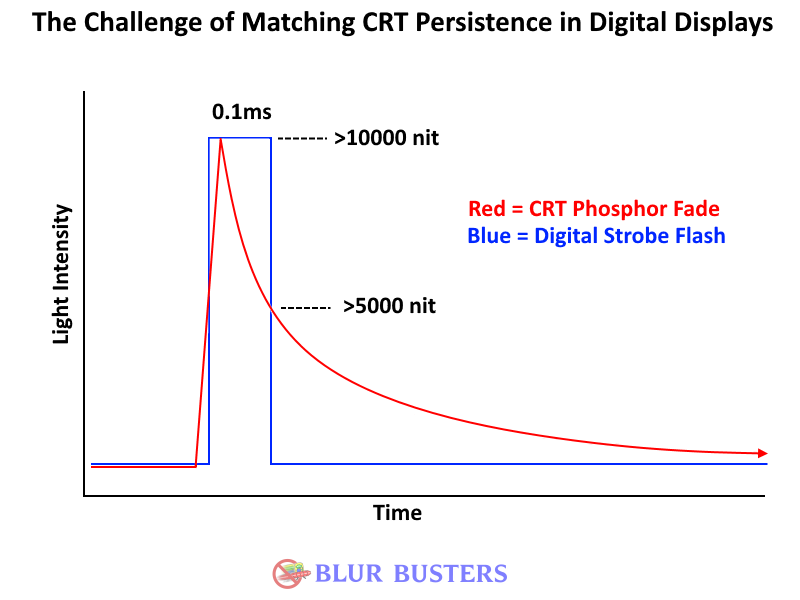
That's why we are stuck with using impulsing (strobing, flicker, black frame insertion) to reduce display motion blur. This concept is demonstrated in the Black Frame Insertion Animation. Pixel response (GtG) is not the primary motion blur factor -- it's pixel visibility time, aka persistence. (Basically: How long a pixel is illuminated for) -- which influences how much the static pixel is motion-blurred across your eyes during your eye-tracking motion, as shown at Eye Tracking Display Motion Blur Animation.
In the long term, instead of strobing or black frames (flickering) -- the use of flickerfree blurless sample and hold (via true genuine-1000 Hz displays) will arrive by the 2020s-2030s as a method of low-persistence without strobing.
A true-480Hz display (2ms persistence without strobing) has now been
tested and a true-1000Hz display (1ms persistence without strobing) are in the laboratory already.
Even 480Hz shows limitations in things like stroboscopic effects:
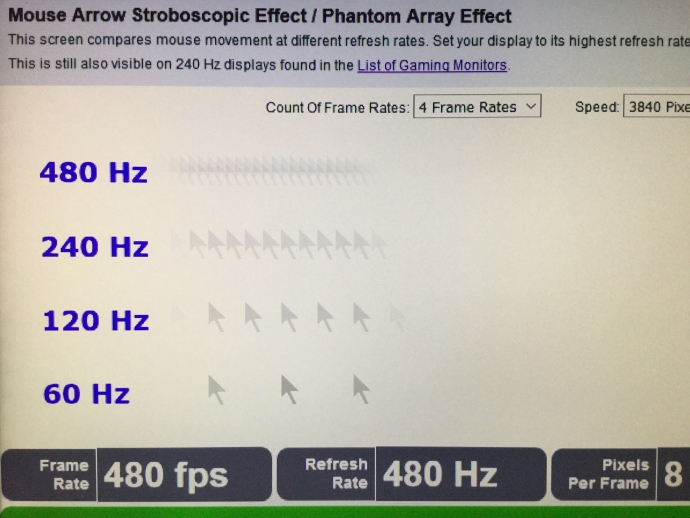
While resolutions have now finally gone retina (8K), refresh rates are still far away from having fully reached retina (simultaneously strobefree + blurfree).
Display motion blur is caused by persistence, is well-demonstrated in motion animations such as TestUFO Persistence Of Vision.
Doubling refresh rates on a CRT (since the already-short phosphor persistence is unchanged) didn't reduce blur like doubling refresh rates on LCD (since full-refresh-cycle persistence is halved). So doubling refresh rates on a sample-and-hold display halves motion blur. So you can keep going up and up, 120Hz -> 240Hz -> 480Hz -> 1000Hz to push the "diminishing points of return" envelope.
There is also a vicious cycle effect where higher resolutions require ever-lower persistence to eliminate the difference of sharpness between static imagery and moving imagery.
Lately, this is a very intense area of study by virtual reality scientists (who nearly universally agree on 1000Hz now) where imperfections caused by using a series static-images to represent moving images -- causes side effects such as persistence (motion blur) and stroboscopic effects. The only way to fix both simultaneously, is ultra-high refresh rates.
There is an eventual need for 1000Hz displays (once sufficiently inexpensive to engineer in humankind) to achieve low-persistence without strobing (no motion blur, no flicker, no PWM, no wagonwheel effects, no impulsing, no phosphor decay, no black frame insertion). This is well-explained in Blur Busters Law: The Amazing Journey To Future 1000Hz Displays.

There are citations from many good scientists (Oculus, NVIDIA, etc) that confirm the benefits of quadruple-digit refresh rates as an alternative to strobed/flicker based methods of display motion blur reduction.
While useful for displays, it is even more important for VR. In virtual reality, anything that differs from real life (e.g. display motion blur, stroboscopic effects, etc) can create VR nausea, so Holodecks will require insane refresh rates to pass the reality test, with zero motion blur above-and-beyond human vision limitations.
CRT electron gun beam dot shines pretty much north of 10,000 nits for ~0.1 millisecond (from 50%-to-50%).
Display motion blur is related to persistence (pixel visibility time) from the ON-to-OFF, whereas 1ms of persistence translates to 1 pixel of display motion blur per 1000 pixels/second.
That's why we are stuck with using impulsing (strobing, flicker, black frame insertion) to reduce display motion blur. This concept is demonstrated in the Black Frame Insertion Animation. Pixel response (GtG) is not the primary motion blur factor -- it's pixel visibility time, aka persistence. (Basically: How long a pixel is illuminated for) -- which influences how much the static pixel is motion-blurred across your eyes during your eye-tracking motion, as shown at Eye Tracking Display Motion Blur Animation.
In the long term, instead of strobing or black frames (flickering) -- the use of flickerfree blurless sample and hold (via true genuine-1000 Hz displays) will arrive by the 2020s-2030s as a method of low-persistence without strobing.
A true-480Hz display (2ms persistence without strobing) has now been
tested and a true-1000Hz display (1ms persistence without strobing) are in the laboratory already.
Even 480Hz shows limitations in things like stroboscopic effects:
While resolutions have now finally gone retina (8K), refresh rates are still far away from having fully reached retina (simultaneously strobefree + blurfree).
Display motion blur is caused by persistence, is well-demonstrated in motion animations such as TestUFO Persistence Of Vision.
Doubling refresh rates on a CRT (since the already-short phosphor persistence is unchanged) didn't reduce blur like doubling refresh rates on LCD (since full-refresh-cycle persistence is halved). So doubling refresh rates on a sample-and-hold display halves motion blur. So you can keep going up and up, 120Hz -> 240Hz -> 480Hz -> 1000Hz to push the "diminishing points of return" envelope.
There is also a vicious cycle effect where higher resolutions require ever-lower persistence to eliminate the difference of sharpness between static imagery and moving imagery.
Lately, this is a very intense area of study by virtual reality scientists (who nearly universally agree on 1000Hz now) where imperfections caused by using a series static-images to represent moving images -- causes side effects such as persistence (motion blur) and stroboscopic effects. The only way to fix both simultaneously, is ultra-high refresh rates.
There is an eventual need for 1000Hz displays (once sufficiently inexpensive to engineer in humankind) to achieve low-persistence without strobing (no motion blur, no flicker, no PWM, no wagonwheel effects, no impulsing, no phosphor decay, no black frame insertion). This is well-explained in Blur Busters Law: The Amazing Journey To Future 1000Hz Displays.
There are citations from many good scientists (Oculus, NVIDIA, etc) that confirm the benefits of quadruple-digit refresh rates as an alternative to strobed/flicker based methods of display motion blur reduction.
While useful for displays, it is even more important for VR. In virtual reality, anything that differs from real life (e.g. display motion blur, stroboscopic effects, etc) can create VR nausea, so Holodecks will require insane refresh rates to pass the reality test, with zero motion blur above-and-beyond human vision limitations.
Upvote
54
(55
/
-1)
DMD with an obscenely bright projector bulb?CRT electron gun beam dot shines pretty much north of 10,000 nits for ~0.1 millisecond (from 50%-to-50%).
Why? The video itself has one.You might want to put up an epilepsy warning.
Upvote
28
(28
/
0)
You might want to put up an epilepsy warning.
You mean like the epilepsy warning about three seconds in to the video?
Upvote
47
(47
/
0)
You bring up a very good point there.Why? The video itself has one.You might want to put up an epilepsy warning.
Upvote
13
(15
/
-2)
I just want a large OLED display that makes good on the old promise that it consumes far less electricity than even its LCD counterparts. I've been waiting for so many years now that I've lost count.
That's actually not possible. LED's are going to take roughly the same amount of energy to generate the same amount of light, and so OLED, Quantum Dot, and LED-lit LCD panels should all take roughly the same amount of energy.
This is like saying that all cars have the same fuel efficiency because they all have engines. Not true, the type of car/engine makes a very big difference! It is the same with LEDs, the efficiency varies by orders of magnitude depending on what they're made of. Even for relatively boring old visible light LEDs, the efficiency of blue is much better than green for instance.
By the way, quantum dots are a type of "phosphore", not a type of LED. A QD backlight is just a normal blue backlight, but using a QDs as the "phosphore" instead of YAG.
OLED will use less energy than fluorescent-lit displays, but I think all new TVs have moved to LED backlighting these days.
OLEDs are much less energy efficient than white LEDs based on a GaN pumped phosphore (QD or YAG), but they can make up for it if the screen has a lot of dark pixels since they don't waste energy on blacks.
Don't the polarizers in the LCD immediately throw out 50% of the backlight energy? I think that's the primary theoretical inefficiency that LED displays can avoid.
On older or less efficient panels, yes. On newer ones they do polarization harvesting, where the opposite polarization is backscattered rather than absorbed and then some of it is reflected back after rotation. This way you can recover some of the half of the energy that is in the wrong polarization state.
Upvote
10
(12
/
-2)
That can make it easier to reduce persistence (shorter flash, longer black frames). However, DMD has lots of difficulty with color depth during shorter persistence. This is because the colors are generated temporally.CRT electron gun beam dot shines pretty much north of 10,000 nits for ~0.1 millisecond (from 50%-to-50%).
DMD with an obscenely bright projector bulb?
There is now a true-1440Hz scientific DLP projector for vision-research on the market now (linked in that 1000Hz article). It's full-persistence refresh cycles (no black frame insertion) -- by avoiding strobing, full brightness can be kept without a brighter bulb.
At 1440Hz, you only have greyscale, instead of 24+ bits of color -- because of lack of time for DLP to generate the colors temporally in such short refresh cycle visibilities (whether consecutive, 1440Hz, or via brief flashes during black frame insertion).
For strobing or BFI, reducing persistence by 90% has the unfortunate disadvantage of reducing light output by 90%.
The two main ways to reduce display motion blur, via shortening frame visibility time (persistence):
(1) Flash the pixel briefer (black periods in between)
(2) Fill all timeslots with ever-shorter new, unique frames.
So 1ms persistence requires either a 1ms flash per pixel per refresh cycle (strobing method) -- or a thousand consecutive 1ms frames (1000fps@1000Hz strobeless method). The strobing method requires double brightness in order to halve persistence (flash time) without making the picture dimmer. While the strobeless method doesn't have that disadvantage.
After displays went retina (8K), refresh rates are still far away from going retina. There are a lot of indirect side effects (motion blur, stroboscopic effects) of using static imagery to represent moving images. Progress of the 2020s and 2030s will include 1000Hz displays coming to the mainstream, in applications such as virtual reality.
Upvote
10
(11
/
-1)
Post content hidden for low score.
Show…
Old. Crusty. Dead technology. Who cares.
Ars, stop writing to cater to the nostalgia of the olds. They don't welcome innovation, and moreover - they're dying off.
EDIT: Oh here we go with downvotes from the over 40 crowd. Get over yourselves, it's not my problem that you can't keep up.
No one is calling for the return of CRTs. It's a video explaining the difference between how the old CRTs worked versus the LCDs, LEDs, and OLEDs we have today.
Your comment, on the other hand, was just pretentious, stupid, and fairly ignorant. Are your initials DJT?
Upvote
72
(74
/
-2)
Post content hidden for low score.
Show…
It is also worth posting a high speed video of an LCD, and also of a LCD strobe backlight too (ULMB, LightBoost) as well:
https://m.youtube.com/watch?v=hD5gjAs1A
It needs to be eventually redone with a Phanton Flex camera.
https://m.youtube.com/watch?v=hD5gjAs1A
It needs to be eventually redone with a Phanton Flex camera.
Upvote
0
(2
/
-2)
Post content hidden for low score.
Show…

Meanwhile you've visited this article that was clearly labeled about CRTs a minimum of three times.Ars is becoming a Gen-xers nostalgia site. They can pursue that if they want, the result will be loss of relevance.
Upvote
82
(82
/
0)
Thomas Harte
Ars Tribunus Militum
Old. Crusty. Dead technology. Who cares.
Ars, stop writing to cater to the nostalgia of the olds. They don't welcome innovation, and moreover - they're dying off.
EDIT: Oh here we go with downvotes from the over 40 crowd. Get over yourselves, it's not my problem that you can't keep up.
No one is calling for the return of CRTs. It's a video explaining the difference between how the old CRTs worked versus the LCDs, LEDs, and OLEDs we have today.
Your comment, on the other hand, was just pretentious, stupid, and fairly ignorant. Are your initials DJT?
I have no idea who "DJT" is. Ars is becoming a Gen-xers nostalgia site. They can pursue that if they want, the result will be loss of relevance.
I would suggest that if you receive too much blowback here, Twitter might be an ideal forum for your rhetorical style. Or maybe consider becoming a Youtube celebrity?
Upvote
42
(42
/
0)
- Status
- Not open for further replies.