
Review: Exquisite <em>Drops of God</em> brings the world of elite wine down to earth

Setting aside the show itself, hasn't high end wine been pretty thoroughly debunked as bullshit?

When I was young, I worked at the premier wine store in NYC. The list of clients was a who's who of every famous person in the city. I liked wine, for sure, but after I was given truly fine wines as part of our training, I fully understood people writing sonnets about wine. It spoiled me for years, since there was no way I could afford the wines I was trained on or had at the Christmas dinner. So, no, it's not bullshit, you just don't know any better. Be thankful for that.
 
Upvote
33 (48 / -15)

graylshaped

Ars Legatus Legionis
68,348
Subscriptor++
I think my copy was in a box donated to the public library, but "The Billionaire's Vinegar" is an excellent non-fiction book on this topic. If I recall correctly, it starts by discussing Thomas Jefferson's fascination with wine, spends time on discussing the marketplace for highly-priced wines, and ends with disclosing how easy it is to fake those high-end wines.
 
Upvote
5 (5 / 0)

android_alpaca

Ars Praefectus
5,375
Subscriptor
Setting aside the show itself, hasn't high end wine been pretty thoroughly debunked as bullshit?
AFAIK, there is difference with high end vs low end wines (i.e. a sommelier can do a blind taste test and generally identify the high end vs mid vs low end wines, as well as identify not only the type of grapes, but the region of the world the grape was grown in). I think the descriptions of the the wine "floral" are just ways to describe the various flavor/scents of the various volatile organic compound in a way that (while sometimes poetic) that someone else could understand.

The question is whether the differences actually make a substantial difference to the enjoyment of the wine to a regular person and whether those difference are worth the high prices. Personally, I think that is kind of really a personal choice. I'm sure a lot of rich people are buying fancy wines because they can and not because they actually care - but I'm also sure there are some oenophiles that get really pleasure in trying out different wines and stuff. However, that's true in basically all product industries I think.

Personally, I don't drink wine much and anything above the worse level is good enough for me (sometimes when I get dragged to wine tasting event by friend since we live near Napa, I vaguely can tell a difference that they suggest... I just don't really care myself).
 
Last edited:
Upvote
38 (39 / -1)

Frodo Douchebaggins

Ars Legatus Legionis
12,128
Subscriptor
So, no, it's not bullshit, you just don't know any better. Be thankful for that.

The amount of money I've saved in my life by never having consumed alcohol is high, and enabled me to have all sorts of other stupid shit to waste money on instead.
 
Upvote
23 (30 / -7)
Post content hidden for low score. Show…

J.Solo

Wise, Aged Ars Veteran
105
My girlfriend and I stumbled on this show by accident (I don't recall ever seeing a preview for it on Apple TV). It really is exquisite. We were immediately hooked on the series and eagerly waited for the next installment and have recommended it to lots of our friends. Everything from the writing to the cinematography, and little technical details made it one of our all time favorites. I'm sure we'll watch it again now that the whole series can be binged watched.
 
Upvote
18 (18 / 0)

Fred Duck

Ars Tribunus Angusticlavius
7,365
Setting aside the show itself, hasn't high end wine been pretty thoroughly debunked as bullshit?
That sounds of sour grapes.

One simply needs to thoroughly research the top kit. This is why I always wire my Bose speakers with Monster Cable.

In Japan, there are several luxury cultivars of fruit. They're often advertised as high class gifts. As for whether it's worth spending 1 quid for a single cherry, well, here are various articles mostly related to when the staff at the hit site Sora News 24 taste test to see if they can tell the difference between expensive and inexpensive fruit.

Jennifer Ouellette said:
While the Drops of God manga is lively and often irreverent, the series is more somber and serious, though it's not without some lovely humorous interludes.
I don't watch them often but I find Live Action adaptations to be more serious overall. The silly expressions manga characters can pull off don't work with human actors and as with the hit series Honey and Clover, the need to discard as much as possible to compress the story into a much shorter space generally means the comedic bits get short shrift.

There was also a Japanese LA version in 2009.
 
Upvote
18 (18 / 0)
When I was young, I worked at the premier wine store in NYC. The list of clients was a who's who of every famous person in the city. I liked wine, for sure, but after I was given truly fine wines as part of our training, I fully understood people writing sonnets about wine. It spoiled me for years, since there was no way I could afford the wines I was trained on or had at the Christmas dinner. So, no, it's not bullshit, you just don't know any better. Be thankful for that.

Science has repeatedly said otherwise. You're responding to the training in expected ways. IE: You're being trained to push expensive wines on rich people that are expecting to buy expensive wines to flaunt. Price matters only in wines as far as it reinforces a person's biases towards pretense, skewed expectations (the "you get what you pay for" trope), and social standing cues.


This study is directly on point with your claim (and it says it is indeed BS)
https://web.archive.org/web/2023020...nce-from-a-Large-Sample-of-Blind-Tastings.pdf
 
Upvote
9 (17 / -8)

Edgar Allan Esquire

Ars Praefectus
3,100
Subscriptor
I'm a bit surprised it didn't end up on Prime, I thought the manga was being continued under Comixology which was owned by Amazon. I guess that's the best of both worlds if you can just license it out and not worry about production costs. But yes, it is as pretentious as you can imagine. I think the only food-manga to top in terms of that would be Oshinbo.
 
Upvote
0 (0 / 0)

Bash

Ars Scholae Palatinae
1,486
Subscriptor++
When I was young, I worked at the premier wine store in NYC. The list of clients was a who's who of every famous person in the city. I liked wine, for sure, but after I was given truly fine wines as part of our training, I fully understood people writing sonnets about wine. It spoiled me for years, since there was no way I could afford the wines I was trained on or had at the Christmas dinner. So, no, it's not bullshit, you just don't know any better. Be thankful for that.

It would be extremely hard to avoid bias when tasting 'high end' wines presented where you worked. I've never heard any reasonable rebuttal of the failed double-blind wine tasting tests. For example:
https://www.theguardian.com/lifeandstyle/2013/jun/23/wine-tasting-junk-science-analysis
My conclusion is that fine wines are about 75% 'Emperor's New Clothes". Is there any scientific evidence such as double blind testing that supports the opinions held by people who profit from selling premiere wine?

 
Upvote
15 (16 / -1)

EnPeaSea

Ars Scholae Palatinae
5,251
The amount of money I've saved in my life by never having consumed alcohol is high, and enabled me to have all sorts of other stupid shit to waste money on instead.
Good on ya; it is impossible to not spend all available cash on alcohol if one has ever allowed a potent potable to pass one's lips. (post-semi-colon is sarcastic, but not before)
 
Upvote
2 (2 / 0)

jimlux

Ars Tribunus Militum
1,669
Setting aside the show itself, hasn't high end wine been pretty thoroughly debunked as bullshit?
There's two aspects of high end wine - one is the quality and complexity of the wine - the other is "wine as an investment or conspicuous consumption item".

For the former - There's quite a bit of tangible difference between low, mid and high up to a certain price point (I'd guess around $100-200/bottle, retail). Once you're into the higher end, the wines are all good, but different and distinctive and repeatable. And there could be great wines at the low end, too. Lower end wines won't have complexity (multiple odors or tastes evolving over time as you sip it), long finish (you're tasting it long after it's no longer in your mouth - yeah, that could be good or bad.

But, what wine enthusiasts like is that the wine is characteristic and unique in some way - often related to where the grapes were grown, how it was made, the variety of the grape. It's fun to distinguish between different Chardonnays grown in a range of cool to warm climates (green apple flavors at the cold end, peaches in the middle, tropical fruit at the warm end). And you don't have to spend $100/bottle to have that fun - in fact, the $15 bottles give you that distinction too (unless it's "blended for consistency"). And, for a given winery, they may try to "hit the same mark" every time or they may deliberately change it every year - "It was a warm summer and fall, so this year, it's tropical fruit, unlike last year it was cool, so it's green apples". That's a little different than, say, Apothic Red (a popular, somewhat sweet <$10 red blend, it's a Gallo brand) - a bottle you bought just now will taste pretty much like the bottle you bought 5 years ago, even though the grapes come from different places, the weather was different, etc. You're not going to say, "wow it must have been warmer than usual in Modesto so the fruit was really ripe". That's part of the skill of the winemaker, by the way - if you're selling 100,000s of cases a year, you need to have a consistent product that won't surprise the consumer.

Having had family members own a vineyard and winery, I really appreciate the level of skill at all market positions. Especially today, there's a lot less of the "well, let's pick when the grapes taste right, crush it, age it, and hope it turns out ok this year".

Wine as an investment or conspicuous consumption item, though, is totally different. You're hoping to buy low, sell high - get those tannic young Bordeaux (Cab and Merlot blends), hang onto them for 15-20 years, and then (maybe) have a great wine (or a merely OK wine). Age and scarcity cost money. Or you buy a bunch, and hope that it becomes trendy.

Or, you're showing off in some way - Why yes, you, my customer, are going to be tasting this $10,000 bottle of Domaine de la Romanee-Conti, which is a pretty darn good Pinot Noir (but probably not 100 times as good as a $100 bottle of Pinot Noir - never having had it, I can't give my opinion), because it shows that I care about you. They've got about 4 and a half acres producing 450 cases of wine a year, using labor intensive processes and low yield. (for comparison 200-300 cases/acre is a typical yield on most vineyards) Sure, low yield can give better more intense fruit flavors, but it also makes it scarce - which is an advantage for a tiny vineyard that has an intriguing history from pre-revolutionary France. Yeah, so it's an expensive, scarce item, with a good story. it probably also has a distinctive nose, taste, etc. - so having had it once, you might be able to pick it out from other high end Pinots from the same general area.
 
Upvote
28 (30 / -2)

graylshaped

Ars Legatus Legionis
68,348
Subscriptor++
It would be extremely hard to avoid bias when tasting 'high end' wines presented where you worked. I've never heard any reasonable rebuttal of the failed double-blind wine tasting tests. For example:
https://www.theguardian.com/lifeandstyle/2013/jun/23/wine-tasting-junk-science-analysis
My conclusion is that fine wines are about 75% 'Emperor's New Clothes". Is there any scientific evidence such as double blind testing that supports the opinions held by people who profit from selling premiere wine?
Two-Buck Chuck from Trader Joe's (now at $3.49 in my locale)* routinely wins taste tastes.

The best wine is the one you like to drink that works well with the meal you are eating.


*when my parents lived in Tucson and drove over to visit, they would load up with several cases of two-buck chuck, because at that point it was cheaper here than in Tucson, and the savings paid for their gas to come visit. Side benefit: when they came, they would offload stuff they didn't need, including a beautiful 300-year old scroll top secretary cabinet that sits just to my left as I type this. And, admittedly, sometimes stuff like the books I left behind because I didn't want them anymore and assumed they would donate them somewhere, which just meant a box I could lug to the library myself.
 
Upvote
10 (10 / 0)

Da Truff

Ars Scholae Palatinae
718
People say that there is no such thing, but my group of friends does a monthly "brown bag" blind tasting of six different wines known only to the host.

The best of the group can consistently tell you the varietal, region, and sometimes the producer, and a price range. One guy can usually get producer and sometimes vintage and actual vineyard.
 
Upvote
8 (9 / -1)

android_alpaca

Ars Praefectus
5,375
Subscriptor
It would be extremely hard to avoid bias when tasting 'high end' wines presented where you worked. I've never heard any reasonable rebuttal of the failed double-blind wine tasting tests. For example:
https://www.theguardian.com/lifeandstyle/2013/jun/23/wine-tasting-junk-science-analysis
My conclusion is that fine wines are about 75% 'Emperor's New Clothes". Is there any scientific evidence such as double blind testing that supports the opinions held by people who profit from selling premiere wine?
That article you linked you is much more nuanced than what the headline implied

I agree that what is the "best" very high-end wine is probably more subjective and inconsistent than what wine experts would like to admit... but I think that is just a reflection of that all high end wines are all extremely good and there is difficult in properly distinguishing them on a flat (better or worse) scale versus personal preference, kind of like how the targets in air rifle competitions are ridiculously small (see size comparison to a dime below).

10m-air-rifle-target.jpg


Still a +/- 5% variation in wine scoring, while obviously very problematic when thousands of dollars are at stake... to me doesn't mean that all fine wines are "75% emperor clothes." I say that again as someone who has had maybe 1-2 glass of wine in the past 12 months and find a Two Buck Chuck perfectly drinkable.

Similarly, the second part of your linked article where they test regular people and only ~50% were able to >$15 wine doesn't mean that wine tasting is nonsense... it's just that most modern wine is very drinkable and most people don't care about the subtle differences (again I've been dragged to Napa for wine tasting and I vaguely can tell what they are talking about... but generally I don't care enough to pay more).

I salut people who really enjoy the history/story/narrative of wine, food, watches, clothes and coffee - but at the same time again my personal takeaway is less than fine wines are a scam - but more that it's nice that in modern times we can get pretty decent consumables for cheap and most of us don't need to pay more if we don't want to (so I can waste my money on camera bags, EDC backpacks, longboard skateboards and technical midlayer/puffy/shells jackets)

connoisseur.png
 
Last edited:
Upvote
23 (23 / 0)

jimlux

Ars Tribunus Militum
1,669
People say that there is no such thing, but my group of friends does a monthly "brown bag" blind tasting of six different wines known only to the host.

The best of the group can consistently tell you the varietal, region, and sometimes the producer, and a price range. One guy can usually get producer and sometimes vintage and actual vineyard.
This isn't surprising - Varietal and Regional differences are a matter of "taste memory" - Santa Barbara County Pinots - They are grown in either Santa Maria Valley or Santa Rita Hills, about 10-15 miles apart- the former taste of strawberries, the latter of cherries (for the most part). Some people have really, really good taste memory, too. So remembering vintage and vineyard is very doable. The real question would be, could they do that without having had the example before? And without side information (Oh yeah, Bob had a tough year with his vines, so his wines came out with bell pepper notes). Or, more notoriously, my in-laws got some sauvignon blanc or chardonnay grapes one year (a special deal) from the edge of a vineyard where there were eucalyptus trees along the edge. There was a reason they got a deal on the grapes: it wasn't super noticeable at crush and fermentation time, but after about a year, it tasted like eucalyptus cough drops. That would be a trivially memorable wine.

I think what the "blind tasting" papers show is that "ratings" are not consistent, either for the same judge or across judges. On the other hand, in a contest (like the Cal State Fair) - all the entrants are going to be quite similar, nobody is going to enter some horrible junk. So there's inherently not much spread.

I think that if you gave people a random pinot noir and a random cabernet - let them taste each (identified). Then, you brought them back a week later and gave them a "comparable price point" pinot and cab, they could correctly identify which was which. It's kind of like differentiating Coke and Pepsi - they're both colas, they look the same, but they taste different.

And you could probably set up a test with a cheap red bordeaux blend (Cab/Merlot) and a nice blend (e.g. Inglenook Rubicon). Again, they could probably tell that they are different, but wouldn't necessarily match on "which is better" because that's a more subjective decision. I think that if they have any wine drinking experience, they'd probably say the Rubicon is better than the cheaper one (longer finish mostly)

And when it comes to pairing similar wines (2 different $50/bottle mid range bordeaux blends from the same general area) - yeah, that is a) tough to tell the difference in absolute terms; and b) really tough to say one is better than the other.

Sure, there are rubrics for scoring - but ultimately it's subjective, and subject to all the problems identified in the various papers.
 
Upvote
9 (10 / -1)

jimlux

Ars Tribunus Militum
1,669
That article you linked you is much more nuanced than what the headline implied

I agree that what is the "best" very high-end wine is probably more subjective and inconsistent than what wine experts would like to admit... but I think that is just a reflection of that all high end wines are all extremely good and there is difficult in properly distinguishing them on a flat (better or worse) scale versus personal preference, kind of like how the targets in air rifle competitions are ridiculously small (see size comparison to a dime below).

10m-air-rifle-target.jpg


Still a +/- 5% variation in wine scoring, while obviously very problematic when thousands of dollars are at stake... to me doesn't mean that all fine wines are "75% emperor clothes." I say that again as someone who has had maybe 1-2 glass of wine in the past 12 months and find a Two Buck Chuck perfectly drinkable.

Similarly, the second part of your linked article where they test regular people and only ~50% were able to >$15 wine doesn't mean that wine tasting is nonsense... it's just that most modern wine is very drinkable and most people don't care about the subtle differences (again I've been dragged to Napa for wine tasting and I vaguely can tell what they are talking about... but generally I don't care enough to pay more).

I salut people who really enjoy the history/story/narrative of wine, food, watches, clothes and coffee - but at the same time again my personal takeaway is less than fine wines are a scam - but more that it's nice that in modern times we can get pretty decent consumables for cheap and most of us don't need to pay more if we don't want to (so I can waste my money on camera bags, EDC backpacks, longboard skateboards and technical midlayer/puffy/shells jackets)

connoisseur.png
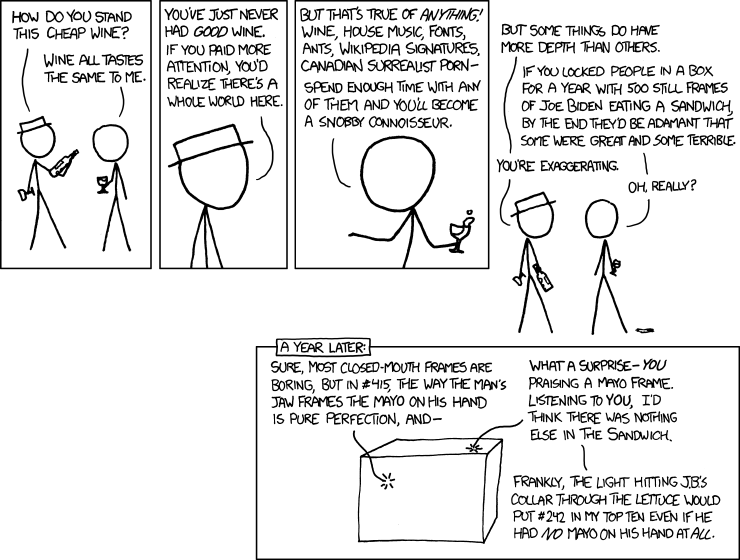
Work computer, so not searching for the Canadian Surrealist art, but, the thought of hundreds of frames of POTUS eating a sandwich is intriguing.
 
Upvote
3 (3 / 0)

vonduck

Ars Scholae Palatinae
1,192
at least the languages make sense.. unlike a certain cop show set in cannes, played i think by french actresses.... where everyone and dog speak english. wtf.

this is an adaptation alright.. never finished reading the manga (that'll be something like 20 years ago), the show really doesn't have much to do with it aside from the basic premises. not a criticism.
 
Upvote
-1 (1 / -2)

Ezzy Black

Ars Scholae Palatinae
1,086
Setting aside the show itself, hasn't high end wine been pretty thoroughly debunked as bullshit?
A group of people have codified what they think is a good wine, OK wine, and bad wine. I have no problem with that. Whatever qualities they've decided on are true in their minds. They simply created a standard.

Assuming you know nothing of that standard, and simply drink a glass of wine that you like, who cares? Unless, as the wine maker in the article found out, that your $10 bottle gets accepted into one of those classifications and becomes a $100 or even $1000 bottle overnight.
 
Upvote
4 (4 / 0)

Bash

Ars Scholae Palatinae
1,486
Subscriptor++
A group of people have codified what they think is a good wine, OK wine, and bad wine. I have no problem with that. Whatever qualities they've decided on are true in their minds. They simply created a standard.

Assuming you know nothing of that standard, and simply drink a glass of wine that you like. Who cares unless, as the wine maker in the article found out, that your $10 bottle gets accepted into one of those classifications and becomes a $100 or even $1000 bottle overnight.

It's not as simple as people codifying their (potentially extremely sensitive) chemical smelling & tasting ability; it's also non-wine-related brain / psychological effects:

https://www.foodandwine.com/news/expensive-wine-doesnt-taste-good-we-think-it-doeshttps://www.insead.edu/news/2017-why-expensive-wine-tastes-better
The research team discovered that above all parts of the medial pre-frontal cortex and also the ventral striatum were activated more when prices were higher. While the medial pre-frontal cortex particularly appears to be involved in integrating the price comparison and thus the expectation into the evaluation of the wine, the ventral striatum forms part of the brain’s reward and motivation system. “The reward and motivation system is activated more significantly with higher prices and apparently increases the taste experience in this way,” says Prof. Weber.

*Caveat from the article: this does not apply for ultra-cheap wines (where the bottle is likely worth significantly more than the fluid it contains).
 
Upvote
4 (4 / 0)

Mazzicc

Ars Scholae Palatinae
1,040
I gave up on Alice In Borderland before finishing, but Tomohisa Yamashita's amazing performance in that show is enough to get me to at least watch an episode of this. I've never been so captivated watching a non-English performance as I was with his, and despite the absolute ridiculous premise of that series, he knocked his arc out of the park and made me take every scene he was in seriously.
 
Upvote
1 (1 / 0)

Trifun

Smack-Fu Master, in training
1
A lot of the discussion here has not been about the show itself, but veered towards people's opinions about wine, wine-tasting, the wine industry, wine as an investment, etc. And there's a lot to be said about each of these things.
But for anyone who knows at least a little bit about wine, Drops of God is ludicrous -- as @Rauth85 implies, it's so bad it seems like a parody, only sadly it isn't. And it takes itself very seriously, making it even worse.
 
Upvote
0 (2 / -2)

mgc8

Ars Praetorian
437
Subscriptor++
I gave up on Alice In Borderland before finishing, but Tomohisa Yamashita's amazing performance in that show is enough to get me to at least watch an episode of this. I've never been so captivated watching a non-English performance as I was with his, and despite the absolute ridiculous premise of that series, he knocked his arc out of the park and made me take every scene he was in seriously.

Agreed, but if you've watched enough of Season 2 to get to the King of Clubs arc, then you don't really have that many episodes left... Granted, it is an uneven series with some difficult to watch parts, yet the finale and ending are exquisitely done and actually manage to wrap up and explain everything in that surreal setting, even the title. I'd give it a second chance!
 
Upvote
0 (0 / 0)

mtbooks

Seniorius Lurkius
11
Science has repeatedly said otherwise. You're responding to the training in expected ways. IE: You're being trained to push expensive wines on rich people that are expecting to buy expensive wines to flaunt. Price matters only in wines as far as it reinforces a person's biases towards pretense, skewed expectations (the "you get what you pay for" trope), and social standing cues.


This study is directly on point with your claim (and it says it is indeed BS)
https://web.archive.org/web/2023020...nce-from-a-Large-Sample-of-Blind-Tastings.pdf

The crux of it in your link:
A number of studies have reported positive correlations between price and subjective
appreciation of a wine for wine experts (e.g., Oczkowski, 1994; Landon and Smith, 1997;
Benjamin and Podolny, 1999; Schamel and Anderson, 2003; Lecocq and Visser, 2006).
Non-experts, however, may not be particularly sensitive to some of the refinements that are
held in high esteem by wine aficionados.
I think, like most things when you really get down to details, one has to really be clear and precise in their claim or question. Is there a difference? Well, what's the difference, can the difference be perceived, who can perceive the difference, does the difference matter to the enjoyment of the product, and to the enjoyment of the product by whom?

Examples that need context/precise definitions:
Masks don't work.
A hot dog is a sandwich.

(Not refuting anything you're saying, just adding my thoughts)
 
Upvote
0 (0 / 0)