
You are using an out of date browser. It may not display this or other websites correctly.
You should upgrade or use an alternative browser.
You should upgrade or use an alternative browser.
America’s sports car racing series embraces being green again
- Thread starter JournalBot
- Start date

I like seeing the racing organizations and communities looking at things like this. I love auto racing, but it's been increasingly difficult to square that with being someone who cares about climate change and my impact on the environment. I'd like to replace my racecar with an EV but the EV options aren't quite there and I wouldn't be able to dedicate an EV to racing like my current car (which has a cage, 6 point harness, full containment seat, racing brakes and other things that make it a bad idea to drive on public roads). Plus, I bought my racecar as a new car and have owned it for over 15 years so there's an emotional attachment... It's all very conflicting...
On another note, I was really surprised when I went to a NASCAR event and saw all the cars were running E85. I've been running E85 in my racecar for ~5 years now and it's pretty amazing the extra power you can get out of it and how relatively cheap it is. You can even manage pretty comparable gas mileage out of it, if you try. However, it still pales to EV in power delivery, dealing with gears, and parts that can break.
On another note, I was really surprised when I went to a NASCAR event and saw all the cars were running E85. I've been running E85 in my racecar for ~5 years now and it's pretty amazing the extra power you can get out of it and how relatively cheap it is. You can even manage pretty comparable gas mileage out of it, if you try. However, it still pales to EV in power delivery, dealing with gears, and parts that can break.
Upvote
4
(7
/
-3)
Le Mans was experimenting with hybrids and various bio-fuels even earlier. As early as the late 90's regenerative braking was being discussed with flywheels at the top of the list for energy storage. The fun part of flywheels is putting them on a gimbal and using them for dynamic stabilization.... but then you might not need to do much braking going into a corner. Fully spun up, a reasonably sized flywheel can generate more cornering force than the tires.But well before Formula E was a thing, there was the American Le Mans Series. Back in 2008, the series partnered with SAE International, the US Department of Energy, and the Environmental Protection Agency to create the Green Racing Challenge...
Upvote
9
(9
/
0)
BilTheGalacticHero
Ars Scholae Palatinae
Reducing the carbon and environmental impact of the sport as a whole is a commendable goal. Worrying about the impact from the racing itself (fuel, tires, etc.) is silly. It's negligible compared to the sport itself, fans don't care and it's RACING.
As for race to road technology transfers, none of that is happening in IMSA. That ship has sailed to the WEC (well, the WEC in past years) and Formula 1. Current F1 powertrains are the most thermally efficient in the world and that's where any road car technology is going to flow from.
As for race to road technology transfers, none of that is happening in IMSA. That ship has sailed to the WEC (well, the WEC in past years) and Formula 1. Current F1 powertrains are the most thermally efficient in the world and that's where any road car technology is going to flow from.
Upvote
3
(6
/
-3)
Okay maybe it's a stupid question, but -- Why do they need generators? Why doesn't the venue provide power connections in the paddock?
Upvote
10
(10
/
0)

Reducing the carbon and environmental impact of the sport as a whole is a commendable goal. Worrying about the impact from the racing itself (fuel, tires, etc.) is silly. It's negligible compared to the sport itself, fans don't care and it's RACING.
As for race to road technology transfers, none of that is happening in IMSA. That ship has sailed to the WEC (well, the WEC in past years) and Formula 1. Current F1 powertrains are the most thermally efficient in the world and that's where any road car technology is going to flow from.
I don't entirely agree. The Corvettes race in GTLM, not WEC (outside of Le Mans and one car entered into the Super Sebring WEC event) and as this article shows, there is plenty of tech transfer happening there. Similarly, the Ford and Porsche GTE/GTLM programs were equally split between IMSA and WEC.
https://meincmagazine.com/cars/2018/11/th ... than-ever/
Tech transfer between F1 and road cars is virtually non-existent, although I suppose when the Mercedes Project One or whatever it's called now actually goes into production that will be less true since that car uses a version of the Mercedes-AMG F1 powertrain. But things like Turbulent Jet Ignition don't appear to be making their way to road cars at all:
https://meincmagazine.com/cars/2016/05/tu ... ncy-gains/
Upvote
8
(10
/
-2)
Okay maybe it's a stupid question, but -- Why do they need generators? Why doesn't the venue provide power connections in the paddock?
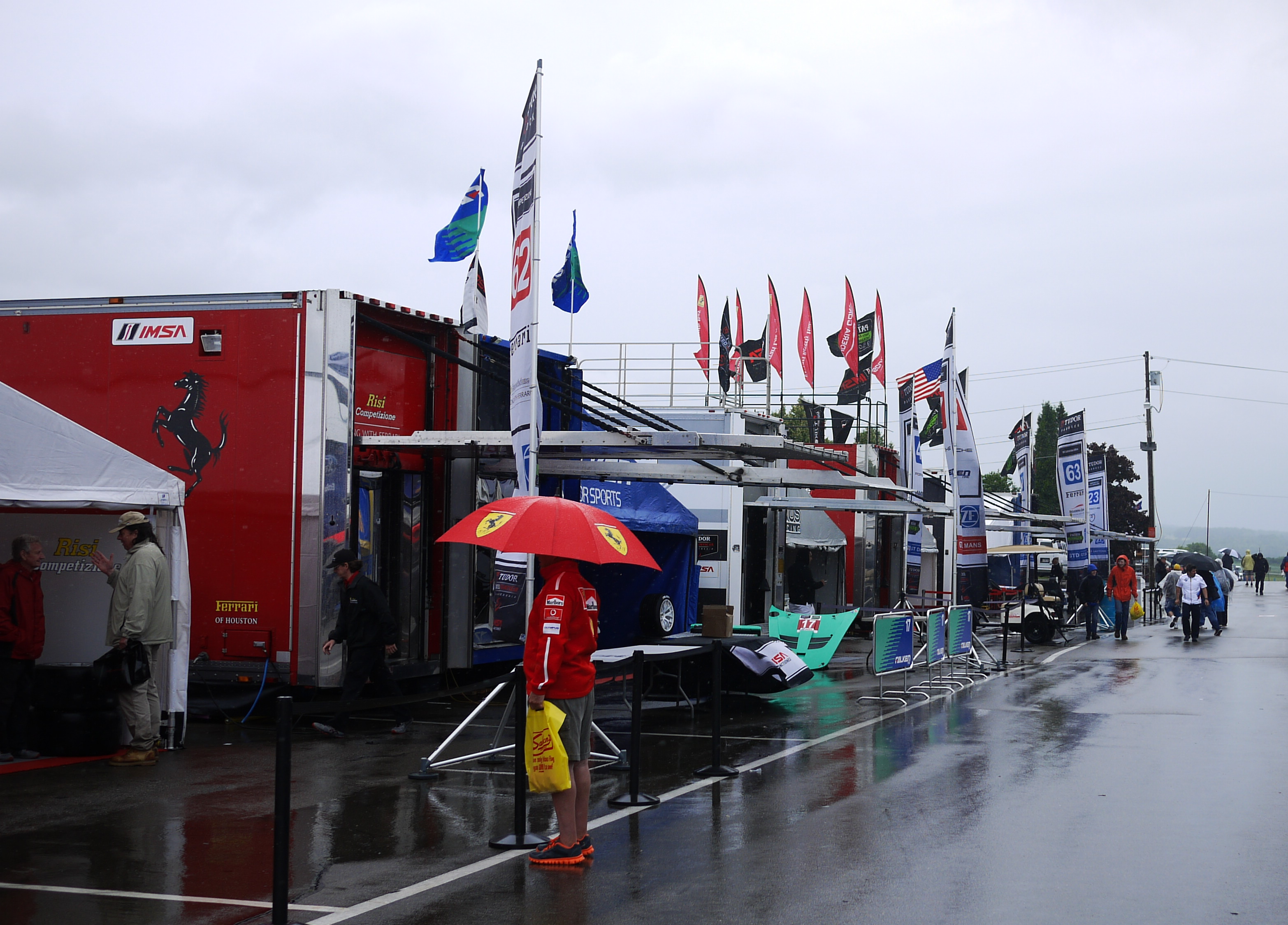
Most of the tracks are either really quite old and actually very basic (Sebring, Mid-Ohio, Road America, Road Atlanta, Watkins Glen, Lime Rock, VIR, Laguna Seca) or temporary street circuits (Detroit, Long Beach).
Daytona has proper permanent garages that the teams can use for the Rolex 24, but otherwise the paddock at an IMSA race looks like this:
Upvote
10
(12
/
-2)
Except with turbulent jet ignition, similar pre-chamber ignition technologies have shown up in road cars before and there is plenty of prior art (Ford stratified charge, Honda CVCC, etc.). It's just not being used today, unless you count the dozen or so experimenters who used SmartPlugs in their lawnmowers.Reducing the carbon and environmental impact of the sport as a whole is a commendable goal. Worrying about the impact from the racing itself (fuel, tires, etc.) is silly. It's negligible compared to the sport itself, fans don't care and it's RACING.
As for race to road technology transfers, none of that is happening in IMSA. That ship has sailed to the WEC (well, the WEC in past years) and Formula 1. Current F1 powertrains are the most thermally efficient in the world and that's where any road car technology is going to flow from.
I don't entirely agree. The Corvettes race in GTLM, not WEC (outside of Le Mans and one car entered into the Super Sebring WEC event) and as this article shows, there is plenty of tech transfer happening there. Similarly, the Ford and Porsche GTE/GTLM programs were equally split between IMSA and WEC.
https://meincmagazine.com/cars/2018/11/th ... than-ever/
Tech transfer between F1 and road cars is virtually non-existent, although I suppose when the Mercedes Project One or whatever it's called now actually goes into production that will be less true since that car uses a version of the Mercedes-AMG F1 powertrain. But things like Turbulent Jet Ignition don't appear to be making their way to road cars at all:
https://meincmagazine.com/cars/2016/05/tu ... ncy-gains/
And it's not being used because it's not yet necessary to meet emissions. Car makers don't add extra parts (like an extra set of fuel injectors in this case) until it's the last resort to meet an emissions target. Mahle already has it all fleshed out and ready to plug an play for when the automakers start to need it.
Upvote
9
(9
/
0)
How energetically efficient is E85, after all? Yes, it's carbon neutral, and all that nice energy coming from the Sun has been captured on the ethanol, but after considering fertilizer (petrochemicals), pesticide (petrochemicals), water usage, transportation/processing and displacement of other crops, how much better is it than to just burn petrol instead?
Upvote
5
(5
/
0)
I like seeing the racing organizations and communities looking at things like this. I love auto racing, but it's been increasingly difficult to square that with being someone who cares about climate change
I don't have that problem. I am a hardcore car enthusiast (read: engine enthusiast) and am also very aware of the necessity to lower carbon emissions. I will never compromise regarding my adulation of V-8's and V-12's and I don't feel the need to feel bad about the high-performance cars that I love because of their carbon emissions. Especially when regarding racing. Let's face it, the percentage of carbon emissions in this country coming from high-performance, large IEC-powered sports and race cars is almost irrelevantly low, especially when compared to the vast majority of carbon criminals: the boat loads of 90's clunker trash on the road.
Upvote
2
(3
/
-1)
BlackMan614
Seniorius Lurkius
Green racing is not a 'thing'. Nothing 'green' about destroying the earth to mine the lithium. Nothing 'green' about tossing batteries in the landfill. Stop the nonsense.
Upvote
-14
(2
/
-16)
Racing is inherently wasteful. Green racing makes no sense. The greenest racing is canceling all the races.
Racing also happens to be where a lot of safety equipment that now comes standard on our cars was pioneered. Racing is not wasteful.
Upvote
5
(6
/
-1)
How energetically efficient is E85, after all? Yes, it's carbon neutral, and all that nice energy coming from the Sun has been captured on the ethanol, but after considering fertilizer (petrochemicals), pesticide (petrochemicals), water usage, transportation/processing and displacement of other crops, how much better is it than to just burn petrol instead?
Generally straight petrol also gives you better gas mileage because E85 has a lower energy content. Emissions, and carbon emissions, are usually tied to efficiency. This is why MPG is a useful proxy for regulations like CARB's and the federal government's CAFE. I'd think straight petrol is better.
Upvote
1
(2
/
-1)
Maybe "safety systems" like tire compound technology, torque vectoring, and chassis reinforcement (i.e. mostly preventative). But the crash protection system of a racecar (harness, seat, roll protection, helmet, neck restraint) is fundamentally different than a road going car (regular seatbelt, airbags).Racing is inherently wasteful. Green racing makes no sense. The greenest racing is canceling all the races.
Racing also happens to be where a lot of safety equipment that now comes standard on our cars was pioneered. Racing is not wasteful.
Upvote
-5
(0
/
-5)
Maybe "safety systems" like tire compound technology, torque vectoring, and chassis reinforcement (i.e. mostly preventative). But the crash protection system of a racecar (harness, seat, roll protection, helmet, neck restraint) is fundamentally different than a road going car (regular seatbelt, airbags).Racing is inherently wasteful. Green racing makes no sense. The greenest racing is canceling all the races.
Racing also happens to be where a lot of safety equipment that now comes standard on our cars was pioneered. Racing is not wasteful.
Anything wearable obviously doesn't count (helmet, neck restraint), but other things do. Disc brakes, anti-lock brakes, crash data recorders, and even things like controlling the radio from buttons on the steering wheel (teams found it was better for the driver's focus if they never had to take their hands off the wheel to adjust controls), all came from racing. Heck, even the basics like rear view mirrors came from racing. Rear view mirrors were banned from the Indy 500 for years because it was thought to be an unfair advantage.
Upvote
6
(6
/
0)
Oh, but 90s cars are some of the best! How I'd love an fd rx7. Or an R33 Skyline GTR that will be legal in the US next year...I like seeing the racing organizations and communities looking at things like this. I love auto racing, but it's been increasingly difficult to square that with being someone who cares about climate change
I don't have that problem. I am a hardcore car enthusiast (read: engine enthusiast) and am also very aware of the necessity to lower carbon emissions. I will never compromise regarding my adulation of V-8's and V-12's and I don't feel the need to feel bad about the high-performance cars that I love because of their carbon emissions. Especially when regarding racing. Let's face it, the percentage of carbon emissions in this country coming from high-performance, large IEC-powered sports and race cars is almost irrelevantly low, especially when compared to the vast majority of carbon criminals: the boat loads of 90's clunker trash on the road.
I get your point, though. Partly my racecar has just been a complete broken pain in the ass this year. So I'm in the hate part of that relationship. Once I get to drive it again I'll have that "yup, that's why I like this" moment. At the same time, I'll really excited to see the upcoming performance EV wars. The power delivery and no shifting is just so damn appealing from a racing perspective.
Upvote
1
(1
/
0)
DepressedRobot
Ars Praefectus
I would imagine racing teams burn far more fuel moving around from location to location than they do racing. Take F1, for example. Getting all of that gear all over the world is a major logistical effort requiring massive fuel consumption. The equipment, the people, not to mention the fans attending the races. The racing itself is a rounding error.
Upvote
4
(4
/
0)
Maybe "safety systems" like tire compound technology, torque vectoring, and chassis reinforcement (i.e. mostly preventative). But the crash protection system of a racecar (harness, seat, roll protection, helmet, neck restraint) is fundamentally different than a road going car (regular seatbelt, airbags).Racing is inherently wasteful. Green racing makes no sense. The greenest racing is canceling all the races.
Racing also happens to be where a lot of safety equipment that now comes standard on our cars was pioneered. Racing is not wasteful.
Anything wearable obviously doesn't count (helmet, neck restraint), but other things do. Disc brakes, anti-lock brakes, crash data recorders, and even things like controlling the radio from buttons on the steering wheel (teams found it was better for the driver's focus if they never had to take their hands off the wheel to adjust controls), all came from racing. Heck, even the basics like rear view mirrors came from racing. Rear view mirrors were banned from the Indy 500 for years because it was thought to be an unfair advantage.
Racing may have popularized disc brakes, but they were first used on Lanchester automobiles circa 1903 (based on Patent 26,407/1902). The Chrysler Town & Country had disc brakes by 1950, a year before the BRM Type 15 was the first race car to have them.
Upvote
4
(4
/
0)
How energetically efficient is E85, after all? Yes, it's carbon neutral, and all that nice energy coming from the Sun has been captured on the ethanol, but after considering fertilizer (petrochemicals), pesticide (petrochemicals), water usage, transportation/processing and displacement of other crops, how much better is it than to just burn petrol instead?
This is why I've avoided using E85, all sources seem to point toward increased individual cost to use it, though I haven't done a lot of research on environmental cost to be honest...
"MPG. Due to ethanol's lower energy content, FFVs operating on E85 get roughly 15% to 27% fewer miles per gallon than when operating on regular gasoline, depending on the ethanol content. Regular gasoline typically contains about 10% ethanol.5
Cost. The cost of E85 relative to gasoline or E10 can vary due to location and fluctuations in energy markets. E85 is typically cheaper per gallon than gasoline but slightly more expensive per mile."
https://www.fueleconomy.gov/feg/ethanol.shtml
Upvote
3
(3
/
0)
WilburGoat
Seniorius Lurkius
Let me say I am ALL FOR this initiative.
Anything and everything to be more efficient in all aspects of racing. And trying to make that work in streetcars too (although, we've already got Tesla's and Priuses with way lower emissions than anything except Formula E, so the track>street transition claim is effectively dead).
Anything and everything to be more efficient in all aspects of racing. And trying to make that work in streetcars too (although, we've already got Tesla's and Priuses with way lower emissions than anything except Formula E, so the track>street transition claim is effectively dead).
Upvote
0
(1
/
-1)
The cost difference can be pretty significant depending on location. Last I checked, in Washington, E85 cost about the same as, or more than, 92 octane (highest/most expensive available) while in Idaho, E85 is cheaper than 87 octane (lowest/cheapest available). For a car that requires high octane fuel, E85 could be cheaper in Idaho despite the mileage difference, depending on how you drive. But my understanding is that E85 is massively subsidized by the gov (in the US) due to it being corn-based, which I've also heard/read isn't optimal compared to sugar-based.How energetically efficient is E85, after all? Yes, it's carbon neutral, and all that nice energy coming from the Sun has been captured on the ethanol, but after considering fertilizer (petrochemicals), pesticide (petrochemicals), water usage, transportation/processing and displacement of other crops, how much better is it than to just burn petrol instead?
This is why I've avoided using E85, all sources seem to point toward increased individual cost to use it, though I haven't done a lot of research on environmental cost to be honest...
"MPG. Due to ethanol's lower energy content, FFVs operating on E85 get roughly 15% to 27% fewer miles per gallon than when operating on regular gasoline, depending on the ethanol content. Regular gasoline typically contains about 10% ethanol.5
Cost. The cost of E85 relative to gasoline or E10 can vary due to location and fluctuations in energy markets. E85 is typically cheaper per gallon than gasoline but slightly more expensive per mile."
https://www.fueleconomy.gov/feg/ethanol.shtml
I don't see much point in using E85 to try and be cleaner or save money, though, it's more for making good power (while maybe being a little cleaner) due to it's high octane equivalent (generally 100+). Then there's the issue of most cars not supporting it. Some cars can be modified pretty easily to run it which is mostly just about adding more fuel and tuning for the additional octane (my car required larger injectors, fuel pump, and tune; picked up ~30whp and ~30wtq with a far earlier torque curve) but newer cars with direct injection can only generally run up to 30-40% ethanol without adding a second set of injectors. Finally, E85 availability generally sucks and can be wildly inconsistent from the same pump throughout the year. In Idaho I got "E85" out of the pump that tested less than 60% ethanol... I know people who started getting 50gal drums of E98 and mixing their own E85 just so it would be consistent. I tried mixing my own but gave up very quickly because it's absolutely miserable.
Upvote
0
(0
/
0)
Racing is inherently wasteful. Green racing makes no sense. The greenest racing is canceling all the races.
Racing also happens to be where a lot of safety equipment that now comes standard on our cars was pioneered. Racing is not wasteful.
Safety equipments should be tested in a crash test lab. Racing is a spectator sport, it's entertainment.
Upvote
-3
(0
/
-3)
Finally, E85 availability generally sucks and can be wildly inconsistent from the same pump throughout the year. In Idaho I got "E85" out of the pump that tested less than 60% ethanol... I know people who started getting 50gal drums of E98 and mixing their own E85 just so it would be consistent. I tried mixing my own but gave up very quickly because it's absolutely miserable.
E85 is a branding label and not a percentage. The exact blends vary by time of year because high E% mixes have trouble starting in cold weather. "Summer" E85 (Category 1) is 79% or more, and normal "winter" E85 (Category 3) is 70%. ASTM's D5798 specification allows for mixes as low as 51% ethanol and as high as 83% ethanol (so no E85 blend should actually be 85% ethanol).
Upvote
2
(2
/
0)
Yes, in the US, E85 can be as low as 51%. It's not the exact percent that I necessarily care about (above the threshold for the timing benefits, obviously), more the consistency. I don't have flex fuel, I have to tune with the fuel I have so if it's changing it makes it difficult to get a good, consistent tune. The place I've been getting E85 in WA seems like it's really consistent, to the point I stopped bothering to test it.Finally, E85 availability generally sucks and can be wildly inconsistent from the same pump throughout the year. In Idaho I got "E85" out of the pump that tested less than 60% ethanol... I know people who started getting 50gal drums of E98 and mixing their own E85 just so it would be consistent. I tried mixing my own but gave up very quickly because it's absolutely miserable.
E85 is a branding label and not a percentage. The exact blends vary by time of year because high E% mixes have trouble starting in cold weather. "Summer" E85 (Category 1) is 79% or more, and normal "winter" E85 (Category 3) is 70%. ASTM's D5798 specification allows for mixes as low as 51% ethanol and as high as 83% ethanol (so no E85 blend should actually be 85% ethanol).
Upvote
0
(0
/
0)
Racing is inherently wasteful. Green racing makes no sense. The greenest racing is canceling all the races.
What a moron. fuel injection antilock brakes traction control all wheel drive.
Not to mention racing motors are much more efficient than any passenger car motor except what's in a Prius, and some are even more efficient than that.
Upvote
-1
(0
/
-1)